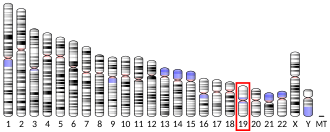
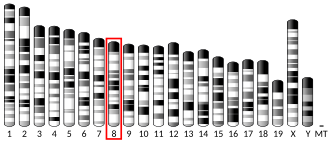
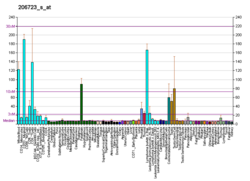
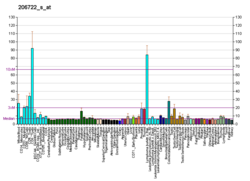
Lysophosphatidic acid receptor 2 also known as LPA2 is a protein that in humans is encoded by the LPAR2 gene.567 LPA2 is a G protein-coupled receptor that binds the lipid signaling molecule lysophosphatidic acid (LPA).8
Function
This gene encodes a member of family I of the G protein-coupled receptors, as well as the EDG family of proteins. This protein functions as a lysophosphatidic acid (LPA) receptor and contributes to Ca2+ mobilization, a critical cellular response to LPA in cells, through association with Gi and Gq proteins.5
Interactions
LPAR2 has been shown to interact with TRIP6.9
Evolution
Source:1011
See also
See also
References
References
- GRCh38: Ensembl release 89: ENSG00000064547 – Ensembl, May 2017
- GRCm38: Ensembl release 89: ENSMUSG00000031861 – Ensembl, May 2017
- "Human PubMed Reference:". National Center for Biotechnology Information, U.S. National Library of Medicine.
- "Mouse PubMed Reference:". National Center for Biotechnology Information, U.S. National Library of Medicine.
- "Entrez Gene: LPAR2 Lysophosphatidic acid receptor 2".
- An S, Bleu T, Hallmark OG, Goetzl EJ (April 1998). "Characterization of a novel subtype of human G protein-coupled receptor for lysophosphatidic acid". J. Biol. Chem. 273 (14): 7906–10. doi:10.1074/jbc.273.14.7906. PMID 9525886.
- An S, Bleu T, Zheng Y, Goetzl EJ (November 1998). "Recombinant human G protein-coupled lysophosphatidic acid receptors mediate intracellular calcium mobilization". Mol. Pharmacol. 54 (5): 881–8. doi:10.1124/mol.54.5.881. PMID 9804623. S2CID 37327084.
- Choi JW, Herr DR, Noguchi K, Yung YC, Lee CW, Mutoh T, Lin ME, Teo ST, Park KE, Mosley AN, Chun J (January 2010). "LPA Receptors: Subtypes and Biological Actions". Annual Review of Pharmacology and Toxicology. 50 (1): 157–186. doi:10.1146/annurev.pharmtox.010909.105753. PMID 20055701.
- Xu J, Lai Yun-Ju, Lin Weei-Chin, Lin Fang-Tsyr (March 2004). "TRIP6 enhances lysophosphatidic acid-induced cell migration by interacting with the lysophosphatidic acid 2 receptor". J. Biol. Chem. 279 (11). United States: 10459–68. doi:10.1074/jbc.M311891200. ISSN 0021-9258. PMC 3904432. PMID 14688263.
- "GeneCards®: The Human Gene Database".
- "Ensembl Genome Browser".
Further reading
Further reading
- Spiegel S (2000). "Sphingosine 1-phosphate: a ligand for the EDG-1 family of G-protein-coupled receptors". Ann. N. Y. Acad. Sci. 905 (1): 54–60. Bibcode:2000NYASA.905...54S. doi:10.1111/j.1749-6632.2000.tb06537.x. PMID 10818441. S2CID 9257870.
- Contos JJ, Ishii I, Chun J (2001). "Lysophosphatidic acid receptors". Mol. Pharmacol. 58 (6): 1188–96. doi:10.1124/mol.58.6.1188. PMID 11093753. S2CID 6936621.
- Goetzl EJ, Dolezalova H, Kong Y, et al. (1999). "Distinctive expression and functions of the type 4 endothelial differentiation gene-encoded G protein-coupled receptor for lysophosphatidic acid in ovarian cancer". Cancer Res. 59 (20): 5370–5. PMID 10537322.
- Contos JJ, Chun J (2000). "Genomic characterization of the lysophosphatidic acid receptor gene, lp(A2)/Edg4, and identification of a frameshift mutation in a previously characterized cDNA". Genomics. 64 (2): 155–69. doi:10.1006/geno.2000.6122. PMID 10729222.
- Bandoh K, Aoki J, Taira A, et al. (2000). "Lysophosphatidic acid (LPA) receptors of the EDG family are differentially activated by LPA species. Structure-activity relationship of cloned LPA receptors". FEBS Lett. 478 (1–2): 159–65. Bibcode:2000FEBSL.478..159B. doi:10.1016/S0014-5793(00)01827-5. PMID 10922489. S2CID 21584151.
- Young KW, Bootman MD, Channing DR, et al. (2001). "Lysophosphatidic acid-induced Ca2+ mobilization requires intracellular sphingosine 1-phosphate production. Potential involvement of endogenous EDG-4 receptors". J. Biol. Chem. 275 (49): 38532–9. doi:10.1074/jbc.M006631200. PMID 10954727.
- Zheng Y, Voice JK, Kong Y, Goetzl EJ (2001). "Altered expression and functional profile of lysophosphatidic acid receptors in mitogen-activated human blood T lymphocytes". FASEB J. 14 (15): 2387–9. doi:10.1096/fj.00-0492fje. PMID 11024010. S2CID 24778289.
- Hama K, Bandoh K, Kakehi Y, et al. (2002). "Lysophosphatidic acid (LPA) receptors are activated differentially by biological fluids: possible role of LPA-binding proteins in activation of LPA receptors". FEBS Lett. 523 (1–3): 187–92. Bibcode:2002FEBSL.523..187H. doi:10.1016/S0014-5793(02)02976-9. PMID 12123830. S2CID 44924895.
- Strausberg RL, Feingold EA, Grouse LH, et al. (2003). "Generation and initial analysis of more than 15,000 full-length human and mouse cDNA sequences". Proc. Natl. Acad. Sci. U.S.A. 99 (26): 16899–903. Bibcode:2002PNAS...9916899M. doi:10.1073/pnas.242603899. PMC 139241. PMID 12477932.
- Fujita T, Miyamoto S, Onoyama I, et al. (2003). "Expression of lysophosphatidic acid receptors and vascular endothelial growth factor mediating lysophosphatidic acid in the development of human ovarian cancer". Cancer Lett. 192 (2): 161–9. doi:10.1016/S0304-3835(02)00713-9. PMID 12668280.
- Hu YL, Albanese C, Pestell RG, Jaffe RB (2003). "Dual mechanisms for lysophosphatidic acid stimulation of human ovarian carcinoma cells". J. Natl. Cancer Inst. 95 (10): 733–40. doi:10.1093/jnci/95.10.733. PMID 12759391.
- Xu J, Lai YJ, Lin WC, Lin FT (2004). "TRIP6 enhances lysophosphatidic acid-induced cell migration by interacting with the lysophosphatidic acid 2 receptor". J. Biol. Chem. 279 (11): 10459–68. doi:10.1074/jbc.M311891200. PMC 3904432. PMID 14688263.
- Ota T, Suzuki Y, Nishikawa T, et al. (2004). "Complete sequencing and characterization of 21,243 full-length human cDNAs". Nat. Genet. 36 (1): 40–5. doi:10.1038/ng1285. PMID 14702039.
- Grimwood J, Gordon LA, Olsen A, et al. (2004). "The DNA sequence and biology of human chromosome 19". Nature. 428 (6982): 529–35. Bibcode:2004Natur.428..529G. doi:10.1038/nature02399. PMID 15057824.
- Oh YS, Jo NW, Choi JW, et al. (2004). "NHERF2 specifically interacts with LPA2 receptor and defines the specificity and efficiency of receptor-mediated phospholipase C-beta3 activation". Mol. Cell. Biol. 24 (11): 5069–79. doi:10.1128/MCB.24.11.5069-5079.2004. PMC 416407. PMID 15143197.
- Gerhard DS, Wagner L, Feingold EA, et al. (2004). "The status, quality, and expansion of the NIH full-length cDNA project: the Mammalian Gene Collection (MGC)". Genome Res. 14 (10B): 2121–7. doi:10.1101/gr.2596504. PMC 528928. PMID 15489334.
External links
External links
This article incorporates text from the United States National Library of Medicine, which is in the public domain.