Flatbreads are the most common type of bread.1 There are many types of flatbread from many parts of the world.2 Flatbreads come in many shapes and sizes, with thicknesses ranging from below 1 millimeter to about 4 centimeters,3 and diameters ranging from around 5 to 70 centimeters.4
Flatbreads are made of flour, often using cereal grains such as wheat, barley, maize, millet, sorghum, or rye.2 The flour is generally mixed with water and salt to form a dough. Leavening is sometimes added, which may include sourdough or baker's yeast. Other dough ingredients may include fat or oil, used as shortening.5 Some flatbreads have additional ingredients as fillings or toppings.6 Flatbreads may be baked with any method.7 Most types are baked on top of a griddle or in a vertical oven—such as a tandoor—while other types are baked in a domed oven or heated directly on embers.8 Some types are instead fried.9
Flatbreads are categorized into two forms: double-layered and single-layered. Double-layered flatbreads are leavened and expand from gases while baking, which results in a separation between top and bottom. Single-layered flatbreads do not experience this, sometimes being punctured to prevent expansion.10 Single-layered flatbreads are further divided into unleavened versions, which are rolled thin, and leavened versions, which are thick and airy.11
Pancakes, which are made of liquid batter rather than firm dough, may be considered a type of flatbread.12 Pancakes and pancake-like flatbreads are listed separately at List of pancakes.
List
| Name | Classification | Dough ingredientsa | Thickness | Diameter | Physical description | Baking method |
Cuisine | Ref. |
|---|---|---|---|---|---|---|---|---|
Aghrum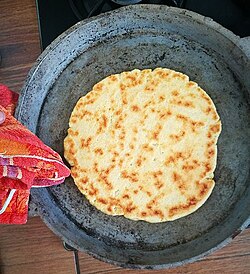
|
— | Semolina | — | — | — | — | North Africa (Kabyle) | 13 |
Arepa
|
Single-layered, unleavened | Maize flour; sometimes uses fillings | 1–3 cm (0.4–1.2 in) |
8–10 cm (3.1–3.9 in) |
Round, with flat or convex top | Griddle (sometimes boiled before baking) | Americas (Colombia, Peru, Venezuela) |
14 |
Ash cake
|
Unleavened (usually) | Varies | — | — | — | Embers | Worldwide | 15 |
Bakarkhani
|
Leavened (yeast) | Wheat flour (refined), sugar, milk, ghee, almonds, raisins | — | — | — | Baked | South Asia (Pakistan) | 16 |
Baladi
|
Double-layered, leavened (sourdough, sometimes with additional yeast) | Wheat flour | 1.25 cm (0.5 in) |
20 cm (7.9 in) |
Round with pocket | Oven | North Africa (Egypt, Sudan) | 17 |
Bammy
|
— | Cassava | — | — | Round | — | Americas (Jamaica) | 18 |
Bannock
|
Unleavened (usually) | Oats or barley flour or wheat flour | — | — | Round | — | Europe (Scotland) | 4 |
Bannock
|
Leavened (baking powder) | Wheat flour (refined), fat, sugar; sometimes milk, eggs, fruits (such as berries), or nuts | — | — | Round, large | Oven, campfire, cast iron pan, or fried | Americas (Indigenous Canadian, including Inuit) | 19 |
Barbari bread
|
Single-layered, leavened (sourdough or yeast) |
Wheat flour (or barley flour) | 2.5–3 cm (1.0–1.2 in) |
70–80 cm (28–31 in) by 25–30 cm (10–12 in) |
Oval, heavy | Brick oven (partially pregelatinized) | West Asia (Iran, Afghanistan) | 20 |
Bataw
|
Single-layered, unleavened | Wheat flour, maize flour, fenugreek | — | 50 cm (20 in) |
Round, thin | — | — | 21 |
Batbout
|
Double-layered, leavened | — | — | — | — | — | North Africa (Morocco) | 11 |
Bati
|
Unleavened | Wheat flour, fat | 1.5 cm (0.6 in) |
5 cm (2.0 in) |
Ball-shaped, hard and crusty, low in moisture and high in fat | — | South Asia (Rajasthan) | 22 |
Bazlama
|
Single-layered, leavened (sourdough) |
— | 3 cm (1.2 in) |
10–20 cm (3.9–7.9 in) |
— | Griddle | West Asia (Turkey, Middle East) | 23 |
Bhakri
|
Single-layered, unleavened | Sorghum flour, finger millet flour, pearl millet flour, rice flour | 3 mm (0.1 in) |
15–20 cm (5.9–7.9 in) |
Round | Griddle | South Asia (Western India) | 24 |
Bhatura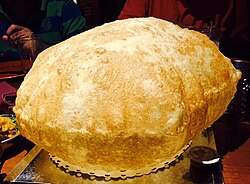
|
Single-layered, leavened (sodium bicarbonate and yogurt) | Wheat flour | 2 mm (0.1 in) |
15–20 cm (5.9–7.9 in) |
Round, puffy | Deep-fried | South Asia (North India, Pakistan) | 25 |
Carchiola
|
Single-layered, unleavened | Cornmeal | 2 cm (0.8 in) |
— | Hard | Reversible grill in fireplace | Europe (Basilicata) | 26 |
Casabe
|
— | Cassava flour | — | — | Similar to arepa | — | Americas (Caribbean coast, including Venezuela, Garifuna) | 27 |
Chapatib
|
Single-layered, unleavened | Wheat flour (atta) or other flour (sorghum or pearl millet) | 2 mm (0.1 in) |
15–20 cm (5.9–7.9 in) |
Round, thin, bubbly with brown spots | Griddle, then placed over a direct flame | Worldwide, originally South Asia (North India, Pakistan, Bangladesh), also commonly East Africa (Kenya, Uganda, Tanzania) | 29 |
Chipa
|
Varies (may be flatbreads or rolls) | — | — | — | Crisp | — | Americas (Paraguay) | 30 |
| Chorek | Single-layered, leavened | — | — | — | Pressed with decorative stamps | — | Central Asia (Turkmenistan) | 11 |
Cong you bingc
|
Unleavened or leavened (yeast) | Wheat flour (refined), oil (or lard), scallions | — | — | Round with spiraling layers, varying textures | Griddle | East Asia (China) | 32 |
Crescenta
|
Single-layered, leavened (yeast) | Wheat flour, lard, diced ham, diced bacon | — | — | — | — | Europe (Emilia-Romagna and Tuscany) | 33 |
| Crescenta fritta | Double-layered, leavened (sodium bicarbonate) | Wheat flour, milk, pork fat (strutto) | — | — | Diamond-shaped | Deep-fried | Europe (Emilia-Romagna and Tuscany) | 33 |
Crescentina modenese
|
Single-layered, leavened (yeast or sodium bicarbonate); historically unleavened | Wheat flour; sometimes milk and lard | 1.5 cm (0.6 in) |
15 cm (5.9 in) |
Decorative imprint from griddle | Between clay plates held in fire | Europe (Emilia-Romagna) | 33 |
| Crescia sfogliata | Single-layered, unleavened | Wheat flour, egg, pork fat (strutto), black pepper | — | — | — | Cast-iron pan | Europe (Marche) | 26 |
| Crostolo | Single-layered, unleavened | Wheat flour, egg, milk, black pepper | — | — | Round with spiral layers, blackened stripes | Grill | Europe (Emilia-Romagna and Marche) | 34 |
Crumpet
|
— | — | — | — | — | Griddle | Europe (Britain) | 35 |
Damper
|
— | Wheat flour; historically seed flour | — | — | — | Campfire | Oceania (Aboriginal Australian) | 36 |
English muffin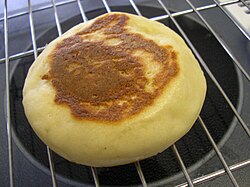
|
Single-layered, leavened (yeast) |
Wheat flour; coated in cornmeal | — | — | Round with straight edges, chewy, light-colored | Griddle, then oven | — | 37 |
Flatbrød
|
— | Barley flour | — | — | — | — | Europe (Norway) | 38 |
Flatkaka
|
Single-layered, unleavened | Rye and/or barley flour; sometimes milk products | 1 cm (0.4 in) |
— | Round, dense | Oven | Europe (Scandinavia) | 39 |
Focaccia
|
Single-layered, leavened (yeast) |
Wheat flour, olive oil; sometimes topped with rosemary or other ingredients | 1.25–5 cm (0.5–2.0 in) |
20 cm (7.9 in) |
Various shapes, similar dough to pizza | Oven | Europe (Italy) | 40 |
Fougasse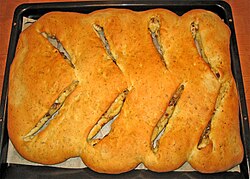
|
— | Wheat flour; other ingredients vary | — | — | Large | — | Europe (France) | 35 |
| Frena | — | Flour, olive oil, nigella | — | — | — | Baked on pebbles | North Africa (Originally Morocco; also Israel) | 41 |
Frybread
|
Leavened (sometimes baking powder) | Wheat flour, milk, oil | — | — | — | Fried | Americas (Indigenous North American) | 35 |
| Girda | Single-layered, leavened | Wheat flour | 2 mm (0.1 in) |
15 cm (5.9 in) |
Round | Tandoor or Griddle | South Asia (Kashmir) | 22 |
| Gomme | Single-layered, unleavened | Flour, milk | Up to 5 cm (2.0 in) |
35–40 cm (14–16 in) |
Round | Griddle covered in ashes | West Asia (Turkey) | 42 |
| Gnocco ingrassato | Single-layered, leavened (yeast) | Wheat flour, lard, diced ham | 2–3 cm (0.8–1.2 in) |
— | Rectangular | Oven | Europe (Emilia-Romagna) | 43 |
Gnocco fritto
|
Double-layered, leavened (sodium bicarbonate) | Wheat flour, pork fat (strutto) | 5 mm (0.2 in) |
5–15 cm (2.0–5.9 in) |
Rectangular | Deep-fried | Europe (Emilia-Romagna) | 43 |
Gul poli
|
Stuffed, unleavened | Wheat flour; filled with jaggery, coconut, peanuts, sesame seeds, poppy seeds, cardamom | 3 mm (0.1 in) |
10–15 cm (3.9–5.9 in) |
Round, crisp, sweet | Griddle | South Asia (Maharashtra) | 24 |
| Hamursuz | Leavened | — | — | — | — | Vertical oven | West Asia (Turkey) | 44 |
Harcha
|
Unleavened | Semolina, fat | — | — | Rough | — | North Africa (Algeria) | 45 |
Himbasha
|
Leavened | Wheat flour, flavorings such as cardamom | — | — | Sweet | — | East Africa (Ethiopia, Eritrea) | 45 |
| Jow | Single-layered, leavened | Barley flour | — | — | — | — | West Asia (Iran) | 11 |
| Kaak | — | — | — | — | Very hard | Tandoor | South Asia (Balochistan) | 46 |
Kesra rakhis
|
Single-layered, unleavened | Semolina, fat | — | — | Firm, homogenous surface | — | North Africa (Algeria, Berber) | 47 |
Khamiri roti
|
Leavened (yeast or sodium bicarbonate) | Wheat flour, yogurt (or buttermilk), sugar, ghee, aniseed | — | — | Sweet | Griddle, tandoor, or deep-fried | South Asia (India, Pakistan) | 48 |
Khakhra
|
— | Wheat flour, mat bean, oil | — | — | Thin, crisp | — | South Asia | 38 |
| Khobz el-dâr | Single-layered, leavened (sourdough or yeast) | Semolina, fat, milk, egg, sesame seeds | 1–2 cm (0.4–0.8 in) |
— | Round, docked with rectangular cuts | Oven | Africa (Morocco, Algeria) |
49 |
| Khoshk | Single-layered, leavened | — | — | — | — | — | West Asia (Iran) | 11 |
Kitcha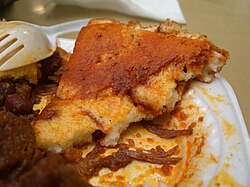
|
Single-layered, unleavened or leavened | Teff flour, sometimes with sorghum or millet flour | — | — | — | — | East Africa (Ethiopia) | 50 |
| Korsan | Single-layered, unleavened | Wheat flour (whole) | — | 57 cm (22.4 in) |
Round, thin | Oven | West Asia (Saudi Arabia) | 51 |
Kulcha
|
Single-layered, leavened | Wheat flour; various fillings or flavorings | 3–4 mm (0.1–0.2 in) |
10–12 cm (3.9–4.7 in) |
Round | Tandoor | South Asia (Kashmir, Punjab) | 28 |
Laffa
|
— | — | — | — | Thin, soft; similar to pita | — | West Asia (originally Iraq and Yemen; also Israel) | 41 |
Lagana
|
Unleavened | Flour, sesame seeds | — | — | Fairly dry | — | Europe (Greece) | 52 |
Lahmacun
|
Single-layered, leavened (yeast) |
Wheat flour; topped with minced meat and vegetables | — | — | Round, thin | Oven | West Asia (Turkey, Middle East) | 53 |
Lángos
|
Leavened (yeast) | — | — | — | Savory | Deep-fried | Europe (Hungary) | 54 |
Laobing
|
Single-layered, unleavened | — | — | 23–26 cm (9.1–10.2 in) by 13–17 cm (5.1–6.7 in) |
— | Griddle (shallow-fried) |
East Asia (China) |
55 |
Laufabrauð
|
— | — | — | — | Thin | Fried | Europe (Iceland) | 56 |
Lavash
|
Single-layered, leavened (sourdough or yeast) |
Wheat flour | 2–5 mm (0.1–0.2 in) |
20–70 cm (8–28 in) by 10–40 cm (4–16 in) |
Oval or rectangular, sometimes dried | Clay oven | West Asia (including Armenia, Turkey) | 57 |
Lefse
|
— | Wheat flour, potato, milk (or cream); optionally lard | — | — | — | Griddle | Europe (Norway, Sweden) | 58 |
Lepeshka
|
Single-layered, leavened | — | — | — | — | — | Central Asia (Uzbekistan, Kazakhstan) | 11 |
Litti
|
Stuffed | Wheat flour; filled with sattu | — | — | — | Oven such as tandoor | South Asia (Bihar) | 38 |
Luchi
|
— | Wheat flour (refined), oil | — | — | Round | Deep-fried | South Asia (Bangladesh) | 59 |
| Maadjouna | Leavened | Semolina | — | — | — | — | North Africa (Algeria) | 50 |
Makki ki roti
|
Single-layered, unleavened | Maize flour | 2–3 mm (0.1–0.1 in) |
15 cm (5.9 in) |
Round | Baked or sautéed | South Asia (Punjab) | 60 |
| Maluj | Single-layered, leavened (sourdough or yeast) |
Wheat flour (refined); some variations use barley flour | 3–5 mm (0.1–0.2 in) |
30–35 cm (12–14 in) |
Round | Clay oven | West Asia (Yemen) |
61 |
Manakish
|
Leavened | Wheat flour; topped with ingredients such as cheese, chili pepper, minced lamb, za'atar, sesame seeds, sumac, or kashk | — | — | Various styles; griddled version is thin and crisp | Griddle or oven | West Asia (including Lebanon and Palestine) | 62 |
Markoukd
|
Single-layered, unleavened | — | — | — | Very thin | — | West Asia (Lebanon, Palestine, Syria, Jordan, Saudi Arabia, UAE, Oman) | 11 |
Matloue
|
Single-layered, leavened (yeast) |
Wheat flour, semolina | 2.5 cm (1.0 in) |
— | — | Griddle | Africa (Algeria) |
63 |
Matnakash
|
Single-layered, leavened | — | — | — | — | — | West Asia (Armenia) | 11 |
Matzah
|
Single-layered, unleavened | Wheat flour (whole); sometimes additional ingredients | — | — | Round or rectangular, thin, crisp, laminated, docked with even cuts | Oven | Worldwide (Jewish) | 64 |
Merahrah
|
Double-layered, leavened (sourdough) |
Maize flour, ground fenugreek seeds | — | — | Round | — | North Africa (Egypt) | 45 |
Missi roti
|
Single-layered, unleavened | Wheat flour, chickpea flour | 2–3 mm (0.1–0.1 in) |
15 cm (5.9 in) |
Round, yellow | Tandoor or Griddle | South Asia (Punjab) | 24 |
Mlinci
|
— | — | — | — | Thin | — | Europe (Balkans) | 65 |
Mo
|
— | — | — | — | Round, white, hard outside with soft inside | Steamed | East Asia (Shaanxi) | 32 |
| Mont lay bway | — | Rice flour | — | — | Thin, crisp, airy | Fried | Southeast Asia (Myanmar) | 65 |
Murtabak
|
Stuffed | Filled with chicken, mutton or other meat | — | — | Folded | Fried | Southeast Asia (Malaysia, Singapore) | 66 |
| Muufoe | Single-layered, leavened | — | — | — | — | Oven (mofa) | East Africa (Somalia, Kenya) | 11 |
Naan
|
Single-layered, leavened (sourdough or yeast) |
Wheat flour, yogurt (or milk), shortening; some variations use egg or various toppings | 3 mm (0.1 in) |
17 cm (6.7 in) by 12 cm (4.7 in)f |
Teardrop-shaped, puffy; version in Uzbek cuisine is pressed with decorative stamps | Tandoor | Worldwide, originally South Asia (North India, Pakistan) and Central Asia | 67 |
| Ngome | — | Millet flour, vegetable oil | — | — | — | — | West Africa (Mali) | 50 |
Pane carasau
|
Double-layered, leavened (yeast, historically sourdough) | Semolinag | 1–2 mm (0.0–0.1 in) |
— | Round or rectangular, thin, crisp, sliced to separate layers | Oven (twice-baked) | Europe (Sardinia) | 69 |
Papadam
|
— | Non-grain flour (lentil, chickpea, or potato) | — | — | Thin, crisp | Fried; dried before cooking | South Asia (North India) | 70 |
Paratha
|
Multilayered, unleavened | Wheat flour (whole or refined), shortening | 2–3 mm (0.1–0.1 in) |
15 cm (5.9 in) |
Round, square, or triangular, with folded or spiraling layers | Shallow-fried | South Asia (North India) | 71 |
Paratha, stuffed
|
Stuffed, unleavened | Wheat flour; filled with spiced vegetables such as potatoes | 3 mm (0.1 in) |
15 cm (5.9 in) |
Round | Shallow-fried | South Asia (North India) | 22 |
Panigaccio
|
Double-layered, leavened | — | — | — | — | Griddle (testo) | Europe (Tuscany) | 11 |
Parotta
|
Multilayered, unleavened | Wheat flour; optionally egg and sugar | 2 mm (0.1 in) |
15 cm (5.9 in) |
Round with spiraling layers, cream-colored | Shallow-fried | South Asia (South India) | 72 |
Piadina romagnola
|
Single-layered, unleavened; sometimes leavened (sodium bicarbonate) | Wheat flour (refined), olive oil, pork fat (strutto); historically made with cornmeal | 4–8 mm (0.2–0.3 in)h |
15–25 cm (5.9–9.8 in) |
— | Griddle (testo) | Europe (Emilia-Romagna) | 74 |
Pide / İçli pide
|
— | Topped with meat, cheese, eggs, or spinach | — | — | Oval, thin | — | West Asia (Turkey) | 75 |
Pide / Ramazan pidesi
|
Single-layered, leavened (yeast) | Wheat flour, shortening, sugar | 1.5–2 cm (0.6–0.8 in) |
20–25 cm (7.9–9.8 in) |
Round | Oven | West Asia (Turkey) | 76 |
Pistoccu
|
Double-layered, leavened (yeast) | Semolina | 3–4 mm (0.1–0.2 in) |
— | Crisp, sliced to separate layers | Steam oven (twice-baked); historically wood-fired oven | Europe (Sardinia) | 77 |
Pitai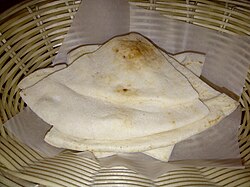
|
Double-layered, leavened (yeast) | Wheat flour | 1.5–10 mm (0.1–0.4 in) |
15 cm (5.9 in) |
Round with pocket | Oven | Worldwide (including Greece, Turkey, Middle East, North Africa) |
79 |
Pitta
|
Single-layered, leavened | — | — | — | — | — | Europe (Calabria, Sicily, Apulia) | 11 |
Pizza
|
Single-layered, leavened (yeast/chemical) |
Wheat flour, sugar, shortening; topped with tomato sauce, cheese, and other ingredients | Varies | About 25 cm (9.8 in) |
Wide range of styles, see list of pizzas | Oven | Worldwide (Originally Italy) |
80 |
Planc
|
— | — | — | — | — | — | Europe (Wales) | 81 |
Puccia 
|
Double-layered, leavened (sourdough) | Semolina (or barley flour), olive oil | — | 20 cm (8 in) |
Round | Stone | Europe (Apulia) | 26 |
Pupusa
|
Stuffed | Maize flour; filled with beans, cheese, squash, chicharrones, or other ingredients | — | — | Similar dough to tortilla | Griddle | Americas (El Salvador, Guatemala, Honduras) | 82 |
Puran poli
|
Stuffed, unleavened | Wheat flour; filled with jaggery and Bengal gram | 2 mm (0.1 in) |
15 cm (5.9 in) |
Round, sweet | Griddle | South Asia (Maharashtra) | 24 |
Puri
|
Single-layered, unleavened | Wheat flour (atta or maida), sometimes additional flours, sometimes shortening; sometimes stuffed | 1.5–2 mm (0.1–0.1 in) |
10–15 cm (3.9–5.9 in) |
Puffy, gold-colored | Deep-fried | South Asia (India, Pakistan, Bangladesh) | 83 |
Roomali roti
|
Single-layered, unleavened | Wheat flour | 1–1.5 mm (0.0–0.1 in) |
30 cm (11.8 in) |
Large, very thin, tender | Griddle (on convex side) | South Asia (North India, Central India) | 84 |
Roti canai / Roti prata
|
Unleavened | — | — | — | Thin, layered; similar to parotta | Fried | Southeast Asia (Malaysia, Singapore) | 85 |
Rotla
|
— | Millet or sorghum flour | — | — | — | Griddle (sautéed) | South Asia (Gujarat) | 86 |
| Rye flatbread
|
Varies | Rye flour | 5–10 mm (0.2–0.4 in) |
5 cm (2.0 in) |
Round (sometimes with hole), crisp, wide range of styles | — | Europe (Scandinavia, Finland) | 87 |
| Salouf | — | — | — | — | Oblong | Grill | West Asia (originally Yemen; also Israel) | 41 |
| Samoli | Single-layered, leavened (yeast) |
Wheat flour, sugar, shortening | — | 19 cm (7.5 in) by 15 cm (5.9 in) |
Resembles a loaf | — | West Asia (Arabian Peninsula) | 88 |
Samoon
|
Double-layered, leavened | — | — | — | — | — | West Asia (Iraq) | 11 |
| Sanchuisanda | — | — | — | — | — | Embers | East Asia (China) | 31 |
Sangak
|
Single-layered, leavened (sourdough) |
Wheat flour; topped with sesame or poppy seeds |
3–5 mm (0.1–0.2 in) |
70–80 cm (28–31 in) by 40–50 cm (16–20 in) |
Blistered | Oven with heated pebbles | West Asia (Iran) |
89 |
Schiacciata
|
Single-layered, leavened (yeast) | Wheat flour, olive oil (or strutto) | — | — | — | Griddle (testo) covered in embers | Europe (Tuscany and Lombardy) | 43 |
Schüttelbrot
|
Single-layered, leavened (sourdough) | Rye and wheat flour, spices such as fennel | data-sort-value=0.3 | 3–15 mm (0.1–0.6 in) |
10–35 cm (4–14 in) |
Round, dry, sour, with irregular holes | — | Europe (South Tyrol) | 73 |
Shamsi
|
Single-layered, leavened (sourdough) |
— | — | 20 cm (7.9 in) |
Round or square | Oven; exposed to sunlight before baking | North Africa (Egypt) | 90 |
Shaobing
|
Leavened (sourdough or yeast) | Topped with sesame seeds | — | — | Round, thick, hand-sized; various styles | Baked | East Asia (China) | 32 |
Sheermal
|
Single-layered, leavened | Wheat flour, milk, sugar; sometimes saffron and cardamom | 3–4 mm (0.1–0.2 in) |
15 cm (5.9 in) |
Round, sweet | Tandoor | South Asia (Kashmir) | 22 |
Shoti
|
— | — | — | — | — | Tandoor | West Asia (Georgia) | 91 |
| Shrak | Unleavened | Wheat flour (whole) | — | — | Large | Griddle | West Asia (Middle East, including Bedouin tribes) | 92 |
| Shuraik | — | — | — | — | Soft, gold-colored | — | West Asia (Arabian Peninsula) | 93 |
| Spianata | Double-layered, leavened (sourdough) | Semolina | 1 cm (0.4 in) |
20–30 cm (8–12 in) |
Round, crusty | Wood-fired oven | Europe (Sardinia) | 94 |
| Tachnift | Single-layered, leavened | — | — | — | — | — | North Africa Morocco | 11 |
Tafarnout
|
Double-layered, leavened | — | — | — | — | Oven with heated pebbles | North Africa (Berber) | 11 |
Taftoonj
|
Single-layered, unleavened | Wheat flour | 2 mm (0.1 in) |
40–50 cm (16–20 in) by 40–50 cm (16–20 in) |
Round or oval, red-brown, docked | — | West Asia (Iran) | 96 |
| Tamees | Single-layered, leavened (yeast) |
Wheat flour, sugar, shortening | — | 35 cm (14 in) |
Round, thick, golden-brown with brown spots | Oven | West Asia (Saudi Arabia) | 97 |
Tandoor bread
|
Varies (sourdough or yeast) |
Wheat flour, sodium bicarbonate; sometimes mixed with ground meat | — | — | Wide range of styles (including taftoon and tandoori roti) | Tandoor | West and South Asia (Middle East, Indian subcontinent, Afghanistan) |
98 |
Tandoori roti
|
Single-layered, unleavened | Wheat flour | 3–8 mm (0.1–0.3 in) |
15–20 cm (5.9–7.9 in) |
Puffy | Tandoor | South Asia (North India) | 99 |
Tannouri
|
Leavened (sourdough or yeast) | Wheat flour | — | 24–35 cm (9.4–13.8 in) |
Round | Tandoor | West Asia (Saudi Arabia, Jordan, Iraq, Afghanistan) | 100 |
| Tanok | — | — | 0.1–3.5 cm (0.0–1.4 in) |
30–40 cm (11.8–15.7 in) |
Round (usually) | Vertical oven | West Asia (Iran, Afghanistan) | 101 |
| Terabelesi | Leavened (yeast) | Wheat flour (refined) | 2 cm (0.8 in) |
20 cm (7.9 in) |
Round, docked with square cuts | Oven | North Africa (Tunisia) | 102 |
Thepla
|
Single-layered, unleavened | Wheat flour, gram flour, fenugreek leaf | 1–2 mm (0.0–0.1 in) |
15 cm (5.9 in) |
Round, thin | Griddle | South Asia (Gujarat) | 22 |
Torta al testo
|
Single-layered, leavened (sodium bicarbonate) | Wheat flour, fat (lard or olive oil) | — | — | Docked using a fork | Griddle (testo) in embers | Europe (Umbria) | 43 |
Tortilla, maize
|
Single-layered, unleavened | Maize flour (nixtamalized) | 2–3 mm (0.1–0.1 in) |
15 to 20 cm (5.9 to 7.9 in) |
Round, thin, dense, chewy, light-colored | — | Americas (including Mexico, Guatemala) |
103 |
Tortilla, wheat
|
Single-layered, unleavened | Wheat flour, shortening (lard) | 3–4.8 cm (1.2–1.9 in) |
18–25 cm (7.1–9.8 in) |
Round, bubbly with brown spots | Griddle | Worldwide (Originally Mexico; also United States) |
104 |
Tunnbröd
|
Single-layered, leavened (yeast or chemical agent) |
Wheat and/or rye and/or barley flour | — | — | Rectangular, thin | — | Europe (Sweden) | 39 |
| Wrap | Single-layered, leavened (yeast) | Wheat flour, improving agents | — | 25–30 cm (9.8–11.8 in) |
Round, large, thin | Oven | Worldwide | 39 |
Yufka
|
Single-layered, unleavened | Wheat flour, acid (vinegar or lemon), olive oil | 1–2 mm (0.0–0.1 in) |
40–80 cm (16–31 in) |
Round, cream-colored, crisp | Griddle | West Asia (Turkey) | 105 |
Zichi
|
Double-layered, leavened (sourdough) | Semolina | 5 mm (0.2 in) |
35–40 cm (14–16 in) |
Stamped; sometimes dried | Wood-fired oven | Europe (Sardinia) | 106 |
See also
See also
Notes
Notes
- Excluding water, salt, and yeast
- Also called roti or phulka28
- Also called green onion pancake31
- Also called mashrooh or mafrood11
- Also called mkate wa mofa11
- Historical versions of naan were 25 cm (9.8 in) by 13 cm (5.1 in) across.39
- A variant, pane guttiau, adds olive oil.68
- A variant of piadina romagnola from Rimini has a thickness of 3 mm (0.1 in) and a diameter of 28–30 cm (11–12 in).73
- Also called Arabic bread or Lebanese bread78
- Also called tanoor bread95
References
References
- Qarooni 1996, p. xiii.
- Qarooni 1996, p. 68.
- Qarooni 1996, p. 72.
- Faridi 1988, p. 458.
- Qarooni 1996, p. 49; Pasqualone 2018, p. 11.
- Mefleh et al. 2024, p. 2.
- Rubel 2011, p. 102.
- Pasqualone 2013, pp. 14–15. sfn error: no target: CITEREFPasqualone2013 (help)
- Qarooni 1996, p. 49.
- Qarooni 1996, pp. 68, 71.
- Pasqualone 2018, p. 13.
- Rubel 2011, p. 51.
- Park (b) 2011, p. 1:235.
- Qarooni 1996, p. 72; Banerji, Ananthanarayan & Lele 2020, p. 3.
- Rubel 2011, p. 133.
- Sen (c) 2011, p. 3:198.
- Qarooni 1996, pp. 137–138; Taylor 2023, p. 293.
- Goto 2011, p. 2:201.
- Appell-Warren 2011, p. 2:196.
- Faridi 1988, p. 458; Qarooni 1996, pp. 75–76; Kumar 2016, p. 726.
- Qarooni 1996, p. 78.
- Banerji, Ananthanarayan & Lele 2020, p. 6.
- Qarooni 1996, p. 78; Kumar 2016, p. 726.
- Banerji, Ananthanarayan & Lele 2020, p. 7.
- Kumar 2016, p. 725; Sen (c) 2011, p. 3:198; Banerji, Ananthanarayan & Lele 2020, p. 6.
- Mefleh et al. 2024, pp. 8, 11.
- Albala 2011, pp. 2:75, 187.
- Banerji, Ananthanarayan & Lele 2020, p. 5.
- Qarooni 1996, p. 80; Banerji, Ananthanarayan & Lele 2020, p. 5; Bultosa 2019, p. 67; Taylor 2023, p. 292.
- Sánchez 2011, p. 2:255.
- Parimala & Sudha 2015, p. 69.
- Tan, Kraig & Sen 2013, p. 92.
- Mefleh et al. 2024, pp. 7, 11.
- Mefleh et al. 2024, pp. 7–8, 11.
- Rubel 2011, p. 138.
- Trivedi-Grenier 2011, p. 3:3.
- Qarooni 1996, pp. 81–82.
- Kumar 2016, p. 725.
- Taylor 2023, p. 292.
- Qarooni 1996, p. 82; Kumar 2016, p. 724; Banerji, Ananthanarayan & Lele 2020, p. 2.
- Weingarten 2013, p. 199.
- Faridi 1988, p. 459; Qarooni 1996, p. 83.
- Mefleh et al. 2024, pp. 6, 11.
- Faridi 1988, p. 459.
- Bultosa 2019, p. 67.
- Sen (c) 2011, p. 3:200.
- Park (a) 2011, p. 1:7; Pasqualone 2018, p. 13; Bultosa 2019, p. 68.
- Faridi 1988, p. 460; Sen (c) 2011, p. 3:198.
- Qarooni 1996, p. 85; Bultosa 2019, p. 68.
- Bultosa 2019, p. 68.
- Faridi 1988, p. 460; Qarooni 1996, pp. 85–86.
- Maltezakis 2011, p. 4:168.
- Tan 2011, p. 1:313; Taylor 2023, p. 292.
- Nussdorfer 2013, p. 163.
- Qarooni 1996, p. 86.
- Rubel 2011, p. 139.
- Qarooni 1996, p. 86; Banerji, Ananthanarayan & Lele 2020, p. 2; Taylor 2023, p. 292.
- Faridi 1988, p. 460; Kumar 2016, p. 725.
- Sen (a) 2011, p. 3:34.
- Sen (c) 2011, p. 3:198; Banerji, Ananthanarayan & Lele 2020, p. 7.
- Faridi 1988, pp. 458, 460; Qarooni 1996, p. 86.
- Rubel 2011, p. 140; Helou 2013, p. 226.
- Qarooni 1996, pp. 81, 87.
- Faridi 1988, p. 461; Qarooni 1996, p. 87.
- Faridi 1988, p. 461.
- Albala 2011, pp. 3:161, 240.
- Qarooni 1996, pp. 100–101; Pasqualone 2018, p. 13; Banerji, Ananthanarayan & Lele 2020, p. 5; Taylor 2023, p. 292.
- Mefleh et al. 2024, p. 9.
- Rubel 2011, p. 143; Pasqualone 2018, p. 13; Mefleh et al. 2024, pp. 8–9, 11.
- Rubel 2011, p. 143.
- Qarooni 1996, p. 88; Banerji, Ananthanarayan & Lele 2020, p. 5.
- Gocmen, Inkaya & Aydin 2009, p. 302; Banerji, Ananthanarayan & Lele 2020, p. 5.
- Mefleh et al. 2024, pp. 5, 11.
- Mefleh et al. 2024, pp. 4–5.
- Tan 2011, p. 1:313.
- Gocmen, Inkaya & Aydin 2009, p. 303; Banerji, Ananthanarayan & Lele 2020, p. 2.
- Pasqualone 2018, p. 13; Mefleh et al. 2024, pp. 9, 11.
- Qarooni 1996, p. 121.
- Qarooni 1996, pp. 121, 128, 132; Banerji, Ananthanarayan & Lele 2020, p. 2; Taylor 2023, p. 293.
- Qarooni 1996, p. 88–92; Taylor 2023, p. 292.
- Faridi 1988, p. 462.
- Albala 2011, pp. 2:137, 157, 188.
- Qarooni 1996, p. 169; Kumar 2016, p. 726; Sen (c) 2011, p. 3:198; Banerji, Ananthanarayan & Lele 2020, p. 2.
- Pasqualone 2018, p. 13; Banerji, Ananthanarayan & Lele 2020, p. 5.
- Hammond 2013, p. 301; Parimala & Sudha 2015, p. 69.
- Sen (b) 2011, p. 3:97.
- Qarooni 1996, p. 96; Gocmen, Inkaya & Aydin 2009, p. 301; Banerji, Ananthanarayan & Lele 2020, p. 3.
- Qarooni 1996, p. 87; Crawford-Oppenheimer 2011, p. 1:220.
- Qarooni 1996, p. 98; Banerji, Ananthanarayan & Lele 2020, p. 2.
- Faridi 1988, p. 463; Qarooni 1996, p. 99.
- Goldstein 2011, p. :124.
- Rubel 2011, p. 146.
- Crawford-Oppenheimer 2011, p. 1:220.
- Mefleh et al. 2024, pp. 9, 11.
- Banerji, Ananthanarayan & Lele 2020, p. 2.
- Gocmen, Inkaya & Aydin 2009, p. 301; Banerji, Ananthanarayan & Lele 2020, p. 2.
- Faridi 1988, p. 463; Qarooni 1996, p. 101.
- Qarooni 1996, pp. 87, 99–100; Banerji, Ananthanarayan & Lele 2020, p. 5.
- Gocmen, Inkaya & Aydin 2009, p. 301; Mir & Shah 2019, p. 93; Banerji, Ananthanarayan & Lele 2020, p. 5.
- Faridi 1988, p. 463.
- Faridi 1988, p. 464.
- Faridi 1988, p. 464; Qarooni 1996, p. 101.
- Qarooni 1996, p. 74; Banerji, Ananthanarayan & Lele 2020, p. 3.
- Qarooni 1996, pp. 101–102, 105; Taylor 2023, p. 292.
- Qarooni 1996, p. 106; Gocmen, Inkaya & Aydin 2009, p. 304; Banerji, Ananthanarayan & Lele 2020, p. 2; Taylor 2023, p. 292.
- Mefleh et al. 2024, pp. 9–11.
Works cited
- Albala, Ken, ed. (2011). Food Cultures of the World Encyclopedia. Santa Barbara: Greenwood. ISBN 978-0-313-37626-9.
- Park (a), Susan Ji-Young. "Algeria". In Albala (2011).
- Crawford-Oppenheimer, Christine. "Arabian Peninsula". In Albala (2011).
- Park (b), Susan Ji-Young. "Berbers and Tuaregs". In Albala (2011).
- Tan, Aylin Öney. "Turkey". In Albala (2011).
- Sánchez, Cari. "Paraguay and Uruguay". In Albala (2011).
- Appell-Warren, Laura P. "Inuit". In Albala (2011).
- Goto, Keiko. "Jamaica". In Albala (2011).
- Trivedi-Grenier, Leena. "Aboriginal Australians". In Albala (2011).
- Sen (a), Colleen Taylor. "Bangladesh". In Albala (2011).
- Sen (b), Colleen Taylor. "India". In Albala (2011).
- Sen (c), Colleen Taylor. "Pakistan". In Albala (2011).
- Goldstein, Darra. "Georgia". In Albala (2011).
- Maltezakis, Giorgos. "Greece". In Albala (2011).
- Banerji, Anamika; Ananthanarayan, Laxmi; Lele, S. S. (2020). The Science and Technology of Chapatti and Other Indian Flatbreads. Boca Raton: CRC Press. doi:10.1201/9781003018131. ISBN 9781003018131.
- Faridi, Hamed (1988). "Flat Breads". In Pomeranz, Yeshajahu (ed.). Wheat: Chemistry and Technology. AACC monograph series (3rd ed.). St. Paul: American Association of Cereal Chemists. pp. 457–506. ISBN 978-0-913250-65-5.
- Gocmen, D.; Inkaya, A. N.; Aydin, E. (2009). "Flat Breads" (PDF). Bulgarian Journal of Agricultural Science. 15 (4). Agricultural Academy: 298–306. ISSN 1310-0351.
- Kraig, Bruce; Sen, Colleen Taylor, eds. (2013). Street Food around the World: An Encyclopedia of Food and Culture. Santa Barbara, California: ABC-CLIO. ISBN 978-1-59884-954-7.
- Tan, Richard; Kraig, Bruce; Sen, Colleen Taylor. "China". In Kraig & Sen (2013).
- Nussdorfer, Katerina. "Hungary". In Kraig & Sen (2013).
- Weingarten, Susan. "Israel". In Kraig & Sen (2013).
- Helou, Anissa. "Lebanon". In Kraig & Sen (2013).
- Hammond, David. "Singapore". In Kraig & Sen (2013).
- Kumar, A. (2016). "Chapatis and Related Products". In Caballero, Benjamin; Finglas, Paul M.; Toldra, Fidel (eds.). Encyclopedia of Food and Health. Academic Press. pp. 724–734. doi:10.1016/B978-0-12-384947-2.00131-8. ISBN 978-0-12-384953-3.
- Mefleh, Marina; Vurro, Francesca; Summo, Carmine; Pasqualone, Antonella (22 July 2024). "Traditional Italian Flatbreads: Cultural Diversity, processing technology and future perspectives". Journal of Ethnic Foods. 11 (1): 24. doi:10.1186/s42779-024-00238-2. hdl:11586/498421. ISSN 2352-619X.
- Parimala, K. R.; Sudha, M. L. (2 January 2015). "Wheat-Based Traditional Flat Breads of India". Critical Reviews in Food Science and Nutrition. 55 (1): 67–81. doi:10.1080/10408398.2011.647121. ISSN 1040-8398. PMID 24915406.
- Pasqualone, Antonella (March 2018). "Traditional Flat Breads Spread from the Fertile Crescent: Production Process and History of Baking Systems". Journal of Ethnic Foods. 5 (1): 10–19. doi:10.1016/j.jef.2018.02.002. hdl:11586/217814.
- Qarooni, Jalal (1996). Flat Bread Technology (1st ed.). Boston: Springer US. doi:10.1007/978-1-4613-1175-1. ISBN 978-1-4612-8498-7.
- Rubel, William (2011). Bread: A Global History. London: Reaktion Books. ISBN 978-1-86189-854-8 – via Internet Archive.
- Taylor, John R. N. (1 January 2023). "Flatbreads and Pancakes". ICC Handbook of 21st Century Cereal Science and Technology. Academic Press. pp. 291–302. doi:10.1016/B978-0-323-95295-8.00031-9. ISBN 978-0-323-95295-8.
- Varelis, Peter; Melton, Laurence D.; Shahidi, Fereidoon, eds. (2019). Encyclopedia of Food Chemistry. Vol. 3. Elsevier. ISBN 978-0-12-814026-0.
- Bultosa, Geremew. "Traditional African Bread and the Physicochemical Properties of Unfermented Flatbreads". In Varelis, Melton & Shahidi (2019).
- Mir, Shabir Ahmad; Shah, Manzoor Ahmad. "Indian Flatbreads: How Structure Influences Properties". In Varelis, Melton & Shahidi (2019).