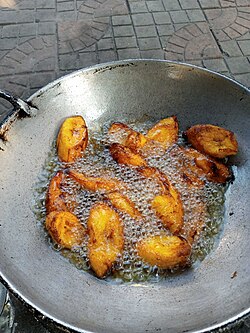
Frying is the cooking of food in oil or fat.a2 Similar to sautéing, pan-fried foods are generally turned over once or twice during cooking to ensure that the food is evenly cooked, using tongs or a spatula, whereas sautéed foods are cooked by "tossing in the pan".3 A large variety of foods may be fried. Frying is a dehydration process which involves the transfer of mass and heat. Different chemical changes take place during the frying process such as protein denaturation, starch gelatinization, surface browning, rapid water evaporation and oil absorption.4
History
Frying is believed to have first appeared in Ancient Egyptian cuisine during the Old Kingdom, around 2500 BC.5 There is evidence of frying dating to c. 1500 BC in India, when ghee was used to fry appam.6 In China, the Book of Rites describes a Zhou dynasty-era recipe for fried rice and fat from a wolf's breast. It is hypothesised that stir frying emerged in field kitchens in the late Han dynasty, but evaded the literary record due to its informal nature.5 In Leviticus, a distinction is made between baked bread and bread fried in a pan with oil.7
In Europe, frying pans begin appearing in Norwegian grave goods in the seventh century.8 Frying is mentioned in the Wife of Bath's Tale and a reference is made to fried eggs in Don Quixote in the 14th and 17th centuries respectively.7
Process
When in contact with oil heated to 150–200 °C (302–392 °F), food undergoes heat and mass transfer.9 The food's water content reaches boiling point and begins to vaporise, creating pores in its cell walls which enable it to absorb oil.10 As heat exposure is greater on the surface of the food in direct contact with the oil, water vaporisation occurs more quickly. This dehydration effect causes a crisp crust to form which protects the centre of the food against further oil absorption.10
The crust browns due to the formation of melanoidins caused by caramelisation and the Maillard reaction. The food's starch content gelatinises, causing it to soften; the surface contains less water and retains its crisp crust.9 Frying is complete when all water content in the food vaporises.10 When a fried food reduces in temperature below 100 °C (212 °F), water vapour inside condenses and internal pressure drops, causing oil absorption into the food via a vacuum effect.10
Techniques
Deep frying
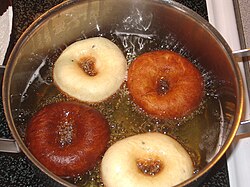
In deep frying, food is submerged in hot oil or fat so that all sides are cooked simultaneously. A deep fryer or chip pan may be used, or, in an industrial frying operation, a pressure fryer or vacuum fryer. One method for preparing food for deep frying involves battering or breading, which adds colour and crunch to its surface.11 French fries, doughnuts, cong you bing, and tempura are common deep-fried foods.1213
Sautéing
In sautéing, food is tossed over high heat in a frying pan with minimal oil to prevent sticking.1415 A sauté pan, which has higher sides to prevent food escaping during tossing, may also be used.12
Shallow frying
In shallow frying, also known as pan frying, food is fried in shallow oil on one side until browned, then flipped to cook the other side.12
Stir frying
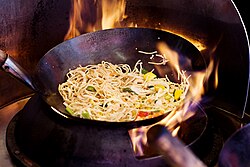
Stir frying is a Chinese, high-heat technique using a wok in which ingredients are constantly stirred for even cooking. The base of the wok is placed directly in the fire and its concave shape allows the flames to envelop the bowl; the base of the wok can reach 400 °C (752 °F).1617 Frying is finished in two to three minutes.18
Health effects
A 2021 meta-analysis found that the highest category of fried food consumption compared to the lowest is associated with a 3% increase in the risk of all-cause mortality, as well as with a 2% increase in the risk of cardiovascular mortality.19 Compared to participants with a low intake, those who ate the most fried food had a 37% increased risk of heart failure, a 28% increased risk of major cardiovascular events, and a 22% increased risk of coronary heart disease.19 The risk of stroke, heart failure, and heart attack modestly increased with the increase of weekly servings of fried food.19 The study concluded that fried food consumption may increase the risk of cardiovascular disease and presents a linear dose-response relation.19 The researchers theorized the main reasons behind these associations are the high trans fat and calorie content of fried foods and their pro-inflammatory nature.19 It was also noted that eating hyperpalatable crisp-fried foods may entice people to engage in routine overeating.19
A 2023 meta-analysis found that fried food consumption is linked to a 52% increase in the risk of stomach cancer.20 Fried food intake is also associated with prehypertension,21 hypertension22232124 and obesity.2425
Nutrition
Due to oil absorption during frying, the nutritional profile of the oil used becomes part of the final product; up to 75% of calories can be from fat in fried foods.9 15% of battered chicken or fish’s final weight is absorbed frying oil, compared to 20% when breaded. Doughnuts’ final weight is between 15–20% frying oil, and this figure increases to up to 35–40% for potato chips.1
Vitamins like thiamin, riboflavin, and vitamin A are unstable at high temperatures and vitamin C is water soluble, meaning they can be lost from fried foods during water evaporation. Vitamin A is particularly unstable—24% of vitamin A is destroyed during frying compared to 14% when boiled due to oxidation. Fibre increases in fried foods due to the formation of brown melanoidins, which form part of the crust. The proportion of protein also increases due to the concentrating effects of dehydration, with the exception of amino acid lysine due to its role in the Maillard reaction. Minerals increase in concentration in the same way, but this means that heavy metals found in some fish are also concentrated during frying.9
Fume inhalation
Toxic compounds such as aldehydes (e.g. formaldehyde) are produced during frying and evaporate with steam, which can irritate lung tissue if inhaled.14 Fumes from frying have been classified as "probably carcinogenic to humans" by the International Agency for Research on Cancer.26
Effects of oil
During frying, oil is exposed to water from food, high temperatures, and oxygen from the surroundings, which cause degradation. Hydrolysis causes an oil's smoke point to decrease and oxidation causes the formation of volatile compounds which change the flavour, quality, and texture of the food.27 These are mostly toxic aldehydes, of which some amount is required to achieve a characteristic fried smell and taste.9 Oils have varying proportions of saturated, monounsaturated, and polyunsaturated fats which change their performance during frying.27
Monounsaturated fats
Rapeseed oil, also known as canola oil, is the third most used frying oil, especially in northern Europe, Japan, Oceania, and Canada. Despite mostly comprising monounsaturated fat, its high linolenic acid content makes it prone to oxidation. Peanut oil, also known as groundnut oil, is commonly used in west Africa but, unlike rapeseed oil, is low in linolenic acid.27 Olive oil is stable at high temperatures because of its high monounsaturated fat and antioxidant content, which make it less likely to oxidise during frying and improves the nutritional content of fried foods.10 It degrades two times as slowly as sunflower oil and ten times as slowly as linseed oil. Its widespread use may be the cause of fried food consumption not being linked to increased mortality in Mediterranean countries.27
Polyunsaturated fats
Polyunsaturated fats are most prone to oxidation and polymerisation, which form toxic compounds that are absorbed by food.27 A 2022 WHO review and meta-analysis of 170 studies found that polyunsaturated fat consumption reduced overall mortality, but that higher quality evidence was needed.28 Sunflower oil is most commonly used in eastern Europe. Despite being a source of vitamin E, its high polysaturated fat content makes it poor for frying. Sunflower oil is sold with added oleic acid to increase its monounsaturated fat content and therefore its stability.27
Saturated fats
Palm oil is the most common oil, especially in subsaharan Africa, southeast Asia, and some parts of South America. Its saturated and unsaturated fat content are nearly equal, but is slightly more saturated. It has a high palmitic acid content, which is linked to heart disease.27
Oil reuse
Oil is reused in industrial frying to reduce costs, but prolonged use causes oxidation, producing aldehydes that affect flavour and increase cancer risks.10 Unsaturated fats oxidise more quickly than saturated fats, and oils with high linolenic acid content can smell fishy.927 Oil reuse reduces the nutritional value of foods and increases saturated and trans fats while reducing monounsaturated and polyunsaturated fats.10 Foods fried in reused oil absorb more.9
Fire risks
Oil or fat with a smoke point below 200 °C (392 °F) may foam and rise, spilling and causing a fire. Foaming can be distinguished from bubbles caused by water evaporation because the foam covers the whole surface of the oil, not just above the food.1 Blended oils are more prone to foaming.14 Oil with a flash point below 315 °C (599 °F) may explode.1
Gallery
-

-

-
 Guastedde a fried Sicilian dessert, in a shop window
Notes
Notes
- Chemically, oils and fats are the same, differing only in melting point: oils are liquid at room temperature and fats are solid.1
References
References
- Rosseli, J. B. (30 August 1998). "Industrial Frying Process". Grasas y Aceites. 49 (3–4). doi:10.3989/gya.1998.v49.i3-4.729. Retrieved 3 April 2026.
- Montagné, Prosper, ed. (1977). The New Larousse Gastronomique: The Encyclopedia of Food, Wine & Cookery. Crown. pp. 299, 307. ISBN 0517531372.
- Peterson, James (April 2003). Essentials of Cooking. Artisan Books. ISBN 978-1-57965-236-4.
- Onigbogi, Isaac O; Olatunji, T.O; Nupo, S.S; Bello, T.K (December 2011). "Effect of Repeated Frying Operations on the Quality Attributes of Frying Oil and Acceptability of Sweet Potato Chips". Journal of Sciences and Multidisciplinary Research. 3: 10 – via ResearchGate.
- Tannahill, Reay. (1995). Food in History. Three Rivers Press.
- Prakash, Om (1961). Food and Drinks In Ancient India: From Earliest Times To B.c. 1200 A.d. Munshi Ram Manohar Lal. p. 250. Retrieved 3 April 2026.
- Morton, I. D. (30 August 1998). "Geography and history of the frying process". Grasas y Aceitas. 49 (3–4). doi:10.3989/gya.1998.v49.i3-4.745. Retrieved 12 April 2026.
- Bukkemoen, Grethe Bjørkan (2017). The Agrarian Life of the North 2000 BC–AD 1000: Studies in Rural Settlement and Farming in Norway. pp. 117–132. Retrieved 3 April 2026.
- Bordin, Keliani; Tomihe Kunitake, Mariana; Kazue Aracava, Keila; Silvia Favaro Trindade, Carmen (2013). "Changes in food caused by deep fat frying". Órgano Oficial de la Sociedad Latinoamericana de Nutrición. 63 (1). ISSN 0004-0622. Retrieved 5 May 2026.
- Valle, Consuelo; Echeverría, Francisca; Chávez, Vilma; Valenzuela, Rodrigo; Bustamante, Andrés. "Deep-frying impact on food and oil chemical composition: Strategies to reduce oil absorption in the final product". Food Safety and Health. 2 (4): 414–428. doi:10.1002/fsh3.12056. Retrieved 3 April 2026.
- Stevenson, Danny (1996). Food Preparation and Cooking: Cookery Units (2nd ed.). Nelson Thornes Ltd. p. 18. ISBN 0 7487 2566 0. Retrieved 4 May 2026.
- Davidson, Alan (1999). The Oxford Companion to Food. Oxford University Press. ISBN 0192115790. Retrieved 11 May 2026.
- Y. W. Ang, Catharina; Liu, KeShun; Huang, Yao-Wen (1999). Asian Foods: Science and Technology. Technomic Publishing Company, Inc. p. 94. ISBN 1-56676-736-9. Retrieved 4 May 2026.
- Boskou, Dimitrios (2011). Frying Fats (2 ed.). CRC Press. Retrieved 10 May 2026.
- Ibitoye, Tai (May 2024). "What's the healthiest way to cook vegetables?". BBC Food. Retrieved 7 May 2026.
- Lam, Lan. "The Science of Stir-Frying in a Wok". America's Test Kitchen. Retrieved 7 May 2026.
- Lo, Eileen Yin-Fei (2009). Mastering the Art of Chinese Cooking. Chronicle Books LLC. p. 76. ISBN 0811859339.
- Chao, Yang Buwei (1945). How to Cook and Eat in Chinese. The John Day Company. Retrieved 7 May 2026.
- Qin P, Zhang M, Han M, Liu D, Luo X, Xu L, Zeng Y, Chen Q, Wang T, Chen X, Zhou Q, Li Q, Qie R, Wu X, Li Y, Zhang Y, Wu Y, Hu D, Hu F (October 2021). "Fried-food consumption and risk of cardiovascular disease and all-cause mortality: a meta-analysis of observational studies". Heart. 107 (19): 1567–1575. doi:10.1136/heartjnl-2020-317883. PMID 33468573.
- Zhang T, Song SS, Liu M, Park S (June 2023). "Association of Fried Food Intake with Gastric Cancer Risk: A Systemic Review and Meta-Analysis of Case-Control Studies". Nutrients. 15 (13): 2982. doi:10.3390/nu15132982. PMC 10347084. PMID 37447308.
- Provido SM, Abris GP, Hong S, Yu SH, Lee CB, Lee JE (February 2020). "Association of fried food intake with prehypertension and hypertension: the Filipino women's diet and health study". Nutr Res Pract. 14 (1): 76–84. doi:10.4162/nrp.2020.14.1.76. PMC 6997139. PMID 32042377.
- Sayon-Orea C, Bes-Rastrollo M, Gea A, Zazpe I, Basterra-Gortari FJ, Martinez-Gonzalez MA (September 2014). "Reported fried food consumption and the incidence of hypertension in a Mediterranean cohort: the SUN (Seguimiento Universidad de Navarra) project". Br J Nutr. 112 (6): 984–91. doi:10.1017/S0007114514001755. PMID 25201306.
- Kang Y, Kim J (January 2016). "Association between fried food consumption and hypertension in Korean adults". Br J Nutr. 115 (1): 87–94. doi:10.1017/S000711451500402X. PMID 26449129.
- Qin P, Liu D, Wu X, Zeng Y, Sun X, Zhang Y, Li Y, Wu Y, Han M, Qie R, Huang S, Zhao Y, Feng Y, Yang X, Liu Y, Li H, Zhang M, Hu D, Hu F (2022). "Fried-food consumption and risk of overweight/obesity, type 2 diabetes mellitus, and hypertension in adults: a meta-analysis of observational studies". Crit Rev Food Sci Nutr. 62 (24): 6809–6820. doi:10.1080/10408398.2021.1906626. PMID 33825582.
- Guallar-Castillón P, Rodríguez-Artalejo F, Fornés NS, Banegas JR, Etxezarreta PA, Ardanaz E, Barricarte A, Chirlaque MD, Iraeta MD, Larrañaga NL, Losada A, Mendez M, Martínez C, Quirós JR, Navarro C, Jakszyn P, Sánchez MJ, Tormo MJ, González CA (July 2007). "Intake of fried foods is associated with obesity in the cohort of Spanish adults from the European Prospective Investigation into Cancer and Nutrition". Am J Clin Nutr. 86 (1): 198–205. doi:10.1093/ajcn/86.1.198. PMID 17616781.
- Abrante-Pascual, Susana; Nieva-Echevarría, Barbara; Goicoechea-Oses, Encarnacion (23 December 2024). "Vegetable Oils and Their Use for Frying: A Review of Their Compositional Differences and Degradation". Foods. 13 (24): 4186. PMID 39767128. Retrieved 13 May 2026.
- Choe, E.; Min, D. B. (1 May 2007). "Chemistry of Deep-Fat Frying Oils". Journal of Food Science. 72 (5). doi:10.1111/j.1750-3841.2007.00352.x. Retrieved 13 May 2026.
- J. de Souza, Russell; A. Zulyniak, Michael; Kazemi, Mina; Ali, Rahim; Bierbrier, Rachel; Williams, Natalie; Stennett, Rosain; Banfield, Laura (2022). Polyunsaturated fatty acids intake and risk of all-cause mortality, cardiovascular disease, breast cancer, mental health, and type 2 diabetes. World Health Organisation. ISBN 978-92-4-006164-4. Retrieved 6 May 2026.