
The Hurrian pantheon consisted of gods of varied backgrounds, some of them natively Hurrian, while others adopted from other pantheons,12 for example Eblaite3 and Mesopotamian.4 Like the other inhabitants of the Ancient Near East, Hurrians regarded their gods as anthropomorphic.5 They were usually represented in the form of statues holding the symbols associated with a specific deity.6 The Yazılıkaya sanctuary, which was Hittite in origin but served as a center of the practice of Hurrian religion, is considered a valuable source of information about their iconography.7
Hurrians organized their gods into lists known as kaluti8 or into similar lexical lists as the Mesopotamians.9 The formal structure of the pantheon was most likely based on either Mesopotamian or Syrian theology.104 The status of individual deities11 and composition of the pantheon could vary between individual locations, but some can nonetheless be identified as "pan-Hurrian."12
The following list does not include deities only attested in the two Hurrian god lists whose names are transcriptions of Mesopotamian divine names, as it is unlikely that they were actively worshiped.13 Identification of the Yazılıkaya reliefs used in the image column follows Piotr Taracha's analysis from the monograph Religions of Second Millennium Anatolia.14
Major deities
| Name | Image | Attested cult centers | Origin | Attested equivalencies | Details |
|---|---|---|---|---|---|
| Teššub | 
|
Kumme,15 Halab,16 Irrite,17 Arrapha,18 Kaḫat, Waššukkanni, Uḫušmāni19 | Hurrian1815 | Ishkur/Hadad (Syrian and Mesopotamian),1820 Baal (Ugaritic),16 Tarhunna (Hittite)19 | Teššub was the Hurrian king of the gods, as well as a weather deity.18 In Hurrian areas, as well as in these where the royal families were under the influence of Hurrian culture, he was often also the tutelary god of the ruling house.21 While it is assumed that he was not necessarily regarded as the head of the pantheon from the very beginning,4 he likely already acquired this role in the late third millennium BCE.15 His principal sanctuaries were Kumme, located east of the Upper Tigris,15 and Halab (modern Aleppo), where he merged with the local weather god Hadad.16 His name could be written logographically as dIM.15 A god with a cognate name, Teišeba, was present in the pantheon of Urartu, but his position was different.18 |
| Šauška | 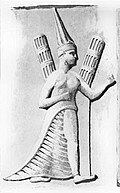 |
Nineveh,11 Nuzi,22 Šamuha, Hattarina, Lawazantiya,23 Tameninga24 | Hurrian22 | Inanna/Ishtar (Mesopotamian), Ashtart (Ugaritic), possibly Anzili (Hittite)23 | Šauška (šwšk or šušk in the Ugaritic alphabetic script23) was the main goddess of the Hurrian pantheon in locations like the kingdom of Arrapha, Alalakh and Ugarit.11 Nineveh was particularly closely associated with her, and in myths she is often called the "Queen of Nineveh."25 She was regarded as the sister of Teššub,19 and by extension presumably as a daughter of Kumarbi and Anu, though references to the moon god as her father are also known.26 Her spheres of influence included war, love, magic and medicine.27 Šauška's gender could be ambiguous: in the Yazilikaya reliefs, Šauška is present both among gods and goddesses, while in a ritual text "female attributes" and "male attributes" are both mentioned.28 Her name could be written logographically as dIŠTAR.22 She was also introduced into the Mesopotamian pantheon, and appears in texts from Puzrish-Dagan, Umma, Isin and Uruk.22 |
| Kumarbi Kumurwe28 |
Urkesh, Azuhinnu, Taite28 | Hurrian15 | Enlil (Mesopotamian),29 Dagan (Syrian),20 El (Ugaritic), Halki (Hittite)30 | Kumarbi was regarded as the "father of gods," and as one of the parents of Teššub.31 He might have also been the god of grain, though the evidence is inconclusive.32 His name might mean "he of Kumar," Kumar presumably being a place name, though other proposed etymologies connect it with Kumme, the cult center of Teššub, and with the word kum, "tower."15 He is also attested as one of the Hurrian deities from Taite in the Assyrian Tākultu ritual, alongside Nabarbi and Samnuha.28 In myths, he was described as allied with forces hostile to the rule of Teššub: the "former gods" inhabiting the underworld, gods and monsters living in the sea, and a stone giant named Ullikummi, "Destroy Kumme."33 | |
| Ḫepat |  |
Halab,20 Lawazantiya34 | Syrian35 | Sun goddess of Arinna (Hittite),36 Pidray (Ugaritic)3738 | Ḫepat was the wife of the head of the Hurrian pantheon, Teššub.35 She was initially the wife of the storm god of Halab (Aleppo), Hadad.20 In some western locations her position in the pantheon surpassed that of Šauška,11 but in the eastern Hurrian centers she is only present in theophoric names and likely was not one of the major deities.39 |
| Šimige |  |
No specific cult center,40 attested in sources from Urkesh, Tigunani, Alalakh, Nuzi, Arrapha, Tell al-Rimah and Chagar Bazar41 | Hurrian42 | Utu/Shamash (Mesopotamian),43 Shapash (Ugaritic),42 Sun god of Heaven (Hittite)30 | Šimige was the Hurrian sun god.12 His name means "sun."42 He also served as a god of oracles.30A Hurrian incantation from Mari indicates that he was believed to have seven daughters.44 His name could be written logographically as dUTU.17 Due to syncretism between him and Shamash, Aya was adopted into the Hurrian pantheon as his wife, and one text from Hattusa lists Sippar as his cult city.42 It is also possible that the Hittite Sun god of Heaven was patterned after him, or was outright the same deity.30 A god with a cognate name, Šiwini, was also present in the pantheon of Urartu.42 |
| Kušuḫ Umbu20 |
 |
Kuzina (Harran),45 Šuriniwe46 | Hurrian47 | Sin (Mesopotamian),48 Yarikh (Ugaritic),49 Arma (Anatolian)50 | Kušuḫ was the Hurrian moon god.40 He was also the god of oaths.30 His name might be derived from Kuzina,4047 the Hurrian name of Harran.45 In a single text he is named as the father of Teššub.51 His name could be represented logographically as dEN.ZU48 or dXXX.52 It is unclear if Umbu was his alternate name, a manifestation linked to a specific phase of the moon, or a separate moon god originating in an unidentified Anatolian or Syrian pantheon.53 Origin in the northern part of Jezirah has been proposed,20 though a Hurrian etymology is also not implausible.54 In Kizzuwatna, Kušuḫ was syncretised with the Luwian moon god Arma, and they were depicted identically in art.50 |
| Allani Allatum55 |
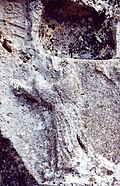 |
Ḫaššum, Zimudar55 | Hurrian56 | Ereshkigal (Mesopotamian),57 Lelwani (Hattic/Hittite),58 Sun goddess of the Earth (Hittite),59 Arsay (Ugaritic)60 | Allani ("the lady") was the goddess of the underworld.56 She resided in a palace located at the gates of the land of the dead.61 While according to Gernot Wilhelm she was only worshiped in the western Hurrian areas,62 Tonia Sharlach in a more recent publication points out that Mesopotamian sources seem to associate her with Zimudar, a city in the Diyala area.55 She is well attested in theophoric names from the Tur Abdin area as well.55 |
| Išḫara | 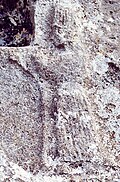 |
Ebla, Alalakh,63 Emar,64 Kizzuwatna6563 | Syrian (Eblaite)66 | Išḫara was originally one of the deities of Ebla in the third millennium BCE, and served as the tutelary goddess of the royal family.67 Later she came to be incorporated into the pantheons of various cultures of ancient Anatolia, Syria and Mesopotamia.2 She had a variety of functions, including those of a love goddess, guardian of oaths, disease deity and underworld goddess associated with divine ancestors.68 She was frequently associated with Allani, most likely based on their shared association with the underworld,65 and they could be worshiped as a dyad.59 | |
| Hayya Ea48 |
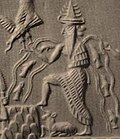 |
Hattusa69 | Mesopotamian48 | Kothar-wa-Khasis (Ugaritic)70 | Hayya was the Hurrian spelling of the name of the Mesopotamian god of wisdom Ea,48 who most likely was incorporated into Hurrian religion in the Sargonic period.71 He was referred to with his Akkadian epithets, such as "lord of wisdom," and played the same role as in Mesopotamia in Hurrian sources.48 According to Alfonso Archi, his position in the Hurrian pantheon was comparable to that of gods like Kumarbi or Kušuḫ,52 and to that he held in Babylonia.72 THe is well attested in Mitanni sources.73 |
| Hutena and Hutellura | Ugarit,74 Halab, Hattusa75 | Hurrian76 | Gulšes and Ḫannaḫanna (Hittite),7778 Kotharāt (Ugaritic),37 Šassūrātu (Mesopotamian)79 | Hutena and Hutellura were goddesses of fate75 and divine midwives.80 It is possible they were similarly believed to be responsible for forming the child during pregnancy.81 It has been proposed that Hutena means "she of favoring"75 and Hutellura (or Hutelluri) - "midwife."76 Piotr Taracha assumes the names might only refer to a pair of goddesses,82 but it has also been proposed that the term referred to a heptad of deities similar to Ugaritic Kotharāt.80 It is also possible that Hutena and Hutellura were based on the latter group.83 | |
| Nabarbi | 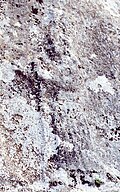 |
Taite2884 | Hurrian15 or Syrian77 | possibly Belet Nagar (Syrian)15 | Nabarbi ("she of Nawar," from Hurrian naw, "pasture"15) was a goddess worshiped chiefly in the Upper Khabur area.84 Piotr Taracha argues that Nabarbi is one and the same as Belet Nagar,84 and therefore believes she should not be considered a Hurrian deity in origin.77 However, according to Alfonso Archi Nawar from Nabarbi s name and Nagar from Belet Nagar s name were two distinct places.15 At the same time, he does not rule out the possibility that Nabarbi and Belet Nagar were identified with each other.15 Nabarbi is also attested as one of the Hurrian deities from in the Neo-Assyrian Tākultu ritual, alongside Kumarbi and Samnuha.28 |
| Nergal | 
|
Arrapha, Azuhinnu, Kurruhanni,71 Ulamme,85 possibly Urkesh17 | Mesopotamian17 | Nergal, the Mesopotamian god of war and death, was worshiped in various locations in the eastern Hurrian kingdoms, including the city of Arrapha itself.71 In Azuhinnu he was regarded as the third most prominent member of the pantheon after Teššub and Šauška.71 He was also worshiped in Ulamme, where he was associated with a goddess referred to as "dIŠTAR Ḫumella,"85 whose identity remains unknown.22 It is possible that in some cases in the west his name served as a logographic representation of one belonging to a Hurrian god (proposals include Aštabi and Kumarbi), but it also cannot be ruled out that he was worshiped under his Mesopotamian name there as well.17 | |
| Nupatik Lubadag,17 Lubadig, Nubadig, Nubandag86 |
 |
Urkesh, Carchemish,86 Ugarit87 | Hurrian86 | Nupatik was one of the "pan-Hurrian" gods,12 but his character, functions and genealogy are poorly known.4088 He appears already in the inscriptions of Hurrian king Atalšen of Urkesh, where his name is spelled syllabically (dLu-ba-da-ga), rather than logographically.86 He is also present in Hurrian texts from Ugarit, where his name is spelled in the local alphabetic script as Nbdg.86 | |
| Tilla | Ulamme, Nuzi,89 Kuruḫanni90 | Hurrian4 | Tilla was a god worshiped in eastern Hurrian cities in the kingdom of Arrapha, such as Nuzi8991 and Kuruḫanni (modern Tell al-Fakhar).90 An entu priestess dedicated to him lived in the latter city.90 Documents from Nuzi indicate he was very commonly worshiped in the east, and he appears in theophoric names with comparable frequency to Teššub.91 While he is commonly described as a "bull god" in modern literature,92 there is presently no evidence that he was necessarily depicted as a bull.93 The only exception is the myth Song of Ullikummi,93 where he a is one of the two bulls who pull Teššub's chariot, the other one being Šeriš, but in most other sources, such as offering lists, Šeriš is paired with Hurriš, not Tilla.94 |
Minor or local deities
| Name | Image | Attested cult centers | Origin | Attested equivalencies | Details |
|---|---|---|---|---|---|
| Adamma | Syrian (Eblaite)95 | Adamma was a goddess originally regarded as the spouse of Resheph in Ebla.95 In the Hurrian pantheon she was instead associated with Kubaba.95 | |||
| Allanzu | Allanzu was one of the two daughters of Ḫepat and Teššub.96 She could be referred to as šiduri ("young woman").97 In the first millennium BCE, she continued to be worshiped by Luwians under the name Alasuwa.98 | ||||
| Ammarik | Haššum99 | Syrian99 | Ammarik was a mountain god already worshiped in Ebla in the third millennium BCE, later incorporated into the Hurrian pantheon.99 | ||
| Anat |  |
Ugarit74 | Ugaritic74 | Anat was an Ugaritic goddess regarded as warlike.100 She appears regularly in Hurrian offering lists from Ugarit, according to Daniel Schwemer most likely because she had no close counterpart in the Hurrian pantheon, unlike the other local gods such as Baʿal, ʿAštart, Šapšu, Yariḫ or Yam.74 The only other deity of Ugaritic origin attested in them is ʾEl,74 her father.101 | |
| Aranzaḫ | Hurrian102103 | Aranzaḫ was a divine personification of the river Tigris.103 In the Song of Kumarbi, his name is written with the determinative ID ("river") rather than with a dingir, the sign designating divine names in cuneiform.104 In the poorly preserved myth about the hero Gurparanzaḫ, he appears in an active role as his ally.102 | |||
| Aštabi |  |
Alalakh, Ugarit, originally Ebla95 | Syrian (Eblaite)105106 | Attar (Ugaritic),107 Ninurta,48 Lugal-Marada (Mesopotamian)107 | Aštabi (aštb in the alphabetic script from Ugarit) was a warrior god.95 While he was initially viewed as a god of Hurrian origin by researchers,62 further discoveries revealed that his background was Eblaite.106 His name could be represented logographically as dNIN.URTA.48 He is absent from eastern Hurrian sources.108 |
| Ayakun | Hurrian109 | Ninsun, Alammuš (Mesopotamian)109 | Ayakun is a deity known from the trilingual god list from Ugarit, where this name is treated as the Hurrian explanation of two Mesopotamian deities, Ninsun and Alammuš.109 According to Frank Simons the reasoning behind this equation is difficult to explain.109 | ||
| Ayu-Ikalti | Mesopotamian48 | Ayu-Ikalti was the Hurrian spelling of Aya kallatu, "Aya, the bride," the name and most common epithet of the wife of Mesopotamian sun god Shamash.48 The Hurrians regarded her as the wife of Šimige.30 | |||
| Belet Nagar | Nagar,110 Urkesh111 | Syrian77 | Belet Nagar, "lady of Nagar," was a Syrian goddess.110 Similar as in the case Assyrian city Assur and its god, her name was derived from the city she represented.110 She is attested for the first time in an inscription of the Hurrian king Tishatal111 alongside various Hurrian deities.17 | ||
| Dadmiš Tadmiš60 |
Ugarit112 | Uncertain112 | Šuzianna (Mesopotamian)60 | Dadmiš or Tadmiš (ddmš in the Ugaritic script, but syllabically dta-ad-mi-iš)60 is attested in Hurrian ritual texts from Ugarit.113 Her origin is presently unknown.112 Her name might be derived from the Akkadian word dādmu ("dwellings"), which has also been linked with Dadmum, the Amorite name for the area of modern Aleppo.114 A different proposal connects her name with that of Tadmuštum, a Mesopotamian goddess associated with the underworld.115 It has been suggested that Dadmiš was either a healing goddess112 or an underworld deity associated with Resheph.60 | |
| Damkina | Mesopotamian48 | Damkina was the wife of the Mesopotamian god Ea, incorporated into the Hurrian pantheon alongside her husband.48 | |||
| DINGIR.GE6 | Kizzuwatna, Šamuha116 | Hurrian (Kizzuwatnean)117 | possibly Ishtar (Mesopotamian)118 | DINGIR.GE6, tentatively referred to as "Goddess of the Night"117 or formerly as the "Black Goddess" in modern scholarship,116 was a deity worshiped by Hurrians living in Kizzuwatna.11 She was associated with the nighttime and dreaming.119 She formed a dyad with Pinikir,120 and it is possible that like her she was associated with Ishtar.118 | |
| Ebrimuša | Hurrian15 | Ebrimuša (also Ibrimuša; ebrmž in alphabetic Ugaritic texts) was a Hurrian god attested in an Old Assyrian document, in Hittite rituals of Hurrian origin, and in texts from Ugarit.121 His name means "king of justice."15 He was associated with Ḫepat, and in rituals also appears with her son Šarruma and sukkal Tiyabenti.121 | |||
| Hašuntarhi | Kizzuwatna95 | Hašuntarhi was a goddess sometimes listed alongside the dyad of Kubaba and Adamma in texts from Kizzuwatna.95 | |||
| Ḫabūrītum | Sikani122 | Syrian123 | Ḫabūrītum was a goddess representing the river Khabur.123 Based on the location of her presumed cult center and on the fact that she was introduced to Mesopotamia at the same time as many Hurrian goddesses, Tonia Sharlach concludes that either belonged to the Hurrian pantheon herself or at least was worshiped chiefly in a "Hurrian-dominated" area.124 Alfonso Archi proposes that she was analogous to Belet Nagar and possibly by extension also to Nabarbi.15 | ||
| Ḫešui | Šapinuwa125 | Hurrian126 | Zababa (Mesopotamian)125 | Ḫešui was a war god.127 The meaning of his name is unknown,128 While annelies Kammenhauber consideref him a Hurrian god in origin,126 according to Alfonso Archi this is presently impossible to tell with certainty.129 He belonged to the circle of deities associated with Teššub,125 and as such appears in kaluti (offering lists) connected with his cult.8 | |
| Ḫupuštukar | Hurrian125 | Ḫupuštukar was the sukkal of Ḫešui.128 His name is derived from the Hurrian verb ḫub-, "to break."125 In one ritual text, he appears alongside the sukkals of other deities: Izzumi, Undurumma, Tenu, Lipparuma and Mukišanu.126 | |||
| Impaluri | Hurrian130 | Impaluri was the sukkal of the sea god (Kiaše).131 Volkert Haas notes that the suffix -luri appears not only in his name, but also in these of other deities, as well some mountain and stone names.130 | |||
| Iršappa | Hattusa, Šamuha132 | Syrian132 | Resheph (Syrian)132 | Iršappa (or Aršappa; eršp in the alphabetic Ugaritic script)132 was a god from the circle of Teššub.133 He was associated with markets,132 and in Hittite texts he was referred to as damkarassi, a Sumerian loanword meaning "of commerce."133 He was derived from the Syrian god Resheph,132 who was himself associated with the marketplace in Emar.134 | |
| Irširra | Hurrian56 | Irširra were a group of Hurrian deities who might have been the goddesses of nursing and midwifery.135 In the Song of Ullikummi the eponymous rock creature is placed on the primordial giant Ullikummi's right shoulder by them, as ordered by Kumarbi.135 | |||
| Iškalli | Possibly Mesopotamian136 | Iškalli was a sparsely attested deity from the court of Ḫepat, usually paired with Uršui.136 She is described as the "witness of the goddess."136 The name might be derived from Akkadian ešgallu, "great temple."136 | |||
| dIŠTAR deities Ḫumella, Akkupaweniwe, Tupukilḫe, Putaḫḫe, Allaiwašwe, bēlat dūri137 |
Nuzi,137 Ulamme85 | Uncertain2285 | In addition to Šauška, administrative documents from Nuzi attest the worship of other goddesses referred to with the logogram dIŠTAR (or rather with it shortened form dU490), identified by the epithets Ḫumella, Akkupaweniwe, Tupukilḫe, Putaḫḫe, Allaiwašwe, and bēlat dūri.137 It is agreed most of these epithets are either etymologically Hurrian or at least Hurrianised, but their meanings remain unknown.22 An exception is bēlat dūri, which is Akkadian in origin and means “lady of the city walls.”85 In Ulamme, another city located in the kingdom of Arraphe, dIŠTAR Ḫumella was closely associated with Nergal.85 | ||
| Izzummi |  |
Mesopotamian48 | Izzummi is the Hurrian spelling of the name of Isimud (Ušmu), the sukkal (attendant deity) of Ea, who was incorporated into Hurrian pantheon alongside his master.48 | ||
| Karḫuḫi | Carchemish138 | Hurrian139 | Karḫuḫi (or Karhuha) was a god worshiped in Carchemish, first attested in the fifteenth century BCE.140 He was associated with Kubaba.138 It is possible that the logogram dLAMMA, which designates one of the adversaries of Teššub in the Kumarbi Cycle, refers to him.138 While a connection between him and the Anatolian god Kurunta is commonly proposed,140 it cannot be conclusively proved, and his character is regarded as uncertain.141 | ||
| dKASKAL.KUR.RA | Syrian142 | dKASKAL.KUR.RA is one of the deities listed in the treaty between Šuppiluliuma I and Šattiwaza.143 This logogram has multiple possible readings, including the deified version of the Balikh River.144 The notion that a deified watercourse is meant in this document is tentatively supported by Alfonso Archi.35 | |||
| Kiaše | Ugarit74 | Hurrian145 | Yam (Ugaritic)74 | The name Kiaše means "sea" in Hurrian.145 The god is therefore sometimes simply referred to as "the Sea"146 or "the Sea God" in modern publications.147 He is mentioned in texts from Ugarit and Hattusa148 and in a hymn to Teššub from Halab.149 In myths about Kumarbi, he is one of his allies.150 | |
| Kubaba |  |
Carchemish,151 Alalakh152 | Syrian142 | Hurrian texts provide little information about Kubaba's character.153 According to Alfonso Archi, she was regarded as the goddess of lawsuits.154 She belonged to the circle of Ḫepat99 and was closely associated with Adamma.95 She should not be confused with the Sumerian queen Kubaba (Kug-Bau),152 whose name is theophoric and invokes the tutelary goddess of Lagash, Bau.155 The exact linguistic origin of Kubaba's name is unknown.95 Kubaba is also not etymologically related with the Phrygian goddess Cybele attested in later time periods.156 | |
| Kunzišalli | Kunzišalli was one of the two daughters of Ḫepat and Teššub.96 | ||||
| Kurri | Kizzuwatna157 | possibly Syrian (Eblaite)158 | possibly Kura (Eblaite)159 | Kurri was a god who was worshiped in the temple of Allani during the hišuwa festival.158 It has been proposed that he is the same deity as the Eblaite god Kura, whose worshiped otherwise ceased with the first destruction of Ebla,159 but it is impossible to establish this with certainty due to lack of information about the functions of either deity.158 | |
| Kurwe | Azuhinnu157 | Hurrian160 | Kurwe was most likely the city god of Azuhinnu.157 He precedes Kumurwe (Kumarbi) in known offering lists.157 It has been proposed that he was the same god as Kurri from Kizzuwatna, though this is uncertain and the latter might also be connected with Eblaite Kura instead.157 It is possible that he continued to be invoked in theophoric names from Azuhinnu in the Neo-Assyrian period.157 | ||
| Lelluri | Haššum,161 Kummanni162 | Hurrian130 | Ninmena (Mesopotamian)163 | Lelluri was a Hurrian mountain goddess, a "lady of the mountains."164 She has been described as a deity "associated with Hurrian identity."165 She had a temple in Kummanni in Kizzuwatna, where she was worshiped alongside Manuzi.166 | |
| Lipparuma | Hurrian86 | Bunene (Mesopotamian)30 | Lipparuma30 or Lipparu was the sukkal of the sun god, Šimige.86 He was regarded as analogous to Mesopotamian Bunene,30 and the latter in one case appears as a courtier of Šimige, with his name transcribed as dWu-u-un-ni-nu-wa-an.42 | ||
| Maliya | Kizzuwatna167 | Anatolian167 | Maliya was a goddess of Anatolian origin, well known from Hittite documents.167 She was associated with gardens and could be called the "mother of wine and grain."168 She was originally associated with Kanesh.167 She was worshiped by Hurrians in Kizzuwatna, where she was associated with a group of deities of Hurrian origin referred to as Kuzzina-Kuzpazena.167 She appears alongside Hurrian deities such as Išḫara, Allani and Nupatik in documents pertaining to the hišuwa festival.169 She was also commonly worshiped by Luwians.170 Her cult survived in the first millennium BCE, and bilingual texts from Lycia attest an association between her and Greek Athena Polias.167 | ||
| Manuzi | Kummani166 | Manuzi was a mountain god regarded as the husband of Lelluri.4 He was associated with a mythical eagle, Eribuški,171 whose name has Hurrian origin.166 Volkert Haas noted the association of deified mountains with eagles is already attested in the case of the Eblaite Adarwan in the third millennium BCE.171 Manuzi could also be identified as a form of Teššub,4 and as such could be referred to as "Teššub Manuzi."169 | |||
| Milkunni | Ugarit172 | Hurrian/Ugaritic172 | Tišpak (Mesopotamian)173 | Milkunni was most likely a god associated with the underworld.174 His name is a combination of the name of an Ugaritic deity, Milku (mlk in the alphabetic texts), and the Hurrian suffix -nni.172 | |
| Mitanni dynastic deities Mitra-ššil, (W)aruna-ššil, Indra and Našattiyana35 |
Indo-European44 | The attested Mitanni deities of Indo-European origin include Indra, Mitra, Varuna and the Nasatya twins,175 all of whom only appear in a single treaty between Šuppiluliuma I and Šattiwaza, where they act as tutelary deities of the latter king.44 The Hurrianised spellings of their names are Mitra-ššil, (W)aruna-ššil, Indra and Našattiyana.35 They most likely were only worshiped by the nobility35 or the ruling dynasty of this kingdom.175 | |||
| Mukišānu | Hurrian40 or Syrian176 | Mukišānu was the sukkal (attendant deity) of Kumarbi.20 His name was derived from Mukiš, a geographic name designating the area around the city of Alalakh,20 where a large percentage of the population spoke Hurrian.177 Some researchers, such as Volkert Haas, nonetheless assume his origin was Syrian rather than Hurrian.176 | |||
| Mušītu | Emar178 | Syrian179 or Hurrian180 | The goddess Mušītu (dmu-ši-tu4, dmu-ši-ti179), "night,"181 was worshiped in Emar.178 According to Gary Beckman, her name most likely originates in a West Semitic language,179 but Alfonso Archi notes it is possible she was a misunderstanding of the Hurrian theonym Mušuni.180 In a ritual text found in Emar, but presumed to be of Anatolian provenance, she appears as a member of a group of Hurrian deities, consisting of Teššub, his bulls, the mountain gods Hazzi and Namni, Allani, "Madi" ("wisdom," an epithet of Ea in Hurrian texts), Nergal (according to Archi in this context possibly a logogram representing the name of another deity) and an unidentified heptad.182 She is also attested as one of the deities venerated in the local zukru festival, in which she appears in association with Saggar.181 | ||
| Mušuni | Hurrian15 | Mušuni was a goddess who formed a dyad with Ḫepat.34 Her name means "she of justice."15 It has been proposed that she was an underworld goddess, and in one case she appears in a ritual alongside Allani and Išḫara.34 | |||
| Namni and Ḫazzi |  |
possibly Halab20 | Syrian183179 | Namni and Ḫazzi were a pair of mountain gods who belonged to the retinue of Teššub.20 Ḫazzi corresponded to Jebel Aqra, in the Bronze Age known as Saphon, but it is presently unknown what mountain was represented by Namni.16 Fragment of a myth appears to indicate that they were believed to be former enemies of Teššub, who fought him with the same weapon he earlier used in his battle against the sea god.184 | |
| Namrazunna | Hurrian/Mesopotamian185 | Namrazunna was a goddess from the entourage of Šauška.185 While she is attested in Hurrian and Hittite sources from Anatolia, her name is derived from Akkadian namru, "shining," and Zunna, a Hurrianized spelling of the name of the Mesopotamian moon god Suen,185 also attested in Hurrian text in transcription of the name of king Naram-Sin of Akkad.186 Volkert Haas proposed translating Namrazunna's name as "moonlight."187 Ilse Wegener instead suggests "the moon (god) shines for me."186 In ritual texts she could be grouped with other servants of Šauška, namely Ninatta, Kulitta and Šintal-irti.188 | |||
| Naya | Hurrian189 | Naya is a deity known from Hurrian theophoric names.189 | |||
| Nikkal | Ugarit82 | Mesopotamian190 | Ningal (Mesopotamian)190 | Nikkal was a Hurrian derivative of the Sumerian Ningal.190 In texts from Ugarit she appears both with Hurrian Kušuḫ and local Yarikh.20 In kaluti of Ḫepat she is attested alongside Umbu, which lead to the theory that Umbu was not a name of a moon deity but rather an epithet of Nikkal analogous to Ugaritic Nikkal-wa-Ib, though according to Mauro Giorgieri this is not plausible.54 | |
| Ninatta and Kulitta | 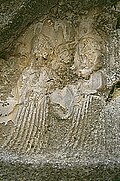 |
Hattusa, Ugarit191 | Possibly Anatolian (Kulitta),192 possibly Amorite (Ninatta)193 | Ninatta and Kulitta were handmaidens of Šauška.191 Their only Bronze Age attestations come from western Hurrian sources from Ugarit and Hattusa,191 though in later periods they are also attested in the entourages of Ishtar of Arbela,194 Ishtar of Assur,28 and Assyrian Ishtar of Nineveh.195 The origins of their names are unknown, though it has been proposed that Kulitta's name might have Anatolian origin192 and that Ninatta's might be derived from the place name Ninêt (Ni-ne-etki) or Nenit (Ne-en-itki) known from documents from Mari and Tell al-Rimah, which might be an Amorite spelling of Nineveh.193 In ritual texts they could be grouped with other deities from Šauška's entourage, namely Namrazunna and Šintal-irti.188 | |
| Pairra | Hurrian56 | Sebitti196 | Pairra were a group of Hurrian gods whose name can be translated as "they who built."196 The singular form of the name is Pairi.196 According to a ritual text pertaining to the worship of Teššub and Ḫepat, the Pairra could appear as both auspicious figures and as malign demons.196 It has been proposed that in Hittite texts the logogram used to designate the Sebitti in Mesopotamia should be read as "Pairra."196 A formal equivalence between these two groups of deities is attested in a god list from Emar.196 | ||
| Partaḫi | Šuda35143 | Partaḫi (also romanized as Pardahi35) belonged to Hurrian pantheon of Mitanni, and appears as the deity of Šuda in the treaty between Šattiwaza with Šuppiluliuma I between a number of hypostases of Teššub from specific locations and Nabarbi.197143 | |||
| Pentikalli | Halab, Samuha, Hattarina,198 Nuzi199 | Syrian or Mesopotamian20 | Ninegal (Mesopotamian)20 | Pentikalli was the Hurrian form of the name Belet Ekalli or Ninegal.200 In Hurrian texts, she is designated as a concubine of Teššub,136 and was assimilated with Pithanu, described as a goddess who sits on Teššub's throne in a ritual text.198 | |
| Pinikir Pirengir201 |
 |
Šamuha202 | Elamite203 | Ishtar,204 Ninsianna (Mesopotamian)205 | Pinikir was a goddess of Elamite origin203 worshiped by the western Hurrians.17 It is possible that she was a divine representation of the planet Venus.201 She was referred to with epithets such as "Lady of the Lands," "Lady of Gods and Kings," "Queen of Heaven"206 and "Elamite goddess."207 She has been characterized as a "cosmopolitan deity" due to being worshiped in various locations all across the Ancient Near East, from modern Turkey to Iran.204 Pinikir's gender in Hurrian texts is not entirely consistent and in some offering lists he is counted among the male deities.204 |
| Pišaišapḫi | Alalakh208 | Hurrian132 | Pišaišapḫi (pḏḏpẖ in the alphabetic Ugaritic script) was a mountain god whose name is an adjective, "(he) of the mount Pišaiša."209 The corresponding landmark was most likely located close to the Mediterranean coast.132 Sometimes in offering lists he forms a dyad with another deified mountain, Hatni, in which case he appears second.208 However, unlike him Hatni is never mentioned on his own.208 He is attested alongside other mountains in oath formulas as well.209 He appears in a myth about Šauška,132 in which he promises to tell her the story of rebellion of the mountain gods against Teššub in exchange for being forgiven for own misdeeds.210 | ||
| Saggar | Emar,59 Kurda, Tell al-Rimah,211 Kizzuwatna59 | Syrian212 | Saggar was one of the gods incorporated into Hurrian religion who were originally worshiped in Ebla, but did not retain their former prominence after the fall of this city.3 His name could be written logographically as dḪAR.212 He was a divine representation of the Sinjar Mountains, but seemingly also a lunar deity.213 He was also closely associated with Išḫara.213 | ||
| Samnuha Šamanminuḫi214 |
Šadikanni,215 Taite28 | Hurrian216 | Samnuha (also spelled Samanuha) was the tutelary god of Šadikanni (modern Tell 'Ağağa).215 Šamanminuḫi, a god known from a treaty of Šattiwaza, is likely the same deity.214 He continued to be invoked in theophoric names as late as in the Achaemenid period.214 He is also attested as one of the three Hurrian deities from Taite in the Neo-Assyrian Tākultu ritual, the other two being Kumarbi and Nabarbi.28 | ||
| Sarie | Apenaš199 | Sarie was a god whose temple was located in Apenaš in the kingdom of Arrapha.199 | |||
| Sumuqan | Gurta35 | Mesopotamian217 | Sumuqan was a god associated with wild animals, herding and wool.217 He was already worshiped over a wide area in the third millennium, as attested in documents from Ebla, Nabada, Mari and various cities in Mesopotamia.218 He appears as the deity of Gurta in the treaty between Šattiwaza with Šuppiluliuma I.35 | ||
| Šaluš Pidenḫi219 |
Bitin95 | Syrian132 | Šaluš (Šalaš) was a Syrian goddess who was originally the wife of Dagan.132 Due to syncretism between him and Kumarbi she came to also be viewed as the wife of the latter in Hurrian tradition.220 However, she does not appear in this role in any Hurrian myths.221 In Hurrian sources she could be referred to as Pidenḫi, in reference to her cult center Piten,219 also known as Bitin.95 | ||
| Šarrēna | Various222 | Šarrēna was a term collectively applied to deified kings in Hurrian culture.222 Lists of them known from rituals include historical Hurrian kings (Atal-Shen of Urkesh and Nawar), members of the Akkadian Sargonic dynasty (Sargon, Naram-Sin, Manishtushu and Shar-Kali-Sharri), kings of various distant locations (Autalumma of Elam, Immashku of Lullubi, Kiklip-Atal of Tukrish223) and mythical figures (Ḫedammu and Silver known from the cycle of Kumarbi).224 Šarrēna and its singular form šarri were not the same as the terms used in royal titulature of Hurrian rulers, ewri and endan.224 | |||
| Šarruma |
 |
Kizzuwatna,8 Halab,91 | Anatolian,63 Syrian225 or Hurrian212 | Šarruma was the son of Teššub and Ḫepat.226 He was sometimes referred to as a "calf," possibly indicating that he could be depicted in theriomorphic form.227 He was also associated with mountains.228 Due to the similarity of his name to the Akkadian word šarru, "king," his name could be written as dLUGAL-da, LUGAL being a Sumerian logogram of analogous meaning.229 | |
| Šayu | Hurrian189 | Šayu (Šaju) is an element attested in feminine personal names from Nuzi, identified as a possible name of a goddess by Gernot Wilhelm189 and Thomas Richter.230 | |||
| Šeri and Ḫurri |  |
Hurrian20 | Šeri and Ḫurri were a pair of bulls believed to pull Teššub's chariot.20 While Šeri is occasionally attested on his own and he had a distinct role as a mediator between worshipers and Teššub, nothing is known about Ḫurri's characteristics and in known texts he only appears paired with the other bull.33 In the Song of Ullikummi, Tilla replaces the latter of the two bull gods.231 | ||
| Šinan-tatukarni | Hurrian28 | Šinan-tatukarni ("twofold at [?] love") was a deity associated with Šauška,28 only known from a single document which lists four figures who bring bad luck, the other three being Ari, Halzari and Taruwi.232 | |||
| Šintal-irti | Hurrian28 | Šintal-irti ("seven-breasted") was a deity associated with Šauška.28 In ritual texts she could be grouped with other deities from her entourage, namely Ninatta, Kulitta and Namrazunna.188 Like them, she was believed to be a bringer of good luck.233 She is only attested in a single offering list, where her name is written without a divine determinative.233 | |||
| Šintal-wuri | Hurrian28 | Šintal-wuri ("seven-eyed") was a deity associated with Šauška.28 She appears alongside Šintal-irti in an offering list.234 | |||
| Šuruḫḫe | Halab235 | Hurrian235 | Šuruḫḫe is one of the deities mentioned in the treaty between Šattiwaza with Šuppiluliuma I, after Partaḫi and Nabarbi.235143 The same deity is also attested in a list of offerings to Teššub and Ḫepat of Halab.235 The name is most likely Hurrian in origin and according to Gernot Wilhelm should be interpreted as a nisba derived from the place name Šuri.235 | ||
| Šuwala | Mardaman236 | Hurrian236 | Šuwala (ṯwl in alphabetic Ugaritic texts237) was an underworld goddess who served as the tutelary deity of Mardaman, a Hurrian city in the north of modern Iraq.236 She belonged to the circle of Ḫepat and could be associated with Allani, but she is best attested in a dyad with Nabarbi.236 She is attested from various locations across the ancient Near East: Nuzi in the kingdom of Arrapha, Ur in southern Mesopotamia, Hattusa in Anatolia, and Alalakh, Ugarit and Emar in Syria.236 In the last of these cities she was associated with Ugur.237 | ||
| Takitu | Ugarit74 | possibly Syrian238 | Takitu (dqt in the Ugaritic alphabetic script; multiple spellings alternating between ta and tu and da and du are attested from Hurro-Hittite sources) was the sukkal of Ḫepat.238 Her name is possibly derived from the Semitic root dqq, "small."238 In myths she travels to various locations on behalf of her mistress.239240 | ||
| Tapšuwari | Hurrian241 | Tapšuwari is a deity known from a fragment of the Hurrian version of Song of Ullikummi, and from another literary fragment, both of which mention the sun and moon gods.242 Meindert Dijkstra proposed that was the sukkal of Kušuḫ,241 while Volkert Haas considered him a courtier of Kumarbi.242 | |||
| Tašmišu | Kizzuwatna, especially Šapinuwa243 | Hurrian244 | Šuwaliyat (Hittite)48 | Tašmišu was a god regarded as the brother and sukkal51 of Teššub48 and husband of Nabarbi.84 It is assumed that his name is derived from the word tašmi, which might mean "strong."244 He appears in ritual texts from Kizzuwatna, especially those connected to the worship of Teššub in Šapinuwa.243 | |
| Tenu | Possibly Halab51 | Syrian24551 or Hurrian246 | In a number of ritual texts, Tenu is listed as the sukkal of Teššub in place of Tašmišu.51 Daniel Schwemer proposes that this is an indication he originally belonged to the pantheon of Aleppo (Halab).51 Gary Beckman also assumes he was a Syrian deity in origin.245 However, Alfonso Archi considers him to simply be a Hurrian deity.246 | ||
| Tirwi | Azuhinnu199 | Tirwi was a god worshiped in Azuhinnu in the kingdom of Arrapha.199 It is assumed that he was a male deity.247 He appears in theophoric names, such as Akit-Tirwi.247 | |||
| Tiyabenti | Kizzuwatna248 | Hurrian15 | Tiyabenti was a deity of unclear gender who could serve as Ḫepat's sukkal.249 The name can be translated "he who speaks favorably" or "she who speaks favorably."15 In many sources, Takitu is identified as Ḫepat's sukkal,248 but she can appear alongside Tiyabenti in ritual texts, and it is unlikely that one of them was merely an epithet of the other.248 | ||
| Ugur Šaumatar250 |
Arrapha,71 Emar237 | Mesopotamian71 | Ugur was originally the sukkal of Nergal, the Mesopotamian god of war of death.251 In Mesopotamian sources his name eventually became a logographic representation of Nergal's.252 The Hurrians viewed him as a god of war and as an underworld deity.253 He is attested in theophoric names from Nuzi.253 Under the epithet Šaum(m)atar he could be considered a member of a triad whose two other members were Nupatik and Aštabi.250 In Emar he appears in ritual texts alongside Šuwala.237 | ||
| Undurumma | Undurumma was the sukkal of Šauška, though only a single attestation of this deity is known.254 It is uncertain if Unudurupa ( or Unduruwa), who appears in another document in association with Allani, should be considered identical with Undurumma.254 | ||||
| Uršui | possibly Uršu136 | Hurrian255 | Uršui (or Uršue) was a goddess included in the circle of either Ḫepat or Šauška.255 She was always paired with Iškalli, though the latter sporadically occurs alone.136 The name might be derived from the name of the city Uršu(m),136 likely located in the proximity of modern Gaziantep.256 Alfonso Archi proposes that the joint name Uršui-Iškalli could initially mean "the great temple of the city of Uršu."136 In the past a different etymology of Uršui's name has been proposed by Emmanuel Laroche, who explained it as a combination of the Hurrian words ur-, "to be available" and šui, "all."255 It has also been proposed that Uršui was not a separate goddess but merely an epithet of Iškalli.255 | ||
| Zarwan | Apenaš, Azuhinnu199 | Zarwan was a god worshiped in Apenaš and Azuhinnu in the kingdom of Arrapha.199 It is assumed that he was a male deity.247 He is attested in theophoric names such as Itḫiz-Zarwa.247 |
Primordial beings and mythical antagonists
| Name | Image | Origin | Details |
|---|---|---|---|
| Ammatina Enna |  |
Various257 | Ammatina Enna, whose name can be translated as "former gods" or "primordial gods," were a special type of Hurrian deities.99 Typically twelve of them were listed at a time.257 The standard group included Nara, Napšara, Minki, Tuḫuši, Ammunki, Ammizzadu, Alalu, Anu, Antu, Apantu, Enlil and Ninlil.257 Additional names attested in various source include Eltara, Ta(i)štara, Muntara, Mutmuntara,258 Aduntarri, Zulki 259 and Irpitiga.258 Some of these deities were Mesopotamian in origin (for example Anu, Enlil and their spouses), while others have names which cannot be presently classified and possibly originate in Syria.257 |
| Alalu | Mesopotamian258 | Alalu was a primordial deity260 of Mesopotamian origin.261258 He is mentioned in the proem of the first part of the Kumarbi Cycle according to which he was originally the king of the gods but later was dethroned by his cupbearer Anu and had to flee to the underworld.262 While it is sometimes assumed in scholarship that he was the father of Anu and grandfather of Kumarbi,257 most likely two separate dynasties of gods are described in the passage in mention, and Alalu and Anu were not regarded as father and son in Hurrian tradition.263 Another myth directly refers to Kumarbi as his son.264 A Mesopotamian text equates him with another primordial deity, Enmesharra.265 | |
| Anu | Mesopotamian257 | The Mesopotamian god Anu commonly appears in Hurrian enumerations of primordial deities.257 He is also attested in the offering lists of the circle of Teššub from Šapinuwa.8 In the Song of Kumarbi, he is one of the three former kings of gods, but his origin is not explained.266 He initially acts as Alalu's cupbearer, but after nine years dethrones him.266 After the same period of time, his own cupbearer Kumarbi dethrones him too and bits off his genitals while he tries to flee to heaven.262 Teššub, the weather god, is his son.267 | |
| Silver Ušḫune268 |
Hurrian268 | Silver was the son of Kumarbi and a mortal woman.269 His name was written without the divine determinative,25 and he was not worshiped as a deity.270 In the myth Song of Silver he most likely temporarily became the king of the gods and dragged the Sun and the Moon down from heaven.25 | |
| Ḫedammu Ḫidam268 |
Ḫedammu was a sea monster who was the son of Kumarbi and Šertapšuruḫi.150 He is described as destructive and voracious.147 Most likely in the end of the corresponding myth, known as Song of Ḫedammu, he was defeated by Šauška.147 | ||
| Šertapšuruḫi | Hurrian271 | Šertapšuruḫi was the daughter of the sea god Kiaše.147 She is mentioned in the myth Song of Hedammu.147 It is possible that her name means "belonging to Šertapšuri" (a term of unknown meaning).271 | |
| Ullikummi |  |
Hurrian | Ullikummi was a stone giant created by Kumarbi to defeat Teššub.272 His name means "Destroy Kumme!"273 It has been proposed that a monster depicted on the golden bowl of Hasanlu who has a human head but whose lower body is a mountain might be Ullikummi, and that the rest of the sculpted figures can be interpreted other characters and events from the same myth.17 |
| Upelluri | Hurrian130 | Upelluri was a giant believed to bear the world on his back.273 In the Song of Ullikummi, the eponymous monster is placed on his shoulder by Kumarbi's servants to let him grow away from the sight of Teššub and his allies.274 | |
| Enlil | Mesopotamian257 | Enlil, the head of the Mesopotamian pantheon,275 commonly appears in Hurrian enumerations of primordial deities.257 In Hurrian tradition he was regarded as the father of Išḫara.65 Enlil and Kumarbi could be equated with each other in theological texts due to sharing the role of father of gods in their respective pantheons.276 At the same time, in Hurrian myths they are treated as two different figures.277 For example, in the Song of Kumarbi Enlil is among the deities invited to listen to the story of Kumarbi, while in the Song of Ullikummi he decries the latter god's intrigue as evil.277 | |
| Eltara | Possibly Ugaritic278 | Eltara was one of the deities who could be counted among the Ammatina Enna.258 In this context he was paired with the deity Ta(i)štara.258 His name is assumed to be a combination of the name of the Ugaritic god El and the suffix -tara.278 El himself appears in Hurrian offering lists from Ugarit.74 A poorly preserved myth describes a period during which Eltara was the king of the gods, and additionally alludes to a conflict involving the mountains.279 | |
| Eni attanni | Hurrian/Ugaritic280 | The concept of eni attanni, the "god father", developed among Hurrians living in Ugarit as an equivalent of the local deity Ilib, and functioned as a representation of a "generic ancestor of the gods".280 | |
| Earth and Heaven | 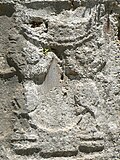 |
Hurrian44 | The Hurrian term referring to the deified Earth and Heaven was eše hawurni.44 The worship of this concept is attested in sources from all areas inhabited by the Hurrians, similar to the major deities such as Teššub,77 but there is no indication that Earth and Heaven were regarded as personified deities themselves.44 |
Deities assumed to have Hurrian origin
| Name | Image | Pantheon | Details |
|---|---|---|---|
| Hahharnum and Hayyashum | Mesopotamian281 | Hahharnum (Ḫamurnu) and Hayyashum were the Mesopotamian reflection of the Hurrian deified Heaven and Earth.282 They appear as a pair of primordial deities in a small number of texts,281282 for example in the myth Theogony of Dunnu.283 Hahharnum is also attested alone in the god list Anšar = Anum which equates him with Anu.281 | |
| Ḫiriḫibi284 | Ugaritic285 | Ḫiriḫibi (Ḫrḫb) is a god only known from the Ugaritic myth Marriage of Nikkal and Yarikh.285 He is assumed to have Hurrian origin,285 which is also proposed for the myth itself.286 It is possible that his name means "he of the mountain Ḫiriḫ(i)," and that it ends with suffix -bi (Ḫiriḫ(i)bi), similar to these of Hurrian deities Kumarbi and Nabarbi.284 | |
| Kašku | Hattic40 | It has been suggested that the presumed name of the Hattic moon god Kašku might be the evidence of early contact between the speakers of Hattic and Hurrian, as it resembles the name of Kušuḫ.40 However, it has been recently proposed that the correct reading of the name is Kab, rather than Kašku.53 | |
| Maḏḏara | Ugaritic287 | It has been proposed that the name of the deity Maḏḏara, who is only attested Ugaritic offering lists,288 might have Hurrian origin.287 This theory is based on the similarity between the syllabic writing of the name, dma-za-ra,289 and the Hurrian word maziri, "help."287 This proposal is not universally accepted.287 | |
| Pidar | Ugaritic290 | According to Manfred Krebernik, it is possible that the name of Pidar, an Ugaritic god associated with Baal, was derived from the Hurrian word pedari, "bull."290 It is also possible his name is connected with that of the goddess Pidray from the same pantheon.290 | |
| dSu-ra-su-gu-WA | Ugaritic291 | The name of the Ugaritic deity dSu-ra-su-gu-WA (reading of the final sign uncertain), only known from a single offering list, might be Hurrian in origin.291 | |
| Šala | 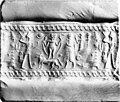 |
Mesopotamian292 | The name of Šala, a goddess who was the wife of the Mesopotamian weather god Adad, is assumed to be derived from the Hurrian word šāla, "daughter."292 She might also be attested in the treaty between Šuppiluliuma I and Šattiwaza,143 but according to Daniel Schwemer it is possible that this is a scribal mistake and the goddess meant there is instead Šalaš.293 |
| Šaraššiya | Ugaritic294 | Šaraššiya is only known from offering lists from Ugarit.294 His name is most likely derived from Hurrian šarašše-, "kingship."294 In Hurro-Hittite texts an essive form of this word, šaraššiya, "for kingship," functioned as a designation of offerings.294 It is assumed that the god Šaraššiya was a divine personification of kingship.294 | |
| Šiduri | Mesopotamian295 | Šiduri is the name assigned to an originally nameless divine alewife in the so-called "Standard Babylonian" version of the Epic of Gilgamesh.295 The etymology of her name is a matter of debate, but it is possible it was derived from the Hurrian word šiduri, "young woman."97 In Hurrian and Hittite translations of the Epic of Gilgamesh known from Hattusa, the alewife is named, Naḫmazulel or Naḫmizulen (an ordinary Hurrian given name), but she is described as a šiduri.296 Gary Beckman proposes that his was the origin of her name in the Standard Babylonian version.296 | |
| Tišpak | Mesopotamian297 | While many researchers today favor the view that Tishpak, the city god of Eshnunna, had Elamite origin,298297 the possibilities that he was either derived directly from Teššub104 or an Elamite reflection of him have also been proposed.299 | |
| Umbidaki | Mesopotamian194 | Umbidaki was a god worshiped in the temple of Ishtar of Arbela in Neo-Assyrian times who might have been derived from Nupatik, possibly introduced to this city after a war which led to Assyrians acquiring a statue of him.194 |
References
References
- Wilhelm 1989, p. 49.
- Archi 2002, p. 31.
- Archi 1997, pp. 417–418.
- Taracha 2009, p. 120.
- Wilhelm 1989, p. 63.
- Wilhelm 1989, p. 67.
- Taracha 2009, p. 93.
- Taracha 2009, p. 118.
- Wilhelm 1989, p. 78.
- Feliu 2003, p. 300.
- Wilhelm 1989, p. 51.
- Archi 2013, pp. 7–8.
- Tugendhaft 2016, p. 177.
- Taracha 2009, pp. 94–95.
- Archi 2013, p. 7.
- Wilhelm 1989, p. 50.
- Archi 2013, p. 8.
- Schwemer 2008, p. 3.
- Schwemer 2008, p. 4.
- Archi 2013, p. 12.
- Taracha 2009, p. 92.
- Trémouille 2011, p. 99.
- Trémouille 2011, p. 100.
- Trémouille 2011, p. 102.
- Archi 2009, p. 214.
- Trémouille 2011, pp. 100–101.
- Trémouille 2011, p. 101.
- Wilhelm 1989, p. 52.
- Archi 2013, p. 1.
- Taracha 2009, p. 127.
- Archi 2004, p. 319.
- Feliu 2003, p. 282.
- Schwemer 2008, pp. 5–6.
- Wilhelm 1997, p. 498.
- Archi 2013, p. 9.
- Schwemer 2008, p. 22.
- Pardee 2002, p. 279.
- Schwemer 2008, pp. 13–14.
- Wilhelm 1989, pp. 55–56.
- Wilhelm 1989, p. 53.
- Giorgieri 2011, pp. 614–615.
- Giorgieri 2011, p. 614.
- Taracha 2009, p. 89.
- Wilhelm 1989, p. 57.
- Haas 2015, p. 374.
- Haas 2015, p. 545.
- Trémouille 2000, p. 126.
- Archi 2013, p. 10.
- Pardee 2002, p. 281.
- Taracha 2009, p. 110.
- Schwemer 2008, p. 6.
- Archi 1993, p. 28.
- Schwemer 2022, p. 374.
- Giorgieri 2014, p. 333.
- Sharlach 2002, p. 99.
- Archi 2013, p. 6.
- Archi 2013a, pp. 16–17.
- Archi 2013a, p. 17.
- Taracha 2009, p. 124.
- Krebernik 2013, p. 205.
- Hoffner 1998, p. 67.
- Wilhelm 1989, p. 55.
- Taracha 2009, p. 122.
- Archi 2002, p. 32.
- Archi 2002, p. 33.
- Archi 2002, p. 28.
- Archi 2002, pp. 27–28.
- Taracha 2009, pp. 123–124.
- Archi 1993, p. 33.
- Pardee 2002, p. 278.
- Wilhelm 1989, p. 54.
- Archi 1993, p. 30.
- Wilhelm 1989, pp. 54–55.
- Schwemer 2001, p. 547.
- Archi 2013a, p. 13.
- Archi 2013, pp. 6–7.
- Taracha 2009, p. 119.
- Archi 2013a, p. 125.
- Archi 2013a, p. 14.
- Archi 2013a, p. 15.
- Archi 2013a, p. 18.
- Taracha 2009, p. 128.
- Archi 2013, p. 19.
- Taracha 2009, p. 121.
- Wilhelm 2014a, p. 305.
- Archi 2013, p. 11.
- Krebernik 2013, p. 201.
- Pardee 2002, p. 282.
- Wilhelm 2014, p. 46.
- Deiner 1976, p. 34.
- Haas 2015, p. 318.
- Taracha 2009, p. 67.
- Schwemer 2001, p. 483.
- Schwemer 2008, pp. 6–7.
- Archi 2013, p. 15.
- Taracha 2009, p. 94.
- George 2003, p. 149.
- Haas 2015, p. 392.
- Archi 2013, p. 16.
- Schwemer 2001, p. 535.
- Schwemer 2001, p. 544.
- Wilhelm 1989, p. 62.
- Schwemer 2001, p. 448.
- Archi 2009, p. 212.
- Pardee 2002, p. 275.
- Archi 2013, pp. 15–16.
- Ayali-Darshan 2014, p. 98.
- Archi 2002, p. 22.
- Simons 2017, p. 83.
- Cavigneaux & Krebernik 1998, p. 475.
- Matthews & Eidem 1993, p. 203.
- Pardee 2002, p. 277.
- Válek 2021, p. 53.
- Bonechi 1998, p. 78.
- Krebernik 2013b, p. 398.
- Beal 2002, p. 197.
- Miller 2008, p. 67.
- Beckman 1999, p. 30.
- Beal 2002, p. 201.
- Miller 2008, p. 68.
- Otten 1980, p. 23.
- Sharlach 2002, p. 104.
- Feliu 2003, p. 55.
- Sharlach 2002, p. 114.
- Haas 2015, p. 364.
- Kammenhuber 1972, p. 370.
- Haas 2015, p. 170.
- Kammenhuber 1972, p. 369.
- Archi 2004, p. 330.
- Haas 2015, p. 409.
- Frantz-Szabó 1980, p. 74.
- Archi 2013, p. 14.
- Rutherford 2019, p. 83.
- Rutherford 2019, p. 84.
- Haas 2015, p. 309.
- Archi 2013, p. 13.
- Beckman 1998, p. 2.
- Archi 2009, p. 217.
- Marchesi & Marchetti 2019, pp. 528–529.
- Marchesi & Marchetti 2019, p. 528.
- Archi 2009, p. 218.
- Beckman 2002, p. 45.
- Haas 2015, p. 543.
- Peterson 2009, p. 89.
- Rutherford 2001, p. 600.
- Dijkstra 2012, p. 69.
- Hoffner 1998, p. 51.
- Tugendhaft 2011, p. 712.
- Rutherford 2001, pp. 603–604.
- Hoffner 1998, p. 41.
- Marchesi & Marchetti 2019, p. 532.
- Hawkins 1983, p. 257.
- Hawkins 1983, p. 258.
- Archi 2011, p. 7.
- Marchesi 2002, p. 163.
- Hutter 2017, pp. 119–120.
- Sallaberger 2018, p. 112.
- Sallaberger 2018, p. 114.
- Archi 2019, p. 44.
- Schwemer 2001, p. 384.
- Wilhelm 1992, p. 28.
- Taracha 2009, pp. 119–120.
- Haas 2015, p. 563.
- Haas 1982, p. 102.
- Pongratz-Leisten 2015, p. 71.
- Haas 2015, p. 849.
- Taracha 2009, p. 115.
- Taracha 2009, pp. 115–116.
- Taracha 2009, p. 138.
- Taracha 2009, p. 107.
- Haas 2015, p. 496.
- Krebernik 2013, p. 204.
- Stol 2014, p. 66.
- Krebernik 2013, pp. 203–204.
- Wilhelm 1989, p. 18.
- Ayali-Darshan 2014, p. 96.
- Archi 2013, p. 3.
- Beckman 2002, p. 51.
- Beckman 2002, p. 46.
- Archi 2014, p. 154.
- Archi 2015, p. 599.
- Archi 2014, pp. 154–155.
- Beckman 2002, p. 43.
- Archi 2009, p. 220.
- Frantz-Szabó 1998, p. 141.
- Wegner 1980, p. 83.
- Haas 2015, p. 347.
- Wegner 1980, p. 76.
- Wilhelm 2004, p. 104.
- Taracha 2009, pp. 127–128.
- Bachvarova 2013, p. 27.
- Frantz-Szabó 1983, p. 303.
- Westenholz 2004, pp. 15–16.
- MacGinnis 2020, p. 109.
- Frantz-Szabó 1983, p. 304.
- Frantz-Szabó & Gambaschidze 2005, p. 190.
- Archi 2013, pp. 8–9.
- Archi 2013, pp. 12–13.
- Haas 2015, p. 544.
- Archi 1990, p. 116.
- Taracha 2009, p. 99.
- Haas 2015, p. 416.
- Beckman 2002a, pp. 37–38.
- Beckman 1999, p. 25.
- Beckman 1999, p. 27.
- Beckman 2002a, p. 39.
- Beckman 1999, p. 28.
- Miller 2005, p. 577.
- Miller 2005, p. 576.
- Rutherford 2001, p. 602.
- Fales 2008, p. 521.
- Beckman 2002, p. 48.
- Fales 2008, p. 520.
- Krebernik 2008, p. 612.
- Kühne 2017, pp. 285–286.
- Kühne 2017, p. 286.
- Archi 2019, p. 41.
- Archi 2019, pp. 40–41.
- Archi 2004, p. 320.
- Archi 2013, pp. 14–15.
- Archi 2011, p. 11.
- Archi 2013, p. 5.
- Wilhelm 1989, p. 73.
- Archi 2013, pp. 5–6.
- Haas 2015, p. 337.
- Schwemer 2008, p. 7.
- Taracha 2009, pp. 118–119.
- Haas 2015, p. 387.
- Haas 2015, p. 390.
- Richter 2010, p. 522.
- Schwemer 2008, p. 5.
- Wegner 1980, pp. 82–83.
- Wegner 1980, p. 81.
- Wegner 1980, p. 82.
- Wilhelm 2013, p. 334.
- Trémouille 2013, p. 374.
- Schwemer 2001, p. 410.
- Wilhelm 2013a, p. 417.
- Wilhelm 2013a, pp. 417–418.
- Bachvarova 2013a, p. 173.
- Dijkstra 2014, p. 76.
- Haas 2006, p. 208.
- Trémouille 2013a, p. 476.
- Trémouille 2013a, p. 475.
- Beckman 2002, p. 49.
- Archi 2013, p. 21.
- Deiner 1976, p. 40.
- Trémouille 2014, p. 31.
- Beckman 1999, p. 37.
- Haas 2015, p. 377.
- Wiggermann 1998, p. 220.
- Wiggermann 1998, p. 216.
- Haas 2015, p. 367.
- Wilhelm 2014b, p. 335.
- Giorgieri 2014a, p. 439.
- Michel 2014, p. 440.
- Wilhelm 2014c, p. 346.
- Taracha 2009, p. 126.
- Archi 2013a, p. 11.
- Lambert 2013, p. 448.
- Archi 2009, p. 211.
- Beckman 2011, p. 27.
- Metcalf 2021, p. 155.
- Bachvarova 2013a, p. 159.
- Lambert 2013, p. 302.
- Beckman 2011, p. 26.
- Beckman 2011, p. 28.
- Wilhelm 2003, p. 395.
- Schwemer 2001, p. 450.
- Hoffner 1998, p. 48.
- Wilhelm 2011, p. 399.
- Hoffner 1998, p. 55.
- Haas 2015, p. 89.
- Hoffner 1998, p. 56.
- Feliu 2003, pp. 45–46.
- Archi 2004, p. 322.
- Archi 2004, p. 321.
- Polvani 2008, p. 619.
- Archi 2009, pp. 213–214.
- Archi 2013, p. 18.
- Lambert 2007, p. 169.
- Wiggermann 2011, p. 672.
- Lambert 2013, p. 389.
- Rahmouni 2008, p. 230.
- Wiggins 1998, p. 769.
- Wiggins 1998, p. 767.
- Vita 2007, p. 182.
- Pardee 2002, p. 280.
- Pardee 2002, p. 18.
- Krebernik 2005, p. 556.
- Krebernik 2013a, p. 327.
- Schwemer 2007, p. 148.
- Schwemer 2008a, p. 566.
- Schwemer 2008, p. 11.
- George 2003, pp. 148–149.
- Beckman 2003, p. 51.
- Stol 2014, p. 64.
- Krebernik 1998, p. 152.
- Westenholz 2010, p. 381.
Bibliography
- Archi, Alfonso (1990). "The Names of the Primeval Gods". Orientalia. 59 (2). GBPress - Gregorian Biblical Press: 114–129. ISSN 0030-5367. JSTOR 43075881. Retrieved 2022-03-11.
- Archi, Alfonso (1993). "The god Ea in Anatolia". Aspects of art and iconography: Anatolia and its neighbors. Studies in honor of Nimet Özgüç. Ankara: Türk Tarih Kurumu Basımevi. pp. 27–33. ISBN 975-95308-0-5. OCLC 31130911.
- Archi, Alfonso (1997). "Studies in the Ebla Pantheon II". Orientalia. 66 (4). GBPress - Gregorian Biblical Press: 414–425. ISSN 0030-5367. JSTOR 43078145. Retrieved 2022-03-09.
- Archi, Alfonso (2002). "Formation of the West Hurrian Pantheon: The Case of Išḫara". Recent Developments in Hittite Archaeology and History. Penn State University Press. pp. 21–34. doi:10.1515/9781575065267-003. ISBN 9781575065267.
- Archi, Alfonso (2004). "Translation of Gods: Kumarpi, Enlil, Dagan/NISABA, Ḫalki". Orientalia. 73 (4). GBPress - Gregorian Biblical Press: 319–336. ISSN 0030-5367. JSTOR 43078173. Retrieved 2022-03-31.
- Archi, Alfonso (2009). "Orality, Direct Speech and the Kumarbi Cycle". Altorientalische Forschungen. 36 (2). De Gruyter. doi:10.1524/aofo.2009.0012. ISSN 0232-8461. S2CID 162400642.
- Archi, Alfonso (2011). "The Gods of Ebla". Annual Report NINO and NIT 2010. Leiden, Istanbul: The Netherlands Institute for the Near East. Retrieved 2022-06-15.
- Archi, Alfonso (2013). "The West Hurrian Pantheon and Its Background". In Collins, B. J.; Michalowski, P. (eds.). Beyond Hatti: a tribute to Gary Beckman. Atlanta: Lockwood Press. ISBN 978-1-937040-11-6. OCLC 882106763.
- Archi, Alfonso (2013a). "The Anatolian Fate-Goddesses and their Different Traditions". Diversity and Standardization. De Gruyter. pp. 1–26. doi:10.1524/9783050057576.1. ISBN 978-3-05-005756-9.
- Archi, Alfonso (2014). "Aštata: A Case of Hittite Imperial Religious Policy". Journal of Ancient Near Eastern Religions. 14 (2). Brill: 141–163. doi:10.1163/15692124-12341260. ISSN 1569-2116.
- Archi, Alfonso (2015). Ebla and Its Archives. De Gruyter. doi:10.1515/9781614517887. ISBN 978-1-61451-716-0.
- Archi, Alfonso (2019). "Šamagan and the Mules of Ebla. Syrian Gods in Sumerian Disguise". Between Syria and the Highlands: studies in honor of Giorgio Buccellati & Marilyn Kelly-Buccellati. Rome: Arbor Sapientiae editore. ISBN 978-88-31341-01-1. OCLC 1137837171.
- Ayali-Darshan, Noga (2014). "The Role of Aštabi in the Song of Ullikummi and the Eastern Mediterranean "Failed God" Stories". Journal of Near Eastern Studies. 73 (1). University of Chicago Press: 95–103. doi:10.1086/674665. ISSN 0022-2968. S2CID 163770018.
- Bachvarova, Mary R. (2013). "Adapting Mesopotamian Myth in Hurro-Hittite Rituals at Hattuša: IŠTAR, the Underworld, and the Legendary Kings". In Collins, B. J.; Michalowski, P. (eds.). Beyond Hatti: a tribute to Gary Beckman. Atlanta: Lockwood Press. ISBN 978-1-937040-11-6. OCLC 882106763.
- Bachvarova, Mary R. (2013a). "The Hurro-Hittite Kumarbi Cycle". Gods, heroes, and monsters: a sourcebook of Greek, Roman, and Near Eastern myths. New York: Oxford University Press. ISBN 978-0-19-064481-9. OCLC 967417697.
- Beal, Richard H. (2002). "Dividing a God". In Mirecki, Paul; Meyer, Marvin (eds.). Magic and Ritual in the Ancient World. Religions in the Graeco-Roman World. Brill. ISBN 978-90-474-0040-0. Retrieved 2022-06-19.
- Beckman, Gary (1998). "Ištar of Nineveh Reconsidered". Journal of Cuneiform Studies. 50. American Schools of Oriental Research: 1–10. doi:10.2307/1360026. ISSN 0022-0256. JSTOR 1360026. S2CID 163362140. Retrieved 2022-06-28.
- Beckman, Gary (1999). "The Goddess Pirinkir and Her Ritual from Ḫattuša (CTH 644)". Ktèma: Civilisations de l'Orient, de la Grèce et de Rome antiques. 24 (1). PERSEE Program: 25–39. doi:10.3406/ktema.1999.2206. hdl:2027.42/77419. ISSN 0221-5896.
- Beckman, Gary (2002). "The Pantheon of Emar". Silva Anatolica: Anatolian studies presented to Maciej Popko on the occasion of his 65th birthday. Warsaw: Agade. hdl:2027.42/77414. ISBN 83-87111-12-0. OCLC 51004996.
- Beckman, Gary (2002a). "Babyloniaca Hethitica: The "babilili-Ritual" from Boǧazköy(CTH 718)". Recent Developments in Hittite Archaeology and History. Penn State University Press. pp. 35–42. doi:10.1515/9781575065267-004. hdl:2027.42/77465. ISBN 9781575065267. S2CID 140806448.
- Beckman, Gary (2003). "Gilgamesh in Ḫatti". Hittite Studies in Honor of Harry A. Hoffner Jr. on the Occasion of His 65th Birthday. Penn State University Press. pp. 37–58. doi:10.1515/9781575065434-006. hdl:2027.42/77471. ISBN 9781575065434.
- Beckman, Gary (2011). "Primordial Obstetrics. "The Song of Emergence" (CTH 344)". Hethitische Literatur: Überlieferungsprozesse, Textstrukturen, Ausdrucksformen und Nachwirken: Akten des Symposiums vom 18. bis 20. Februar 2010 in Bonn. Münster: Ugarit-Verlag. ISBN 978-3-86835-063-0. OCLC 768810899.
- Bonechi, Marco (1998). "On the Name of the Aleppo Kingdom at Ugarit" (PDF). Nouvelles Assyriologiques Brèves et Utilitaires (3).
- Cavigneaux, Antoine; Krebernik, Manfred (1998), "NIN-Nagar", Reallexikon der Assyriologie (in German), retrieved 2022-06-17
- Deiner, Karlheinz (1976). "Materialien zu den Lokalpanthea des Königreiches Arrapḫe". Orientalia. 45. GBPress - Gregorian Biblical Press: 33–45. ISSN 0030-5367. JSTOR 43074680. Retrieved 2022-06-19.
- Dijkstra, Meindert (2012). "Ishtar seduces the Sea-serpent. A New Join in the Epic of Hedammu (KUB 36, 56+95) and its meaning for the battle between Baal and Yam in Ugaritic Tradition". Ugarit-Forschungen. Band 43. Münster: Ugarit Verlag. ISBN 978-3-86835-086-9. OCLC 1101929531.
- Dijkstra, Meindert (2014). "The Hurritic Myth about Sausga of Nineveh and Hasarri (CTH 776.2)". Ugarit-Forschungen. Band 45. Münster: Ugarit Verlag. ISBN 978-3-86835-086-9. OCLC 1101929531.
- Fales, Frederick Mario (2008), "Saggar", Reallexikon der Assyriologie, retrieved 2022-06-14
- Feliu, Lluís (2003). The god Dagan in Bronze Age Syria. Leiden Boston, MA: Brill. ISBN 90-04-13158-2. OCLC 52107444.
- Frantz-Szabó, Gabrielle (1980), "Impaluri", Reallexikon der Assyriologie (in German), retrieved 2022-03-10
- Frantz-Szabó, Gabrielle (1983), "Kulitta, Ninatta und", Reallexikon der Assyriologie (in German), retrieved 2022-03-10
- Frantz-Szabó, Gabrielle (1998), "Namrazunna", Reallexikon der Assyriologie (in German), retrieved 2022-03-10
- Frantz-Szabó, Gabrielle; Gambaschidze, Maya (2005), "Pairra", Reallexikon der Assyriologie (in German), retrieved 2022-06-15
- George, Andrew R. (2003). The Babylonian Gilgamesh epic: introduction, critical edition and cuneiform texts. Oxford New York: Oxford University Press. ISBN 0-19-814922-0. OCLC 51668477.
- Giorgieri, Mauro (2011), "Sonnengott A. III. b. Hurritisch. Philologisch", Reallexikon der Assyriologie (in German), retrieved 2022-03-15
- Giorgieri, Mauro (2014), "Umpu", Reallexikon der Assyriologie (in German), retrieved 2022-06-21
- Giorgieri, Mauro (2014a), "Uršue/i", Reallexikon der Assyriologie (in German), retrieved 2022-06-21
- Haas, Volkert (2006). Die hethitische Literatur. Walter de Gruyter. doi:10.1515/9783110193794. ISBN 978-3-11-018877-6.
- Haas, Volkert (1982). Hethitische Berggötter und hurritische Steindämonen: Riten, Kulte und Mythen: eine Einführung in die altkleinasiatischen religiösen Vorstellungen. Kulturgeschichte der antiken Welt (in German). P. von Zabern. ISBN 978-3-8053-0542-6. Retrieved 2022-03-12.
- Haas, Volkert (1998), "Nabarbi", Reallexikon der Assyriologie (in German), retrieved 2022-03-08
- Haas, Volkert (2015) [1994]. Geschichte der hethitischen Religion. Handbook of Oriental Studies. Section 1: The Near and Middle East (in German). Brill. ISBN 978-90-04-29394-6. Retrieved 2022-03-08.
- Hawkins, John D. (1983), "Kubaba A. Philologisch · Kubaba A. Philological", Reallexikon der Assyriologie, retrieved 2022-06-15
- Hoffner, Harry (1998). Hittite myths. Atlanta, GA: Scholars Press. ISBN 0-7885-0488-6. OCLC 39455874.
- Hutter, Manfred (2017). "Kubaba in the Hittite Empire and the Consequences for her Expansion to Western Anatolia". Hittitology today: Studies on Hittite and Neo-Hittite Anatolia in Honor of Emmanuel Laroche's 100th Birthday. Institut français d'études anatoliennes. ISBN 978-2-36245-083-9. OCLC 1286359422.
- Kammenhuber, Annelies (1972), "Ḫešui, Ḫišue", Reallexikon der Assyriologie (in German), retrieved 2022-03-07
- Krebernik, Manfred (1998), "Nanšak", Reallexikon der Assyriologie (in German), retrieved 2022-06-15
- Krebernik, Manfred (2005), "Pidar", Reallexikon der Assyriologie (in German), retrieved 2022-06-27
- Krebernik, Manfred (2008), "Sam(a)nuḫa/u", Reallexikon der Assyriologie (in German), retrieved 2022-03-11
- Krebernik, Manfred (2013). "Jenseitsvorstellungen in Ugarit". In Bukovec, Predrag; Kolkmann-Klamt, Barbara (eds.). Jenseitsvorstellungen im Orient (in German). Verlag Dr. Kovač. ISBN 978-3-8300-6940-9. OCLC 854347204.
- Krebernik, Manfred (2013a), "dSu-ra-su-gu-WA", Reallexikon der Assyriologie (in German), retrieved 2022-06-27
- Krebernik, Manfred (2013b), "Tadmuštum", Reallexikon der Assyriologie, retrieved 2022-07-02
- Kühne, Hartmut (2017). "The Temple of Salmānu at Dūr-Katlimmu, Nergal of Hubšalum, and Nergal-ereš". At the Dawn of History. Penn State University Press. pp. 271–288. doi:10.1515/9781575064741-020. ISBN 9781575064741.
- Lambert, Wilfred G. (2007). "An Exotic Babylonian God-List". Studies presented to Robert D. Biggs, June 4, 2004. Chicago, Illinois: Oriental Institute of the University of Chicago. ISBN 978-1-885923-44-8. OCLC 67873765.
- Lambert, Wilfred G. (2013). Babylonian creation myths. Winona Lake, Indiana: Eisenbrauns. ISBN 978-1-57506-861-9. OCLC 861537250.
- MacGinnis, John (2020). "The gods of Arbail". In Context: the Reade Festschrift. Archaeopress Publishing Ltd. doi:10.2307/j.ctv1ddckv5.12. S2CID 234551379. Retrieved 2022-03-05.
- Marchesi, Gianni (2002). "On the Divine Name dBA.Ú". Orientalia. 71 (2). GBPress- Gregorian Biblical Press: 161–172. ISSN 0030-5367. JSTOR 43076783. Retrieved 2022-06-15.
- Marchesi, Gianni; Marchetti, Nicolò (2019). "The Deities of Karkemish in the Middle Bronze Age according to Glyptic and Textual Evidence". Pearls of the past : studies on Near Eastern art and archaeology in honour of Frances Pinnock. Münster: Zaphon. ISBN 978-3-96327-058-1. OCLC 1099837791.
- Matthews, Donald; Eidem, Jesper (1993). "Tell Brak and Nagar". Iraq. 55. British Institute for the Study of Iraq: 201–207. doi:10.2307/4200376. ISSN 0021-0889. JSTOR 4200376. S2CID 191403234. Retrieved 2022-06-17.
- Metcalf, Christopher (2021). "Tales of Kings and Cup-Bearers in History and Myth". Gods and Mortals in Early Greek and Near Eastern Mythology. Cambridge University Press. pp. 154–168. doi:10.1017/9781108648028.011. ISBN 9781108648028. S2CID 233538697.
- Michel, Cécile (2014), "Uršu(m) A. In mesopotamischen Quellen", Reallexikon der Assyriologie (in French), retrieved 2022-03-08
- Miller, Jared L. (2005), "Piša(i)šapḫi", Reallexikon der Assyriologie, retrieved 2022-03-10
- Miller, Jared L. (2008). "Setting Up the Goddess of the Night Separately". Anatolian interfaces: Hittites, Greeks, and their neighbours: proceedings of an International Conference on Cross-cultural Interaction, September 17-19, 2004, Emory University, Atlanta, GA. Oxford: Oxbow Books. ISBN 978-1-84217-270-4. OCLC 880878828.
- Otten, Heinrich (1980), "Ibrimuša", Reallexikon der Assyriologie (in German), retrieved 2022-03-08
- Pardee, Dennis (2002). Ritual and cult at Ugarit. Atlanta: Society of Biblical Literature. ISBN 978-90-04-12657-2. OCLC 558437302.
- Peterson, Jeremiah (2009). God lists from Old Babylonian Nippur in the University Museum, Philadelphia. Münster: Ugarit Verlag. ISBN 978-3-86835-019-7. OCLC 460044951.
- Polvani, Anna Maria (2008). "The god Eltara and the Theogony" (PDF). Studi micenei ed egeo-anatolici. 50 (1): 617–624. ISSN 1126-6651. Retrieved 2022-04-29.
- Pongratz-Leisten, Beate (2015). Religion and Ideology in Assyria. Studies in Ancient Near Eastern Records (SANER). De Gruyter. ISBN 978-1-61451-426-8. Retrieved 2022-03-12.
- Rahmouni, Aicha (2008). Divine epithets in the Ugaritic alphabetic texts. Leiden Boston: Brill. ISBN 978-90-474-2300-3. OCLC 304341764.
- Richter, Thomas (2010). "Ein Hurriter wird geboren... und benannt". In Becker, Jörg; Hempelmann, Ralph; Rehm, Ellen (eds.). Kulturlandschaft Syrien: Zentrum und Peripherie. Festschrift für Jan-Waalke Meyer (in German). Münster: Ugarit-Verlag. ISBN 978-3-86835-034-0. OCLC 587015618.
- Rutherford, Ian (2001). "The Song of the Sea (SA A-AB-BA SIR3). Thoughts on KUB 45.63". Akten des IV. Internationalen Kongresses für Hethitologie: Würzburg, 4.-8. Oktober 1999. Wiesbaden: Harrassowitz. ISBN 3-447-04485-3. OCLC 49721937.
- Rutherford, Ian (2019). "Gods of the Market Place". Economy of Religions in Anatolia and Northern Syria. Ugarit-Verlag. doi:10.2307/j.ctv1t4m1xv.11. S2CID 241875651.
- Sallaberger, Walther (2018). "Kura, Youthful Ruler and Martial City-God of Ebla". In Matthiae, Paolo; Pinnock, Frances; D’Andrea, Marta (eds.). Ebla and Beyond. Harrassowitz. doi:10.2307/j.ctvcm4f5r. ISBN 978-3-447-19744-1.
- Schwemer, Daniel (2001). Die Wettergottgestalten Mesopotamiens und Nordsyriens im Zeitalter der Keilschriftkulturen: Materialien und Studien nach den schriftlichen Quellen (in German). Wiesbaden: Harrassowitz. ISBN 978-3-447-04456-1. OCLC 48145544.
- Schwemer, Daniel (2007). "The Storm-Gods of the Ancient Near East: Summary, Synthesis, Recent Studies Part I" (PDF). Journal of Ancient Near Eastern Religions. 7 (2). Brill: 121–168. doi:10.1163/156921207783876404. ISSN 1569-2116.
- Schwemer, Daniel (2008). "The Storm-Gods of the Ancient Near East: Summary, Synthesis, Recent Studies: Part II". Journal of Ancient Near Eastern Religions. 8 (1). Brill: 1–44. doi:10.1163/156921208786182428. ISSN 1569-2116.
- Schwemer, Daniel (2008a), "Šāla A. Philologisch", Reallexikon der Assyriologie (in German), retrieved 2022-06-17
- Schwemer, Daniel (2022). "Religion and Power". Handbook of Hittite Empire. De Gruyter. pp. 355–418. doi:10.1515/9783110661781-009. ISBN 9783110661781.
- Sharlach, Tonia (2002). "Foreign Influences on the Religion of the Ur III Court". General studies and excavations at Nuzi 10/3. Bethesda, Md: CDL Press. ISBN 1-883053-68-4. OCLC 48399212.
- Simons, Frank (2017). "A New Join to the Hurro-Akkadian Version of the Weidner God List from Emar (Msk 74.108a + Msk 74.158k)". Altorientalische Forschungen. 44 (1). De Gruyter. doi:10.1515/aofo-2017-0009. ISSN 2196-6761. S2CID 164771112.
- Stol, Marten (2014), "Tišpak", Reallexikon der Assyriologie (in German), retrieved 2022-06-15
- Taracha, Piotr (2009). Religions of Second Millennium Anatolia. Harrassowitz. ISBN 978-3447058858.
- Trémouille, Marie-Claude (2000). "La religione dei Hurriti". La parola del passato: Rivista di studi antichi (in Italian). 55. Napoli: Gaetano Macchiaroli editore. ISSN 2610-8739.
- Trémouille, Marie-Claude (2011), "Šauška, Šawuška A. Philologisch", Reallexikon der Assyriologie (in French), retrieved 2022-03-08
- Trémouille, Marie-Claude (2013), "Šuwala", Reallexikon der Assyriologie (in French), retrieved 2022-03-08
- Trémouille, Marie-Claude (2013a), "Tašmišu", Reallexikon der Assyriologie (in French), retrieved 2022-03-08
- Trémouille, Marie-Claude (2014), "Tijabenti", Reallexikon der Assyriologie (in French), retrieved 2022-03-08
- Tugendhaft, Aaron (2011). "On ym and dA.AB.BA at Ugarit". Ugarit-Forschungen. Band 42. Münster: Ugarit Verlag. ISBN 978-3-86835-053-1. OCLC 1101873880.
- Tugendhaft, Aaron (2016). "Gods on clay: Ancient Near Eastern scholarly practices and the history of religions". In Grafton, Anthony; Most, Glenn W. (eds.). Canonical Texts and Scholarly Practices. Cambridge: Cambridge University Press. doi:10.1017/cbo9781316226728.009.
- Válek, František (2021). "Foreigners and Religion at Ugarit". Studia Orientalia Electronica. 9 (2): 47–66. doi:10.23993/store.88230. ISSN 2323-5209.
- Vita, Juan-Pablo (2007). "Two Hurrian Loanwords in Ugaritic Texts". Altorientalische Forschungen. 34 (1–2). De Gruyter. doi:10.1524/aofo.2007.34.12.185. ISSN 2196-6761. S2CID 161654316.
- Wegner, Ilse (1980). Gestalt und Kult der Ištar-Šawuška in Kleinasien (in German). Kevelaer Neukirchen-Vluyn: Butzon und Bercker Neukirchener Verlag. ISBN 3-7666-9106-6. OCLC 7807272.
- Westenholz, Joan Goodnick (2004). "The Old Akkadian Presence in Nineveh: Fact or Fiction". Iraq. 66. British Institute for the Study of Iraq: 7–18. doi:10.2307/4200552. ISSN 0021-0889. JSTOR 4200552. Retrieved 2022-06-28.
- Westenholz, Joan G. (2010). "Ninkarrak – an Akkadian goddess in Sumerian guise". Von Göttern und Menschen. BRILL. pp. 377–405. doi:10.1163/9789004187474_020. ISBN 9789004187481.
- Wiggermann, Frans A. M. (1998), "Nergal A. Philological", Reallexikon der Assyriologie, retrieved 2022-03-11
- Wiggermann, Frans A. M. (2011). "Agriculture as Civilization: Sages, Farmers, and Barbarians". Oxford Handbooks Online. Oxford University Press. pp. 662–689. doi:10.1093/oxfordhb/9780199557301.013.0031. ISBN 978-0199557301.
- Wiggins, Steve A. (1998). "What's in a name? Yarih at Ugarit". Ugarit-Forschungen (30): 761–780. ISSN 0342-2356. Retrieved 2022-03-05.
- Wilhelm, Gernot (1989). The Hurrians. Warminster, England: Aris & Phillips. ISBN 978-0-85668-442-5. OCLC 21036268.
- Wilhelm, Gernot (1992). "Zum eblaitischen Gott Kura". Vicino Oriente (in German). 8 (2). Retrieved 2022-03-12.
- Wilhelm, Gernot (1997), "Mušun(n)i, Mušni", Reallexikon der Assyriologie (in German), retrieved 2022-03-08
- Wilhelm, Gernot (2003). "König Silber und König Ḫidam". Hittite Studies in Honor of Harry A. Hoffner Jr. on the Occasion of His 65th Birthday. Penn State University Press. pp. 393–396. doi:10.1515/9781575065434-037. ISBN 9781575065434.
- Wilhelm, Gernot (2004). "Hurrian". In Woodard, Roger D. (ed.). The Cambridge Encyclopedia of the World's Ancient Languages. Cambridge: Cambridge University Press. ISBN 0-521-56256-2. OCLC 59471649.
- Wilhelm, Gernot (2011), "Šertapšuruḫi", Reallexikon der Assyriologie (in German), retrieved 2022-06-15
- Wilhelm, Gernot (2013), "Šuruḫḫe", Reallexikon der Assyriologie (in German), retrieved 2022-03-08
- Wilhelm, Gernot (2013a), "Takitu", Reallexikon der Assyriologie (in German), retrieved 2022-03-08
- Wilhelm, Gernot (2014), "Tilla B. Hethitisch, Hurritisch", Reallexikon der Assyriologie (in German), retrieved 2022-03-05
- Wilhelm, Gernot (2014a), "Ulamme", Reallexikon der Assyriologie (in German), retrieved 2022-03-23
- Wilhelm, Gernot (2014b), "Undurumma(n)", Reallexikon der Assyriologie (in German), retrieved 2022-03-23
- Wilhelm, Gernot (2014c), "Unterwelt, Unterweltsgottheiten C. In Anatolien", Reallexikon der Assyriologie (in German), retrieved 2022-06-14