 | |||||||||||||||||
| Designations | |||||||||||||||||
|---|---|---|---|---|---|---|---|---|---|---|---|---|---|---|---|---|---|
| Pronunciation | /ˈviːnəs/ ⓘ | ||||||||||||||||
Named after | Venus | ||||||||||||||||
| Adjectives | Venusian /vɪˈnjuːziən, -ʒən/,3 rarely Cytherean /sɪθəˈriːən/4 or Venerean / Venerian /vɪˈnɪəriən/5 | ||||||||||||||||
| Symbol |  | ||||||||||||||||
| Orbital characteristics67 | |||||||||||||||||
| Epoch J2000 | |||||||||||||||||
| Aphelion | 0.728213 AU (108.94 million km) | ||||||||||||||||
| Perihelion | 0.718440 AU (107.48 million km) | ||||||||||||||||
| 0.723332 AU (108.21 million km) | |||||||||||||||||
| Eccentricity | 0.0067728 | ||||||||||||||||
| |||||||||||||||||
| 583.92 days6 | |||||||||||||||||
Average orbital speed | 35.02 km/s | ||||||||||||||||
| 50.115° | |||||||||||||||||
| Inclination |
| ||||||||||||||||
| 76.680°8 | |||||||||||||||||
| 54.884° | |||||||||||||||||
| Satellites | None | ||||||||||||||||
| Physical characteristics | |||||||||||||||||
| |||||||||||||||||
| Flattening | 010 | ||||||||||||||||
| |||||||||||||||||
| Volume |
| ||||||||||||||||
| Mass |
| ||||||||||||||||
Mean density | 5.243 g/cm3 | ||||||||||||||||
| 8.87 m/s2 (0.904 g0) | |||||||||||||||||
| 10.36 km/s (6.44 mi/s)12 | |||||||||||||||||
| −116.75 d (retrograde)13
1 Venus solar day | |||||||||||||||||
| −243.0226 d (retrograde)14 | |||||||||||||||||
Equatorial rotation velocity | 1.81 m/s | ||||||||||||||||
| 2.64° (for retrograde rotation) 177.36° (to orbit)6note 1 | |||||||||||||||||
North pole right ascension | |||||||||||||||||
North pole declination | 67.16°16 | ||||||||||||||||
| Albedo | |||||||||||||||||
| Temperature | 232 K (−41 °C) (blackbody temperature)19 | ||||||||||||||||
| |||||||||||||||||
| Surface absorbed dose rate | 2.1×10⁻⁶ μGy/h20 | ||||||||||||||||
| Surface equivalent dose rate | 2.2×10⁻⁶ μSv/h 0.092–22 μSv/h at cloud level20 | ||||||||||||||||
| −4.92 to −2.9821 | |||||||||||||||||
| −4.422 | |||||||||||||||||
| 9.7″–66.0″6 | |||||||||||||||||
| Atmosphere6 | |||||||||||||||||
Surface pressure | 93 bar (9.3 MPa) 92 atm | ||||||||||||||||
| Composition by volume |
| ||||||||||||||||
| |||||||||||||||||
Venus is the second planet from the Sun. Similar in size and mass to Earth, Venus has no liquid water, and its atmosphere is far thicker and denser than that of any other rocky body in the Solar System. The atmosphere is composed mostly of carbon dioxide and has a thick cloud layer of sulfuric acid that spans the whole planet. At the mean surface level, the atmosphere reaches a temperature of 737 K (464 °C; 867 °F) and a pressure 92 times greater than Earth's at sea level, turning the lowest layer of the atmosphere into a supercritical fluid. From Earth, Venus is visible as a star-like point of light, appearing brighter than any other natural point of light in the sky,2324 as either the brightest "morning star" or "evening star".
Venus orbits closer to the Sun than the Earth does. The orbits of Venus and Earth make the two planets approach each other in synodic periods of 1.6 years. In the course of this, Venus comes closer to Earth than any other planet. In interplanetary spaceflight from Earth, Venus is frequently used as a waypoint for gravity assists, offering a faster and more economical route. Venus has no moons and a very slow retrograde rotation about its axis, a result of competing forces of solar tidal locking and differential heating of Venus's massive atmosphere. As a result, a Venusian day is 116.75 Earth days long, about half a Venusian solar year, which is 224.7 Earth days long.
Venus has a weak magnetosphere; lacking an internal dynamo, it is induced by the solar wind interacting with the atmosphere. Internally, Venus has a core, a mantle, and a crust. Internal heat escapes through active volcanism,2526 resulting in resurfacing, instead of plate tectonics. Venus may have had liquid surface water early in its history with a habitable environment,2728 before a runaway greenhouse effect evaporated any water and turned Venus into its present state.293031 There are atmospheric conditions at cloud layer altitudes that are the most similar ones to Earth in the Solar System and have been identified as possibly favourable for life on Venus, with potential biomarkers found in 2020, spurring new research and missions to Venus.
Throughout history humans across the globe have observed Venus and it has acquired particular importance in many cultures. With telescopes, the phases of Venus became discernible and, by 1613, were presented as decisive evidence disproving the then-dominant geocentric model and supporting the heliocentric model. Venus was visited for the first time in 1961 by Venera 1, which flew past the planet, achieving the first interplanetary spaceflight. The first data from Venus were returned during the second interplanetary mission, Mariner 2, in 1962. In 1967, the first interplanetary impactor, Venera 4, reached Venus, followed by the lander Venera 7 in 1970. As of 2025, Solar Orbiter is on its way to fly-by Venus in 2026, and the next mission planned to launch to Venus is the Venus Life Finder, scheduled for 2026 as well.
Physical characteristics


Venus is one of the four terrestrial planets in the Solar System, meaning that it is a rocky body like Earth. It is similar to Earth in size and mass and is often described as Earth's "sister" or "twin".32 Venus is very close to spherical due to its slow rotation.33 It has a diameter of 12,103.6 km (7,520.8 mi)—only 638.4 km (396.7 mi) less than Earth's—and its mass is 81.5% of Earth's, making it the third-smallest planet in the Solar System. Conditions on the surface of Venus differ radically from those on Earth because its dense atmosphere is 96.5% carbon dioxide, causing an intense greenhouse effect, with most of the remaining 3.5% being nitrogen.3435 The surface pressure is 9.3 megapascals (93 bars), and the average surface temperature is 737 K (464 °C; 867 °F), above the critical points of both major constituents and making the surface atmosphere a supercritical fluid of mainly supercritical carbon dioxide and some supercritical nitrogen.
Natural history
Formation
The rocky terrestrial planets including Venus are thought to have formed in 5 stages: dust settling, planetesimal formation, planetary embryos, giant impacts, and finally formation of atmospheres. Limited measurements from Venus have prevented a more detailed analysis of the formation timeline.36
Future
Venus is expected to be destroyed, along with Mercury, and possibly the Earth and the Moon, when the Sun becomes a red giant in approximately seven or eight billion years.37
Geography


The Venusian surface was a subject of speculation until some of its secrets were revealed by probes in the 20th century. Venera landers in 1975 and 1982 returned images of a surface covered in sediment and relatively angular rocks.39 The surface was mapped in detail by Magellan in 1990–91. There is evidence of extensive volcanism, and variations in the atmospheric sulphur dioxide may indicate that there are active volcanoes.4041

About 80% of the Venusian surface is covered by smooth, volcanic plains, consisting of 70% plains with wrinkle ridges and 10% smooth or lobate plains.42 Two highland "continents" make up the rest of its surface area, one lying in the planet's northern hemisphere and the other just south of the equator. The northern continent is called Ishtar Terra after Ishtar, the Babylonian goddess of love, and is about the size of Australia. The Maxwell Montes mountain range lies on Ishtar Terra. The southern continent is called Aphrodite Terra, after the Greek mythological goddess of love, and is the larger of the two highland regions at roughly the size of South America. A network of fractures and faults covers much of this area.43
There is recent evidence of lava flow on Venus (2024),44 such as flows on Sif Mons, a shield volcano, and on Niobe Planitia, a flat plain.25 There are visible calderas. The planet has few impact craters, demonstrating that the surface is relatively young, at 300–600 million years old.4546 Venus has some unique surface features in addition to the impact craters, mountains, and valleys commonly found on rocky planets. Among these are flat-topped volcanic features called "farra", which look somewhat like pancakes and range in size from 20 to 50 km (12 to 31 mi) across, and from 100 to 1,000 m (330 to 3,280 ft) high; radial, star-like fracture systems called "novae"; features with both radial and concentric fractures resembling spider webs, known as "arachnoids"; and "coronae", circular rings of fractures sometimes surrounded by a depression. These features are volcanic in origin.47
Most Venusian surface features are named after historical and mythological women.48 Exceptions are Maxwell Montes, named after James Clerk Maxwell, and highland regions Alpha Regio, Beta Regio, and Ovda Regio. The last three features were named before the current system was adopted by the International Astronomical Union, the body which oversees planetary nomenclature.49
The longitude of physical features on Venus is expressed relative to its prime meridian. The original prime meridian passed through the radar-bright spot at the centre of the oval feature Eve, located south of Alpha Regio.50 After the Venera missions were completed, the prime meridian was redefined to pass through the central peak in the crater Ariadne on Sedna Planitia.1051
The stratigraphically oldest tessera terrains have consistently lower thermal emissivity than the surrounding basaltic plains measured by Venus Express and Magellan, indicating a different, possibly a more felsic, mineral assemblage.3052 The mechanism to generate a large amount of felsic crust usually requires the presence of a water ocean and plate tectonics, implying that habitable condition existed on early Venus, with large bodies of water at some point.53 However, the nature of tessera terrains is far from certain.54
Studies reported in 2023 suggested for the first time that Venus may have had plate tectonics during ancient times and, as a result, may have had a more habitable environment, possibly one capable of sustaining life.2728 Venus has gained interest as a case for research into the development of Earth-like planets and their habitability.
Volcanism

Much of the Venusian surface appears to have been shaped by volcanic activity. Venus has several times as many volcanoes as Earth, and it has 167 large volcanoes that are over 100 km (60 mi) across. The only volcanic complex of this size on Earth is the Big Island of Hawaii.47: 154 More than 85,000 volcanoes on Venus have been identified and mapped.5556 This is not because Venus is more volcanically active than Earth, but because its crust is older and is not subject to the erosion processes active on Earth. Earth's oceanic crust is continually recycled by subduction at the boundaries of tectonic plates, and has an average age of about 100 million years,57 whereas the Venusian surface is estimated to be 300–600 million years old.4547
Several lines of evidence point to ongoing volcanic activity on Venus. Sulfur dioxide concentrations in the upper atmosphere dropped by a factor of 10 between 1978 and 1986, jumped in 2006, and again declined 10-fold.58 This may mean that levels were boosted several times by large volcanic eruptions.5960 It has been suggested that Venusian lightning (discussed below) could originate from volcanic activity (i.e. volcanic lightning). In January 2020, astronomers reported evidence suggesting that Venus is currently volcanically active, specifically the detection of olivine, a volcanic product that would weather quickly on the planet's surface.6162
This massive volcanic activity is fuelled by a hot interior, which models say could be explained by energetic collisions when the planet was young, as well as radioactive decay as in the case of the earth. Impacts would have had significantly higher velocity than on Earth, both because Venus moves faster due to its closer proximity to the Sun and because high-eccentricity objects colliding with the planet would have high speeds.63
In 2008 and 2009, the first direct evidence for ongoing volcanism was observed by Venus Express, in the form of four transient localized infrared hot spots within the rift zone Ganis Chasma,64a near the shield volcano Maat Mons. Three of the spots were observed in more than one successive orbit. These spots are thought to represent lava freshly released by volcanic eruptions.6566 The actual temperatures are not known, because the size of the hot spots could not be measured, but are likely to have been in the 800–1,100 K (527–827 °C; 980–1,520 °F) range, relative to a normal temperature of 740 K (467 °C; 872 °F).67 In 2023, scientists reexamined topographical images of the Maat Mons region taken by the Magellan orbiter. Using computer simulations, they determined that the topography had changed during an 8-month interval, and concluded that active volcanism was the cause.68
Craters

There are almost a thousand impact craters on Venus, evenly distributed across its surface. On other cratered bodies, such as Earth and the Moon, craters show a range of states of degradation. On the Moon, degradation is caused by subsequent impacts, whereas on Earth it is caused by wind and rain erosion. On Venus, about 85% of the craters are in pristine condition. The number of craters, together with their well-preserved condition, indicates the planet underwent a global resurfacing event 300–600 million years ago,4546 followed by a decay in volcanism.69 Whereas Earth's crust is in continuous motion, Venus is thought to be unable to sustain such a process. Without plate tectonics to dissipate heat from its mantle, Venus instead undergoes a cyclical process in which mantle temperatures rise until they reach a critical level that weakens the crust. Then, over a period of about 100 million years, subduction occurs on an enormous scale, completely recycling the crust.47
Venusian craters range from 3 to 280 km (2 to 174 mi) in diameter. No craters are smaller than 3 km, because of the effects of the dense atmosphere on incoming objects. Objects with less than a certain kinetic energy are slowed so much by the atmosphere that they do not create an impact crater.70 Incoming projectiles less than 50 m (160 ft) in diameter will fragment and burn up in the atmosphere before reaching the ground.71
Internal structure

Without data from reflection seismology or knowledge of its moment of inertia, little direct information has been available about the internal structure and geochemistry of Venus.72 The similarity in size and density between Venus and Earth suggests that they share a similar internal structure: a core, mantle, and crust. Like that of Earth, the Venusian core is most likely at least partially liquid because the two planets have been cooling at about the same rate,73 although a completely solid core cannot be ruled out.74 The slightly smaller size of Venus means pressures are 24% lower in its deep interior than Earth's.75 The predicted values for the moment of inertia based on planetary models suggest a core radius of 2,900–3,450 km.74 There is now an estimate of 3,500 km from the moment of inertia based on the rate of axial precession, measured between 2006 and 2020.1476
The crust of Venus is estimated to be 40 kilometers thick on average and at most 65 kilometers thick.77
The principal difference between the two planets is the lack of evidence for plate tectonics on Venus, possibly because its crust is too strong to subduct without water to make it less viscous. This results in reduced heat loss from the planet, preventing it from cooling and providing a likely explanation for its lack of an internally generated magnetic field.78 Instead, Venus may lose its internal heat in periodic major resurfacing events.45
Magnetic field and core

In 1967, Venera 4 found Venus's magnetic field to be much weaker than that of Earth. This magnetic field is induced by an interaction between the ionosphere and the solar wind,7980 rather than by an internal dynamo as in the Earth's core. Venus's small induced magnetosphere provides negligible protection to the atmosphere against solar and cosmic radiation.
The lack of an intrinsic magnetic field on Venus was surprising, given that it is similar to Earth in size and was expected to contain a dynamo at its core. A dynamo requires three things: a conducting liquid, rotation, and convection. The core is thought to be electrically conductive and, although its rotation is often thought to be too slow, simulations show it is adequate to produce a dynamo.8182 This implies that the dynamo is missing because of a lack of convection in Venus's core. On Earth, convection occurs in the liquid outer layer of the core because the bottom of the liquid layer is much higher in temperature than the top. On Venus, a global resurfacing event may have shut down plate tectonics and led to a reduced heat flux through the crust. This insulating effect would cause the mantle temperature to increase, thereby reducing the heat flux out of the core. As a result, no internal geodynamo is available to drive a magnetic field. Instead, the heat from the core is reheating the crust.83
One possibility is that Venus has no solid inner core,84 or that its core is not cooling, so that the entire liquid part of the core is at approximately the same temperature. Another possibility is that its core has already been completely solidified. The state of the core is highly dependent on the concentration of sulphur, which is unknown at present.83
Another possibility is that the absence of a large impact on Venus (contra the Earth's "Moon-forming" impact) left the core of Venus stratified from the core's incremental formation, and without the forces to initiate/sustain convection, and thus a "geodynamo".85
The weak magnetosphere around Venus means that the solar wind interacts directly with its outer atmosphere. Here, ions of hydrogen and oxygen are being created by the dissociation of water molecules due to ultraviolet radiation. The solar wind then supplies energy that gives some of these ions sufficient speed to escape Venus's gravity field. This erosion process results in a steady loss of low-mass hydrogen, helium, and oxygen ions, whereas higher-mass molecules, such as carbon dioxide, are more likely to be retained. Atmospheric erosion by the solar wind could have led to the loss of most of Venus's water during the first billion years after it formed.86 However, the planet may have retained a dynamo for its first 2–3 billion years, so the water loss may have occurred more recently.87 The erosion has increased the ratio of higher-mass deuterium to lower-mass hydrogen in the atmosphere 100 times compared to the rest of the solar system.88
Atmosphere and climate

Venus has a dense atmosphere composed of 96.5% carbon dioxide, 3.5% nitrogen—both exist as supercritical fluids at the planet's surface with a density 6.5% that of water89—and traces of other gases including sulphur dioxide.90 The mass of its atmosphere is 92 times that of Earth's, whereas the pressure at its surface is about 93 times that at Earth's—a pressure equivalent to that at a depth of nearly 1 km (5⁄8 mi) under Earth's ocean surfaces. The density at the surface is 65 kg/m3 (4.1 lb/cu ft), 6.5% that of water89 or 50 times as dense as Earth's atmosphere at 293 K (20 °C; 68 °F) at sea level. The CO2-rich atmosphere generates the strongest greenhouse effect in the Solar System, creating surface temperatures of at least 735 K (462 °C; 864 °F).9192 This makes the Venusian surface hotter than Mercury's,93 even though Venus is nearly twice Mercury's distance from the Sun and thus receives only around a quarter of Mercury's solar irradiance, of 2,600 W/m2 (double that of Earth).6 Because of its runaway greenhouse effect, Venus has been identified by scientists such as Carl Sagan as a warning and research object linked to climate change on Earth.94 Therefore, Venus has been called a greenhouse planet,95 a planet under a greenhouse inferno.96
Venus's atmosphere is rich in primordial noble gases compared to that of Earth.97 This enrichment indicates an early divergence from Earth in evolution. An unusually large comet impact98 or accretion of a more massive primary atmosphere from the solar nebula99 have been proposed to explain the enrichment. However, the atmosphere is poor in radiogenic argon-40, a proxy for mantle degassing, suggesting an early shutdown of major magmatism.100101
Studies have suggested that billions of years ago, the atmosphere of Venus may have been much more like the one surrounding the early Earth, and there may have been substantial quantities of liquid water on the surface.102103104 After a period of 600 million to several billion years,105 the rising luminosity of the Sun and possibly large volcanic resurfacing caused the evaporation of the original water.106 A runaway greenhouse effect was created once a critical level of greenhouse gases (including water) was reached in the atmosphere.107

Thermal inertia and the transfer of heat by winds in the lower atmosphere mean that the surface temperature does not vary significantly between the hemispheres facing and not facing the Sun, despite Venus's slow rotation. Winds at the surface are slow, moving at a few kilometres per hour, but because of the high density of the atmosphere at the surface, they exert a significant amount of force against obstructions, and transport dust and small stones across the surface. This alone would make it difficult for a human to walk through, even without the heat, pressure, and lack of oxygen.108
Above the dense CO2 layer are thick clouds 45 to 70 km above the surface,109 consisting mainly of sulphuric acid, which is formed by a reaction catalyzed by UV radiation from sulphur dioxide molecules and then water,110 resulting in sulphuric acid hydrate.111 Additionally, the clouds contain approximately 1% ferric chloride.112113 Other possible constituents of the cloud particles are ferric sulfate, aluminium chloride and phosphoric anhydride. Clouds at different levels have different compositions and particle size distributions.112 These clouds cover the whole planet and prevent visual observation of the surface.114 The dense atmosphere and highly reflective clouds gives it a high albedo of 0.68, meaning it reflects nearly 70% of the incident sunlight.11517 The permanent cloud cover means that although Venus is closer than Earth to the Sun, it receives less sunlight on the ground, with only 10% of the received sunlight reaching the surface,116 resulting in average daytime levels of illumination at the surface of 14,000 lux, comparable to that on Earth "in the daytime with overcast clouds".117
Venus's atmosphere rotates much faster than its solid body, a phenomenon known as atmospheric super-rotation.118 This results in strong 300 km/h (185 mph) winds at the cloud tops, which complete a full rotation around the planet in about 4 days, corresponding to 60 times the speed of the planet's rotation,119 whereas Earth's strongest winds reach only 10–20% of its rotational speed.
Although Venus looks featureless in visible light, there are bands or streaks in the UV, whose origin has not been pinned down. The absorption of UV may be due to a compound of oxygen and sulfur, OSSO, which has a double bond between the sulfur atoms and exists in "cis" and "trans" forms, or due to polysulfur compounds from S2 to S8.120
| Location | Surface temperature |
|---|---|
| Deep depressions | ~750 K (477 °C) |
| Average | ~740 K (467 °C) |
| atop Maxwell Montes | ~650 K (377 °C) |
The surface of Venus is effectively isothermal; it retains a constant temperature not only between the two hemispheres but between the equator and the poles.6122 Venus's minute axial tilt—less than 3°, compared to 23° on Earth—also minimizes seasonal temperature variation.123 Altitude is one of the few factors that affect Venusian temperatures; in particular, the coolest points occur at the highest-altitude points, such as the mountain peaks of the Maxwell Montes range.121124 In 1995, the Magellan spacecraft imaged a highly reflective substance at the tops of the highest mountain peaks, a "Venus snow" that bore a strong resemblance to terrestrial snow. This substance likely formed by a similar process to snow, albeit at a far higher temperature. Too volatile to condense on the surface, it rose in gaseous form to higher elevations, where it is cooler and could precipitate. The identity of this substance is not known with certainty, but speculation has ranged from elemental tellurium to lead sulfide (galena).125
Although Venus has no seasons, in 2019 astronomers identified a cyclical variation in sunlight absorption by the atmosphere, possibly caused by opaque, absorbing particles suspended in the upper clouds. The variation causes observed changes in the speed of Venus's zonal winds and appears to rise and fall in time with the Sun's 11-year sunspot cycle.126
The existence of lightning in the atmosphere of Venus has been controversial127 since the first suspected bursts were detected by the Soviet Venera probes.128129130 In 2006–07, Venus Express clearly detected whistler mode waves, the signatures of lightning. Their intermittent appearance indicates a pattern associated with weather activity. According to these measurements, the lightning rate is at least half that on Earth,131 however other instruments have not detected lightning at all.127 The origin of any lightning remains unclear, but could originate from clouds or Venusian volcanoes.
In 2007, Venus Express discovered that a huge double atmospheric polar vortex exists at the south pole.132133 Venus Express discovered, in 2011, that an ozone layer exists high in the atmosphere of Venus.134 In 2013 ESA scientists reported that the ionosphere of Venus streams outwards in a manner similar to "the ion tail seen streaming from a comet under similar conditions."135136
In December 2015, and to a lesser extent in April and May 2016, researchers working on Japan's Akatsuki mission observed bow-shaped objects in the atmosphere of Venus. This was considered direct evidence of the existence of perhaps the largest stationary gravity waves in the solar system.137138139
Colour and sound140 of the atmosphere at the surface have been recorded, with the sky having an orange-yellow colour, while at higher altitudes being white.141
Orbit and rotation

Venus orbits the Sun at an average distance of about 0.72 AU (108 million km; 67 million mi), and completes an orbit every 224.7 days. It completes 13 orbits in 7.998 years, so its position in our sky almost repeats every eight years. Although all planetary orbits are elliptical, Venus's orbit is currently the closest to circular, with an eccentricity of less than 0.01.6 Simulations of the early solar system orbital dynamics have shown that the eccentricity of the Venus orbit may have been substantially larger in the past, reaching values as high as 0.31 and possibly impacting early climate evolution.142

Venus has retrograde rotation, meaning that unlike most planets including Earth it rotates clockwise around its own axis, opposite to its anticlockwise rotation around the Sun. Therefore, Venusian sidereal day, 243 Earth days, lasts longer than a Venusian year, 224.7 Earth days. If Venus were tidally locked to the Sun, it would always have the same face pointed to the Sun and its sidereal day would be 224.7 days. However, Venus's atmosphere is massive and it is close to the Sun, so differential heating of the atmosphere gives Venus a small retrograde rotation. The day length also fluctuates by up to 20 minutes for the same reason.143144 Venus's rotation period measured with Magellan spacecraft data over a 500-day period is smaller than the rotation period measured during the 16-year period between the Magellan spacecraft and Venus Express visits, with a difference of about 6.5 minutes.145 Because of the retrograde rotation, the length of a solar day on Venus is significantly shorter than the sidereal day, at 116.75 Earth days.13 One Venusian year is about 1.92 Venusian solar days.146 To an observer on the surface of Venus, the Sun would rise in the west and set in the east,146 although Venus's opaque clouds prevent observing the Sun from the planet's surface.147
Venus may have formed from the solar nebula with a different rotation period and obliquity, reaching its current state because of chaotic spin changes caused by planetary perturbations and tidal effects on its dense atmosphere, a change that would have occurred over the course of billions of years. The rotation period of Venus may represent an equilibrium state between tidal locking to the Sun's gravitation, which tends to slow rotation, and an atmospheric tide created by solar heating of the thick Venusian atmosphere.148149 The 584-day average interval between successive close approaches to Earth is almost exactly equal to 5 Venusian solar days (5.001444 to be precise),150 but the hypothesis of a spin-orbit resonance with Earth has been discounted.151
Venus has no natural satellites.152 It has several trojan asteroids: the quasi-satellite 524522 Zoozve153154 and two other temporary trojans, 2001 CK32 and 2012 XE133.155 In the 17th century, Giovanni Cassini reported a moon orbiting Venus, which was named Neith and numerous sightings were reported over the following 200 years, but most were determined to be stars in the vicinity. Alex Alemi's and David Stevenson's 2006 study of models of the early Solar System at the California Institute of Technology shows Venus likely had at least one moon created by a huge impact event billions of years ago.156 About 10 million years later, according to the study, another impact reversed the planet's spin direction and the resulting tidal deceleration caused the Venusian moon gradually to spiral inward until it collided with Venus.157 If later impacts created moons, these were removed in the same way. An alternative explanation for the lack of satellites is the effect of strong solar tides, which can destabilize large satellites orbiting the inner terrestrial planets.152
The orbital space of Venus has a dust ring-cloud,158 with a suspected origin either from Venus–trailing asteroids,159 interplanetary dust migrating in waves, or the remains of the Solar System's original circumstellar disc that formed the planetary system.160
Orbit in respect to Earth

Earth and Venus have a near orbital resonance of 13:8 (Earth orbits eight times for every 13 orbits of Venus).161 Therefore, they approach each other and reach inferior conjunction in synodic periods of 584 days, on average.6 The path that Venus makes in relation to Earth viewed geocentrically draws a pentagram over five synodic periods, shifting every period by 144°. This pentagram of Venus is sometimes referred to as the petals of Venus due to the path's visual similarity to a flower.162
When Venus lies between Earth and the Sun in inferior conjunction, it makes the closest approach to Earth of any planet, at an average distance of 41 million km (25 million mi).6163 Because of the decreasing eccentricity of Earth's orbit, the minimum distances will become greater over tens of thousands of years. From the year 1 to 5383, there are 526 approaches less than 40 million km (25 million mi); then, there are none for about 60,158 years.164
While Venus approaches Earth the closest, Mercury is more often the closest to Earth of all planets and to any other planet.165166 Venus has been used as a waypoint for gravity assist manoeuvres, which has been identified as a faster and economic way to travel to Mercury,167168 the Sun,169 asteroids,170 Mars,171 Jupiter and beyond.172173
Tidally Venus exerts the third strongest tidal force on Earth, after the Moon and the Sun, though significantly less.174
Observability

To the naked eye, Venus appears as a white point of light with a maximum apparent magnitude of −4.92 brighter than any other planet or star apart from the Sun,175 even when faintest during its transit with an apparent magnitude of −2.98.21 The planet's mean apparent magnitude is −4.14 with a standard deviation of 0.31.21 The brightest magnitude occurs during the crescent phase about one month before or after an inferior conjunction. Venus fades to about magnitude −3 when it is backlit by the Sun, although the exact value depends on the phase angle.176 The planet is bright enough to be seen in broad daylight,177 but is more easily visible when the Sun is low on the horizon or setting. As an inferior planet, it always lies within about 47° of the Sun.178
Venus "overtakes" Earth every 584 days as it orbits the Sun.6 As it does so, it changes from the "Evening Star", visible after sunset, to the "Morning Star", visible before sunrise. Although Mercury, the other inferior planet, reaches a maximum elongation of only 28° and is often difficult to discern in twilight, Venus is hard to miss when it is at its brightest. Its greater maximum elongation means it is visible in dark skies long after sunset. As the brightest point-like object in the sky, Venus is a commonly misreported "unidentified flying object".179
Because Venus comes close to the earth at inferior conjunction and has an orbit inclined to the plane of the earth's orbit, it can appear more than 8° north or south of the ecliptic, more than any other planet or the moon. Every eight years around March it appears this far north of the ecliptic, in Pisces (such as in mid-March 2025), and every eight years it appears this far south of the ecliptic in August or September in Virgo (as in late August 2023). Venus can thus be north of the sun and appear as a morning star and an evening star on the same day, in the northern hemisphere. The timing of these north or south excursions becomes slowly earlier in the year, and over thirty cycles (240 years) the cycle is gradually replaced by another cycle offset by three years, so the situation returns close to the original situation after 243 orbits of Earth, 395 of Venus.180
Lunar occultations of Venus, in which the moon blocks the view of Venus for observers in certain parts of the earth, occur on average about twice a year, sometimes several times in a year (though rarely).
Phases

As it orbits the Sun, Venus displays phases like those of the Moon in a telescopic view. The planet appears as a small and "full" disc when it is on the opposite side of the Sun (at superior conjunction). Venus shows a larger disc and "quarter phase" at its maximum elongations from the Sun, and appears at its brightest in the night sky. The planet presents a much larger thin "crescent" in telescopic views as it passes along the near side between Earth and the Sun. Venus displays its largest size and "new phase" when it is between Earth and the Sun (at inferior conjunction). Its atmosphere is visible through telescopes by the halo of sunlight refracted around it.178 The phases are clearly visible in a 4" telescope.181 Although naked eye visibility of Venus's phases is disputed, records exist of observations of its crescent.182
Daylight apparitions

When Venus is sufficiently bright with enough angular distance from the sun, it is easily observed in a clear daytime sky with the naked eye, though most people do not know to look for it.183 Astronomer Edmund Halley calculated its maximum naked eye brightness in 1716, when many Londoners were alarmed by its appearance in the daytime. French emperor Napoleon Bonaparte once witnessed a daytime apparition of the planet while at a reception in Luxembourg.184 Another historical daytime observation of the planet took place during the inauguration of the American president Abraham Lincoln in Washington, D.C., on 4 March 1865.185
Transits

A transit of Venus is the appearance of Venus in front of the Sun, during inferior conjunction. Since the orbit of Venus is slightly inclined relative to Earth's orbit, most inferior conjunctions with Earth, which occur every synodic period of 1.6 years, do not produce a transit of Venus. Consequently, Venus transits only occur when an inferior conjunction takes place during some days of June or December, when the orbits of Venus and Earth cross a straight line with the Sun.186 This results in Venus transiting above Earth in a sequence currently of 8 years, 105.5 years, 8 years and 121.5 years, forming cycles of 243 years.
Historically, transits of Venus were important, because they allowed astronomers to determine the size of the astronomical unit, and hence the size of the Solar System as shown by Jeremiah Horrocks in 1639 with the first known observation of a Venus transit (after history's first observed planetary transit in 1631, of Mercury).187
Only seven Venus transits have been observed so far, since their occurrences were calculated in 1621 by Johannes Kepler. Captain Cook sailed to Tahiti in 1768 to record the third observed transit of Venus, which subsequently resulted in the exploration of the east coast of Australia.188189
The latest pair was 8 June 2004 and 5–6 June 2012. The transit could be watched live from many online outlets or observed locally with the right equipment and conditions.190 The preceding pair of transits occurred in December 1874 and December 1882.
The next transit will occur in December 2117 and December 2125.191
Ashen light

A long-standing mystery of Venus observations is the so-called ashen light—an apparent weak illumination of its dark side, seen when the planet is in the crescent phase. The first claimed observation of ashen light was made in 1643, but the existence of the illumination has never been reliably confirmed. Observers have speculated it may result from electrical activity in the Venusian atmosphere, but it could be illusory, resulting from the physiological effect of observing a bright, crescent-shaped object.194129 The ashen light has often been sighted when Venus is in the evening sky, when the evening terminator of the planet is towards Earth.
Observation and exploration history
Early observation
Venus is in Earth's sky bright enough to be visible without aid, making it one of the classical planets that human cultures have known and identified throughout history, particularly for being the third brightest object in Earth's sky after the Sun and the Moon. Because the movements of Venus appear to be discontinuous (it disappears due to its proximity to the sun, for many days at a time, and then reappears on the other horizon), some cultures did not recognize Venus as a single entity;195 instead, they assumed it to be two separate stars on each horizon: the morning and evening star.195 Nonetheless, a cylinder seal from the Jemdet Nasr period and the Venus tablet of Ammisaduqa from the First Babylonian dynasty indicate that the ancient Sumerians already knew that the morning and evening stars were the same celestial object.196195197
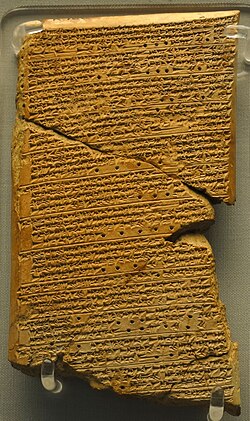
In the Old Babylonian period, the planet Venus was known as Ninsi'anna, and later as Dilbat.198 The name "Ninsi'anna" translates to "divine lady, illumination of heaven", which refers to Venus as the brightest visible "star". Earlier spellings of the name were written with the cuneiform sign si4 (= SU, meaning "to be red"), and the original meaning may have been "divine lady of the redness of heaven", in reference to the colour of the morning and evening sky.199
The Chinese historically referred to the morning Venus as "the Great White" (Tàibái 太白) or "the Opener (Starter) of Brightness" (Qǐmíng 啟明), and the evening Venus as "the Excellent West One" (Chánggēng 長庚).200
The ancient Greeks initially believed Venus to be two separate stars: Phosphorus, the morning star, and Hesperus, the evening star. Pliny the Elder credited the realization that they were a single object to Pythagoras in the sixth century BC,201 while Diogenes Laërtius argued that Parmenides (early fifth century) was probably responsible for this discovery.202 Though they recognized Venus as a single object, the ancient Romans continued to designate the morning aspect of Venus as Lucifer, literally "Light-Bringer", and the evening aspect as Vesper,203 both of which are literal translations of their traditional Greek names.
In the second century, in his astronomical treatise Almagest, Ptolemy theorized that both Mercury and Venus were located between the Sun and the Earth. The 11th-century Persian astronomer Avicenna claimed to have observed a transit of Venus (although there is some doubt about it),204 which later astronomers took as confirmation of Ptolemy's theory.205 In the 12th century, the Andalusian astronomer Ibn Bajjah observed "two planets as black spots on the face of the Sun"; these were thought to be the transits of Venus and Mercury by 13th-century Maragha astronomer Qotb al-Din Shirazi, though this cannot be true as there were no Venus transits in Ibn Bajjah's lifetime.206 Several claims of transit observations made by mediaeval Islamic astronomers have been shown to be sunspots.207
Venus and early modern astronomy
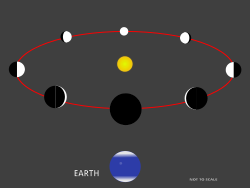
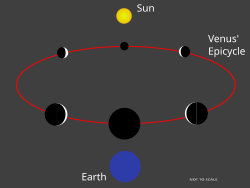
When the planet was first observed with a telescope in December 1610, by the Italian physicist Galileo Galilei, he found it showed phases like the Moon, varying from crescent to gibbous to full and vice versa. When Venus is furthest from the Sun in the sky, it shows a half-lit phase, and when it is closest to the Sun in the sky, it shows as a crescent or full phase. This could be possible only if Venus orbited the Sun, reported by Galileo in his 1613 Letters on Sunspots, becoming one of the first observations to clearly contradict the Ptolemaic geocentric model that the Solar System was concentric and centred on Earth.208209
The 1631 transit of Venus, while not recorded, was the first one successfully predicted, by Johannes Kepler and his calculations, which he published in 1629. The following 1639 transit of Venus was accurately predicted by Jeremiah Horrocks and observed by him and his friend, William Crabtree, at each of their respective homes, on 4 December 1639 (24 November under the Julian calendar in use at that time).210

The atmosphere of Venus was discovered in 1761 by Russian polymath Mikhail Lomonosov.211212 Venus's atmosphere was observed in 1790 by German astronomer Johann Schröter. Schröter found when the planet was a thin crescent, the cusps extended through more than 180°. He correctly surmised this was due to scattering of sunlight in a dense atmosphere. Later, American astronomer Chester Smith Lyman observed a complete ring around the dark side of the planet when it was at inferior conjunction, providing further evidence for an atmosphere.213 The atmosphere complicated efforts to determine a rotation period for the planet, and observers such as Italian-born astronomer Giovanni Cassini and Schröter incorrectly estimated periods of about 24 h from the motions of markings on the planet's apparent surface.214

Early 20th century advances
Little more was discovered about Venus until the 20th century. Its almost featureless disc gave no hint what its surface might be like, and it was only with the development of spectroscopic and ultraviolet observations that more of its secrets were revealed.
The first ultraviolet observations were carried out in the 1920s, when Frank E. Ross found that ultraviolet photographs revealed considerable detail that was absent in visible and infrared radiation. He suggested this was due to a dense, yellow lower atmosphere with high cirrus clouds above it.215
It had been noted that Venus had no discernible oblateness in its disk, suggesting a slow rotation, and some astronomers concluded based on this that it was tidally locked like Mercury was believed to be at the time; but other researchers had detected a significant quantity of heat coming from the planet's nightside, suggesting a quick rotation (a high surface temperature was not suspected at the time), confusing the issue.216 Later work in the 1950s showed the rotation was retrograde.
First missions to Venus

The first interplanetary spaceflight attempt was in 1961 when the robotic space probe Venera 1 of the Soviet Venera programme flew to Venus. It lost contact en route.217
The first successful interplanetary mission, also to Venus, was Mariner 2 of the United States' Mariner programme, passing on 14 December 1962 at 34,833 km (21,644 mi) above the surface of Venus and gathering data on the planet's atmosphere.218219
Additionally radar observations of Venus were first carried out in the 1960s, and provided the first measurements of the rotation period, which were close to the actual value.220
Venera 3, launched in 1966, became humanity's first probe and lander to reach and impact another celestial body other than the Moon, but could not return data as it crashed into the surface of Venus. In 1967, Venera 4 was launched and successfully deployed science experiments in the Venusian atmosphere before impacting. Venera 4 showed the surface temperature was hotter than Mariner 2 had calculated, at almost 500 °C (932 °F), determined that the atmosphere was 95% carbon dioxide (CO
2), and discovered that Venus's atmosphere was considerably denser than Venera 4's designers had anticipated.221222
In an early example of space cooperation the data of Venera 4 was joined with the 1967 Mariner 5 data, analysed by a combined Soviet–American science team in a series of colloquia over the following year.223
On 15 December 1970, Venera 7 became the first spacecraft to soft land on another planet and the first to transmit data from there back to Earth.224
In 1974, Mariner 10 swung by Venus to bend its path towards Mercury and took ultraviolet photographs of the clouds, revealing the extraordinarily high wind speeds in the Venusian atmosphere. This was the first interplanetary gravity assist ever used, a technique which would be used by later probes.
Radar observations in the 1970s revealed details of the Venusian surface for the first time. Pulses of radio waves were beamed at the planet using the 300 m (1,000 ft) radio telescope at Arecibo Observatory, and the echoes revealed two highly reflective regions, designated the Alpha and Beta regions. The observations revealed a bright region attributed to mountains, which was called Maxwell Montes.225 These three features are now the only ones on Venus that do not have female names.49
In 1975, the Soviet Venera 9 and 10 landers transmitted the first images from the surface of Venus, which were in black and white. NASA obtained additional data with the Pioneer Venus project, consisting of two separate missions:226 the Pioneer Venus Multiprobe and Pioneer Venus Orbiter, orbiting Venus between 1978 and 1992.227 In 1982 the first monochrome colour filters images of the surface were obtained with the Soviet Venera 13 and 14 landers. After Venera 15 and 16 operated between 1983 and 1984 in orbit, conducting detailed mapping of 25% of Venus's terrain (from the north pole to 30°N latitude), the Soviet Venera programme came to a close.228


In 1985 the Soviet Vega programme with its Vega 1 and Vega 2 missions carried the last entry probes and carried the first ever extraterrestrial aerobots for the first time achieving atmospheric flight outside Earth by employing inflatable balloons.
Between 1990 and 1994, Magellan operated in orbit until deorbiting, mapping the surface of Venus. Furthermore, probes like Galileo (1990),229 and Cassini–Huygens (1998/1999) visited Venus with flybys en route to other destinations.
Renewed exploration
In April 2006, Venus Express, the first dedicated Venus mission by the European Space Agency (ESA), entered orbit around Venus. Venus Express provided unprecedented observation of Venus's atmosphere. ESA concluded the Venus Express mission in December 2014 deorbiting it in January 2015.230 The same and following year MESSENGER visited Venus with flybys en route to other destinations.
In 2010, the first successful interplanetary solar sail spacecraft IKAROS travelled to Venus for a flyby.
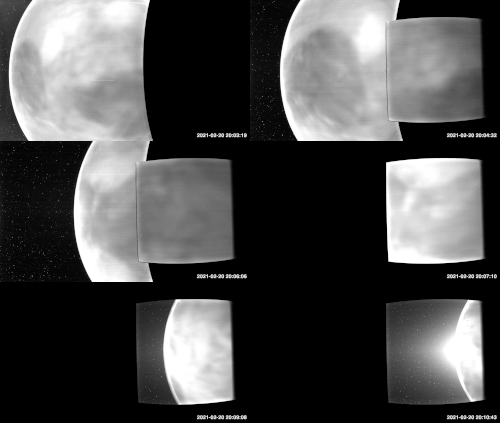
Between 2015 and 2024 Japan's Akatsuki probe was active in orbit around Venus and BepiColombo performed flybys in 2020/2021.
Active and planned missions

As of 2025 there are no active probes at Venus, with Parker Solar Probe scheduled to return repeatedly to Venus until 2030.
Several probes are under development as well as multiple proposed missions still in their early conceptual stages. The next Venus mission scheduled is the Venus Life Finder, expected to launch not earlier than summer 2026.
Indian ISRO is working on Venus Orbiter Mission, aiming to launch it in 2028. UAE mission to asteroids, MBR Explorer, will perform a flyby of the planet. NASA approved two missions to the planet, VERITAS and DAVINCI, planned to be launched not earlier than 2031. ESA plans to launch EnVision also in 2031.
A project by the MIT with the rocket company Rocket Lab aims to be the first private interplanetary space craft with a proposal to look for organics by entering the atmosphere of Venus with a probe named Venus Life Finder.233
Objectives
Venus has been identified for future research as an important case for understanding:
- the origins of the solar system and Earth, and if systems and planets like ours are common or rare in the universe.
- how planetary bodies evolve from their primordial states to today's diverse objects.
- the development of conditions leading to habitable environments and life.234
Crewed mission concepts

Venus has been considered since the 1960s as a waypoint for crewed missions to Mars through opposition missions instead of direct conjunction missions with Venus gravity assist flybys, demonstrating that they should be quicker and safer missions to Mars, with better return or abort flight windows, and less or the same amount of radiation exposure from the flight as direct Mars flights.235236
Possible atmospheric habitation

While the surface conditions of Venus are extremely hostile, the atmospheric pressure, temperature, and solar and cosmic radiation 50 km above the surface are similar to those at Earth's surface ("clement conditions").23720238173 Among the many engineering challenges for any human presence in the atmosphere of Venus are the corrosive amounts of sulfuric acid in the atmosphere.239 Aerostats for crewed exploration and possibly for permanent "floating cities" in the Venusian atmosphere have been proposed as an alternative to the popular idea of living on planetary surfaces such as Mars.239240241242243 NASA's High Altitude Venus Operational Concept was a training concept to study a crewed aerostat design.
Possibility of life
Although the surface conditions on Venus are no longer hospitable to any terrestrial-like life that might have formed before this event, there is speculation that life may exist in the upper cloud layers of Venus, 50 km (30 mi) above the surface, where atmospheric conditions are the most Earth-like in the Solar System,244 with temperatures ranging between 303 and 353 K (30 and 80 °C; 86 and 176 °F), and the pressure and radiation being about the same as at Earth's surface, but with acidic clouds and the carbon dioxide air.245246247 More specifically, between heights of 48 and 59 km temperature and radiation conditions are suitable for life. At lower elevations water would evaporate and at higher elevation UV radiation would be too strong.23820
Speculation on the possibility of life on Venus's surface decreased significantly after the early 1960s when it became clear that conditions were extreme compared to those on Earth. Venus's extreme temperatures and atmospheric pressure make water-based life, as currently known, unlikely.
Some scientists have speculated that thermoacidophilic extremophile microorganisms might exist in the cooler, acidic upper layers of the Venusian atmosphere.248249250 Such speculations go back to 1967, when Carl Sagan and Harold J. Morowitz suggested in a Nature article that tiny objects detected in Venus's clouds might be organisms similar to Earth's bacteria (which are of approximately the same size):
- While the surface conditions of Venus make the hypothesis of life there implausible, the clouds of Venus are a different story altogether. As was pointed out some years ago, water, carbon dioxide and sunlight—the prerequisites for photosynthesis—are plentiful in the vicinity of the clouds.251
In August 2019, astronomers led by Yeon Joo Lee reported that long-term pattern of absorbance and albedo changes in the atmosphere of the planet Venus caused by "unknown absorbers", which may be chemicals or even large colonies of microorganisms high up in the atmosphere of the planet, affect the climate.126 Their light absorbance is almost identical to that of micro-organisms in Earth's clouds. Similar conclusions have been reached by other studies.252
The putative detection of an absorption line of phosphine in Venus's atmosphere, a gas not known to be produced by any known chemical processes on the Venusian surface or atmosphere, led to speculation in September 2020 that there could be extant life currently present in the atmosphere.253254 Later research attributed the spectroscopic signal that was interpreted as phosphine to sulphur dioxide,255 or found that in fact there was no absorption line.256257
Planetary protection
Due to the harsh surface environment of Venus, Venus has been under the planetary protection category two, the second lowest.258 This gives it only a remote chance that spacecraft-borne interplanetary contamination could compromise investigations.
However, with findings of potential biosignatures this categorization for at least some atmospheric layers has been called into question, but since these layers have not been identified as sufficiently conducive to life, adjusting the categorization has not been recommended.259
In culture
Venus is among the most prominent features in the night sky, and has been treated as particularly important in mythology, astrology and fiction across many different cultures.

Several hymns praise Inanna in her role as the goddess of the planet Venus.195260261 Theology professor Jeffrey Cooley has argued that, in many myths, Inanna's movements may correspond with the movements of the planet Venus in the sky.195 The discontinuous movements of Venus relate to both mythology as well as Inanna's dual nature.195 In Inanna's Descent to the Underworld, unlike any other deity, Inanna is able to descend into the netherworld and return to the heavens. The planet Venus appears to make a similar descent, setting in the West and then rising again in the East.195 An introductory hymn describes Inanna leaving the heavens and heading for Kur, what could be presumed to be, the mountains, replicating the rising and setting of Inanna to the West.195 In Inanna and Shukaletuda and Inanna's Descent into the Underworld appear to parallel the motion of the planet Venus.195 In Inanna and Shukaletuda, Shukaletuda is described as scanning the heavens in search of Inanna, possibly searching the eastern and western horizons.195 In the same myth, while searching for her attacker, Inanna herself makes several movements that correspond with the movements of Venus in the sky.195
Via Mesopotamian influence, it is possible that the Ancient Egyptians and Greeks knew that the morning star and the evening star were one and the same as early as the second millennium BC—or the Late Period at the latest.262263 The Egyptians knew the morning star as Tioumoutiri and the evening star as Ouaiti.264 They depicted Venus at first as a phoenix or heron (see Bennu),262 calling it 'the crosser' or 'star with crosses',262 associating it with Osiris, and later depicting it as two-headed (with human or falcon heads), and associated it with Horus,263 son of Isis (which during the even later Hellenistic period was together with Hathor identified with Aphrodite). The Greeks used the names Phōsphoros, meaning 'light-bringer' (whence the element phosphorus; alternately Ēōsphoros, meaning 'dawn-bringer'), for the morning star, and Hesperos, meaning 'Western one', for the evening star,265 both children of dawn Eos and therefore grandchildren of Aphrodite. Though by the Roman era they were recognized as one celestial object, known as "the star of Venus", the traditional two Greek names continued to be used, though usually translated to Latin as Lucifer and Vesper.265266
Classical poets such as Homer, Sappho, Ovid and Virgil spoke of the star and its light.267 Poets such as William Blake, Robert Frost, Letitia Elizabeth Landon, Alfred Lord Tennyson and William Wordsworth wrote odes to it.268 The composer Holst included it as the second movement of his The Planets suite.
In India, the name for Venus in Sanskrit was Shukra Graha, meaning 'the planet Shukra'—in reference to Shukra, a powerful saint. As appears in Vedic astrology,269 the Sanskrit name Shukra means 'clear, pure' or 'brightness, clearness'. One of the nine Navagraha, it is held to affect wealth, pleasure and reproduction; it was the son of Bhrgu, preceptor of the Daityas, and guru of the Asuras.270
The English name Venus stems originally from the ancient Romans. Romans named Venus after their goddess of love, who in turn was based on the ancient Greek love goddess Aphrodite,271 who was herself based on the similar Sumerian religion goddess Inanna (which is Ishtar in Akkadian religion), all of whom were associated with the planet.261260 The weekday of the planet and these goddesses is Friday, named after the Germanic goddess Frigg, who has been associated with the Roman goddess Venus.
In Chinese, the planet is called metal star or gold star (金星; Jīnxīng); of the five elements of traditional Chinese philosophy, Venus was historically associated with metal. These traditions are shared among modern Chinese, Japanese, Korean and Vietnamese cultures, including a name for the planet literally meaning 'metal star' (金星) in each language.272273274275
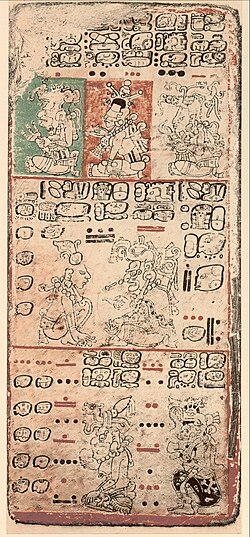
The Maya considered Venus to be the most important celestial body after the Sun and Moon. They called it Chac ek,276 or Noh Ek', 'the Great Star'.277 The cycles of Venus were important to their calendar and were described in some of their books, such as the Maya Codex of Mexico and Dresden Codex. The flag of Chile (Estrella Solitaria, 'Lone Star') depicts Venus.
Modern culture
The impenetrable Venusian cloud cover gave science fiction writers free rein to speculate on conditions at its surface; all the more so when early observations showed that not only was it similar in size to Earth, it possessed a substantial atmosphere. Closer to the Sun than Earth, the planet was often depicted as warmer, but still habitable by humans.280 The genre reached its peak between the 1930s and 1950s, at a time when science had revealed some aspects of Venus, but not yet the harsh reality of its surface conditions. Findings from the first missions to Venus showed reality to be quite different and brought this particular genre to an end.281 As scientific knowledge of Venus advanced, science fiction authors tried to keep pace, particularly by conjecturing human attempts to terraform Venus.282
Symbols

The symbol of a circle with a small cross beneath is the so-called Venus symbol, gaining its name for being used as the astronomical symbol for Venus. The symbol is of ancient Greek origin, and represents more generally femininity, adopted by biology as gender symbol for female,283284285 like the Mars symbol for male and sometimes the Mercury symbol for hermaphrodite. This gendered association of Venus and Mars has been used to pair them heteronormatively, describing women and men stereotypically as being so different that they can be understood as coming from different planets, an understanding popularized in 1992 by the book titled Men Are from Mars, Women Are from Venus.286
The Venus symbol was also used in Western alchemy representing the element copper (like the symbol of Mercury is also the symbol of the element mercury),284285 and since polished copper has been used for mirrors from antiquity the symbol for Venus has sometimes been called Venus mirror, representing the mirror of the goddess, although this origin has been discredited as an unlikely origin.284285
Besides the Venus symbol, many other symbols have been associated with Venus, other common ones are the crescent or particularly the star, as with the Star of Ishtar.287
See also
See also
References
References
- "Venus looks more boring than you think it does". The Planetary Society. Retrieved 19 March 2026.
- "Approaching Venus Image #2 - NASA Science". 5 June 2007. Retrieved 29 October 2025. "This single frame is part of a color sequence taken to help the MESSENGER team calibrate the camera in preparation for the spacecraft's first flyby of Mercury on January 14, 2008." The image is one of 11 greyscale images. "MESSENGER - Unlocking the Mysteries of Planet Mercury". messenger.jhuapl.edu. Retrieved 29 October 2025.
- "Venusian". Lexico UK English Dictionary. Oxford University Press. Archived from the original on 23 March 2020.
"Venusian". Merriam-Webster.com Dictionary. Merriam-Webster. OCLC 1032680871. - "Cytherean". Oxford English Dictionary (Online ed.). Oxford University Press. (Subscription or participating institution membership required.)
- "Venerean, Venerian". Oxford English Dictionary (Online ed.). Oxford University Press. (Subscription or participating institution membership required.)
- Williams, David R. (25 November 2020). "Venus Fact Sheet". NASA Goddard Space Flight Center. Archived from the original on 11 May 2018. Retrieved 15 April 2021.
- Yeomans, Donald K. "Horizons Web-Interface for Venus (Major Body=2)". JPL Horizons On-Line Ephemeris System. Archived from the original on 18 August 2023. Retrieved 30 November 2010.—Select "Ephemeris Type: Orbital Elements", "Time Span: 2000-01-01 12:00 to 2000-01-02". ("Target Body: Venus" and "Center: Sun" should be set to default.) Results are instantaneous osculating values at the precise J2000 epoch.
- Simon, J.L.; Bretagnon, P.; Chapront, J.; Chapront-Touzé, M.; Francou, G.; Laskar, J. (February 1994). "Numerical expressions for precession formulae and mean elements for the Moon and planets". Astronomy and Astrophysics. 282 (2): 663–683. Bibcode:1994A&A...282..663S.
- Souami, D.; Souchay, J. (July 2012). "The solar system's invariable plane". Astronomy & Astrophysics. 543: 11. Bibcode:2012A&A...543A.133S. doi:10.1051/0004-6361/201219011. A133.
- Seidelmann, P. Kenneth; Archinal, Brent A.; A'Hearn, Michael F.; et al. (2007). "Report of the IAU/IAG Working Group on cartographic coordinates and rotational elements: 2006". Celestial Mechanics and Dynamical Astronomy. 98 (3): 155–180. Bibcode:2007CeMDA..98..155S. doi:10.1007/s10569-007-9072-y.
- NASA/JPL Planets and Pluto: Physical Characteristics Last updated 2020-May-29
- "Planets and Pluto: Physical Characteristics". NASA. 5 November 2008. Archived from the original on 7 September 2006. Retrieved 26 August 2015.
- "Planetary Facts". The Planetary Society. Archived from the original on 11 May 2012. Retrieved 20 January 2016.
- Margot, Jean-Luc; Campbell, Donald B.; Giorgini, Jon D.; et al. (29 April 2021). "Spin state and moment of inertia of Venus". Nature Astronomy. 5 (7): 676–683. arXiv:2103.01504. Bibcode:2021NatAs...5..676M. doi:10.1038/s41550-021-01339-7.
- "Report on the IAU/IAG Working Group on cartographic coordinates and rotational elements of the planets and satellites". International Astronomical Union. 2000. Archived from the original on 12 May 2020. Retrieved 12 April 2007.
- Archinal, B. A.; Acton, C. H.; A'Hearn, M. F.; Conrad, A.; Consolmagno, G. J.; Duxbury, T.; Hestroffer, D.; Hilton, J. L.; Kirk, R. L.; Klioner, S. A.; McCarthy, D.; Meech, K.; Oberst, J.; Ping, J.; Seidelmann, P. K.; Tholen, D. J.; Thomas, P. C.; Williams, I. P. (March 2018). "Report of the IAU Working Group on Cartographic Coordinates and Rotational Elements: 2015". Celestial Mechanics and Dynamical Astronomy. 130 (3). Bibcode:2018CeMDA.130...22A. doi:10.1007/s10569-017-9805-5.
- Mallama, Anthony; Krobusek, Bruce; Pavlov, Hristo (2017). "Comprehensive wide-band magnitudes and albedos for the planets, with applications to exo-planets and Planet Nine". Icarus. 282: 19–33. arXiv:1609.05048. Bibcode:2017Icar..282...19M. doi:10.1016/j.icarus.2016.09.023.
- Haus, R.; Kappel, D.; Arnoldb, G. (July 2016). "Radiative energy balance of Venus based on improved models of the middle and lower atmosphere". Icarus. 272: 178–205. Bibcode:2016Icar..272..178H. doi:10.1016/j.icarus.2016.02.048.
- "Atmospheres and Planetary Temperatures". American Chemical Society. 18 July 2013. Archived from the original on 27 January 2023. Retrieved 3 January 2023.
- Herbst, Konstantin; Banjac, Saša; Atri, Dimitra; Nordheim, Tom A. (January 2020). "Revisiting the cosmic-ray induced Venusian radiation dose in the context of habitability". Astronomy & Astrophysics. 633: A15. doi:10.1051/0004-6361/201936968.
- Mallama, Anthony; Hilton, James L. (October 2018). "Computing apparent planetary magnitudes for The Astronomical Almanac". Astronomy and Computing. 25: 10–24. arXiv:1808.01973. Bibcode:2018A&C....25...10M. doi:10.1016/j.ascom.2018.08.002.
- "Encyclopedia – the brightest bodies". IMCCE. Archived from the original on 24 July 2023. Retrieved 29 May 2023.
- Lawrence, Pete (2005). "In Search of the Venusian Shadow". Digitalsky.org.uk. Archived from the original on 11 June 2012. Retrieved 13 June 2012.
- Walker, John. "Viewing Venus in Broad Daylight". Fourmilab Switzerland. Archived from the original on 29 March 2017. Retrieved 19 April 2017.
- Andrews, Roy George (27 May 2024). "Rivers of Lava on Venus Reveal a More Volcanically Active Planet - New software let scientists re-examine old radar images, providing some of the strongest evidence yet that volcanoes continue to reshape the hellish planet". The New York Times. Archived from the original on 1 June 2024. Retrieved 21 February 2026.
- Sulcanese, Davide; Mitri, Giuseppe; Mastrogiuseppe, Marco (27 May 2024). "Evidence of ongoing volcanic activity on Venus revealed by Magellan radar". Nature Astronomy. 8 (8): 973–982. Bibcode:2024NatAs...8..973S. doi:10.1038/s41550-024-02272-1.
- Chang, Kenneth (26 October 2023). "Billions of Years Ago, Venus May Have Had a Key Earthlike Feature – A new study makes the case that the solar system's hellish second planet once may have had plate tectonics that could have made it more hospitable to life". The New York Times. Archived from the original on 1 November 2023. Retrieved 21 February 2026.
- Weller, Matthew B.; Evans, Alexander J.; Ibarra, Daniel E.; Johnson, Alexandria V. (26 October 2023). "Venus's atmospheric nitrogen explained by ancient plate tectonics". Nature Astronomy. 7 (12): 1436–1444. Bibcode:2023NatAs...7.1436W. doi:10.1038/s41550-023-02102-w.
- Jakosky, Bruce M. (1999). "Atmospheres of the Terrestrial Planets". In Beatty, J. Kelly; Petersen, Carolyn Collins; Chaikin, Andrew (eds.). The New Solar System (4th ed.). Boston: Sky Publishing. pp. 175–200. ISBN 978-0-933346-86-4. OCLC 39464951.
- Hashimoto, George L.; Roos-Serote, Maarten; Sugita, Seiji; Gilmore, Martha S.; Kamp, Lucas W.; Carlson, Robert W.; Baines, Kevin H. (31 December 2008). "Felsic highland crust on Venus suggested by Galileo Near-Infrared Mapping Spectrometer data". Journal of Geophysical Research: Planets. 113 (E5) 2008JE003134. Advancing Earth and Space Science. Bibcode:2008JGRE..113.0B24H. doi:10.1029/2008JE003134.
- Shiga, David (10 October 2007). "Did Venus's ancient oceans incubate life?". New Scientist. Archived from the original on 24 March 2009. Retrieved 17 September 2017.
- Lopes, Rosaly M. C.; Gregg, Tracy K. P. (2004). Volcanic worlds: exploring the Solar System's volcanoes. Springer Publishing. p. 61. ISBN 978-3-540-00431-8.
- Squyres, Steven W. (2016). "Venus". Encyclopædia Britannica Online. Archived from the original on 28 April 2014. Retrieved 7 January 2016.
- Darling, David. "Venus". Encyclopedia of Science. Dundee, Scotland. Archived from the original on 31 October 2021. Retrieved 24 March 2022.
- "Venus atmosphere, mainly composed of carbon dioxide and nitrogen". Royal Belgian Institute for Space Aeronomy. Retrieved 28 March 2026.
- Lammer, Helmut; Brasser, Ramon; Johansen, Anders; Scherf, Manuel; Leitzinger, Martin (February 2021). "Formation of Venus, Earth and Mars: Constrained by Isotopes". Space Science Reviews. 217 (1) 7. arXiv:2102.06173. Bibcode:2021SSRv..217....7L. doi:10.1007/s11214-020-00778-4.
- "Chapter 6: Aging Into Gianthood - NASA Science". 11 December 2018. Retrieved 7 September 2025.
- Koren, Marina (3 February 2022). "Our Solar System in True Color Is Really Something Else". The Atlantic. Retrieved 24 June 2025.
- Mueller, Nils (2014). "Venus Surface and Interior". In Tilman, Spohn; Breuer, Doris; Johnson, T. V. (eds.). Encyclopedia of the Solar System (3rd ed.). Oxford: Elsevier Science & Technology. ISBN 978-0-12-415845-0. Archived from the original on 29 September 2021. Retrieved 12 January 2016.
- Esposito, Larry W. (9 March 1984). "Sulfur Dioxide: Episodic Injection Shows Evidence for Active Venus Volcanism". Science. 223 (4640): 1072–1074. Bibcode:1984Sci...223.1072E. doi:10.1126/science.223.4640.1072. PMID 17830154.
- Bullock, Mark A.; Grinspoon, David H. (March 2001). "The Recent Evolution of Climate on Venus". Icarus. 150 (1): 19–37. Bibcode:2001Icar..150...19B. doi:10.1006/icar.2000.6570.
- Basilevsky, Alexander T.; Head, James W. III (1995). "Global stratigraphy of Venus: Analysis of a random sample of thirty-six test areas". Earth, Moon, and Planets. 66 (3): 285–336. Bibcode:1995EM&P...66..285B. doi:10.1007/BF00579467.
- Kaufmann, W. J. (1994). Universe. New York: W. H. Freeman. p. 204. ISBN 978-0-7167-2379-0.
- "Venus is volcanically alive, stunning new find shows". Science. 15 March 2023. Retrieved 28 March 2026.National Geographic (2024) Venus is volcanically alive
- Nimmo, F.; McKenzie, D. (1998). "Volcanism and Tectonics on Venus". Annual Review of Earth and Planetary Sciences. 26 (1): 23–53. Bibcode:1998AREPS..26...23N. doi:10.1146/annurev.earth.26.1.23.
- Strom, Robert G.; Schaber, Gerald G.; Dawson, Douglas D. (25 May 1994). "The global resurfacing of Venus". Journal of Geophysical Research. 99 (E5): 10899–10926. Bibcode:1994JGR....9910899S. doi:10.1029/94JE00388.
- Frankel, Charles (1996). Volcanoes of the Solar System. Cambridge University Press. ISBN 978-0-521-47770-3. Retrieved 30 January 2023.
- Batson, R.M.; Russell, J. F. (18–22 March 1991). "Naming the Newly Found Landforms on Venus" (PDF). Proceedings of the Lunar and Planetary Science Conference XXII. Houston, Texas. p. 65. Bibcode:1991pggp.rept..490B. Archived (PDF) from the original on 13 May 2011. Retrieved 12 July 2009.
- Young, Carolynn, ed. (1 August 1990). The Magellan Venus Explorer's Guide. California: Jet Propulsion Laboratory. p. 93. Archived from the original on 4 December 2016. Retrieved 13 January 2016.
- Davies, M. E.; Abalakin, V. K.; Bursa, M.; Lieske, J. H.; Morando, B.; Morrison, D.; Seidelmann, P. K.; Sinclair, A. T.; Yallop, B.; Tjuflin, Y. S. (1994). "Report of the IAU Working Group on Cartographic Coordinates and Rotational Elements of the Planets and Satellites". Celestial Mechanics and Dynamical Astronomy. 63 (2): 127–148. Bibcode:1996CeMDA..63..127D. doi:10.1007/BF00693410.
- Young, Carolynn, ed. (1 August 1990). The Magellan Venus Explorer's Guide. California: Jet Propulsion Laboratory. pp. 99–100. Archived from the original on 4 December 2016. Retrieved 13 January 2016.
- Helbert, Jörn; Müller, Nils; Kostama, Petri; Marinangeli, Lucia; Piccioni, Giuseppe; Drossart, Pierre (2008). "Surface brightness variations seen by VIRTIS on Venus Express and implications for the evolution of the Lada Terra region, Venus". Geophysical Research Letters. 35 (11): L11201. Bibcode:2008GeoRL..3511201H. doi:10.1029/2008GL033609.
- Petkowski, Janusz; Seager, Sara (18 November 2021). "Did Venus ever have oceans?". Venus Cloud Life – MIT. Archived from the original on 13 April 2023. Retrieved 13 April 2023.
- Gilmore, Martha; Treiman, Allan; Helbert, Jörn; Smrekar, Suzanne (1 November 2017). "Venus Surface Composition Constrained by Observation and Experiment". Space Science Reviews. 212 (3): 1511–1540. Bibcode:2017SSRv..212.1511G. doi:10.1007/s11214-017-0370-8.
- "A new catalog pinpoints volcanic cones in the best available surface images of Venus – those gathered 30 years ago by NASA's Magellan spacecraft". skyandtelescope.org. 14 April 2023. Archived from the original on 16 April 2023. Retrieved 16 April 2023.
- Hahn, Rebecca M.; Byrne, Paul K. (April 2023). "A Morphological and Spatial Analysis of Volcanoes on Venus". Journal of Geophysical Research: Planets. 128 (4) e2023JE007753. Bibcode:2023JGRE..12807753H. doi:10.1029/2023JE007753.
With the Magellan synthetic-aperture radar full-resolution radar map left- and right-look global mosaics at 75 m-per-pixel resolution, we developed a global catalogue of volcanoes on Venus that contains ~85,000 edifices, ~99% of which are <5 km in diameter. We find that Venus hosts far more volcanoes than previously mapped, and that although they are distributed across virtually the entire planet, size–frequency distribution analysis reveals a relative lack of edifices in the 20–100 km diameter range, which could be related to magma availability and eruption rate.
- Karttunen, Hannu; Kroger, P.; Oja, H.; Poutanen, M.; Donner, K. J. (2007). Fundamental Astronomy. Springer. p. 162. ISBN 978-3-540-34143-7. Retrieved 30 January 2023.
- Bauer, Markus (3 December 2012). "Have Venusian volcanoes been caught in the act?". European Space Agency. Archived from the original on 14 April 2021. Retrieved 14 April 2021.
- Glaze, Lori S. (August 1999). "Transport of SO2 by explosive volcanism on Venus". Journal of Geophysical Research. 104 (E8): 18899–18906. Bibcode:1999JGR...10418899G. doi:10.1029/1998JE000619.
- Marcq, Emmanuel; Bertaux, Jean-Loup; Montmessin, Franck; Belyaev, Denis (January 2013). "Variations of sulphur dioxide at the cloud top of Venus's dynamic atmosphere". Nature Geoscience. 6 (1): 25–28. Bibcode:2013NatGe...6...25M. doi:10.1038/ngeo1650.
- Hall, Sannon (9 January 2020). "Volcanoes on Venus Might Still Be Smoking - Planetary science experiments on Earth suggest that the sun's second planet might have ongoing volcanic activity". The New York Times. Archived from the original on 9 January 2020. Retrieved 10 January 2020.
- Filiberto, Justin (3 January 2020). "Present-day volcanism on Venus as evidenced from weathering rates of olivine". Science. 6 (1) eaax7445. Bibcode:2020SciA....6.7445F. doi:10.1126/sciadv.aax7445. PMC 6941908. PMID 31922004.
- "Early, Energetic Collisions Could Have Fueled Venus Volcanism: Study | Sci.News". 20 July 2023. Archived from the original on 21 July 2023. Retrieved 21 July 2023.
- "Ganis Chasma". Gazetteer of Planetary Nomenclature. USGS Astrogeology Science Center. Archived from the original on 13 October 2018. Retrieved 14 April 2021.
- Lakdawalla, Emily (18 June 2015). "Transient hot spots on Venus: Best evidence yet for active volcanism". The Planetary Society. Archived from the original on 20 June 2015. Retrieved 20 June 2015.
- "Hot lava flows discovered on Venus". European Space Agency. 18 June 2015. Archived from the original on 19 June 2015. Retrieved 20 June 2015.
- Shalygin, E. V.; Markiewicz, W. J.; Basilevsky, A. T.; Titov, D. V.; Ignatiev, N. I.; Head, J. W. (17 June 2015). "Active volcanism on Venus in the Ganiki Chasma rift zone". Geophysical Research Letters. 42 (12): 4762–4769. Bibcode:2015GeoRL..42.4762S. doi:10.1002/2015GL064088.
- Kluger, Jeffrey (17 March 2023). "Why the Discovery of an Active Volcano on Venus Matters". Time. Archived from the original on 19 March 2023. Retrieved 19 March 2023.
- Romeo, I.; Turcotte, D. L. (2009). "The frequency-area distribution of volcanic units on Venus: Implications for planetary resurfacing". Icarus. 203 (1): 13–19. Bibcode:2009Icar..203...13R. doi:10.1016/j.icarus.2009.03.036.
- Herrick, R. R.; Phillips, R. J. (1993). "Effects of the Venusian atmosphere on incoming meteoroids and the impact crater population". Icarus. 112 (1): 253–281. Bibcode:1994Icar..112..253H. doi:10.1006/icar.1994.1180.
- Morrison, David; Owens, Tobias C. (2003). The Planetary System (3rd ed.). San Francisco: Benjamin Cummings. ISBN 978-0-8053-8734-6.
- Goettel, K. A.; Shields, J. A.; Decker, D. A. (16–20 March 1981). "Density constraints on the composition of Venus". Proceedings of the Lunar and Planetary Science Conference. Houston, TX: Pergamon Press. pp. 1507–1516. Bibcode:1982LPSC...12.1507G.
- Faure, Gunter; Mensing, Teresa M. (2007). Introduction to planetary science: the geological perspective. Springer eBook collection. Springer. p. 201. ISBN 978-1-4020-5233-0.
- Dumoulin, C.; Tobie, G.; Verhoeven, O.; Rosenblatt, P.; Rambaux, N. (June 2017). "Tidal constraints on the interior of Venus". Journal of Geophysical Research: Planets. 122 (6): 1338–1352. doi:10.1002/2016JE005249.
- Aitta, A. (April 2012). "Venus' internal structure, temperature and core composition". Icarus. 218 (2): 967–974. Bibcode:2012Icar..218..967A. doi:10.1016/j.icarus.2012.01.007.
- O'Callaghan, Jonathan (29 April 2021). "We've measured the size of Venus's planetary core for the first time". New Scientist. Archived from the original on 2 May 2021. Retrieved 2 May 2021.
- Semprich, Julia; Filiberto, Justin; Weller, Matthew; Gorce, Jennifer; Clark, Nolan (25 March 2025). "Metamorphism of Venus as driver of crustal thickness and recycling". Nature Communications. 16 (1) 2905. Bibcode:2025NatCo..16.2905S. doi:10.1038/s41467-025-58324-1. PMC 11937330. PMID 40133342.
- Nimmo, F. (2002). "Crustal analysis of Venus from Magellan satellite observations at Atalanta Planitia, Beta Regio, and Thetis Regio". Geology. 30 (11): 987–990. Bibcode:2002Geo....30..987N. doi:10.1130/0091-7613(2002)030<0987:WDVLAM>2.0.CO;2.
- Dolginov, Sh.; Eroshenko, E. G.; Lewis, L. (September 1969). "Nature of the Magnetic Field in the Neighborhood of Venus". Cosmic Research. 7: 675. Bibcode:1969CosRe...7..675D.
- Kivelson, G. M.; Russell, C. T. (1995). Introduction to Space Physics. Cambridge University Press. ISBN 978-0-521-45714-9.
- Luhmann, J. G.; Russell, C. T. (1997). "Venus: Magnetic Field and Magnetosphere". In Shirley, J. H.; Fainbridge, R. W. (eds.). Encyclopedia of Planetary Sciences. New York: Chapman and Hall. pp. 905–907. ISBN 978-1-4020-4520-2. Archived from the original on 14 July 2010. Retrieved 19 July 2006.
- Stevenson, D. J. (15 March 2003). "Planetary magnetic fields". Earth and Planetary Science Letters. 208 (1–2): 1–11. Bibcode:2003E&PSL.208....1S. doi:10.1016/S0012-821X(02)01126-3.
- Nimmo, Francis (November 2002). "Why does Venus lack a magnetic field?". Geology. 30 (11): 987–990. Bibcode:2002Geo....30..987N. doi:10.1130/0091-7613(2002)030<0987:WDVLAM>2.0.CO;2.
- Konopliv, A. S.; Yoder, C. F. (1996). "Venusian k2 tidal Love number from Magellan and PVO tracking data". Geophysical Research Letters. 23 (14): 1857–1860. Bibcode:1996GeoRL..23.1857K. doi:10.1029/96GL01589.
- Jacobson, Seth A.; Rubie, David C.; Hernlund, John; Morbidelli, Alessandro; Nakajima, Miki (September 2017). "Formation, stratification, and mixing of the cores of Earth and Venus". Earth and Planetary Science Letters. 474: 375–386. doi:10.1016/j.epsl.2017.06.023.
- Svedhem, Håkan; Titov, Dmitry V.; Taylor, Fredric W.; Witasse, Olivier (November 2007). "Venus as a more Earth-like planet". Nature. 450 (7170): 629–632. Bibcode:2007Natur.450..629S. doi:10.1038/nature06432. PMID 18046393.
- O'Rourke, Joseph; Gillmann, Cedric; Tackley, Paul (April 2019). Prospects for an ancient dynamo and modern crustal remnant magnetism on Venus. 21st EGU General Assembly, EGU2019, Proceedings from the conference held 7–12 April 2019 in Vienna, Austria. Bibcode:2019EGUGA..2118876O. 18876.
- Donahue, T. M.; Hoffman, J. H.; Hodges, R. R.; Watson, A. J. (1982). "Venus Was Wet: A Measurement of the Ratio of Deuterium to Hydrogen". Science. 216 (4546): 630–633. Bibcode:1982Sci...216..630D. doi:10.1126/science.216.4546.630. PMID 17783310.
- Lebonnois, Sebastien; Schubert, Gerald (26 June 2017). "The deep atmosphere of Venus and the possible role of density-driven separation of CO2 and N2". Nature Geoscience. 10 (7). Springer Science and Business Media LLC: 473–477. Bibcode:2017NatGe..10..473L. doi:10.1038/ngeo2971.
- Taylor, Fredric W. (2014). "Venus: Atmosphere". In Tilman, Spohn; Breuer, Doris; Johnson, T. V. (eds.). Encyclopedia of the Solar System. Oxford: Elsevier Science & Technology. ISBN 978-0-12-415845-0. Archived from the original on 29 September 2021. Retrieved 12 January 2016.
- "Venus: Facts & Figures". NASA. Archived from the original on 29 September 2006. Retrieved 12 April 2007.
- "Venus". Case Western Reserve University. 13 September 2006. Archived from the original on 26 April 2012. Retrieved 21 December 2011.
- Lewis, John S. (2004). Physics and Chemistry of the Solar System (2nd ed.). Academic Press. p. 463. ISBN 978-0-12-446744-6.
- Newitz, Annalee (11 December 2013). "Here's Carl Sagan's original essay on the dangers of climate change". Gizmodo. Archived from the original on 3 September 2021. Retrieved 3 September 2021.
- Landis, Geoffrey A. (2003). "Colonization of Venus". AIP Conference Proceedings. Vol. 654. AIP. pp. 1193–1198. doi:10.1063/1.1541418.
- Querol, Ricardo de (28 April 2023). "'Cosmos': Carl Sagan was right (and we didn't pay much attention to him)". EL PAÍS English. Retrieved 12 March 2025.
- Halliday, Alex N. (March 2013). "The origins of volatiles in the terrestrial planets". Geochimica et Cosmochimica Acta. 105: 146–171. Bibcode:2013GeCoA.105..146H. doi:10.1016/j.gca.2012.11.015.
- Owen, Tobias; Bar-Nun, Akiva; Kleinfeld, Idit (July 1992). "Possible cometary origin of heavy noble gases in the atmospheres of Venus, Earth and Mars". Nature. 358 (6381): 43–46. Bibcode:1992Natur.358...43O. doi:10.1038/358043a0. PMID 11536499.
- Pepin, Robert O. (1 July 1991). "On the origin and early evolution of terrestrial planet atmospheres and meteoritic volatiles". Icarus. 92 (1): 2–79. Bibcode:1991Icar...92....2P. doi:10.1016/0019-1035(91)90036-S.
- Namiki, Noriyuki; Solomon, Sean C. (1998). "Volcanic degassing of argon and helium and the history of crustal production on Venus". Journal of Geophysical Research: Planets. 103 (E2): 3655–3677. Bibcode:1998JGR...103.3655N. doi:10.1029/97JE03032.
- O'Rourke, Joseph G.; Korenaga, Jun (November 2015). "Thermal evolution of Venus with argon degassing". Icarus. 260: 128–140. Bibcode:2015Icar..260..128O. doi:10.1016/j.icarus.2015.07.009.
- Ernst, Richard (3 November 2022). "Venus was once more Earth-like, but climate change made it uninhabitable". The Conversation. Archived from the original on 21 April 2023. Retrieved 21 April 2023.
- Way, M. J.; Del Genio, Anthony D. (2020). "Venusian Habitable Climate Scenarios: Modeling Venus Through Time and Applications to Slowly Rotating Venus-Like Exoplanets". Journal of Geophysical Research: Planets. 125 (5) e2019JE006276. American Geophysical Union (AGU). arXiv:2003.05704. Bibcode:2020JGRE..12506276W. doi:10.1029/2019je006276.
- Way, M. J.; Del Genio, Anthony D.; Kiang, Nancy Y.; Sohl, Linda E.; Grinspoon, David H.; Aleinov, Igor; Kelley, Maxwell; Clune, Thomas (28 August 2016). "Was Venus the first habitable world of our solar system?". Geophysical Research Letters. 43 (16). American Geophysical Union (AGU): 8376–8383. arXiv:1608.00706. Bibcode:2016GeoRL..43.8376W. doi:10.1002/2016gl069790. PMC 5385710. PMID 28408771.
- Grinspoon, David H.; Bullock, M. A. (October 2007). "Searching for Evidence of Past Oceans on Venus". Bulletin of the American Astronomical Society. 39: 540. Bibcode:2007DPS....39.6109G.
- Steigerwald, Bill (2 November 2022). "NASA Study: Massive Volcanism May Have Altered Ancient Venus' Climate". NASA. Archived from the original on 10 May 2023. Retrieved 5 May 2023.
- Kasting, J. F. (1988). "Runaway and moist greenhouse atmospheres and the evolution of Earth and Venus". Icarus. 74 (3): 472–494. Bibcode:1988Icar...74..472K. doi:10.1016/0019-1035(88)90116-9. PMID 11538226.
- Moshkin, B. E.; Ekonomov, A. P.; Golovin, Iu. M. (1979). "Dust on the surface of Venus". Kosmicheskie Issledovaniia (Cosmic Research). 17 (2): 280–285. Bibcode:1979CosRe..17..232M.
- "New details on venusian clouds revealed". European Space Agency. 2008.
- "Acid clouds and lightning". European Space Agency.
- Delitsky, M. L.; Baines, K. H. (2015). Chemistry in the Venus clouds: Sulfuric acid reactions and freezing behavior of aqueous liquid droplets. AAS/Division for Planetary Sciences Meeting Abstracts #47. Vol. 47. Bibcode:2015DPS....4721702D.
- Krasnopolsky, V. A.; Parshev, V. A. (1981). "Chemical composition of the atmosphere of Venus". Nature. 292 (5824): 610–613. Bibcode:1981Natur.292..610K. doi:10.1038/292610a0.
- Krasnopolsky, Vladimir A. (2006). "Chemical composition of Venus atmosphere and clouds: Some unsolved problems". Planetary and Space Science. 54 (13–14): 1352–1359. Bibcode:2006P&SS...54.1352K. doi:10.1016/j.pss.2006.04.019.
- Knollenberg, R. G.; Hansen, J.; Ragent, B.; Martonchik, J.; Tomasko, M. (May 1977). "The clouds of Venus". Space Science Reviews. 20 (3): 329–354. doi:10.1007/BF02186469.
- Demtröder, Wolfgang (2024). Astrophysics. Undergraduate Lecture Notes in Physics. p. 64. doi:10.1007/978-3-031-22135-4. ISBN 978-3-031-22133-0.
- "The Unveiling of Venus: Hot and Stifling". Science News. 109 (25): 388–389. 19 June 1976. doi:10.2307/3960800. JSTOR 3960800.
100 watts per square meter ... 14,000 lux ... corresponds to ... daytime with overcast clouds
- Sánchez-Lavega, Agustín; Lebonnois, Sebastien; Imamura, Takeshi; Read, Peter; Luz, David (November 2017). "The Atmospheric Dynamics of Venus". Space Science Reviews. 212 (3–4): 1541–1616. Bibcode:2017SSRv..212.1541S. doi:10.1007/s11214-017-0389-x.
- Rossow, W. B.; del Genio, A. D.; Eichler, T. (1990). "Cloud-tracked winds from Pioneer Venus OCPP images". Journal of the Atmospheric Sciences. 47 (17): 2053–2084. Bibcode:1990JAtS...47.2053R. doi:10.1175/1520-0469(1990)047<2053:CTWFVO>2.0.CO;2.
- Antonio Francés-Monerris; et al. (30 July 2022). "Photochemical and thermochemical path- ways to S2 and polysulfur formation in the atmosphere of Venus". Nature Communications. 13 (1) 4425. doi:10.1038/s41467-022-32170-x. PMC 9338966. PMID 35907911.
- Basilevsky, A. T.; Head, J. W. (2003). "The surface of Venus". Reports on Progress in Physics. 66 (10): 1699–1734. Bibcode:2003RPPh...66.1699B. doi:10.1088/0034-4885/66/10/R04.
- Lorenz, Ralph D.; Lunine, Jonathan I.; Withers, Paul G.; McKay, Christopher P. (1 February 2001). "Titan, Mars and Earth: Entropy Production by Latitudinal Heat Transport". Geophysical Research Letters. 28 (3). Ames Research Center, University of Arizona Lunar and Planetary Laboratory: 415–418. Bibcode:2001GeoRL..28..415L. doi:10.1029/2000GL012336.
- "Interplanetary Seasons". NASA Science. NASA. 19 June 2000. Archived from the original on 14 April 2021. Retrieved 14 April 2021.
- McGill, G. E.; Stofan, E. R.; Smrekar, S. E. (2010). "Venus tectonics". In Watters, T. R.; Schultz, R. A. (eds.). Planetary Tectonics. Cambridge University Press. pp. 81–120. ISBN 978-0-521-76573-2. Archived from the original on 23 June 2016. Retrieved 18 October 2015.
- Otten, Carolyn Jones (2004). ""Heavy metal" snow on Venus is lead sulfide". Washington University in St. Louis. Archived from the original on 15 April 2008. Retrieved 21 August 2007.
- Lee, Yeon Joo; Jessup, Kandis-Lea; Perez-Hoyos, Santiago; Titov, Dmitrij V.; Lebonnois, Sebastien; Peralta, Javier; Horinouchi, Takeshi; Imamura, Takeshi; Limaye, Sanjay; Marcq, Emmanuel; Takagi, Masahiro; Yamazaki, Atsushi; Yamada, Manabu; Watanabe, Shigeto; Murakami, Shin-ya; Ogohara, Kazunori; McClintock, William M.; Holsclaw, Gregory; Roman, Anthony (26 August 2019). "Long-term Variations of Venus's 365 nm Albedo Observed by Venus Express, Akatsuki, MESSENGER, and the Hubble Space Telescope". The Astronomical Journal. 158 (3): 126. arXiv:1907.09683. Bibcode:2019AJ....158..126L. doi:10.3847/1538-3881/ab3120.
- Lorenz, Ralph D. (20 June 2018). "Lightning detection on Venus: a critical review". Progress in Earth and Planetary Science. 5 (1) 34. Bibcode:2018PEPS....5...34L. doi:10.1186/s40645-018-0181-x.
- Kranopol'skii, V. A. (1980). "Lightning on Venus according to Information Obtained by the Satellites Venera 9 and 10". Cosmic Research. 18 (3): 325–330. Bibcode:1980CosRe..18..325K.
- Russell, C.T.; Phillips, J.L. (January 1990). "The Ashen Light". Advances in Space Research. 10 (5): 137–141. doi:10.1016/0273-1177(90)90174-X.
- "Venera 12 Descent Craft". National Space Science Data Center. NASA. Archived from the original on 23 May 2019. Retrieved 10 September 2015.
- Russell, C. T.; Zhang, T. L.; Delva, M.; Magnes, W.; Strangeway, R. J.; Wei, H. Y. (29 November 2007). "Lightning on Venus inferred from whistler-mode waves in the ionosphere". Nature. 450 (7170): 661–662. doi:10.1038/nature05930. PMID 18046401.
- Hand, Eric (November 2007). "European mission reports from Venus". Nature (450): 633–660. doi:10.1038/news.2007.297.
- Staff (28 November 2007). "Venus offers Earth climate clues". BBC News. Archived from the original on 11 January 2009. Retrieved 29 November 2007.
- "ESA finds that Venus has an ozone layer too". European Space Agency. 6 October 2011. Archived from the original on 27 January 2012. Retrieved 25 December 2011.
- "When A Planet Behaves Like A Comet". European Space Agency. 29 January 2013. Archived from the original on 2 May 2019. Retrieved 31 January 2013.
- Kramer, Miriam (30 January 2013). "Venus Can Have 'Comet-Like' Atmosphere". Space.com. Archived from the original on 3 May 2019. Retrieved 31 January 2013.
- Fukuhara, Tetsuya; Futaguchi, Masahiko; Hashimoto, George L.; Horinouchi, Takeshi; Imamura, Takeshi; Iwagaimi, Naomoto; Kouyama, Toru; Murakami, Shin-ya; Nakamura, Masato; Ogohara, Kazunori; Sato, Mitsuteru; Sato, Takao M.; Suzuki, Makoto; Taguchi, Makoto; Takagi, Seiko; Ueno, Munetaka; Watanabe, Shigeto; Yamada, Manabu; Yamazaki, Atsushi (16 January 2017). "Large stationary gravity wave in the atmosphere of Venus". Nature Geoscience. 10 (2): 85–88. Bibcode:2017NatGe..10...85F. doi:10.1038/ngeo2873.
- Rincon, Paul (16 January 2017). "Venus wave may be Solar System's biggest". BBC News. Archived from the original on 17 January 2017. Retrieved 17 January 2017.
- Chang, Kenneth (16 January 2017). "Venus Smiled, With a Mysterious Wave Across Its Atmosphere". The New York Times. Archived from the original on 15 July 2017. Retrieved 17 January 2017.
- "Venera 14 : Soviet Academy of Sciences: Free Download, Borrow, and Streaming: Internet Archive". Internet Archive. 23 October 2016. Retrieved 2 June 2025.
- Moroz, V. I.; Golovin, Yu. M.; Ekonomov, A. P.; Moshkin, B. E.; Parfent'ev, N. A.; San'ko, N. F. (March 1980). "Spectrum of the Venus day sky". Nature. 284 (5753): 243–244. Bibcode:1980Natur.284..243M. doi:10.1038/284243a0.
- Kane, S. R.; Vervoort, P.; Horner, J.; Pozuelos, P. J. (September 2020). "Could the Migration of Jupiter Have Accelerated the Atmospheric Evolution of Venus?". Planetary Science Journal. 1 (2): 42–51. arXiv:2008.04927. Bibcode:2020PSJ.....1...42K. doi:10.3847/PSJ/abae63.
- "The length of a day on Venus is always changing – Space". EarthSky. 5 May 2021. Archived from the original on 28 April 2023. Retrieved 28 April 2023.
- Margot, Jean-Luc; Campbell, Donald B.; Giorgini, Jon D.; Jao, Joseph S.; Snedeker, Lawrence G.; Ghigo, Frank D.; Bonsall, Amber (29 April 2021). "Spin state and moment of inertia of Venus". Nature Astronomy. 5 (7): 676–683. arXiv:2103.01504. Bibcode:2021NatAs...5..676M. doi:10.1038/s41550-021-01339-7.
- "Could Venus Be Shifting Gear?". Venus Express. European Space Agency. 10 February 2012. Archived from the original on 24 January 2016. Retrieved 7 January 2016.
- "Space Topics: Compare the Planets". The Planetary Society. Archived from the original on 18 February 2006. Retrieved 12 January 2016.
- Brunier, Serge (2002). Solar System Voyage. Translated by Dunlop, Storm. Cambridge University Press. p. 40. ISBN 978-0-521-80724-1. Archived from the original on 3 August 2020. Retrieved 17 September 2017.
- Correia, Alexandre C. M.; Laskar, Jacques; De Surgy, Olivier Néron (May 2003). "Long-Term Evolution of the Spin of Venus, Part I: Theory". Icarus. 163 (1): 1–23. Bibcode:2003Icar..163....1C. doi:10.1016/S0019-1035(03)00042-3.
- Laskar, Jacques; De Surgy, Olivier Néron (2003). "Long-Term Evolution of the Spin of Venus, Part II: Numerical Simulations". Icarus. 163 (1): 24–45. Bibcode:2003Icar..163...24C. doi:10.1016/S0019-1035(03)00043-5.
- Gold, T.; Soter, S. (1969). "Atmospheric Tides and the Resonant Rotation of Venus". Icarus. 11 (3): 356–66. Bibcode:1969Icar...11..356G. doi:10.1016/0019-1035(69)90068-2.
- Shapiro, I. I.; Campbell, D. B.; De Campli, W. M. (June 1979). "Nonresonance Rotation of Venus". Astrophysical Journal. 230: L123–L126. Bibcode:1979ApJ...230L.123S. doi:10.1086/182975.
- Sheppard, Scott S.; Trujillo, Chadwick A. (July 2009). "A Survey for Satellites of Venus". Icarus. 202 (1): 12–16. arXiv:0906.2781. Bibcode:2009Icar..202...12S. doi:10.1016/j.icarus.2009.02.008.
- Mikkola, S.; Brasser, R.; Wiegert, P.; Innanen, K. (July 2004). "Asteroid 2002 VE68: A Quasi-Satellite of Venus". Monthly Notices of the Royal Astronomical Society. 351 (3): L63. Bibcode:2004MNRAS.351L..63M. doi:10.1111/j.1365-2966.2004.07994.x.
- De la Fuente Marcos, Carlos; De la Fuente Marcos, Raúl (November 2012). "On the Dynamical Evolution of 2002 VE68". Monthly Notices of the Royal Astronomical Society. 427 (1): 728–39. arXiv:1208.4444. Bibcode:2012MNRAS.427..728D. doi:10.1111/j.1365-2966.2012.21936.x.
- De la Fuente Marcos, Carlos; De la Fuente Marcos, Raúl (June 2013). "Asteroid 2012 XE133: A Transient Companion to Venus". Monthly Notices of the Royal Astronomical Society. 432 (2): 886–93. arXiv:1303.3705. Bibcode:2013MNRAS.432..886D. doi:10.1093/mnras/stt454.
- Musser, George (10 October 2006). "Double Impact May Explain Why Venus Has No Moon". Scientific American. Archived from the original on 26 September 2007. Retrieved 7 January 2016.
- Tytell, David (10 October 2006). "Why Doesn't Venus Have a Moon?". Sky & Telescope. Archived from the original on 6 August 2016. Retrieved 21 February 2026.
- Frazier, Sarah (16 April 2021). "NASA's Parker Solar Probe Sees Venus Orbital Dust Ring". NASA. Archived from the original on 22 August 2022. Retrieved 21 January 2023.
- Garner, Rob (12 March 2019). "What Scientists Found After Sifting Through Dust in the Solar System". NASA. Archived from the original on 1 January 2023. Retrieved 21 January 2023.
- Rehm, Jeremy (15 April 2021). "Parker Solar Probe Captures First Complete View of Venus Orbital Dust Ring". JHUAPL. Archived from the original on 21 January 2023. Retrieved 21 January 2023.
- Bazsó, A.; Eybl, V.; Dvorak, R.; Pilat-Lohinger, E.; Lhotka, C. (2010). "A survey of near-mean-motion resonances between Venus and Earth". Celestial Mechanics and Dynamical Astronomy. 107 (1): 63–76. arXiv:0911.2357. Bibcode:2010CeMDA.107...63B. doi:10.1007/s10569-010-9266-6.
- Ottewell, Guy (7 January 2022). "The 5 petals of Venus and its 8-year cycle". EarthSky. Archived from the original on 22 February 2022. Retrieved 17 March 2022.
- Harford, Tim (11 January 2019). "BBC Radio 4—More or Less, Sugar, Outdoors Play and Planets". BBC. Archived from the original on 12 January 2019. Retrieved 30 October 2019.
Oliver Hawkins, more or less alumnus and statistical legend, wrote some code for us, which calculated which planet was closest to the Earth on each day for the past 50 years, and then sent the results to David A. Rothery, professor of planetary geosciences at the Open University.
- "Venus Close Approaches to Earth as predicted by Solex 11". Archived from the original on 9 August 2012. Retrieved 19 March 2009. Numbers generated by Solex
- "Venus is not Earth's closest neighbour". Physics Today (3) 30593. AIP Publishing. 12 March 2019. Bibcode:2019PhT..2019c0593.. doi:10.1063/pt.6.3.20190312a.
- Stockman, Tom; Monroe, Gabriel; Cordner, Samuel (2019). "Venus is not Earth's closest neighbour | Calculations and simulations confirm that on average, Mercury is the nearest planet to Earth-and to every other planet in the solar system". Physics Today. American Institute of Physics. doi:10.1063/PT.6.3.20190312a.
- Yen, C.-W. L. (August 1986). Ballistic Mercury orbiter mission via Venus and Mercury gravity assists. Astrodynamics 1985. pp. 1293–1308. Bibcode:1986asdy.conf.1293Y.
- Sturms, Francis M.; Cutting, Elliott (May 1966). "Trajectory analysis of a 1970 mission to Mercury via a close encounter with Venus". Journal of Spacecraft and Rockets. 3 (5): 624–631. Bibcode:1966JSpRo...3..624C. doi:10.2514/3.28505.
- "Parker Solar Probe Changed the Game Before it Even Launched - NASA". 4 October 2018. Retrieved 23 June 2025.
- "IV-1". nss.org. Retrieved 22 June 2025.
- Izenberg, Noam R.; McNutt, Ralph L.; Runyon, Kirby D.; Byrne, Paul K.; MacDonald, Alexander (March 2021). "Venus Exploration in the New Human Spaceflight Age". Acta Astronautica. 180: 100–104. Bibcode:2021AcAau.180..100I. doi:10.1016/j.actaastro.2020.12.020.
- Petropoulos, Anastassios E.; Longuski, James M.; Bonfiglio, Eugene P. (2000). "Trajectories to Jupiter via Gravity Assists from Venus, Earth, and Mars". Journal of Spacecraft and Rockets. 37 (6). American Institute of Aeronautics and Astronautics (AIAA): 776–783. Bibcode:2000JSpRo..37..776P. doi:10.2514/2.3650.
- Taylor, Chris (9 July 2020). "Welcome to Cloud City: The case for going to Venus, not Mars". Mashable. Archived from the original on 21 October 2022. Retrieved 21 October 2022.
- "Interplanetary Low Tide". Science Mission Directorate. 3 May 2000. Archived from the original on 4 June 2023. Retrieved 25 June 2023.
- Dickinson, Terrence (1998). NightWatch: A Practical Guide to Viewing the Universe. Buffalo, NY: Firefly Books. p. 134. ISBN 978-1-55209-302-3. Archived from the original on 29 September 2021. Retrieved 12 January 2016.
- "Start watching for Venus brightest in the morning sky". Earth & Sky. 15 April 2025. Retrieved 21 April 2025.
- Flanders, Tony (25 February 2011). "See Venus in Broad Daylight!". Sky & Telescope. Archived from the original on 1 March 2012. Retrieved 21 February 2026.
- Espenak, Fred (1996). "Venus: Twelve year planetary ephemeris, 1995–2006". NASA Reference Publication 1349. NASA/Goddard Space Flight Center. Archived from the original on 17 August 2000. Retrieved 20 June 2006.
- "Identifying UFOs". Night Sky Network. Astronomical Society of the Pacific. Archived from the original on 10 April 2021. Retrieved 10 April 2021.
- See this JPL Horizons ephemeris calculation.
- Lavender, Gemma (26 March 2023). "What equipment do you need to see and photograph the planets". Space.com. Retrieved 5 June 2024.
- Goines, David Lance (18 October 1995). "Inferential Evidence for the Pre-telescopic Sighting of the Crescent Venus". Goines.net. Archived from the original on 4 May 2021. Retrieved 19 April 2017.
- "Viewing Venus in Broad Daylight". www.fourmilab.ch. Archived from the original on 15 November 2021. Retrieved 17 July 2023.
- Chatfield, Chris (2010). "The Solar System with the naked eye". The Gallery of Natural Phenomena. Archived from the original on 13 June 2015. Retrieved 19 April 2017.
- Gaherty, Geoff (26 March 2012). "Planet Venus Visible in Daytime Sky Today: How to See It". Space.com. Archived from the original on 19 April 2017. Retrieved 19 April 2017.
- Espenak, Fred (8 June 2004). "2004 and 2012 Transits of Venus". NASA.
- Kollerstrom, Nicholas (1998). "Horrocks and the Dawn of British Astronomy". University College London. Archived from the original on 26 June 2013. Retrieved 11 May 2012.
- Hornsby, Thomas (31 December 1771). "LIII. The quantity of the Sun's parallax as deduced from the observations of the transit of Venus, on June 3, 1769". Philosophical Transactions of the Royal Society of London (61): 574–579. doi:10.1098/rstl.1771.0054.
- Woolley, Richard (1969). "Captain Cook and the Transit of Venus of 1769". Notes and Records of the Royal Society of London. 24 (1): 19–32. doi:10.1098/rsnr.1969.0004. JSTOR 530738.
- Boyle, Alan (5 June 2012). "Venus transit: A last-minute guide". NBC News. Archived from the original on 18 June 2013. Retrieved 11 January 2016.
- Espenak, Fred (2004). "Transits of Venus, Six Millennium Catalog: 2000 BCE to 4000 CE". Transits of the Sun. NASA. Archived from the original on 19 March 2012. Retrieved 14 May 2009.
- Dobbins, Thomas A. (22 February 2022). "The Parker Solar Probe Captures Surprising Images of Venus Nightside". Sky & Telescope. Retrieved 14 March 2025.
- "Nightside observations by the Parker Solar Probe: implications for the reality of the Ashen Light – British Astronomical Association". British Astronomical Association – Supporting amateur astronomers since 1890. 21 May 2024. Retrieved 14 March 2025.
- Baum, R. M. (2000). "The enigmatic ashen light of Venus: an overview". Journal of the British Astronomical Association. 110: 325. Bibcode:2000JBAA..110..325B.
- Cooley, Jeffrey L. (2008). "Inana and Sukaletuda: a Sumerian Astral Myth". Kaskal. 5: 161–172.
- Sachs, A. (1974). "Babylonian Observational Astronomy". Philosophical Transactions of the Royal Society of London. 276 (1257): 43–50. Bibcode:1974RSPTA.276...43S. doi:10.1098/rsta.1974.0008.
- Hobson, Russell (2009). The Exact Transmission of Texts in the First Millennium B.C.E. (PDF) (Ph.D.). University of Sydney, Department of Hebrew, Biblical and Jewish Studies. Archived (PDF) from the original on 29 February 2012. Retrieved 26 December 2015.
- Veede, Raul; Kasak, Enn (2001). "Understanding Planets in Ancient Mesopotamia". Folklore (15–17): 7–33. CEEOL 264567.
- Heimpel, W. (1982). "A catalogue of Near Eastern Venus deities". Syro-Mesopotamian Studies. 4 (3). Undena Publications: 9–22.
- Needham, Joseph (1959). Mathematics and the Sciences of the Heavens and the Earth. Science and Civilisation in China. Vol. 3. Cambridge: Cambridge University Press. p. 398. Bibcode:1959scc3.book.....N. ISBN 978-0-521-05801-8 (reprint)
- Pliny the Elder (1991). Natural History II:36–37. Translated by Healy, John F. Harmondsworth, Middlesex, UK: Penguin. pp. 15–16.
- Burkert, Walter (1972). Lore and Science in Ancient Pythagoreanism. Harvard University Press. p. 307. ISBN 978-0-674-53918-1. Archived from the original on 9 June 2016. Retrieved 28 December 2015.
- Dobbin, Robert (2002). "An Ironic Allusion at "Aeneid" 1.374". Mnemosyne. Fourth series. 55 (6). Brill: 736–738. doi:10.1163/156852502320880285. JSTOR 4433390.
- Goldstein, Bernard R. (March 1972). "Theory and Observation in Medieval Astronomy". Isis. 63 (1): 39–47 [44]. Bibcode:1972Isis...63...39G. doi:10.1086/350839.
- "AVICENNA viii. Mathematics and Physical Sciences". Encyclopædia Iranica. Archived from the original on 20 February 2020. Retrieved 4 March 2016.
- Ansari, S. M. Razaullah (2002). History of Oriental Astronomy. Proceedings of the Joint Discussion-17 at the 23rd General Assembly of the International Astronomical Union, Organised by the Commission 41 (History of Astronomy), Held in Kyoto, 25–26 August 1997. Astrophysics and Space Science Library. Springer Science+Business Media. p. 137. ISBN 978-1-4020-0657-9.
- Vaquero, J. M.; Vázquez, M. (2009). The Sun Recorded Through History. Springer Science & Business Media. p. 75. ISBN 978-0-387-92790-9. Archived from the original on 26 November 2016. Retrieved 18 May 2016.
- Palmieri, Paolo (2001). "Galileo and the discovery of the phases of Venus". Journal for the History of Astronomy. 21 (2): 109–129. Bibcode:2001JHA....32..109P. doi:10.1177/002182860103200202.
- Fegley Jr, B. (2003). "Venus". In Holland, Heinrich D.; Turekian, Karl K. (eds.). Treatise on Geochemistry. Elsevier. pp. 487–507. ISBN 978-0-08-043751-4.
- Kollerstrom, Nicholas (2004). "William Crabtree's Venus transit observation". Proceedings IAU Colloquium No. 196. 2004: 34–40. Bibcode:2005tvnv.conf...34K. doi:10.1017/S1743921305001249.
- Marov, Mikhail Ya. (2004). Kurtz, D. W. (ed.). Mikhail Lomonosov and the discovery of the atmosphere of Venus during the 1761 transit. Transits of Venus: New Views of the Solar System and Galaxy, Proceedings of IAU Colloquium #196, held 7–11 June 2004 in Preston, U.K. Vol. 2004. Cambridge University Press. pp. 209–219. Bibcode:2005tvnv.conf..209M. doi:10.1017/S1743921305001390.
- "Mikhail Vasilyevich Lomonosov". Encyclopædia Britannica Online. Archived from the original on 25 July 2008. Retrieved 12 July 2009.
- Russell, H. N. (1899). "The Atmosphere of Venus". Astrophysical Journal. 9: 284–299. Bibcode:1899ApJ.....9..284R. doi:10.1086/140593.
- Hussey, T. (1832). "On the Rotation of Venus". Monthly Notices of the Royal Astronomical Society. 2 (11): 78–126. Bibcode:1832MNRAS...2...78H. doi:10.1093/mnras/2.11.78d.
- Ross, F. E. (1928). "Photographs of Venus". Astrophysical Journal. 68: 57. Bibcode:1928ApJ....68...57R. doi:10.1086/143130.
- Martz, Edwin P. Jr. (1934). "Venus and life". Popular Astronomy. 42: 165. Bibcode:1934PA.....42..165M.
- Mitchell, Don (2003). "Inventing The Interplanetary Probe". The Soviet Exploration of Venus. Archived from the original on 12 October 2018. Retrieved 27 December 2007.
- Mayer, C. H.; McCullough, T. P.; Sloanaker, R. M. (January 1958). "Observations of Venus at 3.15-cm Wave Length". The Astrophysical Journal. 127: 1. Bibcode:1958ApJ...127....1M. doi:10.1086/146433.
- Jet Propulsion Laboratory (1962). Mariner-Venus 1962 Final Project Report (PDF) (Report). SP-59. NASA. Archived (PDF) from the original on 11 February 2014. Retrieved 7 July 2017.
- Goldstein, R. M.; Carpenter, R. L. (1963). "Rotation of Venus: Period Estimated from Radar Measurements". Science. 139 (3558): 910–911. Bibcode:1963Sci...139..910G. doi:10.1126/science.139.3558.910. PMID 17743054.
- Mitchell, Don (2003). "Plumbing the Atmosphere of Venus". The Soviet Exploration of Venus. Archived from the original on 30 September 2018. Retrieved 27 December 2007.
- Harvey, Brian (2007). Russian Planetary Exploration History, Development, Legacy and Prospects. Springer-Praxis. pp. 115–118. ISBN 978-0-387-46343-8.
- "Report on the Activities of the COSPAR Working Group VII". Preliminary Report, COSPAR Twelfth Plenary Meeting and Tenth International Space Science Symposium. Prague, Czechoslovakia: National Academy of Sciences. 11–24 May 1969. p. 94.
- "Science: Onward from Venus". Time. 8 February 1971. Archived from the original on 21 December 2008. Retrieved 2 January 2013.
- Campbell, D. B.; Dyce, R. B.; Pettengill, G. H. (1976). "New radar image of Venus". Science. 193 (4258): 1123–1124. Bibcode:1976Sci...193.1123C. doi:10.1126/science.193.4258.1123. PMID 17792750.
- Colin, L.; Hall, C. (1977). "The Pioneer Venus Program". Space Science Reviews. 20 (3): 283–306. Bibcode:1977SSRv...20..283C. doi:10.1007/BF02186467.
- Williams, David R. (6 January 2005). "Pioneer Venus Project Information". NASA/Goddard Space Flight Center. Archived from the original on 15 May 2019. Retrieved 19 July 2009.
- Greeley, Ronald; Batson, Raymond M. (2007). Planetary Mapping. Cambridge University Press. p. 47. ISBN 978-0-521-03373-2. Archived from the original on 29 September 2021. Retrieved 19 July 2009.
- "Welcome to the Galileo Orbiter Archive Page". PDS Atmospheres Node. 18 October 1989. Archived from the original on 11 April 2023. Retrieved 11 April 2023.
- Howell, Elizabeth (16 December 2014). "Venus Express Out Of Gas; Mission Concludes, Spacecraft On Death Watch". Universe Today. Archived from the original on 22 April 2021. Retrieved 22 April 2021.
- Hatfield, Miles (9 February 2022). "Parker Solar Probe Captures Visible Light Images of Venus' Surface". NASA. Archived from the original on 14 April 2022. Retrieved 29 April 2022.
- Wood, B. E.; Hess, P.; Lustig-Yaeger, J.; Gallagher, B.; Korwan, D.; Rich, N.; Stenborg, G.; Thernisien, A.; Qadri, S. N.; Santiago, F.; Peralta, J.; Arney, G. N.; Izenberg, N. R.; Vourlidas, A.; Linton, M. G.; Howard, R. A.; Raouafi, N. E. (9 February 2022). "Parker Solar Probe Imaging of the Night Side of Venus". Geophysical Research Letters. 49 (3) e2021GL096302. Bibcode:2022GeoRL..4996302W. doi:10.1029/2021GL096302. PMC 9286398. PMID 35864851.
- "Rocket Lab Probe". Venus Cloud Life – MIT. 7 March 2023. Archived from the original on 8 February 2024. Retrieved 13 May 2023.
- O'Rourke, Joseph G.; Wilson, Colin F.; Borrelli, Madison E.; Byrne, Paul K.; Dumoulin, Caroline; Ghail, Richard; Gülcher, Anna J. P.; Jacobson, Seth A.; Korablev, Oleg; Spohn, Tilman; Way, M. J.; Weller, Matt; Westall, Frances (February 2023). "Venus, the Planet: Introduction to the Evolution of Earth's Sister Planet". Space Science Reviews. 219 (1) 10. doi:10.1007/s11214-023-00956-0. hdl:20.500.11850/598198.
- Rao, Rahul (7 July 2020). "Astronauts bound for Mars should swing by Venus first, scientists say". Space.com. Archived from the original on 24 April 2023. Retrieved 24 April 2023.
- Izenberg, Noam R.; McNutt, Ralph L.; Runyon, Kirby D.; Byrne, Paul K.; MacDonald, Alexander (March 2021). "Venus Exploration in the New Human Spaceflight Age". Acta Astronautica. 180: 100–104. doi:10.1016/j.actaastro.2020.12.020.
- Arredondo, Anicia; Hodges, Amorée; Abrahams, Jacob N. H.; Bedford, Candice C.; Boatwright, Benjamin D.; Buz, Jennifer; Cantrall, Clayton; Clark, Joanna; Erwin, Andrew; Krishnamoorthy, Siddharth; Magaña, Lizeth; McCabe, Ryan M.; McIntosh, E. Carrie; Noviello, Jessica L.; Pellegrino, Marielle; Ray, Christine; Styczinski, Marshall J.; Weigel, Peter (July 2022). "VALENTInE: A Concept for a New Frontiers–Class Long-duration In Situ Balloon-based Aerobot Mission to Venus". The Planetary Science Journal. 3 (7): 152. Bibcode:2022PSJ.....3..152A. doi:10.3847/PSJ/ac7324.
- Patel, M.R.; Mason, J.P.; Nordheim, T.A.; Dartnell, L.R. (February 2022). "Constraints on a potential aerial biosphere on Venus: II. Ultraviolet radiation". Icarus. 373 114796. doi:10.1016/j.icarus.2021.114796.
- Landis, Geoffrey A. (2003). "Colonization of Venus". AIP Conference Proceedings. Vol. 654. pp. 1193–1198. doi:10.1063/1.1541418.
- "Архив фантастики". Архив фантастики (in Russian). Archived from the original on 2 September 2021. Retrieved 2 September 2021.
- Badescu, Viorel; Zacny, Kris, eds. (2015). Inner Solar System. Springer International Publishing. doi:10.1007/978-3-319-19569-8. ISBN 978-3-319-19568-1.
- Tickle, Glen (5 March 2015). "A Look Into Whether Humans Should Try to Colonize Venus Instead of Mars". Laughing Squid. Archived from the original on 1 September 2021. Retrieved 1 September 2021.
- Warmflash, David (14 March 2017). "Colonization of the Venusian Clouds: Is 'Surfacism' Clouding Our Judgement?". Vision Learning. Archived from the original on 11 December 2019. Retrieved 20 September 2019.
- Tillman, Nola Taylor (18 October 2018). "Venus' Atmosphere: Composition, Climate and Weather". Space.com. Archived from the original on 9 May 2023. Retrieved 9 May 2023.
- Mullen, Leslie (13 November 2002). "Venusian Cloud Colonies". Astrobiology Magazine. Archived from the original on 16 August 2014.
- Landis, Geoffrey A. (July 2003). "Astrobiology: The Case for Venus" (PDF). Journal of the British Interplanetary Society. 56 (7–8): 250–254. Bibcode:2003JBIS...56..250L. NASA/TM—2003-212310. Archived from the original (PDF) on 7 August 2011.
- Cockell, Charles S. (December 1999). "Life on Venus". Planetary and Space Science. 47 (12): 1487–1501. Bibcode:1999P&SS...47.1487C. doi:10.1016/S0032-0633(99)00036-7.
- Clark, Stuart (26 September 2003). "Acidic clouds of Venus could harbour life". New Scientist. Archived from the original on 16 May 2015. Retrieved 30 December 2015.
- Redfern, Martin (25 May 2004). "Venus clouds 'might harbour life'". BBC News. Archived from the original on 16 September 2020. Retrieved 30 December 2015.
- Dartnell, Lewis R.; Nordheim, Tom Andre; Patel, Manish R.; Mason, Jonathon P.; Coates, Andrew J.; Jones, Geraint H. (September 2015). "Constraints on a potential aerial biosphere on Venus: I. Cosmic rays". Icarus. 257: 396–405. Bibcode:2015Icar..257..396D. doi:10.1016/j.icarus.2015.05.006.
- Sagan, Carl (December 1967). "Life on the Surface of Venus?". Nature. 216 (5121): 1198–1199. doi:10.1038/2161198a0.
- Anderson, Paul (3 September 2019). "Could microbes be affecting Venus' climate?". Earth & Sky. Archived from the original on 3 September 2019. Retrieved 3 September 2019.
- Drake, Nadia (14 September 2020). "Possible sign of life on Venus stirs up heated debate". National Geographic. Archived from the original on 14 September 2020. Retrieved 14 September 2020.
- Greaves, J. S.; Richards, A. M. S.; Bains, W.; Rimmer, P. B.; Sagawa, H.; Clements, D. L.; Seager, S.; Petkowski, J. J.; Sousa-Silva, Clara; Ranjan, Sukrit; Drabek-Maunder, Emily; Fraser, Helen J.; Cartwright, Annabel; Mueller-Wodarg, Ingo; Zhan, Zhuchang; Friberg, Per; Coulson, Iain; Lee, E'lisa; Hoge, Jim (2020). "Phosphine gas in the cloud decks of Venus". Nature Astronomy. 5 (7): 655–664. arXiv:2009.06593. Bibcode:2021NatAs...5..655G. doi:10.1038/s41550-020-1174-4.
- Lincowski, Andrew P.; Meadows, Victoria S.; Crisp, David; Akins, Alex B.; Schwieterman, Edward W.; Arney, Giada N.; Wong, Michael L.; Steffes, Paul G.; Parenteau, M. Niki; Domagal-Goldman, Shawn (2021). "Claimed Detection of PH3 in the Clouds of Venus is Consistent with Mesospheric SO2". The Astrophysical Journal. 908 (2): L44. arXiv:2101.09837. Bibcode:2021ApJ...908L..44L. doi:10.3847/2041-8213/abde47.
- Beall, Abigail (October 2020). "More doubts cast on potential signs of life in Venus's atmosphere". New Scientist. 248 (3306): 18. doi:10.1016/S0262-4079(20)31910-2.
- Snellen, I. A. G.; Guzman-Ramirez, L.; Hogerheijde, M. R.; Hygate, A. P. S.; van der Tak, F. F. S. (December 2020). "Re-analysis of the 267 GHz ALMA observations of Venus: No statistically significant detection of phosphine". Astronomy & Astrophysics. 644: L2. doi:10.1051/0004-6361/202039717.
- National Research Council (2006). Assessment of Planetary Protection Requirements for Venus Missions: Letter Report. The National Academies Press. Bibcode:2006nap..book11584N. doi:10.17226/11584. ISBN 978-0-309-10150-9. Archived from the original on 17 July 2015. Retrieved 19 January 2021.
- Zorzano, María Paz; Olsson-Francis, Karen; Doran, Peter T.; Rettberg, Petra; Coustenis, Athena; Ilyin, Vyacheslav; Raulin, Francois; Shehhi, Omar Al; Groen, Frank; Grasset, Olivier; Nakamura, Akiko; Ballesteros, Olga Prieto; Sinibaldi, Silvio; Suzuki, Yohey; Kumar, Praveen; Kminek, Gerhard; Hedman, Niklas; Fujimoto, Masaki; Zaitsev, Maxim; Hayes, Alex; Peng, Jing; Ammannito, Eleonora; Mustin, Christian; Xu, Kanyan (2023). "The COSPAR planetary protection requirements for space missions to Venus". Life Sciences in Space Research. 37: 18–24. Bibcode:2023LSSR...37...18Z. doi:10.1016/j.lssr.2023.02.001. PMID 37087175.
- Black, Jeremy; Green, Anthony (1992). Gods, Demons and Symbols of Ancient Mesopotamia: An Illustrated Dictionary. The British Museum Press. pp. 108–109. ISBN 978-0-7141-1705-8. Archived from the original on 20 November 2020. Retrieved 23 August 2020.
- Nemet-Nejat, Karen Rhea (1998). Daily Life in Ancient Mesopotamia. Greenwood. p. 203. ISBN 978-0-313-29497-6. Retrieved 2 February 2023.
- Parker, R. A. (1974). "Ancient Egyptian Astronomy". Philosophical Transactions of the Royal Society of London. Series A, Mathematical and Physical Sciences. 276 (1257). The Royal Society: 51–65. Bibcode:1974RSPTA.276...51P. doi:10.1098/rsta.1974.0009. JSTOR 74274.
- Quack, Joachim Friedrich (23 May 2019). "The Planets in Ancient Egypt". Oxford Research Encyclopedia of Planetary Science. Oxford University Press. doi:10.1093/acrefore/9780190647926.013.61. ISBN 978-0-19-064792-6.
- Cattermole, Peter John; Moore, Patrick (1997). Atlas of Venus. Cambridge University Press. p. 9. ISBN 978-0-521-49652-0.
- "Lucifer". Encyclopædia Britannica Online. 24 January 2020. Archived from the original on 24 January 2020. Retrieved 3 February 2023.
- Cicero, Marcus Tullius (12 September 2005). De Natura Deorum. Archived from the original on 12 September 2005. Retrieved 3 February 2023..
- Atsma, Aaron J. "Eospheros & Hespheros". Theoi.com. Archived from the original on 14 July 2019. Retrieved 15 January 2016.
- Sobel, Dava (2005). The Planets. Harper Publishing. pp. 53–70. ISBN 978-0-14-200116-5.
- Bhalla, Prem P. (2006). Hindu Rites, Rituals, Customs and Traditions: A to Z on the Hindu Way of Life. Pustak Mahal. p. 29. ISBN 978-81-223-0902-7.
- Behari, Bepin; Frawley, David (2003). Myths & Symbols of Vedic Astrology (2nd ed.). Lotus Press. pp. 65–74. ISBN 978-0-940985-51-3.
- "Aphrodite and the Gods of Love: Roman Venus (Getty Villa Exhibitions)". Getty. Archived from the original on 12 April 2023. Retrieved 15 April 2023.
- De Groot, Jan Jakob Maria (1912). Religion in China: universism. a key to the study of Taoism and Confucianism. American lectures on the history of religions. Vol. 10. G. P. Putnam's Sons. p. 300. Archived from the original on 22 July 2011. Retrieved 8 January 2010.
- Crump, Thomas (1992). The Japanese numbers game: the use and understanding of numbers in modern Japan. Routledge. pp. 39–40. ISBN 978-0-415-05609-0.
- Hulbert, Homer Bezaleel (1909). The passing of Korea. Doubleday, Page & company. p. 426. Retrieved 8 January 2010.
- "Sao Kim – VOER". Vietnam Open Educational Resources. Archived from the original on 26 December 2022. Retrieved 26 December 2022.
- The Book of Chumayel: The Counsel Book of the Yucatec Maya, 1539–1638. Richard Luxton. 1995 [1899]. pp. 6, 194. ISBN 978-0-89412-244-6.
- Milbrath, Susan (1999). Star Gods of The Mayans: Astronomy in Art, Folklore, and Calendars. Austin, TX: University of Texas Press. pp. 200–204, 383. ISBN 978-0-292-79793-2.
- Whitney, Charles A. (September 1986). "The Skies of Vincent van Gogh". Art History. 9 (3): 356. doi:10.1111/j.1467-8365.1986.tb00206.x.
- Boime, Albert (December 1984). "Van Gogh's Starry Night: A History of Matter and a Matter of History" (PDF). Arts Magazine: 88. Archived (PDF) from the original on 23 November 2018. Retrieved 28 July 2018.
- Miller, Ron (2003). Venus. Twenty-First Century Books. p. 12. ISBN 978-0-7613-2359-4.
- Dick, Steven (2001). Life on Other Worlds: The 20th-Century Extraterrestrial Life Debate. Cambridge University Press. p. 43. ISBN 978-0-521-79912-6.
- Seed, David (2005). A Companion to Science Fiction. Blackwell Publishing. pp. 134–135. ISBN 978-1-4051-1218-5. Retrieved 3 February 2023.
- Schott, G. D. (22 December 2005). "Sex symbols ancient and modern: their origins and iconography on the pedigree". BMJ. 331 (7531): 1509–1510. doi:10.1136/bmj.331.7531.1509. PMC 1322246. PMID 16373733.
- Stearn, William T. (17 August 1961). "The Male and Female Symbols of Biology". New Scientist (248): 412–413. Archived from the original on 23 November 2021.
- Stearn, William T. (May 1968). "The Origin of the Male and Female Symbols of Biology". Taxon. 11 (4): 109–113. Bibcode:1962Taxon..11..109S. doi:10.2307/1217734. JSTOR 1217734.
- Brammer, John Paul (10 February 2020). "Love/Hate Reads: 'Men Are From Mars, Women Are From Venus,' Revisited". VICE. Archived from the original on 17 April 2023. Retrieved 17 April 2023.
- Liungman, Carl G. (2004). Symbols: Encyclopedia of Western Signs and Ideograms. HME Publishing. p. 228. ISBN 978-91-972705-0-2.
Further reading
Further reading
- O'Rourke, Joseph G.; Wilson, Colin F.; Borrelli, Madison E.; Byrne, Paul K.; Dumoulin, Caroline; Ghail, Richard; Gülcher, Anna J. P.; Jacobson, Seth A.; Korablev, Oleg; Spohn, Tilman; Way, M. J.; Weller, Matt; Westall, Frances (6 February 2023). "Venus, the Planet: Introduction to the Evolution of Earth's Sister Planet". Space Science Reviews. 219 (1): 10. Bibcode:2023SSRv..219...10O. doi:10.1007/s11214-023-00956-0. hdl:20.500.11850/598198.
- Widemann, Thomas; et al. (October 2023). "Venus Evolution Through Time: Key Science Questions, Selected Mission Concepts and Future Investigations". Space Science Reviews. 219 (7): 56. Bibcode:2023SSRv..219...56W. doi:10.1007/s11214-023-00992-w. hdl:10852/109541.
External links
External links
- Venus profile at NASA's Solar System Exploration site
- Missions to Venus Archived 10 February 2015 at the Wayback Machine and Image catalogue Archived 29 March 2015 at the Wayback Machine at the National Space Science Data Center
- Soviet Exploration of Venus and Image catalogue at Mentallandscape.com
- Image catalogue from the Venera missions
- Venus page at The Nine Planets
- Transits of Venus Archived 19 March 2012 at the Wayback Machine at NASA.gov
- Geody Venus, a search engine for surface features
- Interactive 3D gravity simulation of the pentagram that the orbit of Venus traces when Earth is held fixed at the centre of the coordinate system
Cartographic resources
- Map-a-Planet: Venus by the U.S. Geological Survey
- Gazetteer of Planetary Nomenclature: Venus by the International Astronomical Union
- Venus crater database by the Lunar and Planetary Institute
- Map of Venus Archived 6 November 2015 at the Wayback Machine by Eötvös Loránd University
- Google Venus 3D, interactive map of the planet