 | |
 | |
| Clinical data | |
|---|---|
| Other names | 2-Methoxy-4,5-methylenedioxyamphetamine; 6-Methoxy-3,4-methylenedioxyamphetamine; 6-Methoxy-MDA; 6-MeO-MDA |
| Routes of administration | Oral1 |
| Drug class | Serotonin 5-HT2 receptor agonist; Serotonergic psychedelic; Hallucinogen |
| ATC code |
|
| Legal status | |
| Legal status |
|
| Pharmacokinetic data | |
| Duration of action | 8–12 hours1 |
| Identifiers | |
| |
| CAS Number | |
| PubChem CID | |
| ChemSpider | |
| UNII | |
| CompTox Dashboard (EPA) | |
| Chemical and physical data | |
| Formula | C11H15NO3 |
| Molar mass | 209.245 g·mol−1 |
| 3D model (JSmol) | |
| |
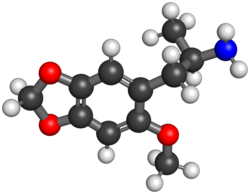
MMDA-2, also known as 2-methoxy-4,5-methylenedioxyamphetamine or as 6-methoxy-MDA, is a psychedelic drug of the phenethylamine, amphetamine, and MDxx families.12 It is the 6-methoxy derivative of MDA and is a positional isomer of MMDA (5-methoxy-MDA).12
Use and effects
In his book PiHKAL (Phenethylamines I Have Known and Loved), Alexander Shulgin lists MMDA-2's dose as 25 to 50 mg orally and its duration as 8 to 12 hours.12 The effects of MMDA-2 have been reported to include enhanced awareness, empathy, and visual facilitation and distortion, as well as some side effects like gastrointestinal upset and appetite loss.1 Shlgin states that MMDA-2 at a dose of 30 mg orally is very similar to MDA at a dose of 80 mg orally, and also remarks that it would be impossible for anyone to have a bad experience on the drug at that dose.1 MMDA-2 is approximately 4- or 5-fold more potent than MMDA, which has a listed dose range of 100 to 250 mg orally.1
Interactions
Pharmacology
Pharmacodynamics
MMDA-2 is a moderately potent serotonin receptor agonist in the rat stomach fundus assay (A2 = 224 nM).3 These serotonin receptors may correspond specifically to the serotonin 5-HT2B receptor.45
It has been found that MMDA-2, unlike MMDA but similarly to 6-methyl-MDA, is very weak or negligible at inducing the release of serotonin or dopamine in vitro.6 Accordingly, it does not produce amphetamine-like responses in animals in drug discrimination studies.7 Instead, MMDA-2 is likely to act as a pure serotonin 5-HT2 receptor agonist similarly to the DOx series of compounds, with activation of the serotonin 5-HT2A receptor believed to be responsible for its psychedelic effects.8
Chemistry
Synthesis
The chemical synthesis of MMDA-2 has been described.1
Analogues
Analogues of MMDA-2 include 2C-MMDA-2 (MMDPEA-2; 6-methoxy-MDPEA), MDA, MMDA (5-methoxy-MDA), MMDA-3a (2-methoxy-MDA), DMMDA-2 (5,6-dimethoxy-MDA; 5-methoxy-MMDA-2), methyl-MMDA-2 (N-methyl-MMDA-2; 6-methoxy-MDMA), EMDA-2 (6-ethoxy-MDA; 6-ethoxy-MMDA-2), 2C2-NBOMe (2C-MMDA-2-NBOMe; NBOMe-MMDPEA-2), F (5-methoxy-6-APDB), 4T-MMDA-2 (4-thio-MMDA-2), 6-methyl-MDA, 6-bromo-MDA (2-Br-4,5-MDA), and 6-chloro-MDA (2-Cl-4,5-MDA), among others.12
History
MMDA-2 was first described in the scientific literature by Alexander Shulgin in 1964.9 Subsequently, it was described in greater detail by Shulgin in his book PiHKAL (Phenethylamines I Have Known and Loved) in 1991.1 MMDA-2 was encountered as a novel designer drug by the 1990s.1011
Society and culture
Legal status
Canada
MMDA-2 may be a controlled substance in Canada under phenethylamine blanket-ban language.12
United States
MMDA-2 is not an explicitly controlled substance in the United States, but may be considered scheduled as an isomer of MMDA.1314
See also
See also
References
References
- Shulgin A, Shulgin A (13 May 2016). "MMDA-2 (2-Methoxy-4,5-methylenedioxyamphetamine)". Pihkal: A Chemical Love Story. Transform Press. ISBN 978-0-9630096-0-9.
- Trachsel D, Lehmann D, Enzensperger C (2013). Phenethylamine: von der Struktur zur Funktion [Phenethylamines: From Structure to Function]. Nachtschatten-Science (in German) (1 ed.). Solothurn: Nachtschatten-Verlag. ISBN 978-3-03788-700-4. OCLC 858805226. Archived from the original on 21 August 2025.
- Glennon RA, Liebowitz SM, Anderson GM (March 1980). "Serotonin receptor affinities of psychoactive phenalkylamine analogues". Journal of Medicinal Chemistry. 23 (3): 294–299. doi:10.1021/jm00177a017. PMID 7365744.
- Baxter GS, Murphy OE, Blackburn TP (May 1994). "Further characterization of 5-hydroxytryptamine receptors (putative 5-HT2B) in rat stomach fundus longitudinal muscle". British Journal of Pharmacology. 112 (1): 323–331. doi:10.1111/j.1476-5381.1994.tb13072.x. PMC 1910288. PMID 8032658.
- Nichols DE, Schooler D, Yeung MC, Oberlender RA, Zabik JE (September 1984). "Unreliability of the rat stomach fundus as a predictor of hallucinogenic activity in substituted phenethylamines". Life Sciences. 35 (13): 1343–1348. doi:10.1016/0024-3205(84)90390-4. PMID 6482656.
- McKenna DJ, Guan XM, Shulgin AT (March 1991). "3,4-Methylenedioxyamphetamine (MDA) analogues exhibit differential effects on synaptosomal release of 3H-dopamine and 3H-5-hydroxytryptamine". Pharmacology, Biochemistry, and Behavior. 38 (3): 505–512. doi:10.1016/0091-3057(91)90005-M. PMID 1829838. S2CID 2740262.
- Glennon RA, Yousif M, Naiman N, Kalix P (March 1987). "Methcathinone: a new and potent amphetamine-like agent". Pharmacology, Biochemistry, and Behavior. 26 (3): 547–551. doi:10.1016/0091-3057(87)90164-X. PMID 3575369. S2CID 5890314.
- Clare BW (2002). "QSAR of benzene derivatives: comparison of classical descriptors, quantum theoretic parameters and flip regression, exemplified by phenylalkylamine hallucinogens". Journal of Computer-Aided Molecular Design. 16 (8–9): 611–633. Bibcode:2002JCAMD..16..611C. doi:10.1023/A:1021966231380. PMID 12602954. S2CID 9948738.
- Shulgin AT (July 1964). "Psychotomimetic amphetamines: methoxy 3,4-dialkoxyamphetamines". Experientia. 20 (7): 366–367. doi:10.1007/BF02147960. PMID 5855670. Archived from the original on 2025-07-12.
- King LA (1996). "Designer drugs related to amphetamine (1990-1996)". J Clan Lab Invest Chem Assoc. 6 (3): 15–16.
- Min JZ, Shimizu Y, Toyo'oka T, Inagaki S, Kikura-Hanajiri R, Goda Y (October 2008). "Simultaneous determination of 11 designated hallucinogenic phenethylamines by ultra-fast liquid chromatography with fluorescence detection". Journal of Chromatography. B, Analytical Technologies in the Biomedical and Life Sciences. 873 (2): 187–194. doi:10.1016/j.jchromb.2008.08.020. PMID 18789774.
- "Controlled Drugs and Substances Act". Department of Justice Canada. Retrieved 19 January 2026.
- Orange Book: List of Controlled Substances and Regulated Chemicals (January 2026) (PDF), United States: U.S. Department of Justice: Drug Enforcement Administration (DEA): Diversion Control Division, January 2026
- Drug Enforcement Administration (3 December 2007). "Definition of "Positional Isomer" as It Pertains to the Control of Schedule I Controlled Substances". Federal Register.