| Emission nebula | |
|---|---|
| H II region | |
 | |
| Observation data: J2000 epoch | |
| Right ascension | 01h 34m 33.2s1 |
| Declination | +30° 47′ 06″1 |
| Distance | 2,700,000 ly (840,0002 pc) |
| Apparent magnitude (V) | +14.01 |
| Apparent dimensions (V) | 1.93′ x 1.2′ arcmins1 |
| Constellation | Triangulum |
| Physical characteristics | |
| Radius | 7603 ly |
| Absolute magnitude (V) | -13.8 |
| Notable features | massive H II region 3.5 million years old2 |
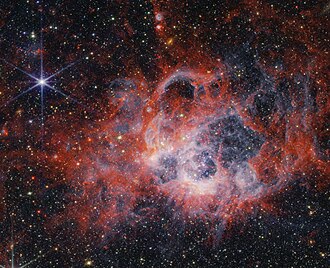
NGC 604 is an H II region inside the Triangulum Galaxy. It was discovered by William Herschel on September 11, 1784. It is among the largest H II regions in the Local Group of galaxies; at the galaxy's estimated distance of 2.7 million light-years, its longest diameter is roughly 1,520 light years (~460 parsecs), over 40 times the size of the visible portion of the Orion Nebula. It is over 6,300 times more luminous than the Orion Nebula, and if it were at the same distance it would outshine Venus. Its gas is ionized by a cluster of massive stars at its center4 with 200 stars of spectral type O and WR, a mass of 105 solar masses, and an age of 3.5 million years;2 however, unlike the Large Magellanic Cloud's Tarantula Nebula central cluster (R136), NGC 604's one is much less compact and more similar to a large stellar association.5

Notes
Notes
- Some data in the table was updated from Sue French's column "Deep-sky Wonders", in the January 2006 issue of Sky & Telescope, p. 83.
References
References
- "NASA/IPAC Extragalactic Database". Results for NGC 604. Retrieved 2006-09-03.
- Barba, Rodolfo (2004). "An in-depth analysis of a prototypical giant H II region: NGC 604". HST Proposal ID #10419: 10419. Bibcode:2004hst..prop10419B.
- distance × sin( diameter_angle / 2 ) = 760 ly. radius
- Nemiroff, R.; Bonnell, J., eds. (2 November 2002). "NGC 604: Giant Stellar Nursery". Astronomy Picture of the Day. NASA.
- Maíz-Apellániz, J.; Pérez, E.; Mas-Hesse, J. M. (2004). "NGC 604, the Scaled OB Association (SOBA) Prototype. I. Spatial Distribution of the Different Gas Phases and Attenuation by Dust". The Astronomical Journal. 128 (3): 1196–1218. arXiv:astro-ph/0406130. Bibcode:2004AJ....128.1196M. doi:10.1086/422925. S2CID 8099926.