| Tails | |
|---|---|
 | |
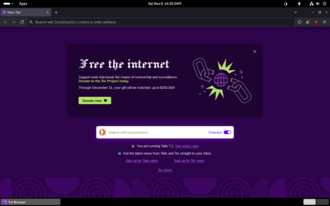 Tor Browser 14.5.8 running on Tails 7.1 | |
| Developer | The Tails Project |
| OS family | Linux (Unix-like) |
| Working state | Active |
| Source model | Open source |
| Initial release | June 23, 2009 (2009-06-23) |
| Latest release | 7.8.11  / 4 June 2026 (4 June 2026) / 4 June 2026 (4 June 2026) |
| Repository | |
| Marketing target | Personal computers |
| Update method | Tails Upgrader2 |
| Package manager | APT (front-end), dpkg |
| Supported platforms | x86-643 |
| Kernel type | Monolithic |
| Userland | GNU |
| Default user interface | GNOME 484 |
| License | GNU GPLv35 |
| Preceded by | Incognito |
| Official website | tails |
Tails, or "The Amnesic Incognito Live System", is a security-focused Debian-based Linux distribution running on a computer, aimed at preserving privacy and anonymity against surveillance.6 It connects to the Internet exclusively through the anonymity overlay network Tor.78 The system is designed to be booted as a live DVD or live USB and never writes to the hard drive or SSD, leaving no digital footprint on the machine unless explicitly told to do so.
In 2024, Tails merged with the Tor Project.910
History
Tails was first released on June 23, 2009. It is the next iteration of development on Incognito, a discontinued Gentoo-based Linux distribution.11 The original project was called Amnesia. The operating system was born when Amnesia was merged with Incognito.12 The Tor Project provided financial support for its development in the beginnings of the project.13 Tails also received funding from the Open Technology Fund, Mozilla, and the Freedom of the Press Foundation.14
Laura Poitras, Glenn Greenwald, Bruce Schneier and Barton Gellman have each said that Tails was an important tool they used in their work with National Security Agency whistleblower Edward Snowden.12151617
From release 3.0 (2017) onwards, Tails requires a 64-bit processor to run.18
In 2023, the Tails Project approached the Tor Project to merge operations. The merger was completed on September 26, 2024, stating that, "By joining forces, the Tails team can now focus on their core mission of maintaining and improving Tails OS, exploring more and complementary use cases while benefiting from the larger organizational structure of The Tor Project."910
Features
Tails must be installed on a DVD or USB stick dedicated to running Tails only, for security,19 and must be run on a PC-compatible computer, not a mobile phone or tablet.20 Though the system can also run as a virtual machine, running Tails in a virtual machine is potentially insecure.21
Tails' pre-installed desktop environment is GNOME. The system includes essential software for functions such as reading and editing documents, editing images, watching videos, printing, and instant messaging.22 It also includes specialized security software such as GnuPG to sign and encrypt files, the cryptocurrency wallet Electrum, and OnionShare to share files anonymously. Other software from Debian can be installed at the user's behest.23 Despite being open-source, Tails contains non-free firmware blobs.24
Tails forces all network connections to use Tor and includes a modified version of Tor Browser that comes with the uBlock Origin browser extension.25
By design, Tails is "amnesic". It runs in the computer's random access memory (RAM) and does not write to the hard drive or SSD. The user may choose to keep files, applications or some settings on their Tails drive in "Persistent Storage", which is encrypted by default, but is not hidden and easily detectable, though not readable, by forensic analysis.26 While shutting down, Tails overwrites most of the used RAM to avoid a cold boot attack.27
Hardware support
Tails is based on Linux. Linux generally supports a wide range of hardware, including many older devices, due to standardized drivers. There may be problems with some hardware for which Linux drivers are not available, or not supported by Tails. Wi-Fi hardware, in particular, can be incompatible without a workaround, requiring a cable for Internet connection. Touchpads and graphics can cause problems which can be worked around.282930
Security incidents
In 2014, Das Erste reported that the US National Security Agency (NSA)'s XKeyscore surveillance system sets threat definitions for people who search for Tails using a search engine or visit the Tails website. A comment in XKeyscore's source code calls Tails "a comsec mechanism advocated by extremists on extremist forums".3132
In the same year, Der Spiegel published slides from an internal NSA presentation dating to June 2012, in which the NSA deemed Tails on its own as a "major threat" to its mission and in conjunction with other privacy tools as "catastrophic".3334
In 2017, the US Federal Bureau of Investigation (FBI) used malicious code developed by Facebook, identifying sexual extortionist and Tails user Buster Hernandez through a zero-day vulnerability in the system's default video player, GNOME Videos. The exploit was never explained to or discovered by the Tails developers, but it is believed that the vulnerability was patched in a later release of Tails. Hernandez had eluded authorities for a long time; the FBI and Facebook had searched for him with no success, and resorted to developing the custom hacking tool. He was arrested in 2017, and in 2021 he was sentenced to 75 years in prison.35
See also
See also
References
References
- "New Release: Tails 7.8.1 | Tor Project". Retrieved June 4, 2026.
- "Upgrading a Tails USB stick". Tails. Retrieved June 13, 2026.
- "Tails - System requirements". tails.boum.org. Archived from the original on December 1, 2017. Retrieved June 15, 2017.
- "Tails 7.0". Tails. Retrieved June 13, 2026.
- "License and source code distribution". Tails. Retrieved June 13, 2026.
- Vervloesem, Koen (April 27, 2011). "The Amnesic Incognito Live System: A live CD for anonymity". LWN.net. Archived from the original on August 21, 2017. Retrieved August 12, 2012.
- "Anonym im Netz" [Anonymous on the Net]. TecChannel (in German). February 6, 2012. Archived from the original on April 1, 2016. Retrieved August 12, 2012.
- "Alternative Networks". Privacy Guides. Retrieved November 12, 2025.
- "Tails - Uniting for Internet Freedom: Tor Project & Tails Join Forces". tails.net. Archived from the original on January 26, 2025. Retrieved September 26, 2024.
- Sawers, Paul (September 26, 2024). "The Tor Project merges with Tails, a Linux-based portable OS focused on privacy". TechCrunch. Archived from the original on September 26, 2024. Retrieved September 26, 2024.
- Gray, James (September 16, 2011). "The Tails Project's The Amnesic Incognito Live System (Tails)". Linux Journal. Archived from the original on August 13, 2019. Retrieved August 12, 2012.
- Finley, Klint (April 14, 2014). "Out in the Open: Inside the Operating System Edward Snowden Used to Evade the NSA". WIRED. Archived from the original on April 19, 2014. Retrieved April 18, 2014.
- "Finances". Tails. April 4, 2013. Archived from the original on March 29, 2019. Retrieved May 13, 2013.
- "Tails report for May, 2014". Tails. June 14, 2014. Archived from the original on July 1, 2014. Retrieved July 6, 2014.
- Timm, Trevor (April 2, 2014). "Help Support the Little-Known Privacy Tool That Has Been Critical to Journalists Reporting on the NSA". Freedom of the Press Foundation. Archived from the original on July 20, 2014. Retrieved April 18, 2014.
- Condliffe, Jamie (April 15, 2014). "Try the Super-Secure USB Drive OS That Edward Snowden Insists on Using". Gizmodo. Archived from the original on April 15, 2014. Retrieved April 15, 2014.
- "Air Gaps - Schneier on Security". www.schneier.com. October 11, 2013. Archived from the original on August 3, 2023. Retrieved August 3, 2023.
- "Tails - Tails 3.0 is out". tails.boum.org. Archived from the original on May 22, 2019. Retrieved June 14, 2017.
- "Frequently asked questions: Do I need a USB stick dedicated to Tails?". Tails. Retrieved June 13, 2026.
- "Install Tails". Tails. Retrieved February 26, 2026.
- "Running Tails in a virtual machine". Tails. Retrieved June 13, 2026.
- "Features and included software". tails.boum.org. October 7, 2019. Archived from the original on August 23, 2019. Retrieved October 7, 2019.
- "Installing additional software". Tails. Retrieved June 13, 2026.
- "Explaining Why We Don't Endorse Other Systems". www.gnu.org. Archived from the original on June 22, 2023. Retrieved June 23, 2023.
- "Browsing the web with Tor Browser". tails.boum.org. Archived from the original on February 8, 2022. Retrieved March 16, 2022.
- "Persistent Storage". Tails. Retrieved June 13, 2026.
- "Protection against cold boot attacks". Tails. Retrieved June 13, 2026.
- "Known issues - sections 'Networking issues' and 'Other hardware issues'". Tails. Retrieved February 26, 2026.
- "The Battle for Wireless Drivers in Linux and BSD – OSnews". March 22, 2025. Archived from the original on March 22, 2025. Retrieved May 24, 2025.
- "Why does Wi-Fi have to be such a pain in Linux? - LinuxQuestions.org". July 28, 2017. Archived from the original on July 28, 2017. Retrieved May 24, 2025.
- Appelbaum, J.; Gibson, A.; Goetz, J.; Kabisch, V.; Kampf, L.; Ryge, L. (July 3, 2014). "NSA targets the privacy-conscious". DasErste.de. Archived from the original on May 23, 2016. Retrieved July 3, 2014.
- Bruce Schneier (July 3, 2014). "NSA Targets Privacy Conscious for Surveillance". Schneier on Security. Archived from the original on June 20, 2023. Retrieved July 3, 2014.
- SPIEGEL Staff (December 28, 2014). "Prying Eyes: Inside the NSA's War on Internet Security". Der Spiegel. Archived from the original on January 24, 2015. Retrieved January 23, 2015.
- "Presentation from the SIGDEV Conference 2012 explaining which encryption protocols and techniques can be attacked and which not" (PDF). Der Spiegel. December 28, 2014. Archived from the original (PDF) on December 30, 2014. Retrieved January 23, 2015.
- Franceschi-Bicchierai, Lorenzo (June 10, 2020). "Facebook Helped the FBI Hack a Child Predator". Vice. Archived from the original on June 13, 2020. Retrieved June 12, 2020.