| GNU | |
|---|---|
 | |
 | |
| Developer | Community |
| Written in | Various languages (notably C and assembly language) |
| OS family | Unix-like |
| Working state | Current |
| Source model | Free software |
| Marketing target | Personal computers, mobile devices, embedded devices, servers, mainframes, supercomputers |
| Supported platforms | Alpha, ARC, ARM, AVR32, Blackfin, C6x, ETRAX CRIS, FR-V, H8/300, IA-32/x86-64, Hexagon, Itanium, M32R, m68k, META, MicroBlaze, MIPS, MN103, OpenRISC, PA-RISC, PowerPC, s390/s390x, S+core, SuperH, SPARC, TILE64, Unicore32, Xtensa, RISC-V (with Linux-libre kernel only) |
| Kernel type | Microkernel (GNU Hurd) or Monolithic kernel (GNU Linux-libre, fork of Linux) |
| Userland | GNU |
| License | GNU GPL, GNU LGPL, GNU AGPL, GNU FDL, GNU FSDG12 |
| Official website | gnu |
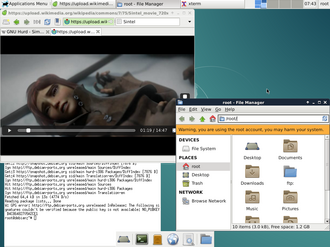
GNU (/ɡnuː/ ⓘ GNOO)34 is an extensive collection of free software (387 packages as of June 2025),5 which can be used as an operating system or can be used in parts with other operating systems.678 Most of GNU is licensed under the GNU Project's own General Public License (GPL).
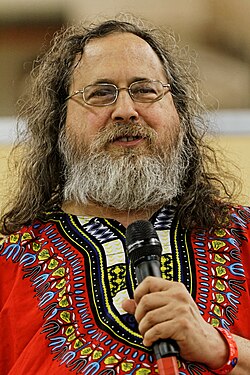
GNU is also the project within which the free software concept originated. Richard Stallman, the founder of the project, views GNU as a "technical means to a social end".9 Relatedly, Lawrence Lessig states in his introduction to the second edition of Stallman's book Free Software, Free Society that in it Stallman has written about "the social aspects of software and how Free Software can create community and social justice".10
Name
GNU is a recursive acronym for "GNU's Not Unix!",611 chosen because GNU's design is Unix-like, but differs from Unix by being free software and containing no Unix code.61213 Stallman chose the name by using various plays on words, including the song "The Gnu".4: 45:30
History
Before the 1980s there existed a widespread practice of sharing software in ways similar to what is now considered free software where the participants are free to share copies of the software. Richard Stallman was a part of a group of developers at the MIT Artificial Intelligence Laboratory working on the Incompatible Timesharing System, an operating system which was effectively developed as what is now seen as free software.1415 This community soon fell to ruin however as the PDP-10 platform which the operating system was developed for was discontinued. According to Stallman, what prompted him to start the GNU Project was having previously had an experience with Xerox refusing to give him access to the source code of a laser printer used at the MIT Lab, now with the realization that this community of sharing software would end and noticing the advancing spread of proprietary software which had undone the culture of sharing software that had previously existed, Richard Stallman refused to adapt by continuing with proprietary software, and he instead decided that with this skills as an operating systems programmer,15 he would begin the development of a new free software operating system and to recreate a community of sharing software that was lost, called GNU.1415
Development of the GNU software was initiated by Richard Stallman while he worked at the MIT Artificial Intelligence Laboratory. It was called the GNU Project, and was publicly announced on September 27, 1983, on the net.unix-wizards and net.usoft newsgroups by Stallman.16 Software development began on January 5, 1984, when Stallman quit his job at the Lab so that they could not claim ownership or interfere with distributing GNU components as free software.17
The goal was to bring a completely free software operating system into existence. Stallman wanted computer users to be free to study the source code of the software they use, share software with other people, modify the behavior of software, and publish their modified versions of the software. This philosophy was published as the GNU Manifesto in March 1985.18
Richard Stallman's experience with the Incompatible Timesharing System (ITS),17 an early operating system written in assembly language that became obsolete due to discontinuation of PDP-10, the computer architecture for which ITS was written, led to a decision that a portable system was necessary.4: 40:52 19 It was thus decided that the development would be started using C and Lisp as system programming languages,20 and that GNU would be compatible with Unix.21 At the time, Unix was already a popular proprietary operating system. The design of Unix was modular, so it could be reimplemented piece by piece.19
Much of the needed software had to be written from scratch, but existing compatible third-party free software components were also used such as the TeX typesetting system, the X Window System, and the Mach microkernel that forms the basis of the GNU Mach core of GNU Hurd (the official kernel of GNU).22 With the exception of the aforementioned third-party components, most of GNU has been written by volunteers; some in their spare time, some paid by companies,23 educational institutions, and other non-profit organizations. In October 1985, Stallman set up the Free Software Foundation (FSF). In the late 1980s and 1990s, the FSF hired software developers to write the software needed for GNU.2425
As GNU gained prominence, interested businesses began contributing to development or selling GNU software and technical support. The most prominent and successful of these was Cygnus Solutions,23 now part of Red Hat.26
Components
The system's basic components include the GNU Compiler Collection (GCC), the GNU C library (glibc), and GNU Core Utilities (coreutils),6 but also the GNU Debugger (GDB), GNU Binary Utilities (binutils),27 and the GNU Bash shell.222829 GNU developers have contributed to Linux ports of GNU applications and utilities, which are now also widely used on other operating systems such as BSD variants, Solaris and macOS.30
Many GNU programs have been ported to other operating systems, including proprietary platforms such as Microsoft Windows31 and macOS.32 GNU programs have been shown to be more reliable than their proprietary Unix counterparts.3334
As of June 2024, there are a total of 467 GNU packages (including decommissioned, 394 excluding) hosted on the official GNU development site.35
GNU as an operating system
With kernels maintained by GNU and FSF

GNU Hurd
The original kernel of GNU Project is the GNU Hurd (together with the GNU Mach microkernel), which was the original focus of the Free Software Foundation (FSF).6363738
With the April 30, 2015 release of the Debian GNU/Hurd 2015 distro,3940 GNU now provides all required components to assemble an operating system that users can install and use on a computer.414243
However, the Hurd kernel is not yet considered production-ready but rather a base for further development and non-critical application usage.4441
Linux-libre
In 2012, a fork of the Linux kernel became officially part of the GNU Project in the form of Linux-libre, a variant of Linux with all proprietary components removed.45 The GNU Project has endorsed Linux-libre distributions, such as Trisquel, Parabola GNU/Linux-libre, PureOS and GNU Guix System.46
With non-GNU kernels
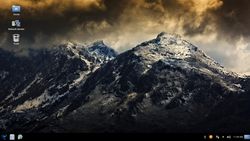
Because of the development status of Hurd, GNU is usually paired with other kernels such as Linux4748 or FreeBSD.49 Whether the combination of GNU libraries with external kernels is a GNU operating system with a kernel (e.g. GNU with Linux), because the GNU collection renders the kernel into a usable operating system as understood in modern software development, or whether the kernel is an operating system unto itself with a GNU layer on top (i.e. Linux with GNU), because the kernel can operate a machine without GNU, is a matter of ongoing debate. The FSF maintains that an operating system built using the Linux kernel and GNU tools and utilities should be considered a variant of GNU, and promotes the term GNU/Linux for such systems (leading to the GNU/Linux naming controversy). This view is not exclusive to the FSF.5051525354 Notably, Debian, one of the biggest and oldest Linux distributions, refers to itself as Debian GNU/Linux.55
Logo

The logo for GNU is a gnu head. Originally drawn by Etienne Suvasa, a bolder and simpler version designed by Aurelio Heckert is now preferred.5657 It appears in GNU software and in printed and electronic documentation for the GNU Project, and is also used in Free Software Foundation materials.

There was also a modified version of the official logo. It was created by the Free Software Foundation in September 2013 in order to commemorate the 30th anniversary of the GNU Project.58
See also
See also
References
References
- "GNU Licenses".
- "GNU FSDG".
- "What is GNU?". The GNU Operating System. Free Software Foundation. September 4, 2009. Retrieved October 9, 2009.
The name 'GNU' is a recursive acronym for 'GNU's Not Unix'; it is pronounced g-noo, as one syllable with no vowel sound between the g and the n.
- Stallman, Richard (March 9, 2006). The Free Software Movement and the Future of Freedom. Zagreb, Croatia: Free Software Foundation Europe. Retrieved February 20, 2007.
- Stallman, Richard. "Software – GNU Project". GNU Project. Free Software Foundation, Inc. Retrieved January 9, 2022.
- St. Amant, Kirk; Still, Brian (2007). Handbook of Research on Open Source Software: Technological, Economic, and Social Perspectives. Information Science Reference. ISBN 978-1-59140999-1. OCLC 1028442948.
- "GNU Manifesto". GNU project. FSF. Retrieved July 27, 2011.
- Raymond, Eric (February 1, 2001). The Cathedral & the Bazaar: Musings on Linux and Open Source by an Accidental Revolutionary. O'Reilly Media, Inc. pp. 10–12. ISBN 978-0-59600108-7.
- Stallman, Richard (1986), "KTH", Philosophy (speech), GNU, Stockholm, Sweden: FSF.
- Stallman, Richard M.; Gay, Joshua (December 2009). Free Software, Free Society: Selected Essays Of Richard M. Stallman. CreateSpace Independent Publishing Platform. ISBN 9781441436856. Retrieved March 24, 2016.
- "GNU's Not Unix". The free dictionary. Retrieved September 22, 2012.
- "The GNU Operating system". GNU project. FSF. Retrieved August 18, 2008.
- Marshall, Rosalie (November 17, 2008). "Q&A: Richard Stallman, founder of the GNU Project and the Free Software Foundation". AU: PC & Tech Authority. Retrieved September 22, 2012.
- "Untitled Document". cs.stanford.edu. Archived from the original on July 12, 2019. Retrieved May 10, 2026.
- "Free Software: Freedom and Cooperation". www.gnu.org. Archived from the original on December 25, 2015. Retrieved May 10, 2026.
- Stallman, Richard (September 27, 1983). "new UNIX implementation". Newsgroup: net.unix-wizards. Usenet: 771@mit-eddie.UUCP. Retrieved August 18, 2008.
- Holmevik, Jan Rune; Bogost, Ian; Ulmer, Gregory (March 2012). Inter/vention: Free Play in the Age of Electracy. MIT Press. pp. 69–71. ISBN 978-0-262-01705-3.
- Stallman, Richard (March 1985). "The {GNU} Manifesto". Dr. Dobb's Journal of Software Tools. 10 (3): 30. Retrieved October 18, 2011.
- DiBona, Chris; Stone, Mark; Cooper, Danese (October 2005). Open Sources 2.0: The Continuing Evolution. O'Reilly Media, Inc. pp. 38–40. ISBN 9780596008024.
- "Timeline of GNU/Linux and Unix".
Both C and Lisp will be available as system programming languages.
- Seebach, Peter (November 2008). Beginning Portable Shell Scripting: From Novice to Professional (Expert's Voice in Open Source). Apress. pp. 177–178. ISBN 9781430210436.
- Kerrisk, Michael (October 2010). The Linux Programming Interface: A Linux and UNIX System Programming Handbook. No Starch Press. pp. 5–6. ISBN 9781593272203.
- Open Sources: Voices from the Open Source Revolution. O'Reilly & Associates, Inc. January 1999. ISBN 978-1-56592-582-3.
- Buxmann, Peter; Diefenbach, Heiner; Hess, Thomas (September 30, 2012). The Software Industry. Springer. pp. 187–196. ISBN 9783642315091.
- Practical UNIX and Internet Security, 3rd Edition. O'Reilly & Associates, Inc. February 2003. p. 18. ISBN 9781449310127.
- Stephen Shankland (November 15, 1999). "Red Hat buys software firm, shuffles CEO". CNET. CBS Interactive. Retrieved March 5, 2016.
- "GCC & GNU Toolchains – AMD". Developer.amd.com. Archived from the original on March 16, 2015. Retrieved September 2, 2015.
- Matthew, Neil; Stones, Richard (April 22, 2011). "The GNU Project and the Free Software Foundation". Beginning Linux Programming. John Wiley & Sons. ISBN 9781118058619.
- Sowe, Sulayman K; Stamelos, Ioannis G; Samoladas, Ioannis M (May 2007). Emerging Free and Open Source Software Practices. Idea Group Inc (IGI). pp. 262–264. ISBN 9781599042107.
- "Linux: History and Introduction". Buzzle.com. August 25, 1991. Archived from the original on December 11, 2017. Retrieved September 22, 2012.
- McCune, Mike (December 2000). Integrating Linux and Windows. Prentice Hall Professional. p. 30. ISBN 9780130306708.
- Sobell, Mark G; Seebach, Peter (2005). A Practical Guide To Unix For Mac Os X Users. Prentice Hall Professional. p. 4. ISBN 9780131863330.
- Fuzz Revisited: A Re-examination of the Reliability of UNIX Utilities and Services – October 1995 – Computer Sciences Department, University of Wisconsin
- "An Inquiry into the Stability and Reliability of UNIX Utilities" (PDF). Archived (PDF) from the original on December 22, 2009.
- "Software – GNU Project". Free Software Foundation, Inc. January 13, 2016. Retrieved January 13, 2016.
- Vaughan-Nichols, Steven J. "Opinion: The top 10 operating system stinkers", Computerworld, April 9, 2009: "... after more than 25 years in development, GNU remains incomplete: its kernel, Hurd, has never really made it out of the starting blocks. ... Almost no one has actually been able to use the OS; it's really more a set of ideas than an operating system."
- Hillesley, Richard (June 30, 2010), "GNU HURD: Altered visions and lost promise", The H (online ed.), p. 3,
Nearly twenty years later the HURD has still to reach maturity, and has never achieved production quality. ... Some of us are still wishing and hoping for the real deal, a GNU operating system with a GNU kernel.
- Lessig, Lawrence (2001). The Future of Ideas: The Fate of the Commons in a Connected World. Random House. p. 54. ISBN 978-0-375-50578-2.
He had mixed all of the ingredients needed for an operating system to function, but he was missing the core.
- "Debian GNU/Hurd 2015 Released – Phoronix". www.phoronix.com. Retrieved March 24, 2016.
- "Debian GNU/Hurd 2015 released!". lists.debian.org. Retrieved March 24, 2016.
- "status". www.gnu.org. Retrieved March 24, 2016.
- "Debian – Debian GNU/Hurd". www.debian.org. Retrieved March 24, 2016.
- "Debian – Debian GNU/Hurd – Configuration". www.debian.org. Retrieved March 24, 2016.
- Status, Free Software Foundation, May 3, 2015, retrieved April 24, 2017
- "GNU Linux-libre". December 17, 2012. Retrieved February 9, 2013.
- "List of Free GNU/Linux Distributions", GNU Project, Free Software Foundation (FSF).
- "1.2 What is Linux?", Debian open book, O'Reilly, October 5, 1991, retrieved September 22, 2012
- "What is GNU/Linux?", Ubuntu Installation Guide (12.4 ed.), Canonical, archived from the original on June 21, 2015, retrieved June 22, 2015
- Kavanagh, Paul (July 26, 2004). Open Source Software: Implementation and Management. Elsevier. p. 129. ISBN 978-1-55558320-0.
- Welsh, Matt (September 8, 1994). "Linux is a GNU system and the DWARF support". Newsgroup: comp.os.linux.misc. Retrieved February 3, 2008.
RMS's idea (which I have heard first-hand) is that Linux systems should be considered GNU systems with Linux as the kernel.
- Proffitt, Brian (July 12, 2012). "Debian GNU/Linux seeks alignment with Free Software Foundation". ITworld. Archived from the original on July 15, 2012. Retrieved September 22, 2012.
- "1.1. Linux or GNU/Linux, that is the question". SAG. TLDP. Archived from the original on December 30, 2005. Retrieved September 22, 2012.
- "GNU Operating System – CCM FAQ". CCM. Archived from the original on December 15, 2019. Retrieved April 8, 2018.
GNU is an operating system that offers a set of free open source programs.
- Snom Technology. "Source Code & GPL Open Source". www.snom.com. Archived from the original on April 9, 2018. Retrieved April 8, 2018.
Variants of the GNU operating system, which use the kernel Linux, are now widely used; though these systems are often referred to as "Linux", they are more accurately called "GNU/Linux systems".
- "Chapter 1. Definitions and overview".
- "A GNU Head". Free Software Foundation (FSF). July 13, 2011. Retrieved July 27, 2011.
- "A Bold GNU Head". Free Software Foundation. July 13, 2011. Retrieved July 27, 2011.
- "GNU 30th Anniversary". Free Software Foundation. October 8, 2013. Retrieved December 15, 2014.
External links
External links
- Official website

- The GNU Project web server, prep.ai.mit.edu at the Wayback Machine (archived 2000-10-25)
- unxutils.sourceforge.net, Ports of GNU utilities for Microsoft Windows
- www.verbumvanum.org/pesalus, The daemon, the GNU and the penguin at the Wayback Machine (archived 2017-06-29)