| OpenMediaVault | |
|---|---|
 | |
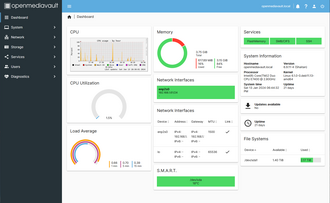 Web interface (2025) | |
| Developer | Volker Theile |
| Written in | Web interface: PHP, TypeScript (Angular) |
| OS family | Unix-like |
| Working state | Current |
| Source model | Open source |
| Initial release | 17 October 2011 (2011-10-17) |
| Latest release | 8.4.01  / 14 June 2026 (14 June 2026) / 14 June 2026 (14 June 2026) |
| Repository | |
| Marketing target |
|
| Available in | English, Chinese, Czech, Danish, Dutch, French, Galician, German, Greek, Hungarian, Italian, Japanese, Korean, Norwegian, Polish, Portuguese, Russian, Spanish, Swedish, Turkish, Ukrainian2 |
| Update method | APT |
| Package manager | dpkg |
| Supported platforms | |
| Kernel type | Monolithic (Linux) |
| Userland | GNU |
| Default user interface | Web-based |
| License | Free software (GPL v3) |
| Preceded by | FreeNAS v0.7 |
| Official website | www |
OpenMediaVault (OMV) is a free Linux distribution designed for network-attached storage (NAS).34 The project's lead developer is Volker Theile, who instituted it in 2009. OMV is based on the Debian operating system, and is licensed through the GNU General Public License v3.5
Background
By the end of 2009, Volker Theile was the only active developer of FreeNAS, a NAS operating system that Olivier Cochard-Labbé started developing from m0n0wall in 2005.678 m0n0wall is a variation of the FreeBSD operating system, and Theile decided he wanted to rewrite FreeNAS for Linux. The project team had known for months that FreeNAS needed a major rewrite in order to support crucial features.7 Since Cochard-Labbé preferred to stay with a FreeBSD-based system, he and Theile agreed that Theile would develop his Linux version under a different name;6 that name was initially coreNAS, but within a matter of days Theile discarded it in favour of OpenMediaVault.8
Technical design
Theile chose Debian because the large number of programs in its package management system meant that he wouldn't have to spend time repackaging software himself.9 OpenMediaVault makes a few changes to the Debian operating system. It provides a Web-based user interface for administration and customisation, and a plug-in API for implementing new features. One can install plug-ins through the Web interface.
Features
- Multi-language, Web-based graphical user interface10
- Protocols: CIFS (via Samba), FTP, NFS (versions 3 and 4), SSH, rsync, iSCSI, AFP and TFTP
- Software-RAID (levels 0, 1, 4, 5, 6, and 10, plus JBOD)
- Monitoring: Syslog, Watchdog, S.M.A.R.T., SNMP (v1, 2c, and 3) (read-only)
- Statistic reports via e-mail
- Statistic graphs for the CPU-workload, LAN transfer rates, hard disk usage and RAM allocation
- GPT/EFI partitioning >2 TByte possible
- File systems: ext2, ext3, ext4, Btrfs, XFS, JFS, NTFS, FAT32 (ZFS with third-party plug-in)
- Quota
- User and group management
- Access controls via ACL
- Link aggregation bonding, Wake-on-LAN
- Plug-in system
Plug-ins
By default, OpenMediaVault comes with a limited set of plug-ins. These include:
- AirPlay – Stream music wirelessly to your iPod/iPad/iPhone/iTunes.
- ClamAV – Antivirus software11
- Diskstats – Complementary plugin to extend system statistics collection by adding I/O statistic graphs.
- Digital Audio Access Protocol (DAAP) – provides audio files in a local network (also for iTunes)
- FileBrowser – File managing interface.
- FTP – Provides a modular FTP/SFTP/FTPS server.
- Logical Volume Manager – enables the possibility to create and administrate dynamic partitions
- Network UPS Tools, to support the use of an uninterruptible power supply
- OneDrive – Synchronizing a shared folder with Microsoft OneDrive cloud storage.
- PhotoPrism – AI-powered app for browsing, organizing & sharing your photo collection.
- Podman – A tool for managing containers and images, volumes mounted into those containers, and pods made from groups of containers.
- S3 – MinIO based high-performance, S3 compatible object storage.
- ShareRootFs – Provides shared directories on root file system.
- SNMP
- TFTP
- USB Backup – Allows (automatic) backups to external USB hard disks
- WeTTY – Terminal access in browser over HTTP/HTTPS.
Third-party plug-ins
Additional plug-ins are available via additional package repositories. The majority of those Plug-ins are developed by a group called OpenMediaVault Plugin Developers.12 The status of all Plug-ins can be viewed online.13 In October 2014 there were around 30 plugins available. In June 2015 there were more than 70 stable plug-ins available.
Some of the software that is controllable via third-party plug-ins are:14
- File synchronization: BitTorrent Sync and Syncthing
- Calibre – e-book manager
- Backup: Borg, Clonezilla, duplicati, rsnapshot and SystemRescueCD
- CUPS – print server
- Docker
- eXtplorer – Web-based file manager
- Greyhole, Union mount, and SnapRAID
- KVM
- Let's Encrypt
- Database servers: MySQL / MariaDB and PostgreSQL
- Nginx – Web server
- virtual private networking: OpenVPN and WireGuard
- Media servers: minidlna, Plex and Subsonic
- Download managers: pyLoad and JDownloader
- RDP
- Roundcube – Web-based mail client
- SYSLINUX – Preboot Execution Environment (PXE)
- Usenet download managers: Sickbeard, SABnzdb, Headphones, Couch Potato
- Transmission – a BitTorrent client
- Video Disk Recorder
- VirtualBox – virtual machine host
- WebDAV
- WordPress – blog software
- ZFS – an advanced file system
- and many more
Minimum System requirements
- Any Architecture/hardware1516 that is supported by Debian
- 1 GiB RAM
- 4 GiB hard drive, solid-state drive, or USB flash drive with static wear leveling support for the OS.
- 1 hard drive, solid-state drive, or USB flash drive for storing user data
Release history
For each OpenMediaVault release, Theile chooses a project code name from Frank Herbert's Dune novels.17
| Version | Name | Release Date | EOL Date | Base | Notes |
|---|---|---|---|---|---|
| Unsupported: 0.2 | Ix | 2011-10-1718 | ? | Debian 6 | Named for the planet Ix. |
| Unsupported: 0.3 | Omnius | 2012-04-1819 | 2012-12-3020 | Introduced multi-language web interface and graphical user prompt for rights administration via Access Control List. The release is named for Omnius, a sentient computer network in the Legends of Dune trilogy. | |
| Unsupported: 0.4 | Fedaykin | 2012-09-212122 | 2013-12-0923 | Named for the Fedaykin commandos of the Fremen people. | |
| Unsupported: 0.5 | Sardaukar | 2013-08-2524 | ? | Revised API renders v0.4 plugins incompatible.25 | |
| Unsupported: 1.0 | Kralizec | 2014-09-1526 | 2015-12-2627 | Debian 7 | Improves support for weaker systems; adds a dashboard with support for widgets; improved infrastructure for plug-ins. This release is named for Kralizec, a battle predicted to occur at the end of the universe. |
| Unsupported: 2.0 | Stone burner | 2015-06-292829 | 2017-12-0630 | Sencha ExtJS 5.1.1 Framework for the WebGUI; revised GUI supports configuration of WiFi, VLAN, et al. This release is named for the stone burner, a nuclear weapon held by House Atreides. | |
| Unsupported: 3.0 | Erasmus31 | 2017-06-13 | 2018-07-0932 | Debian 8 | Named for the robot Erasmus. |
| Unsupported: 4.0 | Arrakis33 | 2018-05-08 | 2020-06-3034 | Debian 9 | Named for the planet Dune. |
| Unsupported: 5.035 | Usul36 | 2020-03-30 | 2022-06-3037 | Debian 10 | Named for the secret name of Paul Atreides (Usul) in Dune. |
| Unsupported: 6.038 | Shaitan | 2022-05-0439 | 2024-07-3140 | Debian 11 | Named for the Fremen term for demon and later to the transformed God Emperor Leto Atreides II. |
| Supported: 7.0 | Sandworm | 2024-03-0341 | ? | Debian 12 | Named for the sandworm creature. |
| Latest version: 8.0 | Synchrony | 2025-12-2442 | ? | Debian 13 | Named for the synchrony creature. |
Legend: Unsupported Supported Latest version Preview version Future version | |||||
See also
See also
- Direct Attached Storage (DAS)
- Storage Area Network (SAN)
- TrueNAS (formerly FreeNAS) - the FreeBSD-based NAS from which OpenMediaVault was originally forked
- NexentaOS - open source OS and enterprise class NAS with kernel based ZFS
- Openfiler - CentOS-based NAS operating system
- XigmaNAS - another FreeBSD-based NAS operating system, XigmaNAS is a continuation of the original FreeNAS code which was developed between 2005 and late 2011
References
References
- "New updates available". Volker Theile. 14 June 2026. Retrieved 20 June 2026.
- "OpenMediaVault". Transifex. Archived from the original on 1 April 2016. Retrieved 3 June 2016.
- Huber, Mathias (8 December 2009). "FreeNAS: BSD Line and Linux Fork". Linux Magazine. Retrieved 3 June 2016.
- Halfacree, Gareth (19 July 2012). "WHS Alternatives: Media Streaming". bit-tech.
- GNU General Public License Version 3, 29 June 2007
- Baader, Hans-Joachim (20 October 2011). "Erste Version der NAS-Distribution OpenMediaVault" [First Version of the NAS Distribution OpenMediaVault]. Pro-Linux (in German). Retrieved 3 June 2016.
- "FreeNAS vs OpenMediaVault". FreeNAS.org. iXsystems. Retrieved 3 June 2016.
- Thoma, Jörg (7 December 2009). "FreeNAS bleibt bei FreeBSD" [FreeNAS Stays on FreeBSD]. Golem.de (in German). Retrieved 3 June 2016.
- Seifried, Steven (10 April 2015). "Interview with OpenMediaVault developer Volker Theile". Canox.net. Archived from the original on 23 May 2016. Retrieved 3 June 2016.
- "OpenMediaVault Features". openmediavault.org. Retrieved 29 August 2016.
- "OpenMediaVault Package Repository". openmediavault.org. Retrieved 29 August 2016.
- github.com, "OpenMediaVault Plugin Developers" Retrieved 2014-10-03
- omv-extras.org, "Latest updates..." Retrieved 2014-10-03
- "OpenMediaVault Plugin Developers Package Repository". bintray.com. Retrieved 29 August 2016.
- debian.org/ports. Debian Website, List of ports
- wiki.debian.org/Hardware. Debian Wiki, Supported Hardware
- Theile, Volker (14 July 2011). "First release of OpenMediaVault is called Ix". OpenMediaVault.org. Retrieved 3 June 2016.
- OpenMediaVault 0.2 (Ix) has been released
- OpenMediaVault 0.3 BETA available
- OpenMediaVault 0.3.x end-of-life
- Package repository for 0.4 (Fedaykin) is up
- New updates available - OpenMediaVault 0.4.0.1 released
- OMV 0.4 EOL
- OpenMediaVault 0.5 (Sardaukar) released
- OpenMediaVault Blog. 3rd Party Plug-ins. Retrieved 2013-08-31
- OpenMediaVault 1.0 (Kralizec) released
- OMV 1.x is now EOL
- OMV 2.0 (Stone Burner) will be available soon
- Release of OpenMediaVault 2.1 (Stone burner)
- OMV 2.x is now EOL
- Theile, Volker (17 December 2015). "OMV 3 (Erasmus) on Debian 8 (Jessie)". OpenMediaVault.org. Retrieved 24 June 2016.
- OMV 3.x is now EOL
- Theile, Volker (27 February 2017). "Results from SUSE Hack Week". OpenMediaVault.org. Retrieved 16 March 2017.
- openmediavault 4 goes EOL
- Theile, Volker (21 August 2019). "Releases". openmediavault.readthedocs.io. Retrieved 6 October 2019.
- Theile, Volker (4 May 2022). "Results from Openmediavault Blog". OpenMediaVault.org.
- openmediavault 5 goes EOL
- Theile, Volker (4 May 2022). "Releases". openmediavault.readthedocs.io. Retrieved 12 May 2022.
- Theile, Volker (4 May 2022). "Release of openmediavault 6 (Shaitan)". .openmediavault.org. Retrieved 12 May 2022.
- Theile, Volker (9 July 2024). "openmediavault 6 approaching EOL". .openmediavault.org. Retrieved 9 July 2024.
- Theile, Volker (3 March 2024). "Release of openmediavault 7 (Sandworm)". OpenMediaVault.org. Retrieved 23 March 2024.
- Theile, Volker (24 December 2025). "OMV8 (Synchrony) released". OpenMediaVault.org. Retrieved 24 December 2025.
External links
External links
- Official website
- OpenMediaVault on SourceForge
- OpenMediaVault on DistroWatch
- OpenMediaVault on PcMac