| LRRIQ3 | |||||||||||||||||||||||||||||||||||||||||||||||||||
|---|---|---|---|---|---|---|---|---|---|---|---|---|---|---|---|---|---|---|---|---|---|---|---|---|---|---|---|---|---|---|---|---|---|---|---|---|---|---|---|---|---|---|---|---|---|---|---|---|---|---|---|
| Identifiers | |||||||||||||||||||||||||||||||||||||||||||||||||||
| Aliases | LRRIQ3, LRRC44, leucine-rich repeats and IQ motif containing 3, leucine rich repeats and IQ motif containing 3 | ||||||||||||||||||||||||||||||||||||||||||||||||||
| External IDs | OMIM: 617957; MGI: 1921685; HomoloGene: 23668; GeneCards: LRRIQ3; OMA:LRRIQ3 - orthologs | ||||||||||||||||||||||||||||||||||||||||||||||||||
| |||||||||||||||||||||||||||||||||||||||||||||||||||
| |||||||||||||||||||||||||||||||||||||||||||||||||||
| |||||||||||||||||||||||||||||||||||||||||||||||||||
| |||||||||||||||||||||||||||||||||||||||||||||||||||
| Wikidata | |||||||||||||||||||||||||||||||||||||||||||||||||||
| |||||||||||||||||||||||||||||||||||||||||||||||||||




LRRIQ3 (Leucine-rich repeats and IQ motif containing 3), which is also known as LRRC44, is a protein that in humans is encoded by the LRRIQ3 gene.5 It is predominantly expressed in the testes, and is linked to a number of diseases.6
Gene
Locus
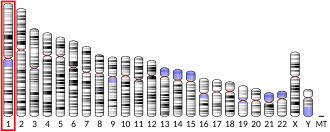
LRRIQ3 is found on the minus strand of the end of the short arm of human chromosome 1 at 1p31.1.7
Overall Structure
There are a total of 7 exons in the putative sequence of LRRIQ3.7
mRNA
Expression
LRRIQ3 is expressed as 2 primary isoforms, which produce proteins of length 624 amino acids and 464 amino acids respectively.7 It is expressed at low levels in human and brown rat tissues,89 with highest expression levels in testes tissue. There are relatively high expression levels in T cells, the epididymis, the kidney, and a number of glands.10
Protein
General Characteristics and Compositional Features
Human protein LRRIQ3 Isoform 1 consists of 624 amino acids, and has a molecular weight of 73.7 kDa. The isoelectric point of LRRIQ3 is 9.73, which suggests that LRRIQ3 is basic at normal physiological pH (~7.4).11 Additionally, there is strong evidence that human LRRIQ3 localizes to the plasma membrane from antibody staining.12 LRRIQ3 is rich in lysine residues, with a total of 82 lysines. It is also slightly low on glycines.13
Domains and Motifs
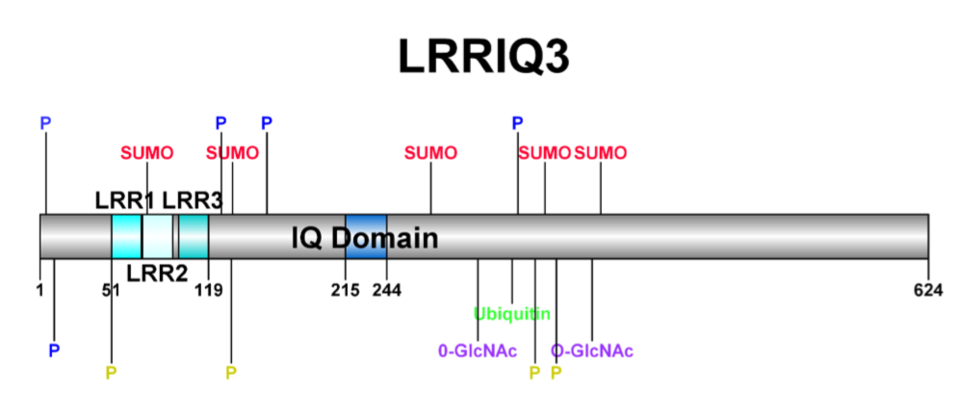
In total, there are 4 conserved domains within LRRIQ3: 3 leucine-rich repeats and 1 IQ calmodulin-binding motif.13 Leucine-rich repeats are typically involved in protein-protein interactions, and form a characteristic α/β horseshoe fold.1415 An IQ motif provides a binding site for calmodulin (CaM) or CaM-like proteins.16
Secondary and Tertiary Structure
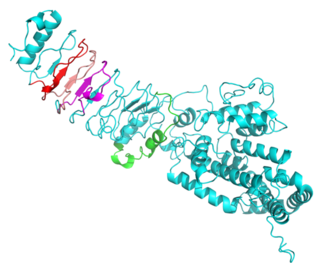
LRRIQ3 is predicted to be mostly alpha-helical in structure, including a long alpha-helical C-terminal domain. It is also predicted to function as a monomer.17181920
Post-translational Modifications
LRRIQ3 is predicted to undergo many post-translational modifications. These include O-GlcNAcylation, SUMOylation, ubiquitination, and phosphorylation.2223 LRRIQ3 is predicted to have 4 well conserved SUMOylation sites and 1 well conserved ubiquitination site.22 A representation of these post-translational modifications is shown in the figure below.
Protein Interactions
There is evidence that LRRIQ3 interacts with a number of proteins from two-hybrid assays and affinity chromatography. The proteins LRRIQ3 interact with include LYN, NCK2, GNB4, and ABL1.2526 These proteins are associated with cell signalling, cytoskeletal reorganization, and cell differentiation, as well as others.27282930
Homology and evolution
Paralogs and Orthologs
No paralogs exists for LRRIQ3 in humans.6 However, there are a number of orthologs, as reported by BLAST, some of which are listed below.31 The number of years since divergence from the human protein, listed in "million of years ago (MYA)" below, were calculated using TimeTree.32
| Genus and species | Common name | Divergence from Human Lineage (MYA) | Accession number | Sequence length (aa) | Sequence Identity to Human Protein | Sequence Similarity to Human Protein |
|---|---|---|---|---|---|---|
| Gorilla gorilla gorilla | Gorilla | 9.06 | XP_004026030.1 | 624 | 97% | 98% |
| Macaca mulatta | Rhesus monkey | 29.44 | XP_001097148.2 | 623 | 93% | 95% |
| Ursus maritimus | Polar bear | 96 | XP_008689049.1 | 625 | 76% | 87% |
| Felis catus | Domestic cat | 96 | XP_003990274.1 | 625 | 74% | 86% |
| Camelus ferus | Bactrian camel | 96 | XP_006178380.1 | 618 | 73% | 84% |
| Oryctolagus cuniculus | European rabbit | 90 | XP_002715603.1 | 622 | 71% | 83% |
| Bison bison bison | American bison | 96 | XP_010847739.1 | 625 | 70% | 82% |
| Trichechus manatus latirostris | Manatee | 105 | XP_004369192.1 | 623 | 70% | 82% |
| Loxodonta africana | African elephant | 105 | XP_003411181.1 | 625 | 68% | 80% |
| Condylura cristata | Star-nosed mole | 96 | XP_004679575.1 | 627 | 67% | 80% |
| Eptesicus fuscus | Big brown bat | 96 | XP_008137759.1 | 621 | 66% | 80% |
| Myotis davidii | Vesper bat | 96 | XP_006775977.1 | 618 | 65% | 79% |
| Rattus norvegicus | Norway rat | 90 | NP_001019478.1 | 633 | 62% | 77% |
| Mus Musculus | House mouse | 90 | NP_083214.2 | 633 | 63% | 76% |
| Sorex araneus | Common shrew | 96 | XP_004603704.1 | 612 | 55% | 73% |
| Chrysemys picta bellii | Painted turtle | 312 | XP_005285573.1 | 624 | 40% | 56% |
| Pogona vitticeps | Bearded dragon | 312 | XP_020650341.1 | 651 | 35% | 54% |
| Apteryx australis mantelli | Brown kiwi | 312 | XP_013800580.1 | 664 | 35% | 54% |
| Struthio camelus australis | Southern Ostrich | 312 | XP_009685099.1 | 628 | 34% | 51% |
Clinical significance
LRRIQ3 is linked to a number of cancers. RNA-seq experiments have shown that LRRIQ3 is severely down-regulated (Log2-fold changes between -3.4 and -4.2) in a number of disease states, including pancreatic cancer, colorectal cancer, and breast cancer.333435
References
References
- GRCh38: Ensembl release 89: ENSG00000162620 – Ensembl, May 2017
- GRCm38: Ensembl release 89: ENSMUSG00000028182 – Ensembl, May 2017
- "Human PubMed Reference:". National Center for Biotechnology Information, U.S. National Library of Medicine.
- "Mouse PubMed Reference:". National Center for Biotechnology Information, U.S. National Library of Medicine.
- "LRRIQ3 Gene - GeneCards".
- "AceView entry on LRRIQ3".
- "LRRIQ3 leucine rich repeats and IQ motif containing 3 [Homo sapiens (human)] - Gene - NCBI". www.ncbi.nlm.nih.gov. Retrieved 2018-04-30.
- "Lrriq3 protein abundance in PaxDb". pax-db.org. Retrieved 2018-04-30.
- "LRRIQ3 protein abundance in PaxDb". pax-db.org. Retrieved 2018-04-30.
- "GDS3834 / 3169". www.ncbi.nlm.nih.gov. Retrieved 2018-05-06.
- "ExPASy - Compute pI/Mw tool". web.expasy.org. Retrieved 2018-04-30.
- "Cell atlas - LRRIQ3 - The Human Protein Atlas". www.proteinatlas.org. Archived from the original on 2018-05-07. Retrieved 2018-04-30.
- EMBL-EBI. "SAPS < Sequence Statistics < EMBL-EBI". www.ebi.ac.uk. Retrieved 2018-04-30.
- Kobe B, Deisenhofer J (October 1994). "The leucine-rich repeat: a versatile binding motif". Trends Biochem. Sci. 19 (10): 415–21. doi:10.1016/0968-0004(94)90090-6. ISSN 0968-0004. PMID 7817399.
- Enkhbayar P, Kamiya M, Osaki M, Matsumoto T, Matsushima N (February 2004). "Structural principles of leucine-rich repeat (LRR) proteins". Proteins. 54 (3): 394–403. doi:10.1002/prot.10605. ISSN 1097-0134. PMID 14747988. S2CID 19951452.
- Rhoads AR, Friedberg F (April 1997). "Sequence motifs for calmodulin recognition". FASEB J. 11 (5): 331–40. doi:10.1096/fasebj.11.5.9141499. ISSN 0892-6638. PMID 9141499. S2CID 1877645.
- Rost B (2001). "Review: protein secondary structure prediction continues to rise". J. Struct. Biol. 134 (2–3): 204–18. CiteSeerX 10.1.1.8.8169. doi:10.1006/jsbi.2001.4336. ISSN 1047-8477. PMID 11551180.
- Ouali M, King RD (June 2000). "Cascaded multiple classifiers for secondary structure prediction". Protein Sci. 9 (6): 1162–76. doi:10.1110/ps.9.6.1162. ISSN 0961-8368. PMC 2144653. PMID 10892809.
- Cuff JA, Barton GJ (August 2000). "Application of multiple sequence alignment profiles to improve protein secondary structure prediction". Proteins. 40 (3): 502–11. doi:10.1002/1097-0134(20000815)40:3<502::AID-PROT170>3.0.CO;2-Q. ISSN 0887-3585. PMID 10861942. S2CID 855816.
- Jones DT (September 1999). "Protein secondary structure prediction based on position-specific scoring matrices". J. Mol. Biol. 292 (2): 195–202. doi:10.1006/jmbi.1999.3091. ISSN 0022-2836. PMID 10493868. S2CID 15506630.
- Yang J, Yan R, Roy A, Xu D, Poisson J, Zhang Y (January 2015). "The I-TASSER Suite: protein structure and function prediction". Nat. Methods. 12 (1): 7–8. doi:10.1038/nmeth.3213. ISSN 1548-7091. PMC 4428668. PMID 25549265.
- Pagni M, Ioannidis V, Cerutti L, Zahn-Zabal M, Jongeneel CV, Falquet L (July 2004). "MyHits: a new interactive resource for protein annotation and domain identification". Nucleic Acids Res. 32 (Web Server issue): W332–5. doi:10.1093/nar/gkh479. ISSN 0305-1048. PMC 441617. PMID 15215405.
- de Castro E, Sigrist CJ, Gattiker A, Bulliard V, Langendijk-Genevaux PS, Gasteiger E, Bairoch A, Hulo N (July 2006). "ScanProsite: detection of PROSITE signature matches and ProRule-associated functional and structural residues in proteins". Nucleic Acids Res. 34 (Web Server issue): W362–5. doi:10.1093/nar/gkl124. ISSN 1362-4962. PMC 1538847. PMID 16845026.
- Ren J, Wen L, Gao X, Jin C, Xue Y, Yao X (February 2009). "DOG 1.0: illustrator of protein domain structures". Cell Res. 19 (2): 271–3. doi:10.1038/cr.2009.6. ISSN 1001-0602. PMID 19153597.
- "Results - mentha: the interactome browser". mentha.uniroma2.it. Retrieved 2018-04-30.
- "LRRIQ3 - Leucine-rich repeat and IQ domain-containing protein 3 - Homo sapiens (Human) - LRRIQ3 gene & protein". www.uniprot.org. Retrieved 2018-04-30.
- Harder KW, Parsons LM, Armes J, Evans N, Kountouri N, Clark R, Quilici C, Grail D, Hodgson GS, Dunn AR, Hibbs ML (October 2001). "Gain- and loss-of-function Lyn mutant mice define a critical inhibitory role for Lyn in the myeloid lineage". Immunity. 15 (4): 603–15. doi:10.1016/s1074-7613(01)00208-4. ISSN 1074-7613. PMID 11672542.
- Downes GB, Gautam N (December 1999). "The G protein subunit gene families". Genomics. 62 (3): 544–52. doi:10.1006/geno.1999.5992. ISSN 0888-7543. PMID 10644457.
- Tu Y, Li F, Wu C (December 1998). "Nck-2, a novel Src homology2/3-containing adaptor protein that interacts with the LIM-only protein PINCH and components of growth factor receptor kinase-signaling pathways". Mol. Biol. Cell. 9 (12): 3367–82. doi:10.1091/mbc.9.12.3367. ISSN 1059-1524. PMC 25640. PMID 9843575.
- Era T (July 2002). "Bcr-Abl is a "molecular switch" for the decision for growth and differentiation in hematopoietic stem cells". Int. J. Hematol. 76 (1): 35–43. doi:10.1007/BF02982716. PMID 12138893. S2CID 10269867.
- Altschul SF, Gish W, Miller W, Myers EW, Lipman DJ (October 1990). "Basic local alignment search tool". J. Mol. Biol. 215 (3): 403–10. doi:10.1016/S0022-2836(05)80360-2. ISSN 0022-2836. PMID 2231712. S2CID 14441902.
- "TimeTree :: The Timescale of Life". www.timetree.org. Retrieved 2018-05-06.
- "Tissue expression of LRRIQ3 - Summary - The Human Protein Atlas". www.proteinatlas.org. Retrieved 2018-05-06.
- github.com/gxa/atlas/graphs/contributors, EMBL-EBI Expression Atlas development team. "Search results < Expression Atlas < EMBL-EBI". www.ebi.ac.uk. Retrieved 2018-04-30.
{{cite web}}:|last=has generic name (help) - github.com/gxa/atlas/graphs/contributors, EMBL-EBI Expression Atlas development team. "Experiment < Expression Atlas < EMBL-EBI". www.ebi.ac.uk. Retrieved 2018-05-06.
{{cite web}}:|last=has generic name (help)