| Aphrodite | |
|---|---|
Goddess of love, lust, passion, pleasure, beauty, and sexuality | |
| Member of the Twelve Olympians | |
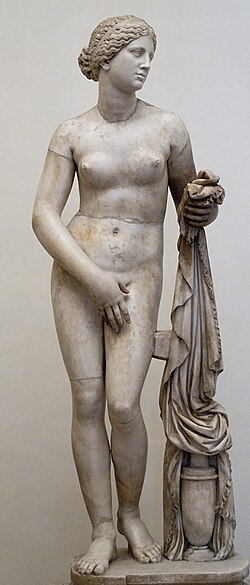 The Ludovisi Cnidian Aphrodite, Roman marble copy (torso and thighs) with restored head, arms, legs and drapery support | |
| Abode | Mount Olympus |
| Planet | Venus |
| Animals | dolphin, sparrow, dove, swan, hare, goose, bee, fish, butterfly |
| Symbol | rose, seashell, pearl, mirror, girdle, anemone, lettuce, narcissus |
| Tree | myrrh, myrtle, apple, pomegranate |
| Genealogy | |
| Parents | Zeus and Dione (Homer)2 Uranus (Hesiod)3 |
| Spouse | Hephaestus (divorced) Ares1 |
| Children | Eros, Phobos, Deimos, Harmonia, Pothos, Anteros, Himeros, Hermaphroditus, Rhodos, Eryx, Peitho, The Graces, Beroe, Golgos, Priapus, Aeneas |
| Equivalents | |
| Roman | Venus |
| Mesopotamia and the Levant | Inanna |
| Iranian | Anahita |
| Egyptian | Hathor, Isis |
Aphrodite (/ˌæfrəˈdaɪtiː/ ⓘ, AF-rə-DY-tee)a is an ancient Greek goddess associated with love, lust, beauty, pleasure, passion, procreation, and as her syncretised Roman counterpart Venus, desire, sex, fertility, prosperity, and victory. Aphrodite's major symbols include seashells, myrtles, roses, doves, sparrows, and swans. The cult of Aphrodite was largely derived from that of the Phoenician goddess Astarte, a cognate of the East Semitic goddess Ishtar, whose cult was based on the Sumerian cult of Inanna. Aphrodite's main cult centers were Cythera, Cyprus, Corinth, and Athens. Her main festival was the Aphrodisia, which was celebrated annually in midsummer. In Laconia, Aphrodite was worshipped as a warrior goddess. She was also the patron goddess of prostitutes, an association which led early scholars to propose the concept of sacred prostitution in Greco-Roman culture, an idea which is now generally seen as erroneous.
A major goddess in the Greek pantheon, Aphrodite featured prominently in ancient Greek literature. According to many sources, like Homer's Iliad and Sappho's Ode to Aphrodite, she is the daughter of Zeus and Dione. In Hesiod's Theogony, however, Aphrodite is born off the coast of Cythera from the foam (ἀφρός, aphrós) produced by Uranus's genitals, which his son Cronus had severed and thrown into the sea. In his Symposium, Plato asserts that these two origins actually belong to separate entities; Aphrodite Urania (a transcendent "Heavenly" Aphrodite, who "partakes not of the female but only of the male", with Plato describing her as inspiring love between men, but having nothing to do with the love of women) and Aphrodite Pandemos (Aphrodite common to "all the people" who Plato described as "wanton", to contrast her with the virginal Aphrodite Urania, who did not engage in sexual acts at all. Pandemos inspired love between men and women, unlike her older counterpart).4 The epithet Aphrodite Areia (the "Warlike") reveals her contrasting nature in ancient Greek religion. Aphrodite had many other epithets, each emphasizing a different aspect of the same goddess or used by a different local cult. Thus she was also known as Cytherea (Lady of Cythera) and Cypris (Lady of Cyprus), because both locations claimed to be the place of her birth. Sappho's Ode to Aphrodite is one of the earliest poems dedicated to the goddess and survives from the Archaic period nearly complete.
In Greek mythology, Aphrodite was married to Hephaestus, the god of fire, blacksmiths and metalworking. Aphrodite was frequently unfaithful to him and had many lovers; in the Odyssey, she is caught in the act of adultery with Ares, the god of war. In the First Homeric Hymn to Aphrodite, she seduces the mortal shepherd Anchises after Zeus made her fall in love with him. Aphrodite was also the surrogate mother and lover of the mortal shepherd Adonis, who was killed by a wild boar. Along with Athena and Hera, Aphrodite was one of the three goddesses whose feud resulted in the beginning of the Trojan War and plays a major role throughout the Iliad. Aphrodite has been featured in Western art as a symbol of female beauty and has appeared in numerous works of Western literature. She is a major deity in modern Neopagan religions, including the Church of Aphrodite, Wicca, and Hellenism.
Etymology
Hesiod derives the name Aphrodite from aphrós (ἀφρός) 'sea-foam',5 interpreting the name as "risen from the foam",65 but most modern scholars regard this as a spurious folk etymology.57 Early-modern scholars of classical mythology attempted to argue that Aphrodite's name was of Greek or Indo-European origin, but these efforts have mostly been abandoned.7 Aphrodite's name is generally accepted to likely be of Semitic origin, due to the believed Near Eastern origins of Aphrodite's worship, but its exact derivation cannot be determined with confidence.789 Some scholars, such as Fritz Hommel, have suggested that Aphrodite's name is a hellenized pronunciation of the name "Astarte"; other scholars, however, reject this as being linguistically untenable.1011 Martin West reconstructs a Cyprian Canaanite form of the name as either *ʿAprodît or *ʿAproḏît, and cautiously suggests the latter as being an epithet with the meaning "She of the Villages".12 Aren Wilson-Wright suggests the Phoenician form *ʾAprodīt as an elative epithet meaning "unique, excellent, sublime".13
Scholars in the late-nineteenth and early-twentieth centuries, accepting Hesiod's "foam" etymology as genuine, analyzed the second part of Aphrodite's name as *-odítē "wanderer"14 or as *-dítē "bright".1516 More recently, Michael Janda, also accepting Hesiod's etymology, has argued in favor of the latter of these interpretations and claims the story of a birth from the foam as an Indo-European mytheme.1718 Similarly, Krzysztof Tomasz Witczak proposes an Indo-European compound *abʰor- "very" and *dʰei- "to shine", also referring to Eos,19 and Daniel Kölligan has interpreted Aphrodite's name as "shining up from the mist/foam".20 Other scholars have argued that these hypotheses are unlikely, since Aphrodite's attributes are entirely different from those of both Eos and the Vedic deity Ushas.2122
A number of improbable non-Greek etymologies have also been suggested. One Semitic etymology compares Aphrodite to the Assyrian barīrītu, the name of a female demon that appears in Middle Babylonian and Late Babylonian texts.23 Hammarström24 looks to Etruscan, comparing (e)prθni "lord", an Etruscan honorific loaned into Greek as πρύτανις.25826 This would make the theonym in origin an honorific, "the lady".258 Most scholars reject this etymology as implausible,25826 especially since Aphrodite's name actually appears in Etruscan in the borrowed form Apru (from Greek Aphrō, clipped form of Aphrodite).8 The medieval Etymologicum Magnum (c. 1150) offers a highly contrived etymology, deriving Aphrodite from the compound habrodíaitos (ἁβροδίαιτος), "she who lives delicately", from habrós and díaita. The alteration from b to ph is explained as a "familiar" characteristic of Greek "obvious from the Macedonians".27
In the Cypriot syllabary, a syllabic script used on the island of Cyprus from the eleventh until the fourth centuries BC, Aphrodite's name is attested in the forms 𐠀𐠡𐠦𐠭𐠃𐠂 (a-po-ro-ta-o-i, read right-to-left),28 𐠀𐠡𐠦𐠯𐠭𐠂 (a-po-ro-ti-ta-i, samewise),29 and finally 𐠀𐠡𐠦𐠯𐠪𐠈 (a-po-ro-ti-si-jo, "Aphrodisian", "related to Aphrodite", in the context of a month).30
Origins
Near Eastern love goddess
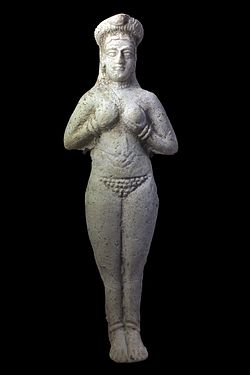

The cult of Aphrodite in Greece was imported from, or at least influenced by, the cult of Astarte in Phoenicia,31323334 which, in turn, was influenced by the cult of the Mesopotamian goddess known as "Ishtar" to the East Semitic peoples and as "Inanna" to the Sumerians.353334 Pausanias states that the first to establish a cult of Aphrodite were the Assyrians, followed by the Paphians of Cyprus and then the Phoenicians at Ascalon. The Phoenicians, in turn, taught her worship to the people of Cythera.36
Aphrodite took on Inanna-Ishtar's associations with sexuality and procreation.37 Furthermore, she was known as Ourania (Οὐρανία), which means "heavenly",38 a title corresponding to Inanna's role as the Queen of Heaven.3839 Early artistic and literary portrayals of Aphrodite are extremely similar on Inanna-Ishtar.37 Like Inanna-Ishtar, Aphrodite was also a warrior goddess;373240 the second-century AD Greek geographer Pausanias records that, in Sparta, Aphrodite was worshipped as Aphrodite Areia, which means "warlike".4142 He also mentions that Aphrodite's most ancient cult statues in Sparta and on Cythera showed her bearing arms.41424337 Modern scholars note that Aphrodite's warrior-goddess aspects appear in the oldest strata of her worship44 and see it as an indication of her Near Eastern origins.4445
Nineteenth-century classical scholars had a general aversion to the idea that ancient Greek religion was at all influenced by the cultures of the Near East,46 but even Friedrich Gottlieb Welcker, who argued that Near Eastern influence on Greek culture was largely confined to material culture,46 admitted that Aphrodite was clearly of Phoenician origin.46 The significant influence of Near Eastern culture on early Greek religion in general, and on the cult of Aphrodite in particular,47 is now widely recognized as dating to a period of orientalization during the eighth century BC,47 when archaic Greece was on the fringes of the Neo-Assyrian Empire.48
Indo-European dawn goddess
Some early comparative mythologists opposed to the idea of a Near Eastern origin argued that Aphrodite originated as an aspect of the Greek dawn goddess Eos4950 and that she was therefore ultimately derived from the Proto-Indo-European dawn goddess *Haéusōs (properly Greek Eos, Latin Aurora, Sanskrit Ushas).4950 Most modern scholars have now rejected the notion of a purely Indo-European Aphrodite,7512252 but it is possible that Aphrodite, originally a Semitic deity, may have been influenced by the Indo-European dawn goddess.52 Both Aphrodite and Eos were known for their erotic beauty and aggressive sexuality50 and both had relationships with mortal lovers.50 Both goddesses were associated with the colors red, white, and gold.50 Michael Janda etymologizes Aphrodite's name as an epithet of Eos meaning "she who rises from the foam [of the ocean]"18 and points to Hesiod's Theogony account of Aphrodite's birth as an archaic reflex of Indo-European myth.18 Aphrodite rising out of the waters after Cronus defeats Uranus as a mytheme would then be directly cognate to the Rigvedic myth of Indra defeating Vrtra, liberating Ushas.1718 Another key similarity between Aphrodite and the Indo-European dawn goddess is her close kinship to the Greek sky deity,52 since both of the main claimants to her paternity (Zeus and Uranus) are sky deities.53
Forms and epithets
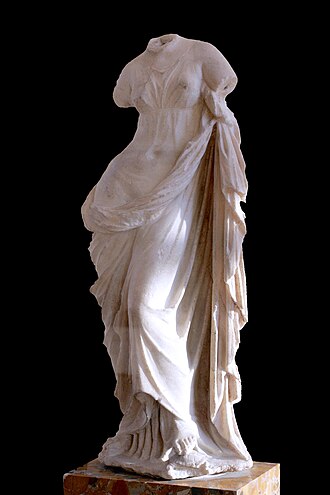
Aphrodite's most common cultic epithet was Ourania, meaning "heavenly",5758 but this epithet almost never occurs in literary texts, indicating a purely cultic significance.59 Another common name for Aphrodite was Pandemos ("For All the Folk").60 In her role as Aphrodite Pandemos, Aphrodite was associated with Peithō (Πείθω), meaning "persuasion",61 and could be prayed to for aid in seduction.61 The character of Pausanias in Plato's Symposium, takes differing cult-practices associated with different epithets of the goddess to claim that Ourania and Pandemos are, in fact, separate goddesses. He asserts that Aphrodite Ourania is the celestial Aphrodite, born from the sea foam after Cronus castrated Uranus, and the older of the two goddesses. According to the Symposium, Aphrodite Ourania is the inspiration of male homosexual desire, specifically the ephebic eros, and pederasty. Aphrodite Pandemos, by contrast, is the younger of the two goddesses: the common Aphrodite, born from the union of Zeus and Dione, and the inspiration of heterosexual desire and sexual promiscuity, the "lesser" of the two loves.6263 Paphian (Παφία), was one of her epithets, after the Paphos in Cyprus where she had emerged from the sea at her birth.64
Among the Neoplatonists and, later, their Christian interpreters, Ourania is associated with spiritual love, and Pandemos with physical love (desire). A representation of Ourania with her foot resting on a tortoise came to be seen as emblematic of discretion in conjugal love; it was the subject of a chryselephantine sculpture by Phidias for Elis, known only from a parenthetical comment by the geographer Pausanias.65 The image was taken up again after the Renaissance.66
One of Aphrodite's most common literary epithets is Philommeidḗs (φιλομμειδής),67 which means "smile-loving",67 but is sometimes mistranslated as "laughter-loving".67 This epithet occurs throughout both of the Homeric epics and the First Homeric Hymn to Aphrodite.67 Hesiod references it once in his Theogony in the context of Aphrodite's birth,68 but interprets it as "genital-loving" rather than "smile-loving".68 Monica Cyrino notes that the epithet may relate to the fact that, in many artistic depictions of Aphrodite, she is shown smiling.68 Other epithets of her include Mechanitis meaning skilled in inventing69 and Automata because, according to Servius, she was the source of spontaneous love.70
Common literary epithets of Aphrodite are Cypris and Cythereia,71 which derive from her associations with the islands of Cyprus and Cythera respectively.71 On Cyprus, Aphrodite was sometimes called Eleemon ("the merciful").58 In Athens, she was known as Aphrodite en kēpois ("Aphrodite of the Gardens").58 At Cape Colias, a promontory on the Attic coast, she was venerated as Genetyllis (Γενετυλλίς), the protectress of births.58 Her companions, who presided over generation and birth, were known by the plural form Genetyllides (Γενετυλλίδες).727374 The Spartans worshipped her as Potnia "Mistress", Enoplios "Armed", Morpho "Shapely", Ambologera "She who Postpones Old Age".58 Across the Greek world, she was known under epithets such as Melainis in Corinth "Black or Dark One",75 Skotia "Dark One", Androphonos "Killer of Men", Anosia "Unholy", and Tymborychos "Gravedigger",56 all of which indicate her darker, more violent nature.56
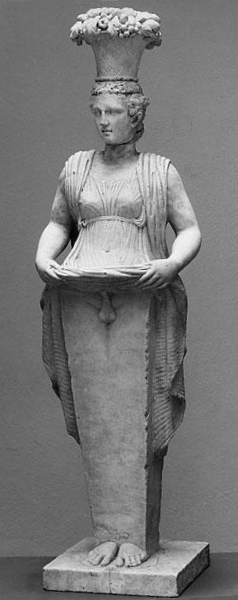
A male version of Aphrodite known as Aphroditus was worshipped in the city of Amathus on Cyprus.545556 Aphroditus was depicted with the figure and dress of a woman, but had a beard, and was shown lifting his dress to reveal an erect phallus.5455 This gesture was believed to be an apotropaic symbol, and was thought to convey good fortune upon the viewer.76 Eventually, the popularity of Aphroditus waned as the mainstream, fully feminine version of Aphrodite became more popular, but traces of his cult are preserved in the later legends of Hermaphroditus.55
List of epithets
- Androphagos, Man-eater.
- Anosia, Unholy.
- Aphrogeneia, Foam-sprung.80
- Areia, War-like. There was an old xoanon of the goddess at Cythera.81 Several depictions in Greek art show Aphrodite as the opponent of the giant Mimas.82
- Cypris (Κύπρις), of Cyprus. Cyprus is identified as her homeland by Homer and Hesiod; alternatively, according to the Suda, the name derives from her role as a bestower of pregnancy (κυόπορις; kyóporis).83
- Cytheria (Κυθέρεια), of Cythera; alternatively, according to the Suda, the name derives from her concealment (κεύθειν) of love affairs (κεύθειν τοὺς ἔρωτας).8384
- Eleēmon, Merciful
- Enoplios, Armed, at Sparta.
- Euploia, of the good sailing tide, related to ships. She had a temple at Piraeus.85
- Genetyllis, of the hour-of-birth. by Aristophanes, an epithet close to Kolias.86
- Hera, at Sparta there was a temple of Hera-Hypercheiria and a xoanon of Aphrodite-Hera that was offered to the brides.87
- En kẽpois, of the gardens. The oldest of the fates was called "Άφροδίτη έν κήποις" (Aphrodite of the Gardens).
- Epistrophia, of the return.
- Idalia, from Idalion in Cyprus.88
- Kōlias, of Colias. goddess of childbirth in Attica, with a temple on the mountain "Colias".
- Limenia, of the harbour, at Hermione.89
- Melainis, Dark.
- Melaina, Black.
- Morphō, Shapely, at Sparta. She was depicted with a veil and rocks near her feet.90
- Nymphia, of marriage. She had a temple on the road from Troezen to Hermione.
- Olympia, of Olympia.
- Pandemos, of the whole demos. In Athens a great festival was celebrated on the Acropolis.
- Paphia, of Paphos, with a great festival. The priests performed her mysteries.
- Philomeidēs, Smile-loving.
- Pontia, of the open sea, at Hermione.89
- Praxis, Active.
- Skotia, Gloomy.
- Ourania, Heavenly, that indicates her oriental descent.
- Zerynthia, from the town of Zerynthus.91
Worship
Classical period
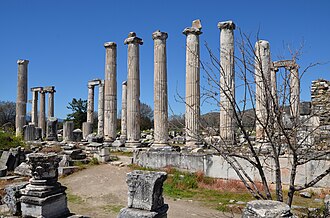
Aphrodite's main festival, the Aphrodisia, was celebrated across Greece, but particularly in Athens and Corinth. In Athens, the Aphrodisia was celebrated on the fourth day of the month of Hekatombaion in honor of Aphrodite's role in the unification of Attica.9293 During this festival, the priests of Aphrodite would purify the temple of Aphrodite Pandemos on the southwestern slope of the Acropolis with the blood of a sacrificed dove.94 Next, the altars would be anointed94 and the cult statues of Aphrodite Pandemos and Peitho would be escorted in a majestic procession to a place where they would be ritually bathed.95 Aphrodite was also honored in Athens as part of the Arrhephoria festival.96 The fourth day of every month was sacred to Aphrodite.97
Pausanias records that, in Sparta, Aphrodite was worshipped as Aphrodite Areia, which means "warlike".4142 This epithet stresses Aphrodite's connections to Ares, with whom she had extramarital relations.4142 Pausanias also records that, in Sparta4142 and on Cythera, a number of extremely ancient cult statues of Aphrodite portrayed her bearing arms.4358 Other cult statues showed her bound in chains.58
Aphrodite was the patron goddess of prostitutes of all varieties,9858 ranging from pornai (cheap street prostitutes typically owned as slaves by wealthy pimps) to hetairai (expensive, well-educated hired companions, who were usually self-employed and sometimes provided sex to their customers).99 The city of Corinth was renowned throughout the ancient world for its many hetairai,100 who had a widespread reputation for being among the most skilled, but also the most expensive, prostitutes in the Greek world.100 Corinth also had a major temple to Aphrodite located on the Acrocorinth100 and was one of the main centers of her cult.100 Records of numerous dedications to Aphrodite made by successful courtesans have survived in poems and in pottery inscriptions.99 References to Aphrodite in association with prostitution are found in Corinth as well as on the islands of Cyprus, Cythera, and Sicily.101 Aphrodite's Mesopotamian precursor Inanna-Ishtar was also closely associated with prostitution.102103101
Scholars in the nineteenth and twentieth centuries believed that the cult of Aphrodite may have involved ritual prostitution,103101 an assumption based on ambiguous passages in certain ancient texts, particularly a fragment of a skolion by the Boeotian poet Pindar,104 which mentions prostitutes in Corinth in association with Aphrodite.104 Modern scholars now dismiss the notion of ritual prostitution in Greece as a "historiographic myth" with no factual basis.105
Hellenistic and Roman periods
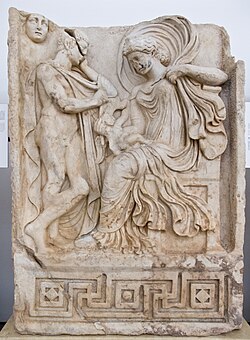
During the Hellenistic period, the Greeks identified Aphrodite with the ancient Egyptian goddesses Hathor and Isis.106107108 Aphrodite was the patron goddess of the Lagid queens and Queen Arsinoe II was identified as her mortal incarnation.109 Aphrodite was worshipped in Alexandria and had numerous temples in and around the city.109 Arsinoe II introduced the cult of Adonis to Alexandria and many of the women there partook in it.109 The Tessarakonteres, a gigantic catamaran galley designed by Archimedes for Ptolemy IV Philopator, had a circular temple to Aphrodite on it with a marble statue of the goddess herself.109 In the second century BC, Ptolemy VIII Physcon and his wives Cleopatra II and Cleopatra III dedicated a temple to Aphrodite Hathor at Philae.109 Statuettes of Aphrodite for personal devotion became common in Egypt starting in the early Ptolemaic times and extending until long after Egypt became a Roman province.109
The ancient Romans identified Aphrodite with their goddess Venus, who was originally a goddess of agricultural fertility, vegetation, and springtime.110 According to the Roman historian Livy, Aphrodite and Venus were officially identified in the third century BC111 when the cult of Venus Erycina was introduced to Rome from the Greek sanctuary of Aphrodite on Mount Eryx in Sicily.111 After this point, Romans adopted Aphrodite's iconography and myths and applied them to Venus.111 Because Aphrodite was the mother of the Trojan hero Aeneas in Greek mythology111 and the Roman tradition claimed Aeneas as the founder of Rome,111 Venus became venerated as Venus Genetrix, the mother of the entire Roman nation.111 Julius Caesar claimed to be directly descended from Aeneas's son Iulus112 and became a strong proponent of the cult of Venus.112 This precedent was later followed by his nephew Augustus and the later emperors claiming succession from him.112
This syncretism greatly impacted Greek worship of Aphrodite.113 During the Roman era, the cults of Aphrodite in many Greek cities began to emphasize her relationship with Troy and Aeneas.113 They also began to adopt distinctively Roman elements,113 portraying Aphrodite as more maternal, more militaristic, and more concerned with administrative bureaucracy.113 She was claimed as a divine guardian by many political magistrates.113 Appearances of Aphrodite in Greek literature also vastly proliferated, usually showing Aphrodite in a characteristically Roman manner.114
Mythology
Birth
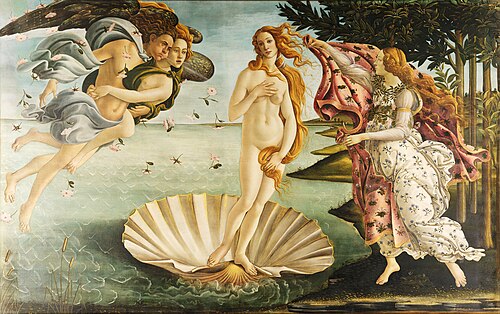
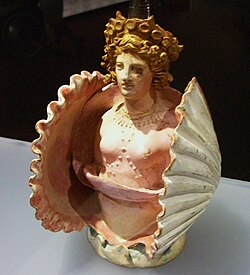
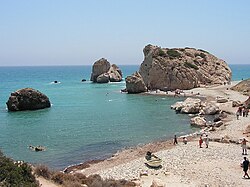
Aphrodite is usually said to have been born near her chief center of worship, Paphos, on the island of Cyprus, which is why she is sometimes called "Cyprian", especially in the poetic works of Sappho. The Sanctuary of Aphrodite Paphia, marking her birthplace, was a place of pilgrimage in the ancient world for centuries.116 Other versions of her myth have her born near the island of Cythera, hence another of her names, "Cytherea".117 Cythera was a stopping place for trade and culture between Crete and the Peloponesus,118 so these stories may preserve traces of the migration of Aphrodite's cult from the Middle East to mainland Greece.119
According to the version of her birth recounted by Hesiod in his Theogony,120121 Cronus severed Uranus' genitals and threw them behind him into the sea.121122123 The foam from his genitals gave rise to Aphrodite5 (hence her name, which Hesiod interprets as "foam-arisen"),5 while the Giants, the Erinyes (furies), and the Meliae emerged from the drops of his blood.121122 Hesiod states that the genitals "were carried over the sea a long time, and white foam arose from the immortal flesh; with it a girl grew". After Aphrodite was born from the sea-foam, she washed up to shore in the presence of the other gods. Hesiod's account of Aphrodite's birth following Uranus's castration is probably derived from The Song of Kumarbi,124125 an ancient Hittite epic poem in which the god Kumarbi overthrows his father Anu, the god of the sky, and bites off his genitals, causing him to become pregnant and give birth to Anu's children, which include Ishtar and her brother Teshub, the Hittite storm god.124125
In the Iliad,126 Aphrodite is described as the daughter of Zeus and Dione.5 Dione's name appears to be a feminine cognate to Dios and Dion,5 which are oblique forms of the name Zeus.5 Zeus and Dione shared a cult at Dodona in northwestern Greece.5 In the Theogony, Hesiod describes Dione as an Oceanid,127 but Apollodorus makes her the thirteenth Titan, child of Gaia and Uranus.128
Marriage
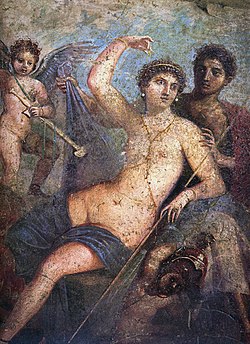
Aphrodite is consistently portrayed as a nubile, infinitely desirable adult, having had no childhood.129 She is often depicted nude.130 In the Iliad, Aphrodite is the apparently unmarried consort of Ares, the god of war,131 and the wife of Hephaestus is a different goddess named Charis.132 Likewise, in Hesiod's Theogony, Aphrodite is unmarried and the wife of Hephaestus is Aglaea, the youngest of the three Charites.132
In Book Eight of the Odyssey,133 however, the blind singer Demodocus describes Aphrodite as the wife of Hephaestus and tells how she committed adultery with Ares during the Trojan War.132134 The sun-god Helios saw Aphrodite and Ares having sex in Hephaestus's bed and warned Hephaestus, who fashioned a fine, near invisible net.134 The next time Ares and Aphrodite had sex together, the net trapped them both.134 Hephaestus brought all the gods into the bedchamber to laugh at the captured adulterers,135 but Apollo, Hermes, and Poseidon had sympathy for Ares136 and Poseidon agreed to pay Hephaestus for Ares's release.137 Aphrodite returned to her temple in Cyprus, where she was attended by the Charites.137 This narrative probably originated as a Greek folk tale, originally independent of the Odyssey.138 In a much later interpolated detail, Ares put the young soldier Alectryon by the door to warn of Helios's arrival but Alectryon fell asleep on guard duty.139 Helios discovered the two and alerted Hephaestus; Ares in rage turned Alectryon into a rooster, which unfailingly crows to announce the sunrise.140
After exposing them, Hephaestus asks Zeus for his wedding gifts and dowry to be returned to him;141 by the time of the Trojan War, he is married to Charis/Aglaea, one of the Graces, apparently divorced from Aphrodite.132142 Afterwards, it was generally Ares who was regarded as the husband or official consort of the goddess; on the François Vase, a sixth-century BC krater, the two arrive at the wedding of Peleus and Thetis on the same chariot, as do Zeus with Hera and Poseidon with Amphitrite. The poets Pindar and Aeschylus refer to Ares as Aphrodite's husband.143
A common interpretation of how Aphrodite's unlikely marriage to Hephaestus came to be is that after he gave his mother Hera a golden throne that trapped her he refused to let her go until the gods agreed to give him Aphrodite's hand in marriage.144 There is no unambiguous evidence for such a version from antiquity. This narrative is reconstructed based on several elements, such as Hyginus' account that Hephaestus demanded (and was given) Athena's hand in marriage for releasing Hera, and the François Vase, which depicts Hephaestus' return to Olympus; Aphrodite stands in front of the scene, with a clear look of agitation on her face, while a sullen-looking Ares kneels down.145 If such narrative indeed existed, it must have been included in the now poorly-preserved Homeric Hymn to Dionysus, which dealt with Hephaestus' return to Olympus after Hera's entrapment, and which was greatly popular and influential during the sixth and fifth centuries BC.146 Another possible echo of it is found in the Deception of Zeus episode of the Iliad, where Hera goes to Lemnos (Hephaestus' sacred island) and asks a favour from the sleep-god Hypnos in exchange for a golden throne and marriage to Pasithea, one of the Graces; the Graces were beauty goddesses and associates of Aphrodite, and in this instance it would seem that Pasithea acts as a substitute for Aphrodite herself.147
While they were still married, Hephaestus was overjoyed to be married to the goddess of beauty, and forged her beautiful jewelry, including a strophion (στρόφιον) known as the kestos himas (κεστὸς ἱμάς),148 a saltire-shaped undergarment (usually translated as the girdle of Aphrodite),149 which accentuated her breasts150 and made her even more irresistible to men.149 Such strophia were commonly used in depictions of the Near Eastern goddesses Ishtar and Atargatis.149
Attendants
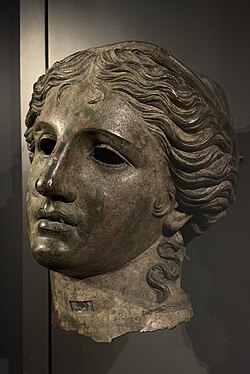
Aphrodite is almost always accompanied by Eros, the god of lust and sexual desire.153 In his Theogony, Hesiod describes Eros as one of the four original primeval forces born at the beginning of time,153 but, after the birth of Aphrodite from the sea foam, he is joined by Himeros and, together, they become Aphrodite's constant companions.154 In early Greek art, Eros and Himeros are both shown as idealized handsome youths with wings.155 The Greek lyric poets regarded the power of Eros and Himeros as dangerous, compulsive, and impossible for anyone to resist.156 In modern times, Eros is often seen as Aphrodite's son,157 but this is actually a comparatively late innovation.158 A scholion on Theocritus's Idylls remarks that the sixth-century BC poet Sappho had described Eros as the son of Aphrodite and Uranus,159 but the first surviving reference to Eros as Aphrodite's son comes from Apollonius of Rhodes's Argonautica, written in the third century BC.160 Later, the Romans, who saw Venus as a mother goddess, seized on this idea of Eros as Aphrodite's son and popularized it,160 making it the predominant portrayal in works on mythology until the present day.160
Aphrodite's main attendants were the three Charites, whom Hesiod identifies as the daughters of Zeus and Eurynome and names as Aglaea ("Splendor"), Euphrosyne ("Good Cheer"), and Thalia ("Abundance").161 The Charites had been worshipped as goddesses in Greece since the beginning of Greek history, long before Aphrodite was introduced to the pantheon.132 Aphrodite's other set of attendants was the three Horae (the "Hours"),132 whom Hesiod identifies as the daughters of Zeus and Themis and names as Eunomia ("Good Order"), Dike ("Justice"), and Eirene ("Peace").162 Aphrodite was also sometimes accompanied by Harmonia, her daughter by Ares, and Hebe, the daughter of Zeus and Hera.163
The fertility god Priapus was usually considered to be Aphrodite's son by Dionysus,164165 but he was sometimes also described as her son by Hermes, Adonis, or even Zeus.164 A scholion on Apollonius of Rhodes's Argonautica166 states that, while Aphrodite was pregnant with Priapus, Hera envied her and applied an evil potion to her belly while she was sleeping to ensure that the child would be hideous.164 In another version, Hera cursed Aphrodite's unborn son because he had been fathered by Zeus.167 When Aphrodite gave birth, she was horrified to see that the child had a massive, permanently erect penis, a potbelly, and a huge tongue.164 Aphrodite abandoned the infant to die in the wilderness, but a herdsman found him and raised him, later discovering that Priapus could use his massive penis to aid in the growth of plants.164
Anchises
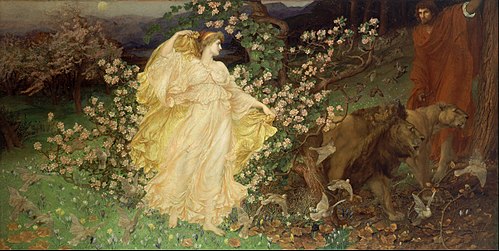
The First Homeric Hymn to Aphrodite (Hymn 5), which was probably composed sometime in the mid-seventh century BC,168 describes how Zeus once became annoyed with Aphrodite for causing deities to fall in love with mortals,168 so he caused her to fall in love with Anchises, a handsome mortal shepherd who lived in the foothills beneath Mount Ida near the city of Troy.168 Aphrodite appears to Anchises in the form of a tall, beautiful, mortal virgin while he is alone in his home.169 Anchises sees her dressed in bright clothing and gleaming jewelry, with her breasts shining with divine radiance.170 He asks her if she is Aphrodite and promises to build her an altar on top of the mountain if she will bless him and his family.171
Aphrodite lies and tells him that she is not a goddess, but the daughter of one of the noble families of Phrygia.171 She claims to be able to understand the Trojan language because she had a Trojan nurse as a child and says that she found herself on the mountainside after she was snatched up by Hermes while dancing in a celebration in honor of Artemis, the goddess of virginity.171 Aphrodite tells Anchises that she is still a virgin and begs him to take her to his parents.171 Anchises immediately becomes overcome with mad lust for Aphrodite and swears that he will have sex with her.171 Anchises takes Aphrodite, with her eyes cast downwards, to his bed, which is covered in the furs of lions and bears.172 He then strips her naked and makes love to her.172
After the lovemaking is complete, Aphrodite reveals her true divine form.173 Anchises is terrified, but Aphrodite consoles him and promises that she will bear him a son.173 She prophesies that their son will be the demigod Aeneas, who will be raised by the nymphs of the wilderness for five years before going to Troy to become a nobleman like his father.174 The story of Aeneas's conception is also mentioned in Hesiod's Theogony and in Book II of Homer's Iliad.174175
Adonis
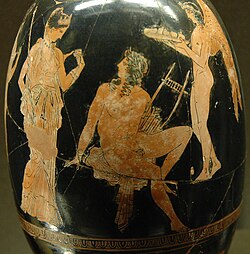
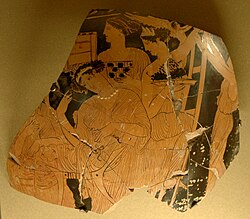
The myth of Aphrodite and Adonis is probably derived from the ancient Sumerian legend of Inanna and Dumuzid.176177178 The Greek name Ἄδωνις (Adōnis, Greek pronunciation: [ádɔːnis]) is derived from the Canaanite word ʼadōn, meaning "lord".179178 The earliest known Greek reference to Adonis comes from a fragment of a poem by the Lesbian poet Sappho (c. 630 – c. 570 BC), in which a chorus of young girls asks Aphrodite what they can do to mourn Adonis's death.180 Aphrodite replies that they must beat their breasts and tear their tunics.180 Later references flesh out the story with more details.181 According to the retelling of the story found in the poem Metamorphoses by the Roman poet Ovid (43 BC – 17/18 AD), Adonis was the son of Myrrha, who was cursed by Aphrodite with insatiable lust for her own father, King Cinyras of Cyprus, after Myrrha's mother bragged that her daughter was more beautiful than the goddess.182 Driven out after becoming pregnant, Myrrha was changed into a myrrh tree, but still gave birth to Adonis.183
Aphrodite found the baby and took him to the underworld to be fostered by Persephone.184 She returned for him once he was grown and discovered him to be strikingly handsome.184 Persephone wanted to keep Adonis, resulting in a custody battle between the two goddesses over whom should rightly possess Adonis.184 Zeus settled the dispute by decreeing that Adonis would spend one third of the year with Aphrodite, one third with Persephone, and one third with whomever he chose.184 Adonis chose to spend that time with Aphrodite.184 Then, one day, while Adonis was hunting, he was wounded by a wild boar and bled to death in Aphrodite's arms.184 In a semi-mocking work, the Dialogues of the Gods, the satirical author Lucian comedically relates how a frustrated Aphrodite complains to the moon goddess Selene about her son Eros making Persephone fall in love with Adonis and now she has to share him with her.185
In different versions of the story, the boar was either sent by Ares, who was jealous that Aphrodite was spending so much time with Adonis, or by Artemis, who wanted revenge against Aphrodite for having killed her devoted follower Hippolytus.186 In another version, Apollo in fury changed himself into a boar and killed Adonis because Aphrodite had blinded his son Erymanthus when he stumbled upon Aphrodite naked as she was bathing after intercourse with Adonis.187 The story also provides an etiology for Aphrodite's associations with certain flowers.186 Reportedly, as she mourned Adonis's death, she caused anemones to grow wherever his blood fell and declared a festival on the anniversary of his death.184 In one version of the story, Aphrodite injured herself on a thorn from a rose bush and the rose, which had previously been white, was stained red by her blood.186 According to Lucian's On the Syrian Goddess,133 each year during the festival of Adonis, the Adonis River in Lebanon (now known as the Abraham River) ran red with blood.184
The myth of Adonis is associated with the festival of the Adonia, which was celebrated by Greek women every year in midsummer.178 The festival, which was evidently already celebrated in Lesbos by Sappho's time, seems to have first become popular in Athens in the mid-fifth century BC.178 At the start of the festival, the women would plant a "garden of Adonis", a small garden planted inside a small basket or a shallow piece of broken pottery containing a variety of quick-growing plants, such as lettuce and fennel, or even quick-sprouting grains such as wheat and barley.178 The women would then climb ladders to the roofs of their houses, where they would place the gardens out under the heat of the summer sun.178 The plants would sprout in the sunlight but wither quickly in the heat.188 Then the women would mourn and lament loudly over the death of Adonis,189 tearing their clothes and beating their breasts in a public display of grief.189
Divine favoritism
In Hesiod's Works and Days, Zeus orders Aphrodite to make Pandora, the first woman, physically beautiful and sexually attractive.190 so "men will love to embrace" her.191 Aphrodite "spills grace" over Pandora's head190 and equips her with "painful desire and knee-weakening anguish".192 Aphrodite's attendants, Peitho, the Charites, and the Horae, adorn Pandora with finery and jewelry.193
After the deaths of their parents, the orphaned Cleothera along with Merope were raised by Aphrodite.194 The other Olympian goddesses also blessed the girls with gifts and blessings; Hera gave them beauty, Artemis high stature, and Athena taught them women's crafts.194195 When Cleothera and Merope were of age, Aphrodite consulted with Zeus to secure happy marriages for them.196
According to one myth, Aphrodite aided Hippomenes, a noble youth who wished to marry Atalanta, a maiden who was renowned throughout the land for her beauty, but who refused to marry any man unless he could outrun her in a footrace.197198 Atalanta was an exceedingly swift runner and she beheaded all of the men who lost to her.197198 Aphrodite gave Hippomenes three golden apples from the Garden of the Hesperides and instructed him to toss them in front of Atalanta as he raced her.197199 Hippomenes obeyed Aphrodite's order197 and Atalanta, seeing the beautiful, golden fruits, bent down to pick up each one, allowing Hippomenes to outrun her.197199 In the version of the story from Ovid's Metamorphoses, Hippomenes forgets to repay Aphrodite for her aid,200197 so she causes the couple to become inflamed with lust while they are staying at the temple of Cybele.197 The couple desecrate the temple by having sex in it, leading Cybele to turn them into lions as punishment.200197
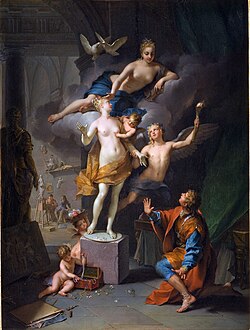
The myth of Pygmalion is first mentioned by the third-century BC Greek writer Philostephanus of Cyrene,201202 but is first recounted in detail in Ovid's Metamorphoses.201 According to Ovid, Pygmalion was an exceedingly handsome sculptor from the island of Cyprus, who was so sickened by the immorality of women that he refused to marry.203204 He fell madly and passionately in love with the ivory cult statue he was carving of Aphrodite and longed to marry it.203205 Because Pygmalion was extremely pious and devoted to Aphrodite,203206 the goddess brought the statue to life.203206 Pygmalion married the girl the statue became and they had a son named Paphos, after whom the capital of Cyprus received its name.203206 Pseudo-Apollodorus later mentions "Metharme, daughter of Pygmalion, king of Cyprus".207
Anger myths
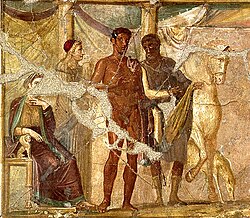
Aphrodite generously rewarded those who honored her, but also punished those who disrespected her, often quite brutally.209 A myth described in Apollonius of Rhodes's Argonautica and later summarized in the Bibliotheca of Pseudo-Apollodorus tells how, when the women of the island of Lemnos refused to sacrifice to Aphrodite, the goddess cursed them to stink horribly so that their husbands would never have sex with them.210 Instead, their husbands started having sex with their Thracian slave-girls.210 In anger, the women of Lemnos murdered the entire male population of the island, as well as all the Thracian slaves.210 When Jason and his crew of Argonauts arrived on Lemnos, they mated with the sex-starved women under Aphrodite's approval and repopulated the island.210 From then on, the women of Lemnos never disrespected Aphrodite again.210
In Euripides's tragedy Hippolytus, which was first performed at the City Dionysia in 428 BC, Theseus's son Hippolytus worships only Artemis, the goddess of virginity, and refuses to engage in any form of sexual contact.210 Aphrodite is infuriated by his prideful behavior211 and, in the prologue to the play, she declares that, by honoring only Artemis and refusing to venerate her, Hippolytus has directly challenged her authority.212 Aphrodite therefore causes Hippolytus's stepmother, Phaedra, to fall in love with him, knowing Hippolytus will reject her.213 After being rejected, Phaedra commits suicide and leaves a suicide note to Theseus telling him that she killed herself because Hippolytus attempted to rape her.213 Theseus prays to Poseidon to kill Hippolytus for his transgression.214 Poseidon sends a wild bull to scare Hippolytus's horses as he is riding by the sea in his chariot, causing the horses to bolt and smash the chariot against the cliffs, dragging Hippolytus to a bloody death across the rocky shoreline.214 The play concludes with Artemis vowing to kill Aphrodite's own mortal beloved (presumably Adonis) in revenge.215
Glaucus of Corinth angered Aphrodite by refusing to let his horses for chariot racing mate, since doing so would hinder their speed.216 During the chariot race at the funeral games of King Pelias, Aphrodite drove his horses mad and they tore him apart.217
Polyphonte was a young woman who chose a virginal life with Artemis instead of marriage and children, as favoured by Aphrodite. Aphrodite cursed her, causing her to have children by a bear. The resulting bear-like offspring Agrius and Oreius were wild cannibals who incurred the hatred of Zeus for attacking traveling strangers. Ultimately, Ares (who was Polyphonte's grandfather) and Hermes (who was originally dispatched by Zeus to kill them) transformed all Polyphonte, Agrius, and Oreius into birds of ill omen while the servant who begged for mercy was transformed into a woodpecker.218
According to Apollodorus, a jealous Aphrodite cursed Eos, the goddess of dawn, to be perpetually in love and have insatiable sexual desire because Eos once had lain with Aphrodite's sweetheart Ares.219
According to Ovid in his Metamorphoses (book 10.238 ff.), Propoetides who are the daughters of Propoetus from the city of Amathus on the island of Cyprus denied Aphrodite's divinity and failed to worship her properly. Therefore, Aphrodite turned them into the world's first prostitutes.220 According to Diodorus Siculus, when the Rhodian sea nymphe Halia's six sons by Poseidon arrogantly refused to let Aphrodite land upon their shore, the goddess cursed them with insanity. In their madness, they raped Halia. As punishment, Poseidon buried them in the island's sea-caverns.221
Xanthius, a descendant of Bellerophon, had two children: Leucippus and an unnamed daughter. Through the wrath of Aphrodite (reasons unknown), Leucippus fell in love with his own sister. They started a secret relationship but the girl was already betrothed to another man and he went on to inform her father Xanthius, without telling him the name of the seducer. Xanthius went straight to his daughter's chamber where she was together with Leucippus right at the moment. On hearing him enter, she tried to escape, but Xanthius hit her with a dagger, thinking that he was slaying the seducer, and killed her. Leucippus, failing to recognise his father at first, slew him. When the truth was revealed, he had to leave the country and took part in colonisation of Crete and the lands in Asia Minor.222
Queen Cenchreis of Cyprus, wife of King Cinyras, bragged that her daughter Myrrha was more beautiful than Aphrodite. Therefore, Myrrha was cursed by Aphrodite with insatiable lust for her own father, King Cinyras of Cyprus and he slept with her unknowingly in the dark. She eventually transformed into the myrrh tree and gave birth to Adonis in this form.223182183224 In another version of the same story, King of Assyria Theias was the father of Myrrha and Adonis, and again Aphrodite urged Myrrha, or Smyrna, to commit incest with her father, Theias. Myrrha's nurse helped with the scheme. When Theias discovered this, he flew into a rage, chasing his daughter with a knife. The gods turned her into a myrrh tree and Adonis eventually sprung from this tree. It was also said that Myrrha fled from her father, and Aphrodite transformed her into a tree. Adonis was then born when Theias shot an arrow into the tree or when a boar used its tusks to tear the tree's bark off.225 Cinyras also had three other daughters: Braesia, Laogora, and Orsedice. These girls by the wrath of Aphrodite (reasons unknown) cohabited with foreigners and ended their life in Egypt.226
The Muse Clio derided the goddess's own love for Adonis. Therefore, Clio fell in love with Pierus, son of Magnes and bore Hyacinth.227
Aegiale was a daughter of Adrastus and Amphithea and was married to Diomedes. Because of anger of Aphrodite, whom Diomedes had wounded in the war against Troy, she had multiple lovers, including a certain Hippolytus.228229 when Aegiale went so far as to threaten his life, he fled to Italy.229230 According to Stesichorus and Hesiod while Tyndareus sacrificing to the gods he forgot Aphrodite, therefore the goddess made his daughters twice and thrice wed and deserters of their husbands. Timandra deserted Echemus and went and came to Phyleus and Clytaemnestra deserted Agamemnon and lay with Aegisthus who was a worse mate for her and eventually killed her husband with her lover and finally, Helen of Troy deserted Menelaus under the influence of Aphrodite for Paris and her unfaithfulness eventually causes the War of Troy.231 As a result of her actions, Aphrodite caused the War of Troy in order to take Priam's kingdom and pass it down to her descendants.232
In one of the versions of the legend, Pasiphae did not make offerings to the goddess Venus [Aphrodite]. Because of this, Venus [Aphrodite] inspired in her an unnatural love for a bull resulting in the birth of the Minotaur233 or she cursed her because she was Helios's daughter who revealed her adultery to Hephaestus.234235 For Helios' own tale-telling, she cursed him with uncontrollable lust over the mortal princess Leucothoe, which led to him abandoning his then-lover Clytie, leaving her heartbroken.236
Lysippe was the mother of Tanais by Berossos. Her son only venerated Ares and was fully devoted to war, neglecting love and marriage. Aphrodite cursed him with falling in love with his own mother. Preferring to die rather than give up his chastity, he threw himself into the river Amazonius, which was subsequently renamed Tanais.237
According to Hyginus, Orpheus's mother Calliope of the Muses at the behest of Zeus, judged the dispute between the goddesses Aphrodite and Persephone over Adonis and decided that both shall possess him half of the year. This enraged Venus [Aphrodite], because she had not been granted what she thought was her right. Therefore, Venus [Aphrodite] inspired love for Orpheus in the women of Thrace, causing them to tear him apart as each of them sought Orpheus for herself.238
Aphrodite personally witnessed the young huntress Rhodopis swear eternal devotion and chastity to Artemis when she joined her group. Aphrodite then summoned her son Eros, and convinced him that such lifestyle was an insult to them both. So under her command, Eros made Rhodopis and Euthynicus, another young hunter who had shunned love and romance just like her, to fall in love with each other. Despite their chaste life, Rhodopis and Euthynicus withdrew to some cavern where they violated their vows. Artemis was not slow to take notice after seeing Aphrodite laugh, so she changed Rhodopis into a fountain as a punishment instead.239240
Judgment of Paris and Trojan War
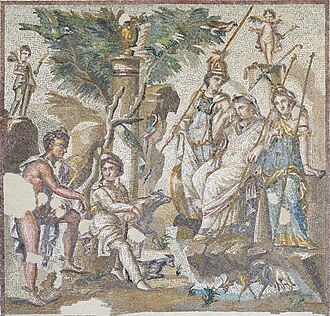
The myth of the Judgment of Paris is mentioned briefly in the Iliad,241 but is described in depth in an epitome of the Cypria, a lost poem of the Epic Cycle,242 which records that all the gods and goddesses as well as various mortals were invited to the marriage of Peleus and Thetis (the eventual parents of Achilles).241 Only Eris, goddess of discord, was not invited.242 She was annoyed at this, so she arrived with a golden apple inscribed with the word καλλίστῃ (kallistēi, "for the fairest"), which she threw among the goddesses.243 Aphrodite, Hera, and Athena all claimed to be the fairest, and thus the rightful owner of the apple.243
The goddesses chose to place the matter before Zeus, who, not wanting to favor one of the goddesses, put the choice into the hands of Paris, a Trojan prince.243 After bathing in the spring of Mount Ida where Troy was situated, the goddesses appeared before Paris for his decision.243 In the extant ancient depictions of the Judgment of Paris, Aphrodite is only occasionally represented nude, and Athena and Hera are always fully clothed.244 Since the Renaissance, however, Western paintings have typically portrayed all three goddesses as completely naked.244All three goddesses were ideally beautiful and Paris could not decide between them, so they resorted to bribes.243 Hera tried to bribe Paris with power over all Asia and Europe,243 and Athena offered wisdom, fame and glory in battle,243 but Aphrodite promised Paris that, if he were to choose her as the fairest, she would let him marry the most beautiful woman on earth.245 This woman was Helen, who was already married to King Menelaus of Sparta.245 Paris selected Aphrodite and awarded her the apple.245 The other two goddesses were enraged and, as a direct result, sided with the Greeks in the Trojan War.245
Aphrodite plays an active role at various points in Homer's Iliad.246 In Book III, she rescues Paris from Menelaus after he foolishly challenges him to a one-on-one duel.247 She then appears to Helen in the form of an old woman and attempts to persuade her to have sex with Paris,248 reminding her of his physical beauty and athletic prowess.249 Helen immediately recognizes Aphrodite by her beautiful neck, perfect breasts, and flashing eyes250 and sharply chides the goddess.251 Aphrodite rebukes Helen, reminding her that, if she vexes her, she will punish her just as much as she has favored her already.252 Helen demurely follows Aphrodite's command.252
In Book V, Aphrodite charges into battle to rescue her son Aeneas from the Greek hero Diomedes.253 Diomedes recognizes Aphrodite as a "weakling" goddess253 and, thrusting his spear under Athena's guidance, nicks her wrist through her "ambrosial robe".254 Aphrodite borrows Ares's chariot to ride back to Mount Olympus, where she meets Dione. Aphrodite complains to her mother about Diomedes' handiwork, and Dione consoles her daughter with examples of gods wounded by mortals and notes that Diomedes is risking his life by fighting against the gods.255 In fact, Diomedes subsequently fought both Apollo and Ares but lived to an old age, his wife Aegialia, however, took other lovers with the help of the vengeful Aphrodite and never permitted him to return home to Argos after the war. Dione then heals Aphrodite's wounds while Zeus chides her for putting herself in danger,255256 reminding her that "her specialty is love, not war."255 According to Walter Burkert, this scene directly parallels a scene from Tablet VI of the Epic of Gilgamesh in which Ishtar, Aphrodite's Akkadian precursor, cries to her mother Antu after the hero Gilgamesh rejects her sexual advances, but she is mildly rebuked by her father Anu.257 In Book XIV of the Iliad, during the Dios Apate episode, Aphrodite lends her kestos himas to Hera for the purpose of seducing Zeus and distracting him from the battlefield, so the gods could interfere without the fear of Zeus.258 In the Theomachia in Book XXI, Aphrodite tries to rescue Ares but is also knocked down.255259
Offspring
Sometimes poets and dramatists recounted ancient traditions, which varied, and sometimes they invented new details; later scholiasts might draw on either or simply guess.260261 Thus while Aeneas and Phobos were regularly described as offspring of Aphrodite, others listed here such as Priapus and Eros were sometimes said to be children of Aphrodite but with varying fathers and sometimes given other mothers or none at all.
| Offspring | Father |
|---|---|
| Aeneas,173 Lyrus/Lyrnus262 | Anchises |
| Phobos,263 Deimos,263 Harmonia,163263 the Erotes (Eros,264154 Anteros,c Himeros,154 Pothos)263 | Ares132263 |
| Hymenaios, Iacchus, Priapus,164 the Charites (Graces: Aglaea, Euphrosyne, Thalia) | Dionysus |
| Hermaphroditos,265 Priapus164 | Hermes |
| Rhodos266 | Poseidon |
| Beroe, Golgos,267 Zariadres,268 Priapus (rarely)164 | Adonis184186 |
| Eryx,269 Meligounis and several more unnamed daughters270 | Butes271272 |
| Astynous273 | Phaethon274 |
| Priapus167 | Zeus |
| Peitho275 | unknown |
Iconography
Symbols
Rich-throned immortal Aphrodite,
scheming daughter of Zeus, I pray you,
with pain and sickness, Queen, crush not my heart,
but come, if ever in the past you heard my voice from afar and hearkened,
and left your father's halls and came, with gold
chariot yoked; and pretty sparrows
brought you swiftly across the dark earth
fluttering wings from heaven through the air.
— Sappho, "Ode to Aphrodite", lines 1–10, translated by M. L. West276
Aphrodite's most prominent avian symbol was the dove,277 which was originally an important symbol of her Near Eastern precursor Inanna-Ishtar.278279 (In fact, the ancient Greek word for "dove", peristerá, may be derived from a Semitic phrase peraḥ Ištar, meaning "bird of Ishtar".278279) Aphrodite frequently appears with doves in ancient Greek pottery277 and the temple of Aphrodite Pandemos on the southwest slope of the Athenian Acropolis was decorated with relief sculptures of doves with knotted fillets in their beaks.280 Votive offerings of small, white, marble doves were also discovered in the temple of Aphrodite at Daphni.280 In addition to her associations with doves, Aphrodite was also closely linked with sparrows277 and she is described riding in a chariot pulled by sparrows in Sappho's "Ode to Aphrodite".280 According to myth, the dove was originally a nymph named Peristera who helped Aphrodite win in a flower-picking contest over her son Eros; for this Eros turned her into a dove, but Aphrodite took the dove under her wing and made it her sacred bird.281282
Because of her connections to the sea, Aphrodite was associated with a number of different types of water fowl,283 including swans, geese, and ducks.283 Aphrodite's other symbols included the sea, conch shells, and roses.284 The rose and myrtle flowers were both sacred to Aphrodite.285 A myth explaining the origin of Aphrodite's connection to myrtle goes that originally the myrtle was a maiden, Myrina, a dedicated priestess of Aphrodite. When her previous betrothed carried her away from the temple to marry her, Myrina killed him, and Aphrodite turned her into a myrtle, forever under her protection.286 Her most important fruit emblem was the apple,287 and in myth, she turned Melos, childhood friend and kin-in-law to Adonis, into an apple after he killed himself, mourning over Adonis' death. Likewise, Melos's wife Pelia was turned into a dove.288 She was also associated with pomegranates,289 possibly because the red seeds suggested sexuality290 or because Greek women sometimes used pomegranates as a method of birth control.290 In Greek art, Aphrodite is often also accompanied by dolphins and Nereids.291
In classical art
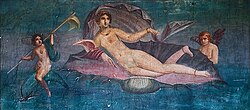
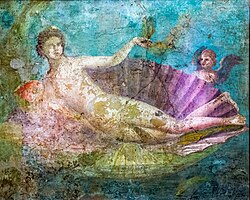
A scene of Aphrodite rising from the sea appears on the back of the Ludovisi Throne (c. 460 BC),294 which was probably originally part of a massive altar that was constructed as part of the Ionic temple to Aphrodite in the Greek polis of Locri Epizephyrii in Magna Graecia in southern Italy.294 The throne shows Aphrodite rising from the sea, clad in a diaphanous garment, which is drenched with seawater and clinging to her body, revealing her upturned breasts and the outline of her navel.295 Her hair hangs dripping as she reaches to two attendants standing barefoot on the rocky shore on either side of her, lifting her out of the water.295 Scenes with Aphrodite appear in works of classical Greek pottery,296 including a famous white-ground kylix by the Pistoxenos Painter dating the between c. 470 and 460 BC, showing her riding on a swan or goose.296
In c. 364/361 BC, the Athenian sculptor Praxiteles carved the marble statue Aphrodite of Knidos,297293 which Pliny the Elder later praised as the greatest sculpture ever made.297 The statue showed a nude Aphrodite modestly covering her pubic region while resting against a water pot with her robe draped over it for support.298299 The Aphrodite of Knidos was the first full-sized statue to depict Aphrodite completely naked300 and one of the first sculptures that was intended to be viewed from all sides.301300 The statue was purchased by the people of Knidos in around 350 BC300 and proved to be tremendously influential on later depictions of Aphrodite.301 The original sculpture has been lost,297299 but written descriptions of it as well several depictions of it on coins are still extant302297299 and over sixty copies, small-scale models, and fragments of it have been identified.302
The Greek painter Apelles of Kos, a contemporary of Praxiteles, produced the panel painting Aphrodite Anadyomene (Aphrodite Rising from the Sea).292 According to Athenaeus, Apelles was inspired to paint the painting after watching the courtesan Phryne take off her clothes, untie her hair, and bathe naked in the sea at Eleusis.292 The painting was displayed in the Asclepeion on the island of Kos.292 The Aphrodite Anadyomene went unnoticed for centuries,292 but Pliny the Elder records that, in his own time, it was regarded as Apelles's most famous work.292
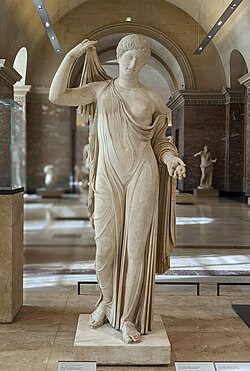
During the Hellenistic and Roman periods, statues depicting Aphrodite proliferated;303 many of these statues were modeled at least to some extent on Praxiteles's Aphrodite of Knidos.303 Some statues show Aphrodite crouching naked;304 others show her wringing water out of her hair as she rises from the sea.304 Another common type of statue is known as Aphrodite Kallipygos, the name of which is Greek for "Aphrodite of the Beautiful Buttocks";304 this type of sculpture shows Aphrodite lifting her peplos to display her buttocks to the viewer while looking back at them from over her shoulder.304 The ancient Romans produced massive numbers of copies of Greek sculptures of Aphrodite303 and more sculptures of Aphrodite have survived from antiquity than of any other deity.304
-
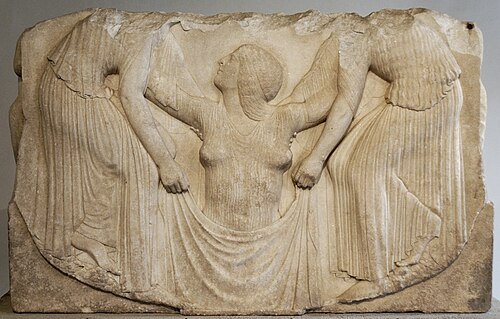 The Ludovisi Throne (possibly c. 460 BC) is believed to be a classical Greek bas-relief, although it has also been alleged to be a 19th-century forgery.
 -
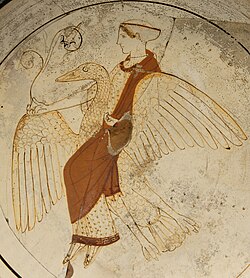 Attic white-ground red-figured kylix of Aphrodite riding a swan (c. 46-470) found at Kameiros (Rhodes)
 -
-
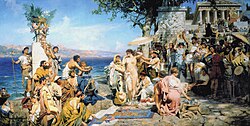
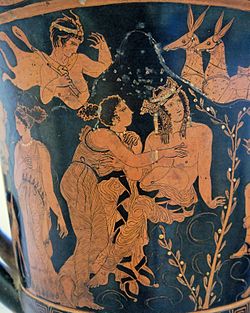 Red-figure vase painting of Aphrodite and Phaon (c. 420-400 BC)
 -
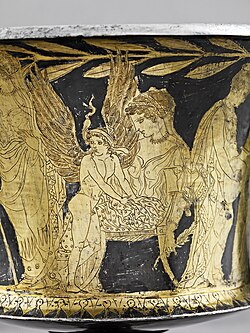
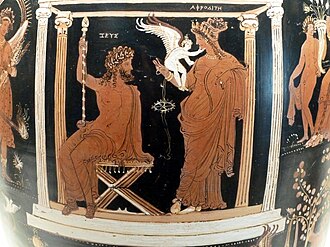 Apuleian vase painting of Zeus plotting with Aphrodite to seduce Leda while Eros sits on her arm (c. 330 BC)
-
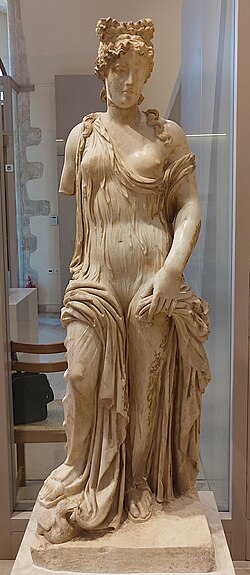
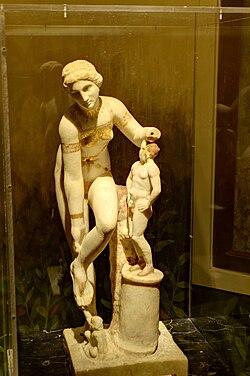
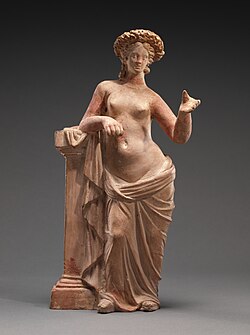 Aphrodite Leaning Against a Pillar (third century BC)
 -
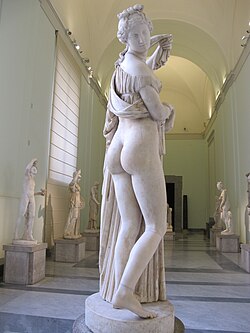 Aphrodite Kallipygos ("Aphrodite of the Beautiful Buttocks")
 -
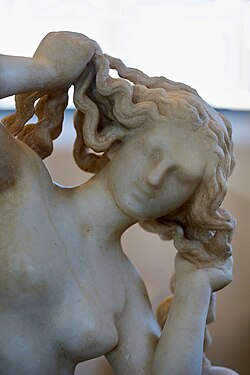
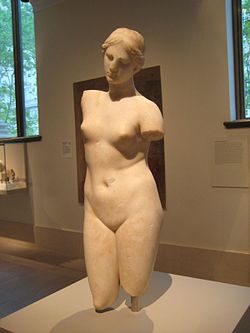 Aphrodite Binding Her Hair (second century BC)
 -
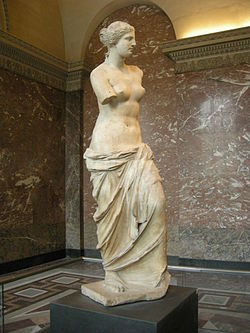 Aphrodite of Milos (c. 100 BC), Louvre
 -
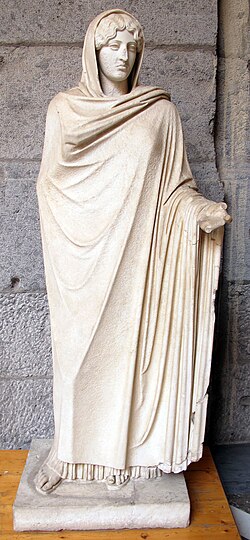 Aphrodite Sosandra (Roman copan copy of 5th century BC)
 -
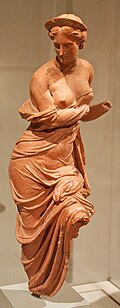 Aphrodite Heyl (second century BC)
 -
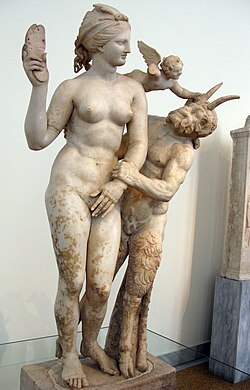 Greek sculpture group of Aphrodite, Pan and Eros (c. 100 BC)
 -
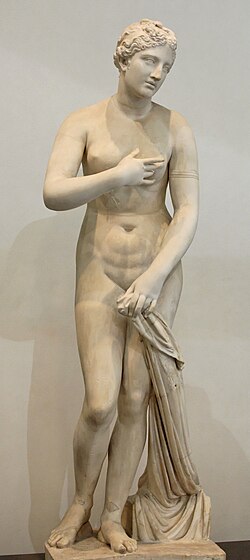 Aphrodite of Menophantos (first century BC)
 -
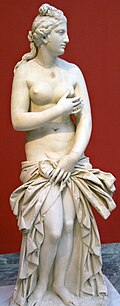 Aphrodite of Syracuse (Roman copy of 2nd century AD), NAMA.
 -
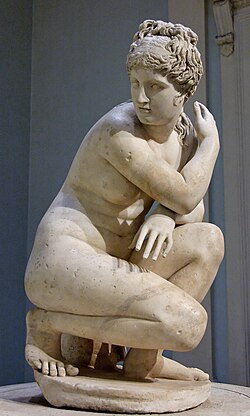 The Lely Venus (c. second century AD)
 -
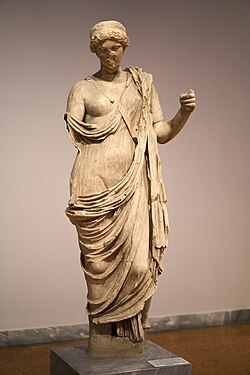 Aphrodite Areia Roman copy, NAMA.
Post-classical culture
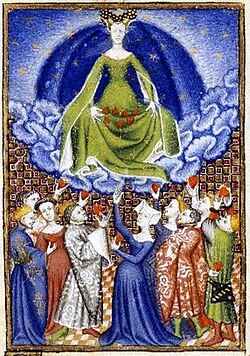
Middle Ages
Early Christians frequently adapted pagan iconography to suit Christian purposes.305306307 In the Early Middle Ages, Christians adapted elements of Aphrodite/Venus's iconography and applied them to Eve and prostitutes,306 but also female saints and even the Virgin Mary.306 Christians in the east reinterpreted the story of Aphrodite's birth as a metaphor for baptism;308 in a Coptic stele from the sixth century AD, a female orant is shown wearing Aphrodite's conch shell as a sign that she is newly baptized.308 Throughout the Middle Ages, villages and communities across Europe still maintained folk tales and traditions about Aphrodite/Venus309 and travelers reported a wide variety of stories.309 Numerous Roman mosaics of Venus survived in Britain, preserving memory of the pagan past.284 In North Africa in the late fifth century AD, Fulgentius of Ruspe encountered mosaics of Aphrodite284 and reinterpreted her as a symbol of the sin of Lust,284 arguing that she was shown naked because "the sin of lust is never cloaked"284 and that she was often shown "swimming" because "all lust suffers shipwreck of its affairs".284 He also argued that she was associated with doves and conches because these are symbols of copulation,284 and that she was associated with roses because "as the rose gives pleasure, but is swept away by the swift movement of the seasons, so lust is pleasant for a moment, but is swept away forever."284
While Fulgentius had appropriated Aphrodite as a symbol of Lust,310 Isidore of Seville (c. 560–636) interpreted her as a symbol of marital procreative sex310 and declared that the moral of the story of Aphrodite's birth is that sex can only be holy in the presence of semen, blood, and heat, which he regarded as all being necessary for procreation.310 Meanwhile, Isidore denigrated Aphrodite/Venus's son Eros/Cupid as a "demon of fornication" (daemon fornicationis).310 Aphrodite/Venus was best known to Western European scholars through her appearances in Virgil's Aeneid and Ovid's Metamorphoses.311 Venus is mentioned in the Latin poem Pervigilium Veneris ("The Eve of Saint Venus"), written in the third or fourth century AD,312 and in Giovanni Boccaccio's Genealogia Deorum Gentilium.313
Since the Late Middle Ages. the myth of the Venusberg (German; French Mont de Vénus, "Mountain of Venus") – a subterranean realm ruled by Venus, hidden underneath Christian Europe – became a motif of European folklore rendered in various legends and epics. In German folklore of the 16th century, the narrative becomes associated with the minnesinger Tannhäuser, and in that form the myth was taken up in later literature and opera.
Art
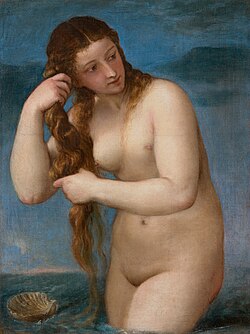
Aphrodite is the central figure in Sandro Botticelli's painting Primavera, which has been described as "one of the most written about, and most controversial paintings in the world",314 and "one of the most popular paintings in Western art".315 The story of Aphrodite's birth from the foam was a popular subject matter for painters during the Italian Renaissance,316 who were attempting to consciously reconstruct Apelles of Kos's lost masterpiece Aphrodite Anadyomene based on the literary ekphrasis of it preserved by Cicero and Pliny the Elder.317 Artists also drew inspiration from Ovid's description of the birth of Venus in his Metamorphoses.317 Sandro Botticelli's The Birth of Venus (c. 1485) was also partially inspired by a description by Poliziano of a relief on the subject.317 Later Italian renditions of the same scene include Titian's Venus Anadyomene (c. 1525)317 and Raphael's painting in the Stufetta del cardinal Bibbiena (1516).317 Titian's biographer Giorgio Vasari identified all of Titian's paintings of naked women as paintings of "Venus",318 including an erotic painting from c. 1534, which he called the Venus of Urbino, even though the painting does not contain any of Aphrodite/Venus's traditional iconography and the woman in it is clearly shown in a contemporary setting, not a classical one.318
-
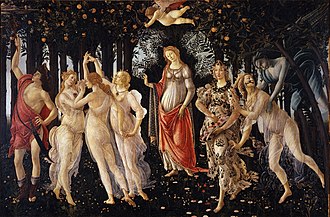 Primavera (late 1470s or early 1480s) by Sandro Botticelli
 -
-
 Venus of Urbino (c. 1534) by Titian
 -

-
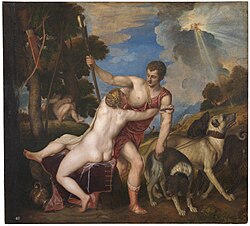 Venus and Adonis (1554) by Titian
 -
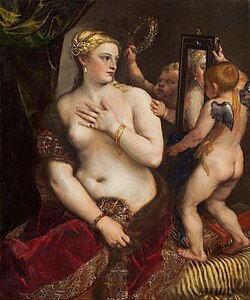 Venus with a Mirror (c. 1555) by Titian
 -
-
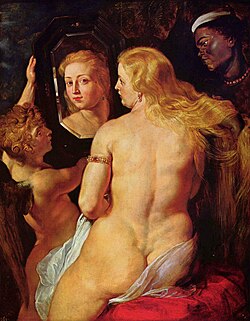 The Toilet of Venus (c. 1612–1615) by Peter Paul Rubens
 -
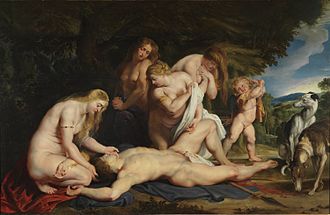 The Death of Adonis (c. 1614) by Peter Paul Rubens
 -
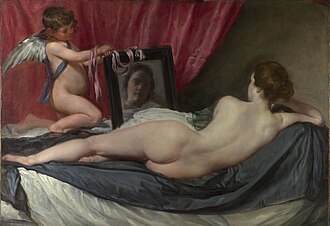 Rokeby Venus (c. 1647–51) by Diego Velázquez
 -
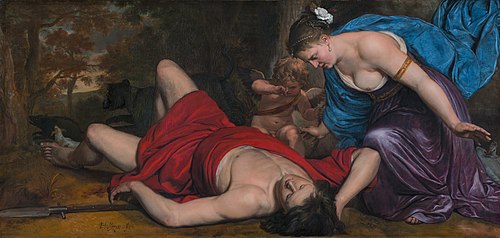 Venus and Cupid Lamenting the Dead Adonis (1656) by Cornelis Holsteyn
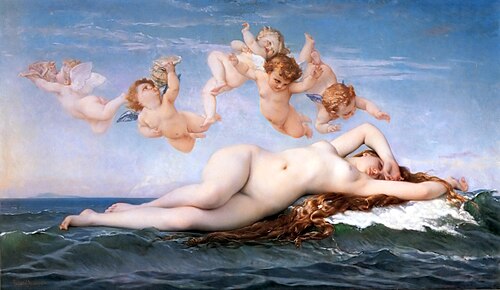
The Birth of Venus (1863) by Alexandre Cabanel Jacques-Louis David's final work was his 1824 magnum opus, Mars Being Disarmed by Venus,319 which combines elements of classical, Renaissance, traditional French art, and contemporary artistic styles.319 While he was working on the painting, David described it, saying, "This is the last picture I want to paint, but I want to surpass myself in it. I will put the date of my seventy-five years on it and afterwards I will never again pick up my brush."320 The painting was exhibited first in Brussels and then in Paris, where over 10,000 people came to see it.320 Jean-Auguste-Dominique Ingres's painting Venus Anadyomene was one of his major works.321 Louis Geofroy described it as a "dream of youth realized with the power of maturity, a happiness that few obtain, artists or others."321 Théophile Gautier declared: "Nothing remains of the marvelous painting of the Greeks, but surely if anything could give the idea of antique painting as it was conceived following the statues of Phidias and the poems of Homer, it is M. Ingres's painting: the Venus Anadyomene of Apelles has been found."321 Other critics dismissed it as a piece of unimaginative, sentimental kitsch,321 but Ingres himself considered it to be among his greatest works and used the same figure as the model for his later 1856 painting La Source.321
Paintings of Venus were favorites of the late nineteenth-century Academic artists in France.322323 In 1863, Alexandre Cabanel won widespread critical acclaim at the Paris Salon for his painting The Birth of Venus, which the French emperor Napoleon III immediately purchased for his own personal art collection.324 Édouard Manet's 1865 painting Olympia parodied the nude Venuses of the Academic painters, particularly Cabanel's Birth of Venus.325 In 1867, the English Academic painter Frederic Leighton displayed his Venus Disrobing for the Bath at the academy.326 The art critic J. B. Atkinson praised it, declaring that "Mr Leighton, instead of adopting corrupt Roman notions regarding Venus such as Rubens embodied, has wisely reverted to the Greek idea of Aphrodite, a goddess worshipped, and by artists painted, as the perfection of female grace and beauty".327 A year later, the English painter Dante Gabriel Rossetti, a founding member of the Pre-Raphaelite Brotherhood, painted Venus Verticordia (Latin for "Aphrodite, the Changer of Hearts"), showing Aphrodite as a nude red-headed woman in a garden of roses.326 Though he was reproached for his outré subject matter,326 Rossetti refused to alter the painting and it was soon purchased by J. Mitchell of Bradford.327 In 1879, William Adolphe Bouguereau exhibited at the Paris Salon his own Birth of Venus,324 which imitated the classical tradition of contrapposto and was met with widespread critical acclaim, rivalling the popularity of Cabanel's version from nearly two decades prior.324
-
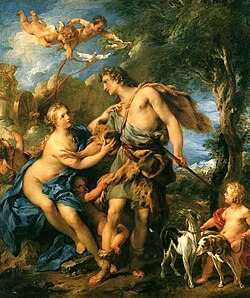 Venus and Adonis (1729) by François Lemoyne
 -

-
 Mars and Venus Surprised by Vulcan (1827) by Alexandre Charles Guillemot
 -

-
 Venus Disrobing for the Bath (1867) by Frederic Leighton
 -
 Venus Verticordia (1868) by Dante Gabriel Rossetti
 -
 The Birth of Venus (c. 1879) by William-Adolphe Bouguereau
 -
 The Birth of Venus (1907) by Henri Gervex
Literature

William Shakespeare's erotic narrative poem Venus and Adonis (1593), a retelling of the courtship of Aphrodite and Adonis from Ovid's Metamorphoses,328329 was the most popular of all his works published within his own lifetime.330331 Six editions of it were published before Shakespeare's death (more than any of his other works)331 and it enjoyed particularly strong popularity among young adults.330 In 1605, Richard Barnfield lauded it,331 declaring that the poem had placed Shakespeare's name "in fames immortall Booke".331 Despite this, the poem has received mixed reception from modern critics;330 Samuel Taylor Coleridge defended it,330 but Samuel Butler complained that it bored him330 and C. S. Lewis described an attempted reading of it as "suffocating".330
Aphrodite appears in Richard Garnett's short story collection The Twilight of the Gods and Other Tales (1888),332 in which the gods' temples have been destroyed by Christians.333 Stories revolving around sculptures of Aphrodite were common in the late nineteenth and early twentieth centuries.334 Examples of such works of literature include the novel The Tinted Venus: A Farcical Romance (1885) by Thomas Anstey Guthrie and the short story The Venus of Ille (1887) by Prosper Mérimée,335 both of which are about statues of Aphrodite that come to life.335 Another noteworthy example is Aphrodite in Aulis by the Anglo-Irish writer George Moore,336 which revolves around an ancient Greek family who moves to Aulis.337 The French writer Pierre Louÿs titled his erotic historical novel Aphrodite: mœurs antiques (1896) after the Greek goddess.338 The novel enjoyed widespread commercial success,338 but scandalized French audiences due to its sensuality and its decadent portrayal of Greek society.338
In the early twentieth century, stories of Aphrodite were used by feminist poets,339 such as Amy Lowell and Alicia Ostriker.340 Many of these poems dealt with Aphrodite's legendary birth from the foam of the sea.339 Other feminist writers, including Claude Cahun, Thit Jensen, and Anaïs Nin also made use of the myth of Aphrodite in their writings.341 Ever since the publication of Isabel Allende's book Aphrodite: A Memoir of the Senses in 1998, the name "Aphrodite" has been used as a title for dozens of books dealing with all topics even superficially connected to her domain.342 Frequently these books do not even mention Aphrodite,342 or mention her only briefly, but make use of her name as a selling point.343
Modern worship
In 1938, Gleb Botkin, a Russian immigrant to the United States, founded the Church of Aphrodite, a neopagan religion centered around the worship of a mother goddess, whom its practitioners identified as Aphrodite.344345 The Church of Aphrodite's theology was laid out in the book In Search of Reality, published in 1969, two years before Botkin's death.346 The book portrayed Aphrodite in a drastically different light than the one in which the Greeks envisioned her,346 instead casting her as "the sole Goddess of a somewhat Neoplatonic Pagan monotheism".346 It claimed that the worship of Aphrodite had been brought to Greece by the mystic teacher Orpheus,346 but that the Greeks had misunderstood Orpheus's teachings and had not realized the importance of worshipping Aphrodite alone.346
Aphrodite is a major deity in Wicca,347 a contemporary nature-based syncretic Neopagan religion. Wiccans regard Aphrodite as one aspect of the Goddess and she is frequently invoked by name during enchantments dealing with love and romance.348 Wiccans regard Aphrodite as the ruler of human emotions, erotic spirituality, creativity, and art.347 As one of the twelve Olympians, Aphrodite is a major deity within Hellenismos (Hellenic Polytheistic Reconstructionism),349 a Neopagan religion which seeks to authentically revive and recreate the religion of ancient Greece in the modern world. Unlike Wiccans, Hellenists are usually strictly polytheistic or pantheistic. Hellenists venerate Aphrodite primarily as the goddess of romantic love, but also as a goddess of sexuality, the sea, and war. Her many epithets include "Sea Born", "Killer of Men", "She upon the Graves", "Fair Sailing", and "Ally in War".
Genealogy
| Aphrodite's family tree350 | |||||||||||||||||||||||||||||||||||||||||||||||||||||||||||||||||||||||||||||||||||||||||||||||||||||||||||||||||||||||||||||||||||||||||||||||||||||||||||||||||||||||||||||||||||||||||||||||||||||||||||||||||||||||||||||||||||||||||||||||||||||||||||||||||||||||||||||||||||||||||||||||||||||||||||||||||||||||||||||||||||||||||||||||||||||||||||||||||||||||||||||||||||||||||||||||||||||||||||||||||||||||||||||||||||||||||||||||||||||||||||||||||||||||||||||||||||||||||||||||||||||||||||||||||||||||||||||||||||||||||||||||||||||||||||||||||||||||||||||||||||||||||||||||||||||||||||||||||||||||||||||||||||||||||||||||||||||||||||||||||||||||||||||||||||||||||||||||||||||||||||||||||||||||||||||||||||||||||||||||||||||||||||||||||||||||||||||||||||||||||||||||||||||||||||||||||||||||||||||||||||||||||||||||||||||||||||||||||||||||||||||||||||||||||||||||||||||||||||||||||||||||||||||||||||||||||||||||||||||||||||||||||||||||||||||||||||||||||||||||||||||||||||||||||||||||||||||||||||||||
|---|---|---|---|---|---|---|---|---|---|---|---|---|---|---|---|---|---|---|---|---|---|---|---|---|---|---|---|---|---|---|---|---|---|---|---|---|---|---|---|---|---|---|---|---|---|---|---|---|---|---|---|---|---|---|---|---|---|---|---|---|---|---|---|---|---|---|---|---|---|---|---|---|---|---|---|---|---|---|---|---|---|---|---|---|---|---|---|---|---|---|---|---|---|---|---|---|---|---|---|---|---|---|---|---|---|---|---|---|---|---|---|---|---|---|---|---|---|---|---|---|---|---|---|---|---|---|---|---|---|---|---|---|---|---|---|---|---|---|---|---|---|---|---|---|---|---|---|---|---|---|---|---|---|---|---|---|---|---|---|---|---|---|---|---|---|---|---|---|---|---|---|---|---|---|---|---|---|---|---|---|---|---|---|---|---|---|---|---|---|---|---|---|---|---|---|---|---|---|---|---|---|---|---|---|---|---|---|---|---|---|---|---|---|---|---|---|---|---|---|---|---|---|---|---|---|---|---|---|---|---|---|---|---|---|---|---|---|---|---|---|---|---|---|---|---|---|---|---|---|---|---|---|---|---|---|---|---|---|---|---|---|---|---|---|---|---|---|---|---|---|---|---|---|---|---|---|---|---|---|---|---|---|---|---|---|---|---|---|---|---|---|---|---|---|---|---|---|---|---|---|---|---|---|---|---|---|---|---|---|---|---|---|---|---|---|---|---|---|---|---|---|---|---|---|---|---|---|---|---|---|---|---|---|---|---|---|---|---|---|---|---|---|---|---|---|---|---|---|---|---|---|---|---|---|---|---|---|---|---|---|---|---|---|---|---|---|---|---|---|---|---|---|---|---|---|---|---|---|---|---|---|---|---|---|---|---|---|---|---|---|---|---|---|---|---|---|---|---|---|---|---|---|---|---|---|---|---|---|---|---|---|---|---|---|---|---|---|---|---|---|---|---|---|---|---|---|---|---|---|---|---|---|---|---|---|---|---|---|---|---|---|---|---|---|---|---|---|---|---|---|---|---|---|---|---|---|---|---|---|---|---|---|---|---|---|---|---|---|---|---|---|---|---|---|---|---|---|---|---|---|---|---|---|---|---|---|---|---|---|---|---|---|---|---|---|---|---|---|---|---|---|---|---|---|---|---|---|---|---|---|---|---|---|---|---|---|---|---|---|---|---|---|---|---|---|---|---|---|---|---|---|---|---|---|---|---|---|---|---|---|---|---|---|---|---|---|---|---|---|---|---|---|---|---|---|---|---|---|---|---|---|---|---|---|---|---|---|---|---|---|---|---|---|---|---|---|---|---|---|---|---|---|---|---|---|---|---|---|---|---|---|---|---|---|---|---|---|---|---|---|---|---|---|---|---|---|---|---|---|---|---|---|---|---|---|---|---|---|---|---|---|---|---|---|---|---|---|---|---|---|---|---|---|---|---|---|---|---|---|---|---|---|---|---|---|---|---|---|---|---|---|---|---|---|---|---|---|---|---|---|---|---|---|---|---|---|---|---|---|---|---|---|---|---|---|---|---|---|---|---|---|---|---|---|---|---|---|---|---|---|---|---|---|---|---|---|---|---|---|---|---|---|---|---|---|---|---|---|---|---|---|---|---|---|---|---|---|---|---|---|---|---|---|---|---|---|---|---|---|---|---|---|---|---|---|---|---|---|---|---|---|---|---|---|---|---|---|---|---|---|---|---|---|---|---|---|---|---|---|---|---|---|---|---|---|---|---|---|---|---|---|---|---|---|---|---|---|---|---|---|---|---|---|---|---|---|---|---|---|---|---|---|---|---|---|---|---|---|---|---|---|---|---|---|---|---|---|---|---|---|---|---|---|---|---|---|---|---|---|---|---|---|---|---|---|---|---|---|---|---|---|---|---|---|---|---|---|---|---|---|---|---|---|---|---|---|---|---|---|---|---|---|---|---|---|---|---|---|---|---|---|---|---|---|---|---|---|---|---|---|---|---|---|---|---|---|---|---|---|---|---|---|---|---|---|---|---|---|---|---|---|---|---|---|---|---|---|---|---|---|---|---|---|---|---|---|---|---|---|---|---|---|---|---|---|---|---|---|---|---|---|---|---|---|---|---|---|---|---|---|---|---|---|---|---|---|---|---|---|---|---|---|---|---|---|---|---|---|---|---|---|---|---|---|---|---|---|---|---|---|---|---|---|---|---|---|---|---|---|---|---|---|---|---|---|---|---|---|---|---|---|---|---|---|---|---|---|---|---|---|---|---|---|---|---|---|---|---|---|
| |||||||||||||||||||||||||||||||||||||||||||||||||||||||||||||||||||||||||||||||||||||||||||||||||||||||||||||||||||||||||||||||||||||||||||||||||||||||||||||||||||||||||||||||||||||||||||||||||||||||||||||||||||||||||||||||||||||||||||||||||||||||||||||||||||||||||||||||||||||||||||||||||||||||||||||||||||||||||||||||||||||||||||||||||||||||||||||||||||||||||||||||||||||||||||||||||||||||||||||||||||||||||||||||||||||||||||||||||||||||||||||||||||||||||||||||||||||||||||||||||||||||||||||||||||||||||||||||||||||||||||||||||||||||||||||||||||||||||||||||||||||||||||||||||||||||||||||||||||||||||||||||||||||||||||||||||||||||||||||||||||||||||||||||||||||||||||||||||||||||||||||||||||||||||||||||||||||||||||||||||||||||||||||||||||||||||||||||||||||||||||||||||||||||||||||||||||||||||||||||||||||||||||||||||||||||||||||||||||||||||||||||||||||||||||||||||||||||||||||||||||||||||||||||||||||||||||||||||||||||||||||||||||||||||||||||||||||||||||||||||||||||||||||||||||||||||||||||||||||||
See also
See also
- Anchises
- Asherah
- Cupid
- Girdle of Aphrodite
- History of nude art
- Lakshmi, rose from the ocean like Aphrodite and has 8-pointed star like Ishtar
Notes
Notes
- Ancient Greek: Ἀφροδίτη, romanized: Aphrodítē; Attic Greek pronunciation: [a.pʰro.dǐː.tɛː], Koine Greek: [a.ɸroˈdi.te̝], Modern Greek: [a.froˈði.ti]
- Museo Archeologico Nazionale (Napoli) so-called Venus in a bikini", Cir.campania.beniculturali.it:
The statuette portrays Aphrodite on the point of untying the laces of the sandal on her left foot, under which a small Eros squats, touching the sole of her shoe with his right hand. The Goddess is leaning with her left arm (the hand is missing) against a figure of Priapus standing, naked and bearded, positioned on a small cylindrical altar while, next to her left thigh, there is a tree trunk over which the garment of the Goddess is folded. Aphrodite, almost completely naked, wears only a sort of costume, consisting of a corset held up by two pairs of straps and two short sleeves on the upper part of her arm, from which a long chain leads to her hips and forms a star-shaped motif at the level of her navel. The "bikini", for which the statuette is famous, is obtained by the masterly use of the technique of gilding, also employed on her groin, in the pendant necklace and in the armilla on Aphrodite's right wrist, as well as on Priapus' phallus. Traces of the red paint are evident on the tree trunk, on the short curly hair gathered back in a bun and on the lips of the Goddess, as well as on the heads of Priapus and the Eros. Aphrodite's eyes are made of glass paste, while the presence of holes at the level of the ear-lobes suggest the existence of precious metal ear-rings which have since been lost. An interesting insight into the female ornaments of Roman times, the statuette, probably imported from the area of Alexandria, reproduces with a few modifications the statuary type of Aphrodite untying her sandal, known from copies in bronze and terracotta.
For extensive research and a bibliography on the subject, see: de Franciscis 1963, p. 78, tav. XCI; Kraus 1973, nn. 270–271, pp. 194–195; Pompei 1973, n. 132; Pompeji 1973, n. 199, pp. 142–144; Pompeji 1974, n. 281, pp. 148–149; Pompeii A.D. 79 1976, p. 83 note 218; Pompeii A.D. 79 1978, I, n. 208, pp. 64–65, II, n. 208, p. 189; Döhl, Zanker 1979, p. 202, tav. Va; Pompeii A.D. 79 1980, p. 79 n. 198; Pompeya 1981, n. 198, p. 107; Pompeii lives 1984, fig. 10, p. 46; Collezioni Museo 1989, I, 2, n. 254, pp. 146–147; PPM II, 1990, n. 7, p. 532; Armitt 1993, p. 240; Vésuve 1995, n. 53, pp. 162–163; Vulkan 1995, n. 53, pp. 162–163; LIMC VIII, 1, 1997, p. 210, s.v. Venus, n. 182; LIMC VIII, 2, 1997, p. 144; LIMC VIII, 1, 1997, p. 1031, s.v. Priapos, n. 15; LIMC VIII, 2, 1997, p. 680; Romana Pictura 1998, n. 153, p. 317 e tav. a p. 245; Cantarella 1999, p. 128; De Caro 1999, pp. 100–101; De Caro 2000, p. 46 e tav. a p. 62; Pompeii 2000, n. 1, p. 62.
- Anteros was originally born from the sea alongside Aphrodite; only later became her son.
References
References
- Hard, p. 202
- Homer, Iliad 5.370.
- Hesiod, Theogony, 188–190.
- This claim is made at Symposium 180e. It is hard to interpret the role of the various speeches in the dialogue and their relationship to what Plato actually thought; therefore, it is controversial whether Plato, in fact, believed this claim about Aphrodite. See Frisbee Sheffield, "The Role of the Earlier Speeches in the "Symposium": Plato's Endoxic Method?" in J. H. Lesher, Debra Nails & Frisbee C. C. Sheffield (eds.), Plato's Symposium: Issues in Interpretation and Reception, Harvard University Press, (2006).
- Cyrino 2010, p. 14.
- Hesiod, Theogony, 190–197.
- West 2000, pp. 134–138.
- Beekes 2009, p. 179.
- Cyrino 2010, pp. 26–27.
- Cyrino 2010, p. 26.
- West 2000, pp. 134–136.
- West 2000, pp. 137–138.
- Wilson-Wright, Aren M. (August 2019). Venus's Name - The Divine Name Aphrodite as a Phoenician Epithet. European Association of Biblical Studies Annual Conference. Warsaw.
- Paul Kretschmer, "Zum pamphylischen Dialekt", Zeitschrift für vergleichende Sprachforschung auf dem Gebiet der Indogermanischen Sprachen, 33 (1895), 267.
- Ernst Maaß, "Aphrodite und die hl. Pelagia", Neue Jahrbücher für das klassische Altertum, 27 (1911), 457–468.
- Vittore Pisani, "Akmon e Dieus", Archivio glottologico italiano, 24 (1930), 65–73.
- Janda 2005, pp. 349–360.
- Janda 2010, p. 65.
- Witczak 1993, pp. 115–123.
- Kölligan, Daniel (2007). "Aphrodite of the Dawn - Indo-European Heritage in Greek Divine Epithets and Theonyms". Letras Clássicas. 11 (11): 105–134. doi:10.11606/issn.2358-3150.v0i11p105-134.
- Penglase 1994, p. 164.
- Boedeker 1974, pp. 15–16.
- Chicago Assyrian Dictionary, vol. 2, p. 111.
- M. Hammarström, "Griechisch-etruskische Wortgleichungen", Glotta: Zeitschrift für griechische und lateinische Sprache 11 (1921), 215–216.
- Frisk 1960, p. 196f.
- West 2000, p. 134.
- Etymologicum Magnum, Ἀφροδίτη
- O'Bryhim, Shawn David (22 June 2021). A Student's Commentary on Ovid's Metamorphoses Book 10. Wiley-Blackwell. p. 80. ISBN 9781119770503.
- "The Cypriot Syllabic Script word a-po-ro-ti-ta-i". palaeolexicon.com. Retrieved 24 April 2023.
- Pestarino, Beatrice (8 August 2022). Kypriōn Politeia, the Political and Administrative Systems of the Classical Cypriot City-Kingdoms. Brill Publishers. pp. 135–136. ISBN 9789004520332.
- Breitenberger 2007, pp. 8–12.
- Cyrino 2010, pp. 49–52.
- Puhvel 1987, p. 27.
- Marcovich 1996, pp. 43–59.
- Burkert 1985, pp. 152–153.
- Pausanias, Description of Greece, I. XIV.7
- Breitenberger 2007, p. 8.
- Breitenberger 2007, pp. 10–11.
- Penglase 1994, p. 162.
- Penglase 1994, p. 163.
- Cyrino 2010, pp. 51–52.
- Budin 2010, pp. 85–86, 96, 100, 102–103, 112, 123, 125.
- Graz 1984, p. 250.
- Iossif & Lorber 2007, p. 77.
- Penglase 1994, pp. 162–163.
- Konaris 2016, p. 169.
- Burkert 1998, pp. 1–6.
- Burkert 1998, pp. 1–41.
- Dumézil 1934.
- Cyrino 2010, p. 24.
- Penglase 1994, pp. 162–164.
- Cyrino 2010, pp. 24–25.
- Cyrino 2010, p. 25.
- Bullough & Bullough 1993, p. 29.
- Clark 2015, p. 381.
- Kerényi 1951, p. 81.
- Cyrino 2010, p. 28.
- Kerényi 1951, p. 80.
- Cyrino 2010, pp. 28–29.
- Cyrino 2010, p. 35.
- Cyrino 2010, pp. 35–38.
- Plato, Symposium, 181a-d.
- Richard L. Hunter, Plato's Symposium, Oxford University Press, 2004, pp. 44–47
- "Suda, π, 825".
- Pausanias, Periegesis, vi.25.1; Aphrodite Pandemos was represented in the same temple riding on a goat, symbol of purely carnal rut: "The meaning of the tortoise and of the he-goat I leave to those who care to guess", Pausanias remarks.
- Andrea Alciato, Emblemata / Les emblemes (1584).
- Cyrino 2010, p. 39.
- Cyrino 2010, pp. 39–40.
- "Mechaneus". Dictionary of Greek and Roman Biography and Mythology. Vol. 2. Little, Brown and Company. 1867. p. 1003.
- Farnell, Lewis Richard (1896). The Cults of the Greek States. Clarendon Press. p. 666.
- Cyrino 2010, p. 27.
- Suda, gamma, 141
- Harry Thurston Peck, Harpers Dictionary of Classical Antiquities (1898), Genetyllis
- A Dictionary of Greek and Roman biography and mythology, Genetyllis
- Schmitz, Leonhard (1867). "Melaenis". Dictionary of Greek and Roman Biography and Mythology. Vol. 2. Little, Brown and Company. p. 1012.
- Koloski-Ostrow & Lyons 2000, pp. 230–231.
- Nlisson, Vol I, pp. 521–526
- Cyrino, 2010, pp. 38–40
- Kerenyi, 1951, pp. 80–81
- Harry Thurston Peck, Harpers Dictionary of Classical Antiquities (1898), Aphrogeneia
- Pausanias 3.17.5
- Giuliani, Luca. Schefold, Karl. Gods and Heroes in Late Archaic Greek Art. Cambridge University Press. Dec. 3, 1992. pgs. 57-59.
- Suda, kappa, 2738
- Suda, kappa, 2628
- Pausanias 1.1.3
- Pausanias 1.1.5
- Pausanias 3.13.8)
- A Dictionary of Greek and Roman biography and mythology, Idalia
- Pausanias 2.34.11
- Pausanias 3.15.11
- "A Dictionary of Greek and Roman biography and mythology, Zery'nthia". Tufts University. Retrieved 29 November 2025.
- Rosenzweig 2004, pp. 15–16.
- Simon 1983, pp. 49–50.
- Simon 1983, p. 48.
- Simon 1983, pp. 48–49.
- Simon 1983, pp. 47–48.
- Simon 1983, p. 49.
- Cyrino 2010, p. 40.
- Cyrino 2010, pp. 40–41.
- Cyrino 2010, pp. 41–42.
- Marcovich 1996, p. 49.
- Black & Green 1992, p. 109.
- Burkert 1985, p. 153.
- Cyrino 2010, pp. 41–43.
- Cyrino 2010, p. 43.
- Witt 1997, p. 125.
- Dunand 2007, p. 258.
- Larousse Desk Reference Encyclopedia, The Book People, Haydock, 1995, p. 215.
- Dunand 2007, p. 257.
- Cyrino 2010, pp. 127–128.
- Cyrino 2010, p. 128.
- Cyrino 2010, pp. 128–129.
- Cyrino 2010, p. 130.
- Cyrino 2010, pp. 130–131.
- Ames-Lewis 2000, p. 194.
- [1] Archived 11 May 2006 at the Wayback Machine
- Homer, Odyssey, viii, 288; Herodotus i. 105; Pausanias iii, 23, § 1; Anacreon v. 9; Horace, Carmina, i, 4, 5.
- Cyrino 2010, p. 21.
- Cyrino 2010, pp. 20–21.
- Hesiod, Theogony 191–192.
- Kerényi 1951, p. 69.
- Graves 1960, p. 37.
- Cyrino 2010, pp. 13–14.
- Cyrino 2010, p. 29.
- Puhvel 1987, p. 25.
- Homer, Iliad 5.370 and xx, 105
- Cyrino 2010, pp. 14–15.
- Apollodorus, 1.1.3
- Cyrino 2010, pp. 53–61.
- Cyrino 2010, pp. 73–78.
- Cyrino 2010, pp. 50, 72.
- Cyrino 2010, p. 72.
- Kerényi 1951, p. 279.
- Kerényi 1951, p. 72.
- Kerényi 1951, pp. 72–73.
- Kerényi 1951, pp. 73–74.
- Kerényi 1951, p. 74.
- Anderson 2000, pp. 131–132.
- Gallagher, David (1 January 2009). Avian and Serpentine. Brill Publishers. ISBN 978-90-420-2709-1.
- Lucian, Gallus 3, see also scholiast on Aristophanes, Birds, 835; Eustathius, Ad Odysseam, 1.300; Ausonius, 26.2.27; Libanius, Progymnasmata 2.26
- Homer, Odyssey 8.267 ff
- Homer, Iliad 18.382
- Hard, p. 202
- Slater 1968, pp. 199–200.
- Gantz 1996, p. 76.
- West 2011, pp. 32–3.
- West 2011, pp. 35–8.
- Bonner 1949, p. 1.
- Bonner 1949, pp. 1–6.
- Bonner 1949, pp. 1–2.
- "The Satala Aphrodite". British Museum. Archived from the original on 11 April 2020.
- Nersessian, Vrej (2001). "Bronze Head of Aphrodite/Anahit". Treasures from the Ark - 1700 Years of Armenian Christian Art. J. Paul Getty Museum. pp. 114–115. ISBN 9780892366392.
- Cyrino 2010, p. 44.
- Cyrino 2010, pp. 44–45.
- Cyrino 2010, p. 45.
- Cyrino 2010, pp. 45–46.
- Cyrino 2010, p. 47.
- Cyrino 2010, pp. 47–48.
- Cyrino 2010, p. 48.
- Cyrino 2010, pp. 48–49.
- Cyrino 2010, pp. 71–72.
- Cyrino 2010, pp. 72–73.
- Cyrino 2010, p. 73.
- Kerényi 1951, p. 176.
- Powell 2012, p. 214.
- Kerényi 1951, p. 283.
- "Priapus", Suda On Line, Tr. Ross Scaife, 10 August 2014, Entry Archived 13 May 2021 at the Wayback Machine
- Cyrino 2010, p. 89.
- Cyrino 2010, p. 90.
- Cyrino 2010, pp. 90–91.
- Cyrino 2010, p. 91.
- Cyrino 2010, p. 92.
- Cyrino 2010, pp. 92–93.
- Cyrino 2010, p. 93.
- Hesiod, Theogony 1008–10; Homer, Iliad 2.819–21.
- West 1997, p. 57.
- Kerényi 1951, p. 67.
- Cyrino 2010, p. 97.
- Burkert 1985, pp. 176–177.
- West 1997, pp. 530–531.
- Cyrino 2010, p. 95.
- Kerényi 1951, p. 75.
- Kerényi 1951, pp. 75–76.
- Kerényi 1951, p. 76.
- Lucian, Dialogues of the Gods, Aphrodite and the Moon
- Cyrino 2010, p. 96.
- Cameron 2004, p. 152: Some translations erroneously add Apollo as one of the men Aphrodite had sex with before Erymanthus saw her.
- Cyrino 2010, pp. 97–98.
- Cyrino 2010, p. 98.
- Cyrino 2010, p. 81.
- Cyrino 2010, p. 80.
- Cyrino 2010, pp. 81–82.
- Cyrino 2010, pp. 82–83.
- Homer, Odyssey 20.66-78
- Pausanias 10.30.1
- Codex Palatino-Vaticanus, scholia on Homer's Odyssey 19.517
- Ruck & Staples 2001, pp. 64–70.
- McKinley 2001, p. 43.
- Wasson 1968, p. 128.
- McKinley 2001, pp. 43–44.
- Clark 2015, pp. 90–91.
- Clement, Exhortation to the Greeks, 4
- Clark 2015, p. 91.
- Powell 2012, p. 215.
- Powell 2012, pp. 215–217.
- Powell 2012, p. 217.
- Apollodorus, 3.14.3.
- Cyrino 2010, pp. 98–103.
- Cyrino 2010, pp. 98–99.
- Cyrino 2010, p. 99.
- Cyrino 2010, p. 100.
- Cyrino 2010, pp. 100–101.
- Cyrino 2010, p. 101.
- Cyrino 2010, p. 102.
- Cyrino 2010, pp. 102–103.
- Vergil, Georgics 3.266–88, with Servius's note to line 268; Hand, The Routledge Handbook of Greek Mythology, pp. 432, 663.
- Hyginus, Fabulae 250.3, 273.11; Pausanias, Guide to Greece 6.20.19
- Antoninus Liberalis, Metamorphoses, 21
- Apollodorus, 1.4.4.
- "Ovid's Metamorphoses, book 10, English Translation". Archived from the original on 15 June 2012. Retrieved 11 January 2021.
- Diodorus Siculus, Bibliotheca historica 5.55.4–7
- Parthenius, Erotica Pathemata 5
- Ovid, Metamorphoses 10.298–518
- Hansen 2004, pp. 289–290.
- Apollodorus, 3.14.4; Antoninus Liberalis, 34
- Pseudo-Apollodorus, 3.14.3; 3.9.1 for Laodice.
- Apollodorus, Bibliotheca 1.3.3
- Scholia on Iliad 5.411
- Tzetzes on Lycophron 610.
- Ovid, Metamorphoses, 14.476
- "Aphrodite Myths 7 Wrath - Greek Mythology".
- Pierre Grimal, The Dictionary of Classical Mythology, s.v. "Aineias"
- Hyginus, Fabulae 40
- Seneca, Phaedra 124
- Scholia on Euripides' Hippolytus 47.
- Ovid, Metamorphoses 4.192–270; Hard, p. 45
- Pseudo-Plutarch, On Rivers, 14
- Hyginus, Astronomica 2.7.4
- Strelan, Rick (1996). "Paul, Artemis, and the Jews in Ephesus". Beihefte zur Zeitschrift für die neutestamentliche Wissenschaft. 80. De Gruyter: 75. ISBN 9783110150209. ISSN 0171-6441.
- Futre Pinheiro, Marília P.; Bierl, Anton; Beck, Roger (29 October 2013). Intende, Lector – Echoes of Myth, Religion and Ritual in the Ancient Novel. De Gruyter. p. 18. ISBN 978-3-11-031181-5.
- Walcot 1977, p. 31.
- Walcot 1977, pp. 31–32.
- Walcot 1977, p. 32.
- Bull 2005, pp. 346–347.
- Walcot 1977, pp. 32–33.
- Cyrino 2010, p. 85.
- Cyrino 2010, pp. 85–86.
- Cyrino 2010, pp. 35–36, 86–87.
- Cyrino 2010, pp. 36, 86–87.
- Cyrino 2010, p. 87.
- Cyrino 2010, pp. 87–88.
- Cyrino 2010, p. 88.
- Cyrino 2010, p. 49.
- Cyrino 2010, pp. 49–50.
- Cyrino 2010, p. 50.
- Burkert 2005, p. 300.
- Burkert 2005, pp. 299–300.
- Cyrino 2010, p. 36.
- Homer, Iliad 21.416–17.
- Bremmer, Jan N. (1996). "Mythology". The Oxford Classical Dictionary (Third ed.). Oxford University Press. pp. 1018–1020. ISBN 019866172X.
- Reeve, Michael D. (1996). "Scholia". The Oxford Classical Dictionary (Third ed.). Oxford University Press. p. 1368. ISBN 019866172X.
- Smith 1873, s.v. Anchises.
- Kerényi 1951, p. 71.
- Eros is usually mentioned as the son of Aphrodite but in other versions he is a parentless primordial.
- Diodorus Siculus, 4.6.5: "... Hermaphroditus, as he has been called, who was born of Hermes and Aphrodite and received a name which is a combination of those of both his parents."
- Pindar, Olympian 7.14 makes her the daughter of Aphrodite, but does not mention any father. Herodorus, fr. 62 Fowler (Fowler 2001, p. 253), apud schol. Pindar Olympian 7.24–5; Fowler 2013, p. 591 make her the daughter of Aphrodite and Poseidon.
- Graves 1960, p. 70.
- Athenaeus 13.35
- Diodorus Siculus, 4.23.2
- Hesychius of Alexandria s. v. Μελιγουνίς: "Meligounis: this is what the island Lipara was called. Also one of the daughters of Aphrodite."
- Apollodorus, 1.9.25.
- Servius on Aeneid, 1.574, 5.24
- Apollodorus, 3.14.3.
- Hesiod, Theogony 986–990; Pausanias, Description of Greece, 1.3.1 (using the name "Hemera" for Eos)
- Gantz 1996, p. 104.
- West 2008, p. 36.
- Cyrino 2010, pp. 121–122.
- Lewis & Llewellyn-Jones 2018, p. 335.
- Botterweck & Ringgren 1990, p. 35.
- Cyrino 2010, p. 122.
- Pepin, Ronald E. (2008). The Vatican Mythographers. Fordham University Press. p. 76. ISBN 978-0-8232-2892-8.
- De Gubernatis, Angelo (1872). Zoological Mythology - Or, The Legends of Animals. Vol. 2. Trübner & Company. p. 305. ISBN 978-0-598-54106-2.
{{cite book}}: ISBN / Date incompatibility (help) - Cyrino 2010, pp. 120–123.
- Tinkle 1996, p. 81.
- Cyrino 2010, pp. 63, 96.
- Pepin, Ronald E. (2008). The Vatican Mythographers. Fordham University Press. p. 117. ISBN 978-0-8232-2892-8.
- Cyrino 2010, p. 64.
- Smith, William (1861), Dictionary of Greek and Roman Biography and Mythology, Walton and Maberly, s.v Melus.
- Cyrino 2010, p. 63.
- Cyrino 2010, pp. 63–64.
- Cyrino 2010, pp. 123–124.
- Havelock 2007, p. 86.
- Cyrino 2010, pp. 76–77.
- Cyrino 2010, p. 106.
- Cyrino 2010, pp. 106–107.
- Cyrino 2010, p. 124.
- Grant 1989, p. 224.
- Grant 1989, p. 225.
- Cyrino 2010, p. 77.
- Cyrino 2010, p. 76.
- Grant 1989, pp. 224–225.
- Palagia & Pollitt 1996, p. 98.
- Cyrino 2010, pp. 77–78.
- Cyrino 2010, p. 78.
- Taylor 1993, pp. 96–97.
- Tinkle 1996, p. 80.
- Link 1995, pp. 43–45.
- Taylor 1993, p. 97.
- Tinkle 1996, pp. 80–81.
- Tinkle 1996, p. 82.
- Tinkle 1996, pp. 106–108.
- Tinkle 1996, pp. 107–108.
- Tinkle 1996, p. 108.
- Fossi 1998, p. 5.
- Cunningham & Reich 2009, p. 282.
- Ames-Lewis 2000, pp. 193–195.
- Ames-Lewis 2000, p. 193.
- Tinagli 1997, p. 148.
- Bordes 2005, p. 189.
- Hill 2007, p. 155.
- Tinterow 1999, p. 358.
- McPhee 1986, pp. 66–67.
- Gay 1998, p. 128.
- McPhee 1986, p. 66.
- Gay 1998, p. 129.
- Smith 1996, pp. 145–146.
- Smith 1996, p. 146.
- Lákta 2017, pp. 56–58.
- Cyrino 2010, p. 131.
- Lákta 2017, p. 58.
- Hiscock 2017, p. unpaginated.
- Clark 2015, pp. 354–355.
- Clark 2015, p. 355.
- Clark 2015, p. 364.
- Clark 2015, pp. 361–362.
- Clark 2015, p. 363.
- Clark 2015, pp. 363–364.
- Brooks & Alden 1980, pp. 836–844.
- Clark 2015, p. 369.
- Clark 2015, pp. 369–371.
- Clark 2015, pp. 372–374.
- Cyrino 2010, pp. 134–135.
- Cyrino 2010, p. 135.
- Clifton 2006, p. 139.
- Pizza & Lewis 2009, pp. 327–328.
- Clifton 2006, p. 141.
- Gallagher 2005, pp. 109–110.
- Gallagher 2005, p. 110.
- Matthew Brunwasser (20 June 2013). "The Greeks who worship the ancient gods". BBC.
- This chart is based upon Hesiod's Theogony, unless otherwise noted.
- According to Homer, Iliad 1.570–579, 14.338, Odyssey 8.312, Hephaestus was apparently the son of Hera and Zeus, see Gantz, p. 74.
- According to Hesiod, Theogony 927–929, Hephaestus was produced by Hera alone, with no father, see Gantz, p. 74.
- According to Hesiod's Theogony 886–890, of Zeus's children by his seven wives, Athena was the first to be conceived, but the last to be born; Zeus impregnated Metis then swallowed her, later Zeus himself gave birth to Athena "from his head", see Gantz, pp. 51–52, 83–84.
- According to Hesiod, Theogony 183–200, Aphrodite was born from Uranus's severed genitals, see Gantz, pp. 99–100.
- According to Homer, Aphrodite was the daughter of Zeus (Iliad 3.374, 20.105; Odyssey 8.308, 320) and Dione (Iliad 5.370–71), see Gantz, pp. 99–100.
Bibliography
Bibliography
- Homer, The Iliad with an English Translation by A.T. Murray, PhD in two volumes, Harvard University Press; William Heinemann, 1924 Online version at the Perseus Digital Library
- Hesiod, Theogony, in The Homeric Hymns and Homerica with an English Translation by Hugh G. Evelyn-White, Harvard University Press; William Heinemann, 1914 Online version at the Perseus Digital Library
- Evelyn-White, Hugh, The Homeric Hymns and Homerica with an English Translation by Hugh G. Evelyn-White, Homeric Hymns, Harvard University Press; William Heinemann, 1914
- Pindar, Odes, Diane Arnson Svarlien, 1990 Online version at the Perseus Digital Library
- Euripides, The Complete Greek Drama, edited by Whitney J. Oates and Eugene O'Neill, Jr. in two volumes, 2, The Phoenissae, translated by E. P. Coleridge, Random House, 1938
- Apollonius Rhodius, Argonautica translated by Robert Cooper Seaton (1853–1915), R. C. Loeb Classical Library Volume 001, William Heinemann, 1912 Online version at the Topos Text Project
- Apollodorus, Apollodorus, The Library, with an English Translation by Sir James George Frazer, F.B.A., F.R.S. in 2 Volumes, Harvard University Press; William Heinemann, 1921 Online version at the Perseus Digital Library
- Pausanias, Pausanias Description of Greece with an English Translation by W.H.S. Jones, Litt.D., and H.A. Ormerod, M.A., in 4 Volumes, Harvard University Press; William Heinemann, 1918 Online version at the Perseus Digital Library
- Diodorus Siculus, Bibliotheca Historica, Vol. 1-2, Immanel Bekker, Ludwig Dindorf, Friedrich Vogel in aedibus B. G. Teubneri, 1888–1890 Greek text available at the Perseus Digital Library
- Ovid, Metamorphoses, translated by A. D. Melville; introduction and notes by E. J. Kenney, Oxford University Press, 2008, ISBN 978-0-19-953737-2
- Gaius Julius Hyginus, The Myths of Hyginus, edited and translated by Mary A. Grant, University Press of Kansas, 1960
- Gaius Julius Hyginus, Astronomica from The Myths of Hyginus, translated and edited by Mary Grant, University of Kansas, publications in Humanistic Studies Online version at the Topos Text Project
- Ames-Lewis, Francis (2000), The Intellectual Life of the Early Renaissance Artist, Yale University Press, ISBN 0-300-09295-4
- Anderson, Graham (2000), Fairytale in the Ancient World, Routledge, pp. 131–132, ISBN 978-0-415-23702-4
- Arscott, Caroline; Scott, Katie, eds. (2000), Manifestations of Venus: Art and Sexuality, Critical Perspectives in Art History, Manchester University Press, ISBN 978-0719055225
- Black, Jeremy; Green, Anthony (1992), Gods, Demons and Symbols of Ancient Mesopotamia: An Illustrated Dictionary, The British Museum Press, ISBN 0-7141-1705-6
- Boedeker, Deborah (1974), Aphrodite's Entry into Greek Epic, Brill Publishers, pp. 15–16
- Beekes, Robert S. P. (2009), Etymological Dictionary of Greek, vol. 1, Brill Publishers, ISBN 978-90-04-17418-4
- Bonner, Campbell (1949), "KESTOS IMAS and the Saltire of Aphrodite", The American Journal of Philology, 70 (1), Johns Hopkins University Press: 1–6, doi:10.2307/290961, JSTOR 290961
- Bordes, Philippe (2005), Jacques-Louis David: Empire to Exile, Yale University Press, ISBN 0-300-10447-2
- Botterweck, G. Johannes; Ringgren, Helmer (1990), Theological Dictionary of the Old Testament, vol. VI, William B. Eerdmans Publishing Company, ISBN 0-8028-2330-0
- Breitenberger, Barbara (2007), Aphrodite and Eros: The Development of Greek Erotic Mythology, Routledge, ISBN 978-0-415-96823-2
- Brooks, Richard A.; Alden, Douglas W. (1980), A Critical Bibliography of French Literature, vol. 6, Syracuse University Press, ISBN 0-8156-2207-4
- Bull, Malcolm (2005), The Mirror of the Gods: How Renaissance Artists Rediscovered the Pagan Gods, Oxford University Press, ISBN 0-19-521923-6
- Bullough, Vern L.; Bullough, Bonnie (1993), Cross Dressing, Sex, and Gender (reprint ed.), University of Pennsylvania Press, p. 29, ISBN 978-0812214314
- Budin, Stephanie L. (2010), "Aphrodite Enoplion", in Smith, Amy C.; Pickup, Sadie (eds.), Brill's Companion to Aphrodite, Brill's Companions in Classical Studies, Brill Publishers, pp. 85–86, 96, 100, 102–103, 112, 123, 125, ISBN 978-9047444503
- Burkert, Walter (1985), Greek Religion, Harvard University Press, ISBN 0-674-36281-0
- Burkert, Walter (1998) [1992], The Orientalizing Revolution: Near Eastern Influence on Greek Culture in the Early Archaic Age, Harvard University Press, ISBN 978-0674643642
- Burkert, Walter (2005), "Chapter Twenty: Near Eastern Connections", in Foley, John Miles (ed.), A Companion to Ancient Epic, Blackwell Publishing, ISBN 978-1-4051-0524-8
- Cameron, Alan (2004). Greek Mythography in the Roman World. Oxford University Press. ISBN 0-19-517121-7.
- Clark, Nora (2015), Aphrodite and Venus in Myth and Mimesis, Cambridge Scholars Publishing, ISBN 978-1-4438-7127-3
- Clifton, Chas S. (2006), Her Hidden Children: The Rise of Wicca and Paganism in America, AltaMira Press, ISBN 978-0-7591-0201-9
- Cunningham, Lawrence S.; Reich, John Jay (2009), Culture & Values, Volume II: A Survey of the Humanities with Readings, Cengage Group, ISBN 978-0-495-56926-8
- Cyrino, Monica S. (2010), Aphrodite, Gods and Heroes of the Ancient World, Routledge, ISBN 978-0-415-77523-6
- Delcourt, Marie (1961), Hermaphrodite: Myths and Rites of the Bisexual Figure in Classical Antiquity, translated by Nicholson, Jennifer, Studio Books, p. 27
- Dumézil, Georges (1934), Ouranos-Varuna: Étude de mythologie comparée indo-européenne, Maisonneuve
- Dunand, Françoise (2007), "The Religious System in Alexandria", in Ogden, Daniel (ed.), A Companion to Greek Religion, Blackwell Publishing, pp. 253–263, ISBN 978-1-4051-2054-8
- Fossi, Gloria (1998), Botticelli - Primavera, Giunti Editore, ISBN 978-88-09-21459-0
- Frisk, Hjalmar (1960), Griechisches etymologisches Wörterbuch, vol. 1, Carl Winter, p. 196f
- Gallagher, Ann-Marie (2005), The Wicca Bible: The Definitive Guide to Magic and the Craft, Sterling Publishing, ISBN 1-4027-3008-X
- Gantz, Timothy (1996), Early Greek Myth: A Guide to Literary and Artistic Sources, Johns Hopkins University Press, ISBN 978-0-8018-5360-9
- Gay, Peter (1998), Pleasure Wars: The Bourgeois Experience: Victoria to Freud, W. W. Norton & Company, ISBN 0-393-31827-3
- Grant, Michael (1989), The Classical Greeks, History of Civilization, Charles Scribner's Sons, ISBN 0-684-19126-1
- Graves, Robert (1960) [1955], The Greek Myths, Penguin Books
- Graz, F. (1984), Eck, W. (ed.), "Women, War, and Warlike Divinities", Zeitschrift für Papyrologie und Epigraphik, 55 (55), Dr. Rudolf Habelt GmbH: 250, JSTOR 20184039
- Hansen, William (2004), Handbook of Classical Mythology, ABC-Clio, ISBN 978-1576072264
- Hard, Robin (2004), The Routledge Handbook of Greek Mythology: Based on H.J. Rose's "Handbook of Greek Mythology", Psychology Press, ISBN 9780415186360
- Havelock, Christine Mitchell (2007) [1995], The Aphrodite of Knidos and Her Successors: A Historical Review of the Female Nude in Greek Art, University of Michigan Press, ISBN 978-0-472-03277-8
- Hill, Laban Carrick (2007), A Brush With Napoleon: An Encounter With Jacques-Louis David, Watson-Guptill, ISBN 978-0-8230-0417-1
- Hiscock, Andrew (2017), ""Suppose thou dost defend me from what is past": Shakespeare's Venus and Adonis and The Rape of Lucrece and the appetite for ancient memory", in Wilder, Lina Perkins (ed.), The Routledge Handbook of Shakespeare and Memory, Routledge, ISBN 978-1-315-74594-7
- Iossif, Panagiotis; Lorber, Catharine (2007), "Laodikai and the Goddess Nikephoros" (PDF), L'Antiquité Classique, 76: 77, doi:10.3406/antiq.2007.2618, ISSN 0770-2817, JSTOR 41665635
- Janda, Michael (2005), Elysion - Entstehung und Entwicklung der griechischen Religion, Institut für Sprachen und Literaturen, ISBN 978-3851247022
- Janda, Michael (2010), Die Musik nach dem Chaos: der Schöpfungsmythos der europäischen Vorzeit, Institut für Sprachen und Literaturen, ISBN 978-3851242270
- Konaris, Michael D. (2016), The Greek Gods in Modern Scholarship: Interpretation and Belief in Nineteenth Century and Early Twentieth Century Germany and Britain, Oxford University Press, ISBN 978-0-19-873789-6
- Kerényi, Karl (1951), The Gods of the Greeks, Thames & Hudson
- Koloski-Ostrow, Ann Olga; Lyons, Claire L. (2000), Naked Truths: Women, Sexuality, and Gender in Classical Art and Archaeology, Routledge, pp. 230–231, ISBN 0415217520
- Lákta, Peter (2017), ""All Adonises Must Die": Shakespeare's Venus and Adonis and the episodic imaginary", in Marrapodi, Michele (ed.), Shakespeare and the Visual Arts: The Italian Influence, Routledge, ISBN 978-1-315-21225-8
- Lewis, Sian; Llewellyn-Jones, Lloyd (2018), The Culture of Animals in Antiquity: A Sourcebook with Commentaries, Routledge, ISBN 978-1-315-20160-3
- Link, Luther (1995), The Devil: A Mask Without a Face, Reaktion Books, ISBN 0-948462-67-1
- Marcovich, Miroslav (1996), "From Ishtar to Aphrodite", Journal of Aesthetic Education, 39 (2): 43–59, doi:10.2307/3333191, JSTOR 3333191
- McKinley, Kathryn L. (2001), Reading the Ovidian Heroine: "Metamorphoses" Commentaries 1100–1618, Brill Publishers, ISBN 90-04-11796-2
- McPhee, Peter (1986), Proceedings of the Fifth George Rudé Seminar in French History, Victoria University of Wellington
- Palagia, Olga; Pollitt, J. J. (1996), Personal Styles in Greek Sculpture, Cambridge University Press, ISBN 0-521-65738-5
- Penglase, Charles (1994), Greek Myths and Mesopotamia: Parallels and Influence in the Homeric Hymns and Hesiod, Routledge, ISBN 0-415-15706-4
- Pizza, Murphy; Lewis, James R. (2009), Handbook of Contemporary Paganism, Brill Publishers, ISBN 978-90-04-16373-7
- Powell, Barry B. (2012) [2004], "Myths of Aphrodite, Artemis, Athena", Classical Myth (Seventh ed.), Pearson, pp. 211–235, ISBN 978-0-205-17607-6
- Puhvel, Jaan (1987), Comparative Mythology, Johns Hopkins University Press, ISBN 0-8018-3938-6
- Pirenne-Delforge, Vinciane (1994), L'Aphrodite grecque: contribution à l'étude de ses cultes et de sa personnalité dans le panthéon archaïque et classique, Centre international d'étude de la religion grecque antique (Kernos, Supplément 4
- Rosenzweig, Rachel (2004), Worshipping Aphrodite: Art and Cult in Classical Athens, University of Michigan Press, ISBN 0-472-11332-1
- Ruck, Carl; Staples, Blaise Daniel (2001), The Apples of Apollo: Pagan and Christian Mysteries of the Eucharist, Carolina Academic Press, pp. 64–70, ISBN 0-89089-924-X
- Simon, Erika (1983), Festivals of Attica: An Archaeological Companion, University of Wisconsin Press, ISBN 0-299-09184-8
- Slater, Philip Elliot (1968), The Glory of Hera: Greek Mythology and the Greek Family, Princeton University Press, ISBN 0-691-00222-3
- Smith, Alison (1996), The Victorian Nude: Sexuality, Morality, and Art, Manchester University Press, ISBN 0-7190-4403-0
- Smith, William (1873), Dictionary of Greek and Roman Biography and Mythology, John Murray
- Stuttard, David (2016), Greek Mythology: A Traveler's Guide, Thames & Hudson, ISBN 978-0500518328
- Taylor, Joan E. (1993), Christians and the Holy Places: The Myth of Jewish-Christian Origins, Oxford University Press, ISBN 0-19-814785-6
- Tinagli, Paola (1997), Women in Italian Renaissance Art: Gender, Representation and Identity, Manchester University Press, ISBN 0-7190-4054-X
- Tinkle, Theresa (1996), Medieval Venuses and Cupids: Sexuality, Hermeneutics, and English Poetry, Stanford University Press, ISBN 978-0804725156
- Tinterow, Gary (1999), "Paris, 1841–1867", Portraits by Ingres: Image of an Epoch, Metropolitan Museum of Art, ISBN 0-87099-891-9
- Walcot, P. (April 1977), "The Judgement of Paris", Greece & Rome, 24 (1), Cambridge University Press: 31–39, doi:10.1017/S0017383500019616, JSTOR 642687, S2CID 162573370
- Wasson, R. Gordon (1968), Soma: Divine Mushroom of Immortality, Harcourt Brace Jovanovich, p. 128, ISBN 0-15-683800-1
- West, Martin Litchfield (2008) [1993], Greek Lyric Poetry: A New Translation by M. L. West, Oxford University Press, ISBN 978-0-19-954039-6
- West, Martin Litchfield (1997), The East Face of Helicon: West Asiatic Elements in Greek Poetry and Myth, Clarendon Press, p. 57, ISBN 0-19-815221-3
- West, Martin L. (June 2011), "The First Homeric Hymn to Dionysus", in Faulkner, Andrew (ed.), The Homeric Hymns: Interpretative Essays, Oxford Academic, pp. 29–43, doi:10.1093/acprof:oso/9780199589036.003.0002, ISBN 9780199589036
- West, Martin Litchfield (2000), "The Name of Aphrodite", Glotta, 76 (1./2. H), Vandenhoeck & Ruprecht: 134–138, JSTOR 40267103
- Witczak, Krzysztof Tomasz (1993), Lambert Isebaert (ed.), "Greek Aphrodite and her Indo-European origins", Miscellanea Linguistica Graeco-Latina, Société des études classiques: 115–123
- Witt, Reginald Eldred (1997), Isis in the Ancient World, Johns Hopkins University Press, ISBN 0-8018-5642-6
- Wunderlich, Hans Georg (1987), The Secret of Crete, translated by Winston, R., p. 134
External links
External links
- APHRODITE from The Theoi Project information from classical literature, Greek and Roman art
- The Glory which Was Greece from a Female Perspective
- Sappho's Hymn to Aphrodite, with a brief explanation
- Warburg Institute Iconographic Database (ca 2450 images of Aphrodite)