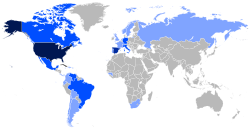
  Map of the Cuban diaspora around the world | |
| Total population | |
|---|---|
| Cubans: ~14 million (2024) Diaspora: ~4.3 million | |
| Regions with significant populations | |
 Cuba 9,748,007 (2024)123 Cuba 9,748,007 (2024)123 | |
 United States United States | 2,948,426 (2024)4 |
 Spain Spain | 252,290 (2024)56 |
 Brazil Brazil | 103,427 (2025)7 |
 Italy Italy | 44,959 (2024)8 |
 Uruguay Uruguay | 28,976 (2025)9 |
 Mexico Mexico | 25,976 (2020) ** |
 Chile Chile | 21,305 (2023)10 |
 Canada Canada | 19,545 (2021)1112 |
 Germany Germany | 16,116 (2020)1314 |
| Puerto Rico (United States) | 12,627 (2024)151617 |
 Venezuela Venezuela | 10,769 (2020)13 |
 Ecuador Ecuador | 10,768 (2022)18 |
 Costa Rica Costa Rica | 6,908 (2020)13 |
 France France | 5,466 (2020)13 |
 Guyana Guyana | 5,000+ (2025) |
 Colombia Colombia | 4,383 (2018)19 |
 Switzerland Switzerland | 3,574 (2020)13 |
 Dominican Republic Dominican Republic | 3,402 (2020)13 |
 Peru Peru | 3,170 (2020)13 |
 Sweden Sweden | 3,093 (2024)20 |
 Belgium Belgium | 2,445 (2024)20 |
 Trinidad and Tobago Trinidad and Tobago | 2,412 (2020)13 |
 United Kingdom United Kingdom | 2,333 (2020)13 212223 |
 Russia Russia | 2,224 (2020)13 |
 Panama Panama | 2,194 (2020)13 |
 Netherlands Netherlands | 1,992 (2024)20 |
 Bolivia Bolivia | 1,971 (2020)13 |
 Portugal Portugal | 1,858 (2020)13 |
 South Africa South Africa | 1,846 (2020)13 |
 Jamaica Jamaica | 1,825 (2020)13 |
 Guinea Guinea | 1,714 (2020)13 |
 Norway Norway | 1,264 (2024)20 |
 Austria Austria | 1,249 (2024)20 |
 Haiti Haiti | 1,185 (2020)13 |
 Argentina Argentina | 1,116 (2020)13 |
 Australia Australia | 1,050 (2024)24 |
| Languages | |
| Cuban Spanish, Lucumí, English (Miami accent), Spanglish, Cubonics | |
| Religion | |
| Majority: Roman Catholicism25 Minority: Irreligion, Protestantism, Santería, Ifá, Palo, Judaism, Islam.26 | |
| Related ethnic groups | |
| · Puerto Ricans · Floridanos · Spaniards · Africans · Taíno · Canarians · Catalans · Galicians · Andalusians · Portuguese · French · Latinos | |
Cubans (Spanish: cubanos) are the citizens and nationals of the Republic of Cuba, as well as members of the Cuban diaspora who identify culturally or ethnically as Cuban, irrespective of their current citizenship.
Cuba's resident population stood at approximately 9.7 million at the end of 2024, according to preliminary figures released by the Oficina Nacional de Estadística e Información (ONEI).27 According to the ONEI, the country's population has been undergoing a sustained decline driven by the combined effect of significant emigration and a negative rate of natural increase.28 Independent demographic analyses suggest that the actual resident population may be lower than official figures indicate, owing in part to an underestimation of emigration to destinations other than the United States.29
Outside the island, the United States hosts by far the largest Cuban community, estimated at approximately 2.9 million people of Cuban origin in 2024, concentrated primarily in Florida—notably in the Miami metropolitan area—as well as in Texas, California, New Jersey, and New York City.3031 Spain constitutes the second-largest Cuban diaspora community, with smaller populations present in Brazil, Italy, and Uruguay.31
The population of Cuba descends primarily from three groups: Spanish settlers and immigrants — drawn largely from Andalusia, Galicia, Asturias, and the Canary Islands32 — sub-Saharan Africans transported to the island through the transatlantic slave trade,33 and the pre-Columbian indigenous peoples, chiefly the Taíno and Ciboney.3435 A significant, though demographically contested, share of Cubans carries mixed ancestry from all three groups, not as a product of recent admixture but of centuries of intermarriage accumulated across many generations.3637 While Afro-Cubans and Cubans of Spanish descent have endured as distinct ethnocultural units, no equivalent indigenous-descended group survived the catastrophic demographic collapse of the sixteenth century;38 Taíno ancestry nonetheless persists in the Cuban population at the genetic level, as evidenced by mitochondrial DNA studies.343940 Cuban Spanish, a variety of Spanish, is the native language of virtually all Cubans on the island and remains widely spoken among a large proportion of the diaspora.
History
The population of Cuba prior to European contact consisted primarily of the Taíno and Ciboney peoples, with smaller groups of Guanahatabey inhabiting the island's westernmost regions. Spanish colonization, initiated following Christopher Columbus's arrival in 1492, resulted in the catastrophic decline of the indigenous population through epidemic disease, forced labor, and violence.41
To sustain the plantation economy that emerged in the eighteenth century—centered above all on sugar cultivation—the Spanish colonial administration oversaw the large-scale forced importation of enslaved Africans. By the mid-nineteenth century, Cuba had become one of the largest slave societies in the Western Hemisphere, with Africans and their descendants constituting a substantial portion of the island's population, drawn from numerous West and Central African societies, including Yoruba-, Fon-, and Kongo-speaking peoples.4243
Spanish settlers—both Iberian-born peninsulares and American-born criollos—completed the colonial demographic triad. The prolonged and coerced cohabitation among these groups, along with the cultural exchange it engendered, gave rise to a syncretic society whose religious practices, music, and social customs reflected multiple origins. The Cuban ethnologist Fernando Ortiz described this process as transculturation—a term he coined to denote the mutual transformation of cultures in sustained contact—and identified it as a defining characteristic of Cuban civilization.44
By the late eighteenth and early nineteenth centuries, a distinct creole consciousness—often articulated under the rubric of Cubanidad—had begun to emerge among the island's non-peninsular population. This developing identity was shaped by the plantation economy, by the growth of Havana as a cosmopolitan urban center, and by the proliferation of cultural forms that drew simultaneously on African, Spanish, and residual indigenous influences, including the danzón, the décima, the syncretic religious practices associated with Regla de Ocha, and the mutual-aid and ritual societies of the Abakuá.45 The emergence of a distinctly Cuban cultural identity developed alongside the political tensions of colonial society, including resentment of Spanish trade restrictions, the contradictions of a slaveholding creole elite seeking greater autonomy, and the gradual emergence of abolitionist sentiment.46
The articulation of Cuban national identity as an explicit political project reached a decisive stage during the independence struggles of the second half of the nineteenth century. The Ten Years' War (1868–1878), initiated in part by creole planters such as Carlos Manuel de Céspedes—who freed his own slaves at the outset of the insurgency—placed questions of race and inclusion at the center of the emerging nationalist movement.47 The figure of José Martí, the leading ideologue of Cuban independence, gave the movement its most influential theoretical expression. In essays including Nuestra América (1891) and Mi raza (1893), Martí argued that racial divisions were incompatible with the construction of a free republic and that Cuban identity itself constituted the basis of national unity.48 The Cuban War of Independence (1895–1898) gave material form to this vision: the mambí insurgent armies were notably multiracial in composition, and Afro-Cuban officers—most prominently Antonio Maceo, known as the "Bronze Titan"—achieved prominence at the highest levels of command. The war's conclusion, however, brought not sovereignty but American military intervention and a prolonged period of U.S. occupation and political oversight, which significantly shaped the subsequent development of Cuban national identity.49
The Cuban Republic established in 1902 inherited both the egalitarian ideals of the independence movement and the racial inequalities of the colonial period. The official republican ideology was grounded in Martí's concept of raceless nationalism, yet historians have argued that this universalist framework often discouraged autonomous Afro-Cuban political mobilization by portraying race-based advocacy as contrary to national unity.50 The Partido Independiente de Color, founded in 1908 to advocate for Afro-Cuban political representation, was outlawed under the Morúa Amendment of 1910; its armed protest in 1912 was met with military suppression in which thousands of Afro-Cubans were killed.51 Nonetheless, the Afrocubanismo cultural movement of the 1920s and 1930s—associated with figures including the poet Nicolás Guillén, the novelist Alejo Carpentier, and Ortiz himself—reasserted the African dimension of Cuban culture as fundamental to national identity.52 At the same time, the pervasive economic, political, and cultural influence of the United States contributed to the development of a reactive nationalism through which many Cubans increasingly defined their collective identity in opposition to American dominance.49
The Cuban Revolution of 1959, led by Fidel Castro and the 26th of July Movement, represented both a political rupture and an attempt to reconstruct Cuban national identity on new ideological foundations. The revolutionary government declared the elimination of racial discrimination an immediate social objective and moved to dismantle many of the institutional structures it identified as mechanisms through which inequality had been reproduced.53 National identity was increasingly reframed in terms of revolutionary commitment and socialist internationalism. The ideal of the hombre nuevo (new man), theorized by Che Guevara in his 1965 essay El socialismo y el hombre en Cuba, emphasized collective sacrifice, socialist construction, and anti-imperialism.54 This anti-imperialist identity was projected internationally through Cuba's military and civilian interventions in Africa and Latin America, most notably in Angola, where Cuban forces supported the MPLA government against UNITA and South African forces between 1975 and 1991, and in Ethiopia, where Cuba intervened on behalf of the Derg during the Ogaden War of 1977–1978.5556 These interventions were presented by the Cuban government as expressions of Third-Worldist solidarity and as continuations of anti-colonial struggle, drawing explicitly on Cuba's historical experiences of colonialism and slavery and on Martí's anti-imperialist legacy.5758 The revolution's emphasis on a unitary, state-centered national identity simultaneously marginalized political dissent and contributed to the formation of a substantial emigrant diaspora, particularly in the United States, whose members developed competing interpretations of Cuban identity rooted in exile and opposition to the revolutionary state.59
-
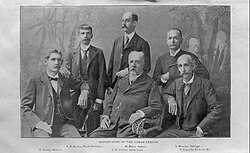
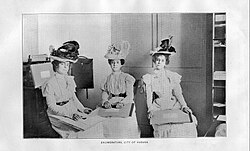 Cuban enumerators for the 1899 census of Havana.
 -
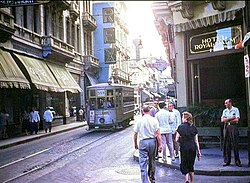 Royal Palm Hotel Havana, entrance. c. 1930
 -
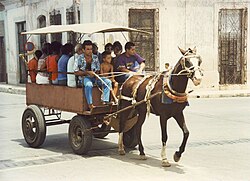 Public transportation in Cuba during the Special Period (1991–2000)
Demographics of Cuba
Census data
The Cuban Census of 2012, conducted between 15 and 24 September of that year by the National Office of Statistics and Information (Oficina Nacional de Estadísticas e Información, ONEI), remains, as of 2026, the most recent completed national population census on the island.60 Cuba follows a decennial census cycle;60 a new Population and Housing Census had originally been scheduled for September 2022,61 but has been postponed on multiple occasions — first to 2025, then to 2026 — owing to the country's severe economic crisis and the logistical constraints it has produced.626364 ONEI conducted a census rehearsal in the municipality of Santa Cruz del Norte, Mayabeque, in November 2025 in preparation for the 2026 census; the full results had not been published as of mid-year.6566 The demographic data presented in this section accordingly reflect conditions recorded in September 2012; subsequent changes are summarised in the subsection below.
According to the 2012 census, Cuba's resident population stood at 11,167,325 inhabitants, of whom 5,570,825 were male and 5,596,500 female, yielding a sex ratio of 995 males per 1,000 females.67 This figure represented a slight decline from the 11,177,743 inhabitants recorded in the 2002 census — the first intercensal population decrease since the independence wars — attributable to a total fertility rate below replacement level and a negative migration balance.6768 The most populous municipalities at the time of the census were Havana (2,106,146 inhabitants), Santiago de Cuba (506,037), Holguín (346,195), Camagüey (323,309), and Santa Clara (240,543).6067
Demographic changes since 2012
Cuba's population has undergone accelerating decline since the 2012 census, driven by three mutually reinforcing simultaneous processes: a total fertility rate that has remained persistently below replacement level, a negative natural increase — with deaths consistently exceeding births — and mass emigration of historically unprecedented scale.6970
Cuban population residing in Cuba View source data.
Fertility rate and natural population change
Cuba has not reached replacement-level fertility since 1977 — though some official Cuban sources, such as the country's 2017 report to the UN Commission on Population and Development and the Statistical Health Yearbook 2022, place the definitive fall below the threshold of 2.1 children per woman in 1978 —,71 placing it among the earliest and most prolonged cases of sub-replacement fertility among developing economies.7273
The total fertility rate (TFR) fluctuated between 1.41 and 1.54 children per woman during the 2021–2023 triennium74 and fell to 1.29 in 2024 — the lowest value ever recorded in the country's history —,7576 well below the replacement threshold of 2.1. In 2024, registered live births totalled 71,358 — the lowest annual figure in 65 years —,7577 with a crude birth rate of 7.2 per 1,000 inhabitants,75 while registered deaths reached 128,098,7578 producing a natural decrease of 56,740 persons7977 and a deaths-to-births ratio of approximately 1.8:1. Deaths have continuously exceeded births since 2020.7578
The combination of very low fertility with relatively high life expectancy reflects the social policies implemented following the Cuban Revolution of 1959 — universal healthcare, broad access to contraceptive methods and to abortion (institutionalised in 1965, making Cuba the first country in Latin America and the Caribbean to do so) —,80 as well as high rates of female school enrolment and women's participation in the labour market, which together produced a demographic transition characteristic of high-income societies without the corresponding level of economic development.8173
Median age
Cuba's median age stood at 39.5 years at the time of the 2012 census,82 and had increased to approximately 42.5 years in the 2025–2026 period according to the 2024 revision of the World Population Prospects by the United Nations Population Division.83 This figure contrasts markedly with the regional median age for Latin America and the Caribbean, which stood at approximately 31 years in 2024 according to the ECLAC.84
Excluding Puerto Rico by virtue of its status as an unincorporated territory — whose median age, at approximately 46.7 years, exceeds that of the island — Cuba is the sovereign country with the highest median age in the Americas, ahead of Canada (~40.6 years)85 and the United States (~39.1 years).8687 This places Cuba in a demographic profile comparable to that of France (~42–43 years) and other Western European nations with advanced economies.88 In 2024, approximately 25.7% of Cuba's resident population was aged 60 or over, the highest proportion in Latin America and the Caribbean.8990
This demographic profile — the product of historically low fertility rates, relatively high life expectancy, and the disproportionate emigration of young adults — is typically associated with high-income economies.9192 Cuba's advanced median age, coexisting with a comparatively low per capita income, constitutes a structurally anomalous demographic condition: among countries whose median age exceeds forty years, Cuba ranks among those with the lowest incomes, though figures for Cuban GDP are not reported by the International Monetary Fund and available estimates vary considerably depending on the methodology employed.9394
Sex distribution
According to the 2012 census, the sex distribution of the Cuban population was nearly balanced, with 5,570,825 males and 5,596,500 females, corresponding to a sex ratio of 995 males per 1,000 females.95 At the close of 2024, ONEI recorded a ratio of 974 males per 1,000 females (4,808,909 males and 4,939,098 females), evidencing a measurable shift in the sex balance relative to the 2012 census.9697
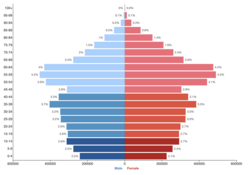
The migratory wave that began in 2021 has been characterised by a high proportion of women, accentuating a trend towards the feminisation of migration that, according to the academic literature, has been consolidating within Cuban emigration since the 1990s and reached unprecedented magnitude during the period 2021–2024.9899100 Approximately 56–57% of Cuban emigrants in the recent period were women — 56.6% according to the accumulated historical stock per UN data, and approximately 57% according to estimates of outgoing flows for 2022–2023 — as reported in the United Nations International Migrant Stock101 and in analyses by economist and demographer Juan Carlos Albizu-Campos published through the Cuba Capacity Building Project at Columbia Law School.102103 With regard to age structure, approximately 77% of the emigrant contingent was of working age, with estimates ranging between the 15–59 age bracket — used in Albizu-Campos's calculations,102 in line with the Cuban definition of the economically active population — and the 15–49 bracket, the standard demographic range for reproductive age, employed by other sources.104 ONEI confirmed that by the close of 2023 the contingent of women of childbearing age (15–49 years) had decreased by 304,717 persons relative to the preceding reference calculation, with more than 70% of that loss concentrated in the 15–39 age group.74105
This dynamic has altered not only the size of the population but also the relative balance between the sexes — reflected in the decline of the masculinity ratio from 995 to 974 between 2012 and 2024 — and the age composition of the population of reproductive age, with direct consequences for the total fertility rate74 and the structure of the labour market. The precise impact on the age and sex distribution cannot, however, be determined with census-level accuracy in the absence of an updated enumeration.96
Ethnography of Cuba
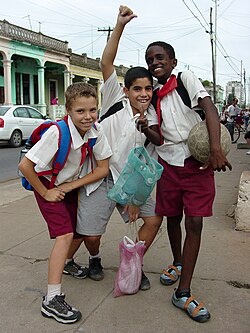
The ethnic and racial composition of Cuba is the product of a prolonged historical process of racial mixing, forced displacement, and voluntary migration.106
The population classified as white descends primarily from Peninsular settlers and immigrants, with a particularly notable presence of individuals from Andalusia, the Canary Islands, Asturias, and Galicia — regions whose imprint is still evident in the island's culture, speech, and toponymy.107
The black population derives primarily from the Sub-Saharan Africans introduced as enslaved people during the Atlantic slave trade, which reached its greatest intensity between the late eighteenth century and the mid-nineteenth century, and in which individuals from the Yoruba, Fon, and Bantu peoples predominated, among other groups from West and Central Africa.108109
The indigenous peoples, principally of Taíno origin, largely disappeared during the first decades of colonisation as a result of violence, disease, and forced labour. Although no communities of unmixed Amerindian descent are recorded today, genetic studies point to the persistence of traces of that ancestral heritage in segments of the present population.110111
To these principal streams are added, on a smaller scale, the descendants of Chinese workers who arrived under contract during the nineteenth century112 and those of immigrants from the Arab Levant, whose presence on the island consolidated between the late nineteenth century and the first half of the twentieth.113A considerable proportion of Cubans carry mixed lineages combining, in varying proportions and across multiple generations, Spanish, African, and indigenous heritage.
| Year | White / % | Mulatto/ Mestizo / % |
Black / % | East Asian (Amarillo) / % | Total | ||||
|---|---|---|---|---|---|---|---|---|---|
| 1774 | 96,440 | 56.2 | 75,180 / 43.8 |  171,620 171,620
| |||||
| 1861 | 793,484 | 56.8 | 603,046 / 43.2 | 1,396,530
| |||||
| 1899 | 1,052,397 | 67.9 | 270,805 | TBD | 234,738 | TBD | 14,857 | TBD | 1,572,797
|
| 1943 | 3,553,312 | 74.3 | 743,113 | 15.6 | 463,227 | 9.7 | 18,931 | 0.4 | 4,778,583
|
| 2002 | 7,271,926 | 65.0 | 2,658,675 | 24.86 | 1,126,894 | 10,08 | 112,268 | 1,02 | 11,177,743
|
| 2012 | 7,160,399 | 64.1 | 2,972,882 | 26.6 | 1,034,044 | 9.3 | - | - |  11,167,325 11,167,325
|
Main ancestral and ethnic origins of the Cuban population
Pre-Columbian peoples
Cuba does not include an indigenous self-identification category in its official population surveys (Oficina Nacional de Estadística e Información, ONEI), meaning that Amerindian ancestry can only be quantified through genetic studies. At the arrival of Christopher Columbus in 1492, Cuba was inhabited by at least three distinct indigenous groups.
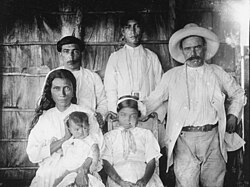
Guanahatabey
The Guanahatabey were the earliest documented inhabitants, archaic hunter-gatherers settled in the western tip of the island from approximately 4000 BC,119 whose language shows no demonstrable relationship to Taíno or any other documented language of the Arawakan family.120
Ciboney
The Ciboney (or Siboney), a Western Arawakan group, inhabited the central and western parts of the island. Although various sources describe them as the most geographically widespread group at the time of contact, their status as the most numerous is a matter of academic debate, given that the Taíno maintained higher-density settlements in the east.121
Taíno
The Taíno, an Arawakan people originating from the South American lowlands and possessing a more advanced level of technological development than the preceding groups, occupied primarily the eastern and central parts of Cuba and were the first group contacted by Columbus when he landed on the island's eastern shores on 28 October 1492.122 Estimates of the pre-contact indigenous population range from approximately 60,000 to 600,000, with the most recent academic estimates clustering toward the lower end of that range.123 The Taíno were organised in villages under hereditary leaders called caciques, practised the cultivation of maize and cassava, and developed a material culture whose imprint persists in contemporary Cuba: words such as tabaco, hamaca, and canoa, as well as numerous toponyms — among them Havana, Camagüey, and Baracoa — derive from the Taíno language.124
Spanish conquest and demographic collapse
The Spanish conquest of Cuba, initiated under Diego Velázquez de Cuéllar from 1511 onwards, brought about the near-total destruction of the indigenous population within a few decades.125 The encomienda system — regulated by the Laws of Burgos of 1512 and their supplementary ordinances of 1513 — subjected Taíno and Ciboney communities to forced labour, principally in gold mining and agricultural production, under conditions that contemporaries such as Bartolomé de las Casas characterised as lethal.126 Las Casas documented the Massacre of Caonao (c. 1513), claiming in his account that several thousand indigenous people perished; this figure has been questioned by subsequent historiography, which notes the chronicler's tendency toward hyperbole in his numerical estimates.127128 To the violence of conquest were added successive epidemics — including one that struck Hispaniola in 1493 prior to the permanent colonisation of Cuba, smallpox (1518–1519), and measles — which caused catastrophic mortality among populations with no prior herd immunity.129 Survivors fled to mountain refuges or were confined to indigenous towns, one of which, Guanabacoa, is today a municipality of Havana. By the mid-sixteenth century, official Spanish records indicated that barely any identifiable indigenous communities survived, and the prevailing academic consensus for much of the twentieth century held that Cuba's Taíno had disappeared as a distinct population within one or two generations of contact.
Revision of the total extinction narrative
This thesis has been substantially revised by ethnographic and genetic research conducted since the 1980s. Nineteenth-century observers — among them the British abolitionist David Turnbull during his stay in Havana in 1838–1840130 and the Spanish naturalist Miguel Rodríguez Ferrer, whose principal work on Cuba was published in 1876 on the basis of fieldwork conducted between 1840 and 1861131 — described communities in Guanabacoa, El Caney, and the foothills of the Sierra Maestra displaying signs of indigenous ancestry, though such testimonies reflect the racial categories of their era and do not constitute genealogical or genetic verification. The most rigorous work was initiated in 1989 by José Barreiro, a Cuban-born scholar and then associate director of research at the National Museum of the American Indian of the Smithsonian Institution, in collaboration with the historian of Baracoa Alejandro Hartmann Matos. Their ethnographic research estimated that at least 5,000 individuals with identifiable indigenous ancestry survived in Cuba, while hundreds of thousands might carry partial indigenous ancestry.132 The community of La Caridad de los Indios, in the mountains southwest of Baracoa, is the most frequently cited in academic literature as the one that best preserves Taíno cultural continuity — including traditional agricultural practices, construction techniques, and oral tradition — within a predominantly mixed-race population. In 2018, the Smithsonian Institution returned to this community bone fragments of seven Taíno individuals removed nearly a century earlier by American archaeologist Mark R. Harrington.133 It is essential to note that the evidence of indigenous survival in Cuba pertains almost exclusively to cultural practices and partial genetic ancestry, not to biologically "pure" populations by any genealogical criterion. All communities identified as Taíno descendants are predominantly mixed-race, with Spanish and African ancestry. Indigenous identity was moreover historically suppressed: Spanish colonial authorities actively persecuted it for the purpose of extinguishing indigenous land rights — the last land claim was rejected by courts in 1850 — and its stigmatisation led many families to conceal their ancestry for generations.134
Genetic evidence of Amerindian ancestry
Several genomic studies confirm the persistence of significant indigenous ancestry in the Cuban population, with a markedly asymmetric distribution with respect to sex and geography. The largest-scale autosomal study, conducted by Marcheco-Teruel et al. (2014) and published in PLOS Genetics with a sample of 1,019 individuals from all Cuban provinces, estimated mean island-wide autosomal Amerindian ancestry at approximately 8% (compared to 72% European and 20% African), while the estimate based on mitochondrial DNA (mtDNA) rose to 34.5%.135 This marked asymmetry — indigenous ancestry traceable almost exclusively through the maternal line — is consistent with colonial-era dynamics, in which unions occurred between indigenous women and European and African men, while male indigenous lineages were effectively eliminated by the conquest and epidemics. The same study recorded a pronounced geographical variation: the eastern provinces of Granma (15%), Holguín (12%), and Las Tunas (12%) showed the highest rates of autosomal Amerindian ancestry, which coincides with the historical distribution of Taíno settlement. Comparative studies of mtDNA in the Caribbean document high frequencies of Amerindian lineages in former Spanish colonies, while they are practically absent in territories of French and British colonisation, reflecting the differing colonial policies of each power and their different reliance on enslaved African labour.136 An analysis of ancient DNA from Ciboney individuals from Cuban archaeological sites confirmed the affinity of their mitochondrial lineages with Arawakan populations from South America.137
Indigenous Florida refugees
The Amerindian demographic legacy of Cuba received a secondary contribution from indigenous refugees from northern Florida, displaced following the transfer of Spanish Florida to Britain under the Treaty of Paris of 1763. During the colonial period, groups such as the Timucua, Calusa, Tequesta, and Apalachee had maintained close ties with Cuba, particularly with Havana; the Calusa conducted regular canoe-borne trade with the city from around 1600.138 These populations had already been drastically reduced by epidemics and raids by British-allied groups before 1763: by the 1720s, the once-numerous Timucua had been reduced to fewer than 40 individuals.139140 In 1763, a small number of indigenous refugees joined the Spanish exodus from St. Augustine, while a remnant population of Calusa descent — whose precise size is difficult to establish from available colonial sources, given the advanced state of tribal disintegration of that people by that date — was transported to Havana.141 These communities, already broadly integrated into Spanish colonial society, were rapidly absorbed into the general Cuban population, and their specific genetic contribution cannot be quantified independently of the considerably more dominant Taíno component.
White or European
In the 2012 Census of Cuba, 64.1% of the inhabitants self-identified as white. Based on genetic testing (2014) in Cuba, the average European, African and Native American ancestry in those auto-reporting to be white were 86%, 6.7%, and 7.8%.142 The majority of the European ancestry comes from Spain. During the 18th, 19th and early part of the 20th century especially, large waves of Asturians, Galicians, Canary Islanders and Catalans emigrated from Spain to Cuba. Other European nationalities with significant influx include: Scots, Poles, French, Italians, English, Irish and Germans. Europeans with lesser influx were Russians, Romanians, Portuguese and Greeks. Central and Eastern European influence was mostly during the Cold War years and immigration from the British Isles was mostly to Havana and Pinar del Rio Province. There is a small remnant of Jewish as well as Levantine peoples, mainly Lebanesse and Syrians. Though there are other Whites or Europeans in Cuba, the majority of White or European ancestry comes from Spain.
Among the various European groups that contributed to the formation of Cuba's Spanish-descended population, Canary Islanders may have exerted one of the most significant demographic influences, owing to their early arrival, sustained migration, and extensive settlement within rural areas of the island. According to data presented by ExploreyourDNA, phylogenetic analysis using UPGMA clustering based on G25 coordinates indicates that the sampled White Cuban population (Cuban Blanco, n = 10) clusters most closely with populations from the Canary Islands among the European reference groups included in the analysis. Using averaged G25 coordinates to represent the European-ancestry component of the Cuban Blanco sample, the results show greater genetic affinity to Canarians than to mainland Iberian populations. This pattern is consistent with historical migration trends from the Canary Islands to Cuba, particularly from the 18th to the 19th centuries, when Canary Islanders (Isleños) were encouraged to settle as agricultural colonists and became heavily represented within the white population. Genetic studies of Canarians indicate that they carry a measurable proportion of North African–related ancestry (commonly estimated at approximately 17–30%), reflecting Guanche ancestry. Within the limitations of the sample size and methodology used, these findings suggest that the European genetic profile of White Cubans may more closely resemble that observed in the Canary Islands than that of the Iberian Peninsula overall.
Multiracial

In the 2012 Census of Cuba, 26.6% (2.97 million) of the Cubans self-identified as mulatto or mestizo.143
Black or African
The Afro-Cuban population was 9.3% in the 2012 Census of Cuba. Just about 1.3 million Cubans described themselves as black.117 Thus a significant proportion of those living on the island affirm some sub-Saharan African ancestry.
Based on genetic testing in 2014, the average African, European and Native American ancestry in those self-reporting to be "negro (Black)" was 65.5% "African", 29% "European" ancestry and 5.5% "Native American" or other ancestry.142
Although Afro-Cubans can be found throughout Cuba, Eastern Cuba has a higher concentration of Blacks than other parts of the island. Havana has the largest population of blacks of any city in Cuba.144
East Asian
Officially called amarilla (yellow in English) in the Cuban census,145 Cubans of East Asian origins made up 1.02% of the population in the 2002 Census of Cuba. They are primarily made up of ethnic Chinese who are descendants of indentured laborers who came in the 19th century to build railroads and work in mines. Historically, Chinese descendants in Cuba were once classified as "white".146
Intermarriage between diverse groups is so frequent as to be the rule.147
Arabs
Population changes
Cuba's birth rate (9.88 births per thousand population in 2006)148 is one of the lowest in the Western Hemisphere. Its overall population increased from around 7 million in 1961 to 11 million today, but the rate of increase slowed over time and has recently turned to a decrease, with the Cuban government in 2006 reporting the first drop in the population since the Mariel boatlift. Immigration and emigration have had noticeable effects on the demographic profile of Cuba during the 20th century. Between 1900 and 1930, close to a million Spaniards migrated to the island.
Since 1959, over two million Cubans have left the island, primarily to Miami, Florida, where a vocal, well-educated and economically successful exile community exists.149
Genetics
An autosomal study from 2014 found the genetic ancestry in Cuba to be 72% European, 20% African and 8% Amerindian.142 Of note, there is high variability between regions within Cuba, with individuals from Western provinces having higher European ancestry on average, and those in the Eastern region having more African and Native American genetic contribution.150 Cuban genealogy has become a rising interest for Cubans in the last 15 years.151
A 1995 study done on the population of Pinar del Río, found that 50% of the Mt-DNA lineages (female lineages) could be traced back to Europeans, 46% to Africans and 3% to Americans. This figure is consistent with both the historical background of the region, and the current demographics of it. According to another study in 2008, regarding the geographical origin attributed to each mtDNA haplogroup, 55% of the sequences found in Cubans are of West Eurasian origin (namely, Europe and the Middle East) and 45% of African origin152 Regarding Y-chromosome haplogroups (male lineages), 78.8% of the sequences found in Cubans are of West Eurasian origin, 19.7% of African origin and 1.5% of East Asian origin. Among the West Eurasian fraction, the vast majority of individuals belong to West European haplogroup R1b. The African lineages found in Cubans have a Western (haplogroups E1, E2, E1b1a ) and Northern (E1b1b-M81 ) African origin. The North African haplogroup E1b1b1b (E-M81), is found at a frequency of 6.1%.152
According to Fregel et al. (2009), the fact that autochthonous male E-M81 and female U6 lineages from the Canaries have been detected in Cuba and Iberoamerica, demonstrates that Canary Islanders with indigenous Guanche ancestors actively participated in the American colonization.153
Likewise, according to ExploreyourDNA using Phylogenetic Tree (UPGMA Clustering) and with the sample population of Cuban Blanco(n=10) which utilizes their G25 coordinates to sum up the averages of the European descent Cuban population, White Cubans are closest genetically to Canarians using the "Cuban Blanco(n=10)" sample. Thus demonstrating that within the sample size used of White Cubans, their closest genetic markers are Canarians who themselves have anywhere from 17-30% northwest African ancestry from their Guanche ancestors further illustrating that the White Cuban population is admixtured with North African genetics higher than is seen in the Iberian peninsula and instead closest to what it seen in the Canary Islands.
Cuban diaspora
The United States has the largest number of Cubans outside Cuba. As of 2024, the United States Census Bureau's American Community Survey showed a total population of 1,688,798 Cuban immigrants.154 As of 2015, 68% of Cuban-born residents of the United States have naturalized155 automatically losing their Cuban citizenship.156 Significant populations of Cubans exist in the cities of Hialeah and Miami in Florida (995,439 Cubans in this state in 2017) and in Texas (60,381), New Jersey (44,974), California (35,364), New York (26,875), and Illinois (22,541) 157
The second largest Cuban diaspora is in Spain. As of 2019, there were 151,423 Cubans in Spain.5 Smaller numbers of Cubans live in Brazil, Uruguay,158 Italy*, Mexico*, and Canada.159
After the founding of the republic in 1902, a considerable migration (over 1 million) arrived from the Iberian Peninsula to the island, between them were more than a few former Spanish soldiers who participated in the wars, and yet it never created an obstacle for the respect and affection of Cubans, who have always been proud of their origins.160 In December 2008, Spain began accepting citizenship applications from the descendants of people who went into exile after its brutal 1936-39 Civil War, part of a 2007 law meant to address the painful legacy of the conflict. This new Historical Memory Law has granted to more than 140,000 Cubans of Spanish ancestry the Spanish citizenship, and there were 143,048 Cubans with Spanish citizenship in Cuba and 93,004 in Spain on January 1, 2019.5 Under the law, the descendants had until December 2011 to present themselves at the Spanish embassy in their home country and turn in documentation that proves their parents or grandparents fled Spain between 1936 and 1955. They did not need to relinquish their current citizenship.161162
Culture and traditions

The culture of Cuba reflects the island's influences from various cultures, primarily European (Spanish), Indigenous and African.
One of the most distinctive parts of Cuban culture is Cuban music and dancing, being well-known far outside the country. Well known Hispanic music styles such as mambo, salsa, rumba, cha-cha-chá, bolero, and son originated in Cuba. The origins of much of Cuban music can be found in the mix of Spanish and West African music, while American musical elements such as trombones and big band were also significant elements in the formation of Cuban music. Cuban literature includes some of the most well-known names of the islands, such as writer and independence hero José Martí in the late 19th century. More contemporary Cuban authors include Daína Chaviano, Pedro Juan Gutiérrez, Antonio Orlando Rodríguez, Zoé Valdés and Leonardo Padura Fuentes.163
The Spanish language is spoken by virtually all Cubans on the island itself. Cuban Spanish is characterized by the reduction of several consonants, a feature that it shares with other dialects of Caribbean Spanish as well as the Canary Islands. Many Cuban-Americans, while remaining fluent in Spanish, use American English as one of their daily languages.164
Religion
Religion in Cuba (2010)25
- Catholicism (60.0%)
- Protestantism and other Christians (5.00%)
- Others/African Religious (11.0%)
- Non-religious (24.0%)

Cuba's prevailing religion is Roman Catholicism, although in some instances it is profoundly modified and influenced through syncretism. A common syncretic religion is Santería, which combined the Yoruba religion of the African slaves with some Catholicism; it shows similarities to Brazilian Umbanda and has been receiving a degree of official support.165
The Roman Catholic Church estimates that 60 percent of the population is Catholic,166 with 10 percent attending mass regularly,167 while independent sources estimate that as few 1.5 percent of Catholics do so.168
Membership in Protestant churches is estimated to be five percent and includes Baptists, Pentecostals, Seventh-day Adventists, Presbyterians, Episcopal Church of Cuba|Episcopalians, Methodists, Religious Society of Friends (Quakers), and Lutherans. Other groups include the Greek Orthodox Church, the Russian Orthodox Church, Jehovah's Witnesses, Hindus, Muslims, Buddhists, Jews, Baháʼís, and the Church of Jesus Christ of Latter-day Saints.
Cuba is home to a variety of syncretic religions of largely African cultural origin. According to a US State Department report,166 some sources estimate that as much as 80 percent of the population consults with practitioners of religions with West African roots, such as Santeria or Yoruba. Santería developed out of the traditions of the Yoruba, one of the African peoples who were imported to Cuba during the 16th through 19th centuries to work on the sugar plantations. Santería blends elements of Christianity and West African beliefs and as such made it possible for the slaves to retain their traditional beliefs while appearing to practice Catholicism. La Virgen de la Caridad del Cobre (Our Lady of Charity) is the Catholic patroness of Cuba, and is greatly revered by the Cuban people and seen as a symbol of Cuba. In Santería, she has been syncretized with the goddess Ochún. The important religious festival "La Virgen de la Caridad del Cobre" is celebrated by Cubans annually on 8 September. Other religions practised are Palo Monte, and Abakuá, which have large parts of their liturgy in African languages.
Symbols
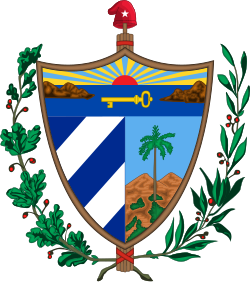
The flag of Cuba is red, white, and blue; and was first adopted by Narciso López on a suggestion by the poet Miguel Teurbe Tolón. The design incorporates three blue stripes, representing the three provinces of the time (Oriente, Centro, and Occidente), and two white stripes symbolizing the purity of the patriotic cause. The red triangle stands for the blood shed to free the nation. The white star in the triangle stands for independence.169
See also
See also
- Afro-Hispanic
- Caribbean people
- Criollo people
- Cuba-United States relations
- Cuban Americans
- Cuban cuisine
- Cuban exile
- Cuban immigration to the United States
- Cuban Mexicans
- Cuban migration to Miami
- Cuban nationality law
- Cuban Spanish
- Cuban Uruguayans
- Cubans in Italy
- Hispanics
- History of Cuban Nationality
- List of Cuban Americans
- List of Cubans
- Spanish American
- Taíno
- White Hispanic
References
References
- http://amp.miamiherald.com/news/nation-world/world/americas/cuba/article290249799.html.
- http://www.onei.gob.cu/node/13815 Archived 14 March 2020 at the Wayback Machine. (in Spanish). Retrieved 2 July 2022
- "Basic Facts". Census.gov. Archived from the original on 23 May 2022. Retrieved 10 December 2022.
- "HISPANIC OR LATINO ORIGIN BY SPECIFIC ORIGIN". data.census.gov. 2022.
- https://www.ine.es/jaxiT3/Tabla.htm?t=68522. Retrieved 10 January 2025.
- "Instituto Nacional de Estadística. (National Statistics Institute)". ine.es. Archived from the original on 25 July 2020. Retrieved 8 August 2020.
- Immigrants in Brazil (2025, in Portuguese)
- https://demo.istat.it/app/?!=RCS&I=en. Revisado 23 diciembre 2025.
- https://www.cnediles.gub.uy/admin/adjuntos/511-24.pdf. Revisado 21 diciembre 2025.
- https://serviciomigraciones.cl/estudios-migratorios/estimaciones-de-extranjeros/Archived 2023-07-09 at the Wayback Machine(Positional parameters ignored)Estimacion de Poblacion Extranjera de Chile, 2023. Source: INE de Chile. Retrieved 13 March 2026
- https://www150.statcan.gc.ca/t1/tbl1/en/tv.action?pid=9810030201 Archived 2 February 2023 at the Wayback Machine. Retrieved 18 January 2023.
- "Canada Census Profile 2021". Census Profile, 2021 Census. Statistics Canada Statistique Canada. 7 May 2021. Archived from the original on 3 January 2023. Retrieved 3 January 2023.
- https://countryeconomy.com/demography/migration/emigration/cuba Archived 22 August 2023 at the Wayback Machine. Data source: UN. Retrieved 22 August 2023.
- "Number of foreigners in Germany from 2019 to 2022, by country of origin". 31 December 2022.
- "2024 Census Estimate B03001: Hispanic or Latino Origin by Specific Origin Population in Puerto Rico". data.census.gov. Retrieved 11 March 2026.
- "Census 2020 T01001: Total Asian Population in Puerto Rico". data.census.gov. Retrieved 11 March 2026.
- "Place of Birth for the Foreign-Born Population in Puerto Rico". data.census.gov. 2022. Archived from the original on 27 September 2023. Retrieved 20 September 2023.
- https://www.primicias.ec/noticias/sociedad/censo-ecuador/inmigrantes-extranjeros-paises/. Retrieved 20 September 2024.
- "From a Cuban Medical Mission in Venezuela to Limbo in Colombia". 24 December 2025.
- https://ec.europa.eu/eurostat/api/dissemination/statistics/1.0/data/migr_pop3ctb?age=TOTAL&c_birth=CU&sex=T&time=2025. Retrieved 14 March 2026.
- "Table QS213EW: 2011 Census: Country of birth (expanded), regions in England and Wales". Office for National Statistics. 26 March 2013. Archived from the original on 23 February 2016. Retrieved 10 July 2016.
- "Country of birth (detailed)" (PDF). National Records of Scotland. Archived (PDF) from the original on 24 September 2015. Retrieved 10 July 2016.
- "Country of Birth - Full Detail: QS206NI". Northern Ireland Statistics and Research Agency. Archived from the original (XLS) on 4 March 2016. Retrieved 10 July 2016.
- https://www.abs.gov.au/statistics/people/population/australias-population-country-birth/latest-release. Retrieved 14 March 2026.
- "RELIGION IN CUBA". Prolades.com. Archived from the original on 23 March 2017. Retrieved 9 August 2017.
- "Central America :: Cuba — The World Factbook - Central Intelligence Agency". cia.gov. 18 October 2021. Archived from the original on 12 August 2021. Retrieved 24 January 2021.
- "Cuba cerró 2024 con 300.000 habitantes menos que en 2023 y una población de 9,7 millones". EFE (in Spanish). 22 February 2025. Retrieved 19 May 2026.
- "Oficina Nacional de Estadística e Información" (in Spanish). Oficina Nacional de Estadística e Información (ONEI). Retrieved 19 May 2026.
- Albizu-Campos Espiñeira, Juan Carlos. "Cuba: Demographic or Systemic Crisis?". Horizonte Cubano — Cuba Capacity Building Project. Columbia Law School. Retrieved 19 May 2026.
- Passel, Jeffrey S.; Fahmy, Dalia (7 May 2026). "10 Facts about Cubans in the U.S." Pew Research Center.
- "Cuban Immigrants in the United States". Migration Policy Institute. September 2023.
- Pérez Jr., Louis A. (2006). Cuba: Between Reform and Revolution (3rd ed.). Oxford University Press. ISBN 978-0-19-517911-8.
- Klein, Herbert S. (2010). The Atlantic Slave Trade (2nd ed.). Cambridge University Press. ISBN 978-0-521-18250-8.
- Mendizabal, Isabel; Sandoval, Karla; Berniell-Lee, Gemma; Calafell, Francesc; Salas, Antonio; Martínez-Fuentes, Antonio; Comas, David (2008). "Genetic origin, admixture, and asymmetry in maternal and paternal human lineages in Cuba". BMC Evolutionary Biology. 8 (1) 213. Bibcode:2008BMCEE...8..213M. doi:10.1186/1471-2148-8-213. PMC 2492877. PMID 18644108.
- Lalueza-Fox, Carles; Gilbert, M. Thomas P.; Martínez-Fuentes, Antonio J.; Calafell, Francesc; Bertranpetit, Jaume (2003). "Mitochondrial DNA from Pre-Columbian Ciboneys from Cuba and the Prehistoric Colonization of the Caribbean". American Journal of Physical Anthropology. 121 (2): 97–108. Bibcode:2003AJPA..121...97L. doi:10.1002/ajpa.10236. PMID 12740952.
- Sawyer, Mark Q. (2006). Racial Politics in Post-Revolutionary Cuba. Cambridge University Press. ISBN 978-0-521-61267-8.
- "Cuba". Minority Rights Group International. 2 November 2023. Retrieved 22 May 2026.
- Cook, Noble David (1998). Born to Die: Disease and New World Conquest, 1492–1650. Cambridge University Press. ISBN 978-0-521-62730-6.
- Bukhari, A.; et al. (2017). "Taino and African maternal heritage in the Greater Antilles". Gene. 637: 33–40. doi:10.1016/j.gene.2017.09.004. PMID 28912065.
- Schroeder, Hannes; et al. (2018). "Origins and genetic legacies of the Caribbean Taino". Proceedings of the National Academy of Sciences. 115 (10): 2341–2346. Bibcode:2018PNAS..115.2341S. doi:10.1073/pnas.1716839115. PMC 5877975. PMID 29463742.
- Pérez, Louis A., Jr. (2010). Cuba: Between Reform and Revolution (4th ed.). Oxford University Press. pp. 17–22. ISBN 978-0-19-539296-8.
{{cite book}}: CS1 maint: multiple names: authors list (link) - Knight, Franklin W. (1970). Slave Society in Cuba during the Nineteenth Century. University of Wisconsin Press. pp. 22–57. ISBN 978-0-299-05790-9.
- Scott, Rebecca J. (1985). Slave Emancipation in Cuba: The Transition to Free Labor, 1860–1899. Princeton University Press. pp. 3–19. ISBN 978-0-691-07667-6.
- Ortiz, Fernando (1995) [1940]. Cuban Counterpoint: Tobacco and Sugar. Translated by Harriet de Onís. Duke University Press. pp. 97–103. ISBN 978-0-8223-1616-9.
- Pérez, Louis A., Jr. (1999). On Becoming Cuban: Identity, Nationality, and Culture. University of North Carolina Press. pp. 14–27. ISBN 978-0-8078-2487-0.
{{cite book}}: CS1 maint: multiple names: authors list (link) - Pérez, Louis A., Jr. (2010). Cuba: Between Reform and Revolution (4th ed.). Oxford University Press. pp. 78–104. ISBN 978-0-19-539296-8.
{{cite book}}: CS1 maint: multiple names: authors list (link) - Ferrer, Ada (1999). Insurgent Cuba: Race, Nation, and Revolution, 1868–1898. University of North Carolina Press. pp. 15–42. ISBN 978-0-8078-4783-1.
- Ferrer, Ada (1999). Insurgent Cuba: Race, Nation, and Revolution, 1868–1898. University of North Carolina Press. pp. 112–136. ISBN 978-0-8078-4783-1.
- Pérez, Louis A., Jr. (2003). Cuba and the United States: Ties of Singular Intimacy (3rd ed.). University of Georgia Press. pp. 147–178. ISBN 978-0-8203-2483-8.
{{cite book}}: CS1 maint: multiple names: authors list (link) - de la Fuente, Alejandro (2001). A Nation for All: Race, Inequality, and Politics in Twentieth-Century Cuba. University of North Carolina Press. pp. 35–69. ISBN 978-0-8078-4922-4.
- Helg, Aline (1995). Our Rightful Share: The Afro-Cuban Struggle for Equality, 1886–1912. University of North Carolina Press. pp. 193–226. ISBN 978-0-8078-4494-6.
- de la Fuente, Alejandro (2001). A Nation for All: Race, Inequality, and Politics in Twentieth-Century Cuba. University of North Carolina Press. pp. 144–175. ISBN 978-0-8078-4922-4.
- de la Fuente, Alejandro (2001). A Nation for All: Race, Inequality, and Politics in Twentieth-Century Cuba. University of North Carolina Press. pp. 259–285. ISBN 978-0-8078-4922-4.
- Pérez-Stable, Marifeli (1999). The Cuban Revolution: Origins, Course, and Legacy (2nd ed.). Oxford University Press. pp. 84–112. ISBN 978-0-19-512749-2.
- Gleijeses, Piero (2002). Conflicting Missions: Havana, Washington, and Africa, 1959–1976. University of North Carolina Press. pp. 246–280. ISBN 978-0-8078-2647-8.
- Gleijeses, Piero (2013). Visions of Freedom: Havana, Washington, Pretoria, and the Struggle for Southern Africa, 1976–1991. University of North Carolina Press. pp. 1–18. ISBN 978-1-4696-0968-3.
- Gleijeses, Piero (2002). Conflicting Missions: Havana, Washington, and Africa, 1959–1976. University of North Carolina Press. pp. 13–40. ISBN 978-0-8078-2647-8.
- Kapcia, Antoni (2008). Cuba in Revolution: A History Since the Fifties. Reaktion Books. pp. 118–145. ISBN 978-1-86189-402-1.
- Pérez-Stable, Marifeli (1999). The Cuban Revolution: Origins, Course, and Legacy (2nd ed.). Oxford University Press. pp. 155–178. ISBN 978-0-19-512749-2.
- Oficina Nacional de Estadísticas e Información (December 2012). "Informe sobre Cifras Preliminares. Censo de Población y Viviendas 2012" (PDF). ONEI. Retrieved 22 May 2026.
- "Los censos en Cuba". Granma. 12 October 2021. Retrieved 22 May 2026.
- "Cuba prevé realizar el censo de población a finales de 2025 pero no descarta un retraso". SWI swissinfo.ch. EFE. 17 June 2025. Retrieved 22 May 2026.
- "Régimen confirma retraso del Censo de Población y Viviendas al menos hasta 2025". Cubanet. 5 June 2024. Retrieved 22 May 2026.
- Ministerio de Economía y Planificación (4 March 2026). "Realizarán en 2025 Censo de Población". Retrieved 22 May 2026.
- "Cuba prepara censo de población y viviendas en 2026". Granma. 20 October 2025. Retrieved 22 May 2026.
- "Cuba prepara censo de población y viviendas en 2026". Prensa Latina. 17 October 2025. Retrieved 22 May 2026.
- Oficina Nacional de Estadísticas e Información (2014). "Informe Nacional. Resultados Definitivos de Indicadores Seleccionados en Cuba, Provincias y Municipios. Censo de Población y Viviendas 2012" (PDF). ONEI. Retrieved 22 May 2026.
- "Censos de población en Cuba: apuntes históricos (II)". Cubanet. 24 September 2021. Retrieved 22 May 2026.
- Oficina Nacional de Estadísticas e Información (23 May 2025). "Éramos 9 millones 748 mil 007 habitantes al cierre de 2024 en Cuba". ONEI. Retrieved 22 May 2026.
- "ONEI actualiza sobre indicadores de población efectiva en Cuba". Cubadebate. 10 August 2024. Retrieved 22 May 2026.
- Oficina Nacional de Estadísticas e Información–CEPDE (9 August 2023). "Encuesta Nacional de Fecundidad, Cuba, 2022". Infomed Santiago de Cuba. Retrieved 22 May 2026.
{{cite web}}: Unknown parameter|note=ignored (help) - Farnós Morejón, Alfonso (2006). "El descenso de la fecundidad en Cuba: de la Primera a la segunda transición demográfica". Revista Cubana de Salud Pública. 32 (1). Retrieved 22 May 2026.
- Oficina Nacional de Estadísticas e Información (2016). "Informe de Cuba a la Tercera Reunión de la Conferencia Regional sobre Población y Desarrollo de América Latina y el Caribe" (PDF). CEPAL. Retrieved 22 May 2026.
- "Cuba: migraciones agravan brechas de género". SemMéxico / SEMlac. 23 September 2024. Retrieved 22 May 2026.
- Oficina Nacional de Estadísticas e Información (23 May 2025). "Éramos 9 millones 748 mil 007 habitantes al cierre de 2024 en Cuba". ONEI. Retrieved 22 May 2026.
- "Cuba pierde población a un ritmo alarmante: entre la demografía y la crisis estructural". Pontificia Universidad Javeriana Cali. 28 May 2025. Retrieved 22 May 2026.
- "Población efectiva de Cuba decreció en 2024". Juventud Técnica. 24 May 2025. Retrieved 22 May 2026.
- "Cuba en datos: la población cubana envejece, decrece y se urbaniza". Cubadebate. 12 June 2025. Retrieved 22 May 2026.
- "Solo un municipio de Cuba ganó población en 2024, el año de menos nacimientos desde 1960". Diario de Cuba. 23 May 2025. Retrieved 22 May 2026.
- "El aborto en Cuba y el derecho a decidir". Granma. 18 August 2022. Retrieved 22 May 2026.
- "La dinámica poblacional en el socialismo cubano". Economía y Desarrollo. University of Havana. 2022. Retrieved 22 May 2026.
- "Cuba en números: lo que el Censo nos dejó". Cubadebate. 16 April 2014. Retrieved 22 May 2026.
Data presented at a televised round table by ONEI officials: "the mean and median ages of Cuba's population rose to 38.8 and 39.5 years respectively".
- United Nations Population Division. "World Population Prospects 2024: Data Portal — Cuba Profiles". United Nations, Department of Economic and Social Affairs. Retrieved 22 May 2026.
{{cite web}}: Unknown parameter|note=ignored (help) - Economic Commission for Latin America and the Caribbean (November 2024). "Population Growth in Latin America and the Caribbean Falls Below Expectations and Region's Total Population Reaches 663 Million in 2024". Retrieved 22 May 2026.
- Statistics Canada (24 September 2025). "Canada's population estimates: Age and gender, July 1, 2025". Retrieved 22 May 2026.
- United States Census Bureau (26 June 2025). "Older Adults Outnumber Children in 11 States and Nearly Half of U.S. Counties". Retrieved 22 May 2026.
- United States Census Bureau (April 2026). "U.S. Population Aging as Nation Turns 250". Retrieved 22 May 2026.
- Central Intelligence Agency. "Median Age — Country Comparison". The World Factbook 2025. Retrieved 22 May 2026.
- Oficina Nacional de Estadísticas e Información (23 May 2025). "Éramos 9 millones 748 mil 007 habitantes al cierre de 2024 en Cuba". ONEI. Archived from the original on 6 June 2025. Retrieved 22 May 2026.
- "Cuba tras el 2024: un país más envejecido y cada vez con menos habitantes". OnCuba News. 24 May 2025. Retrieved 22 May 2026.
- Farnós Morejón, Alfonso (2006). "El descenso de la fecundidad en Cuba: de la Primera a la segunda transición demográfica". Revista Cubana de Salud Pública. 32 (1). Retrieved 22 May 2026.
- Oficina Nacional de Estadísticas e Información (2016). "Informe de Cuba a la Tercera Reunión de la Conferencia Regional sobre Población y Desarrollo de América Latina y el Caribe" (PDF). CEPAL. Retrieved 22 May 2026.
- International Monetary Fund (April 2025). "World Economic Outlook Database, April 2025". Retrieved 22 May 2026.
{{cite web}}: Unknown parameter|note=ignored (help) - World Bank. "GDP per capita (current US$) — Cuba". Retrieved 22 May 2026.
- "Cuba en números: lo que el Censo nos dejó". Cubadebate. 16 April 2014. Retrieved 22 May 2026.
ONEI data presented at a televised round table following the publication of the definitive results of the 2012 Census.
- Oficina Nacional de Estadísticas e Información (23 May 2025). "Éramos 9 millones 748 mil 007 habitantes al cierre de 2024 en Cuba". Oficina Nacional de Estadísticas e Información. Retrieved 22 May 2026.
- "La población cubana decreció en 307.961 habitantes en 2024". Cubadebate. 23 May 2025. Retrieved 22 May 2026.
- Aja Díaz, Antonio (2017). "La migración internacional de Cuba. Escenarios actuales". Novedades en Población. 13 (26). Centro de Estudios Demográficos, University of Havana. Retrieved 22 May 2026.
- Sosa, Jorge Luis; Pérez-Díaz, Addiel (2018). "Las principales tendencias de la comunidad de emigrantes cubanos en España en los albores del siglo XXI". Papeles de Población. 24 (97). Universidad Autónoma del Estado de México: 195–225. doi:10.22185/24487147.2018.97.30. Retrieved 22 May 2026.
- Albizu-Campos Espiñeira, Juan Carlos (15 July 2024). "Cuba. Una rápida mirada a la emigración y la población". Cuba Capacity Building Project. Columbia University. Retrieved 22 May 2026.
- United Nations, Population Division (2024). "International Migrant Stock 2024". Retrieved 22 May 2026.
- Albizu-Campos Espiñeira, Juan Carlos (July 2024). "Cuba: una rápida mirada a la emigración y la población". Horizonte Cubano, Cuba Capacity Building Project, Columbia Law School. Retrieved 22 May 2026.
- "Menos cubanos en Cuba. ¿Cómo llegamos a esta crisis?". El Estornudo. July 2024. Retrieved 22 May 2026.
- "Cuba se vacía: éxodo de un millón de personas que deja una población envejecida". Global Affairs and Strategic Studies. University of Navarra. Retrieved 22 May 2026.
- "ONEI actualiza sobre indicadores de población efectiva en Cuba". Cubadebate. 10 August 2024. Retrieved 22 May 2026.
- Pérez, Louis A. Jr. (2010). Cuba: Between Reform and Revolution (4th ed.). New York: Oxford University Press. ISBN 978-0-19-539296-8.
- Naranjo Orovio, Consuelo (2009). Historia de Cuba. Historia de las Antillas. Vol. 1. coord. Madrid: CSIC / Doce Calles. ISBN 978-84-9744-077-6.
- Moreno Fraginals, Manuel (1978). El Ingenio: Complejo económico social cubano del azúcar. Havana: Editorial de Ciencias Sociales.
- Ortiz, Fernando (1916). Los negros esclavos. Havana: Revista Bimestre Cubana.
- Rouse, Irving (1992). The Tainos: Rise and Decline of the People Who Greeted Columbus. New Haven: Yale University Press. ISBN 978-0-300-05696-9.
- Marcheco-Teruel, Beatriz; Parra, Esteban J.; Fuentes-Smith, Evelyn; Salas, Antonio; Buttenschøn, Henriette N.; Demontis, Ditte; Torres-Español, María; Marín-Padrón, Lilia C.; Gómez-Cabezas, Enrique J.; Álvarez-Iglesias, Vanesa; Mosquera-Miguel, Ana; Martínez-Fuentes, Antonio; Carracedo, Ángel; Børglum, Anders D.; Mors, Ole (2014). "Cuba: Exploring the History of Admixture and the Genetic Basis of Pigmentation Using Autosomal and Uniparental Markers". PLOS Genetics. 10 (7) e1004488. doi:10.1371/journal.pgen.1004488. PMC 4109857. PMID 25058410.
- López, Kathleen M. (2013). Chinese Cubans: A Transnational History. Chapel Hill: University of North Carolina Press. ISBN 978-1-4696-0712-2.
- Klich, Ignacio; Lesser, Jeffrey (1998). Arab and Jewish Immigrants in Latin America: Images and Realities. London: Frank Cass. ISBN 978-0-7146-4450-9.
- "Cifras censales comparadas, 1899 - 1953" (PDF). One.cu. p. 189. Archived from the original (PDF) on 29 October 2019. Retrieved 9 August 2017.
- Fernandez, Nadine T. (18 February 2010). Romance: Interracial Couples in Contemporary Cuba. Rutgers University Press. ISBN 978-0-8135-4923-1. Archived from the original on 27 September 2023. Retrieved 4 April 2020.
- "2012 Official Census - Province, City and ethnic group" (PDF). One.cu. Archived from the original (PDF) on 25 March 2016. Retrieved 9 August 2017.
- "Official 2012 Census" (PDF). One.cu. Archived from the original (PDF) on 3 June 2014. Retrieved 9 August 2017.
- "El Color de la Piel según el Censo de Población y Viviendas" (PDF). Cuba Statistics and Information. pp. 17–18. Archived from the original (PDF) on 21 January 2022. Retrieved 8 February 2022.
- Rouse, Irving (1992). The Tainos: Rise and Decline of the People Who Greeted Columbus. New Haven: Yale University Press. pp. 17–21. ISBN 0-300-05181-6.
- Wilson, Samuel M. (1997). The Indigenous People of the Caribbean. Gainesville: University Press of Florida. ISBN 978-0-8130-1531-6.
- Rouse, Irving (1992). The Tainos: Rise and Decline of the People Who Greeted Columbus. New Haven: Yale University Press. pp. 20–24. ISBN 0-300-05181-6.
- Rouse, Irving (1992). The Tainos: Rise and Decline of the People Who Greeted Columbus. New Haven: Yale University Press. pp. 5–10. ISBN 0-300-05181-6.
- Cook, Noble David (1998). Born to Die: Disease and New World Conquest, 1492–1650. Cambridge: Cambridge University Press. pp. 15–24. ISBN 978-0-521-62208-0.
- Keegan, William F. (2007). Taino Indian Myth and Practice: The Arrival of the Stranger King. Gainesville: University Press of Florida. ISBN 978-0-8130-3038-8.
- Thomas, Hugh (1998) [1971]. Cuba or the Pursuit of Freedom. New York: Da Capo Press. pp. 17–45. ISBN 978-0-306-80827-2.
- Las Casas, Bartolomé de (1951) [c. 1527–1561]. Historia de las Indias. Vol. III. Mexico City: Fondo de Cultura Económica. ISBN 978-968-16-0996-2.
{{cite book}}: ISBN / Date incompatibility (help) - Las Casas, Bartolomé de (2005) [1542]. Brevísima relación de la destrucción de las Indias. Madrid: Cátedra. ISBN 978-84-376-0341-4.
- Thomas, Hugh (1998) [1971]. Cuba or the Pursuit of Freedom. New York: Da Capo Press. pp. 62–65. ISBN 978-0-306-80827-2.
- Cook, Noble David (1998). Born to Die: Disease and New World Conquest, 1492–1650. Cambridge: Cambridge University Press. ISBN 978-0-521-62208-0.
- Turnbull, David (1840). Travels in the West: Cuba; with Notices of Porto Rico, and the Slave Trade. London: Longman, Orme, Brown, Green and Longmans.
- Rodríguez Ferrer, Miguel (1876). Naturaleza y civilización de la grandiosa isla de Cuba. Madrid: Imprenta de J. Noguera.
- Barreiro, José (1990). "A Note on Taínos: Whither Progress?". Northeast Indian Quarterly. 7 (3): 66–77. Archived from the original on 18 January 2013. Retrieved 18 January 2013.
- Harrington, Mark R. (1921). Cuba Before Columbus. Vol. 2 vols. New York: Museum of the American Indian, Heye Foundation.
- Thomas, Hugh (1998) [1971]. Cuba or the Pursuit of Freedom. New York: Da Capo Press. pp. 45–52. ISBN 978-0-306-80827-2.
- Marcheco-Teruel, Beatriz; Parra, Esteban J.; Fuentes-Smith, Enrique; Salas, Antonio (2014). "Cuba: Exploring the History of Admixture and the Genetic Basis of Pigmentation Using Autosomal and Uniparental Markers". PLOS Genetics. 10 (7) e1004488. doi:10.1371/journal.pgen.1004488. PMC 4109857. PMID 25058410.
- Martínez-Cruzado, Juan Carlos; Toro-Labrador, Gladys; Ho-Fung, Vance; Estévez-Montero, M. A.; Lobaina-Manzanet, A.; Padovani-Claudio, D. A.; Sánchez-Cruz, H.; Ortiz-Bermúdez, P.; Sánchez-Crespo, A. (2001). "Mitochondrial DNA Analysis Reveals Substantial Native American Ancestry in Puerto Rico". Human Biology. 73 (4): 491–511. doi:10.1353/hub.2001.0056. PMID 11512677.
- Lalueza-Fox, Carles; Gilbert, M. Thomas P.; Martínez-Fuentes, Antonio J. (2003). "Mitochondrial DNA from pre-Columbian Ciboneys from Cuba and the prehistoric colonization of the Caribbean". American Journal of Physical Anthropology. 121 (2): 97–108. Bibcode:2003AJPA..121...97L. doi:10.1002/ajpa.10236. PMID 12740952.
- Hann, John H. (1991). Missions to the Calusa. Gainesville: University Press of Florida. ISBN 978-0-8130-1075-5.
- Worth, John E. (1998). The Timucuan Chiefdoms of Spanish Florida: Assimilation. Vol. I. Gainesville: University Press of Florida. ISBN 978-0-8130-1574-3.
- Worth, John E. (1998). The Timucuan Chiefdoms of Spanish Florida: Resistance and Destruction. Vol. II. Gainesville: University Press of Florida. ISBN 978-0-8130-1575-0.
- Hann, John H. (1991). Missions to the Calusa. Gainesville: University Press of Florida. pp. 349–367. ISBN 978-0-8130-1075-5.
- Marcheco-Teruel, Beatriz; Parra, Esteban J.; Fuentes-Smith, Evelyn; Salas, Antonio; Buttenschøn, Henriette N.; Demontis, Ditte; Torres-Español, María; Marín-Padrón, Lilia C.; Gómez-Cabezas, Enrique J.; Álvarez-Iglesias, Vanesa; Mosquera-Miguel, Ana; Martínez-Fuentes, Antonio; Carracedo, Ángel; Børglum, Anders D.; Mors, Ole (24 July 2014). "Cuba: Exploring the History of Admixture and the Genetic Basis of Pigmentation Using Autosomal and Uniparental Markers". PLOS Genetics. 10 (7) e1004488. doi:10.1371/journal.pgen.1004488. PMC 4109857. PMID 25058410.
- "Cuba - World Directory of Minorities & Indigenous Peoples". Minority Rights Group. 19 June 2015.
- "Afro-Cubans". Minority Rights Group. 19 June 2015.
- "El Color de la Piel según el Censo de Población y Viviendas" (PDF). Cuba Statistics and Information. pp. 8, 17–18. Archived from the original (PDF) on 21 January 2022. Retrieved 8 February 2022.
- "Report on the Census of Cuba, Census of Cuba 1899". Digital.tcl.sc.edu. p. 81. Archived from the original on 8 October 2011. Retrieved 8 February 2022.
- Pedraza, Silvia (17 September 2007). Political Disaffection in Cuba's Revolution and Exodus. Cambridge University Press. ISBN 978-0-521-86787-0. Archived from the original on 27 September 2023. Retrieved 10 November 2020.
- "Population, birth rate falling in Cuba: Official". thepeninsulaqatar.com. Reuters. 17 May 2007. Archived from the original on 26 September 2007.
- Quiñones, Rolando García. "International Migrations in Cuba: persisting trends and changes". Technical Corporation. Archived from the original on 20 August 2006. Retrieved 9 July 2006.
- Fortes-Lima, Cesar; Bybjerg-Grauholm, Jonas; Marin-Padrón, Lilia Caridad; Gomez-Cabezas, Enrique Javier; Bækvad-Hansen, Marie; Hansen, Christine Søholm; Phuong, Le; Hougaard, David Michael; Verdu, Paul; Mors, Ole; Parra, Esteban J.; Marcheco-Teruel, Beatriz (30 July 2018). "Exploring Cuba's population structure and demographic history using genome-wide data". Scientific Reports. 8 (8): 11422. Bibcode:2018NatSR...811422F. doi:10.1038/s41598-018-29851-3. PMC 6065444. PMID 30061702.
- Padgett, Tim (17 July 2023). "Cubans look to genealogy as a way off the island". NPR. Retrieved 16 January 2024.
- Mendizabal, Isabel; Sandoval, Karla; Berniell-Lee, Gemma; Calafell, Francesc; Salas, Antonio; Martinez-Fuentes, Antonio; Comas, David (2008). "Genetic origin, admixture, and asymmetry in maternal and paternal human lineages in Cuba". BMC Evolutionary Biology. 8 (1): 213. Bibcode:2008BMCEE...8..213M. doi:10.1186/1471-2148-8-213. PMC 2492877. PMID 18644108.
- Fregel, Rosa; Gomes, VeróNica; Gusmão, Leonor; González, Ana M; Cabrera, Vicente M; Amorim, António; Larruga, Jose M (2009). "Demographic history of Canary Islands male gene-pool: replacement of native lineages by European". BMC Evolutionary Biology. 9 (1): 181. Bibcode:2009BMCEE...9..181F. doi:10.1186/1471-2148-9-181. PMC 2728732. PMID 19650893.
- https://data.census.gov/table/ACSDT1Y2022.B05006?q=B05006%20Place%20of%20Birth%20for%20the%20Foreign-Born%20Population%20in%20the%20United%20States. Retrieved 8 August 2024.
- Gonzalez-Barrera, Ana; Krogstad, Jens Manuel (18 January 2018). "Naturalization rate among U.S. immigrants up since 2005, with India among the biggest gainers". Pew Research Center. Archived from the original on 10 April 2021. Retrieved 22 March 2021.
- "Constitución de la República de Cuba, 1992" (PDF). ACNUR. Archived (PDF) from the original on 21 October 2018. Retrieved 21 October 2018.
Artículo 32.- Los cubanos no podrán ser privados de su ciudadanía, salvo por causas legalmente establecidas. Tampoco podrán ser privados del derecho a cambiar de esta. No se admitirá la doble ciudadanía. En consecuencia, cuando se adquiera una ciudadanía extranjera, se perderá la cubana. La ley establece el procedimiento a seguir para la formalización de la perdida de la ciudadanía y las autoridades facultadas para idirlo. / (English translation) Dual citizenship will not be admitted. Consequently, when foreign citizenship is acquired, Cuban citizenship will be lost.
- "U.S. Census website". United States Census Bureau. United States Census Bureau. Archived from the original on 27 December 1996. Retrieved 19 September 2019.
- "Hispanic Groups Population in USA by ORIGIN". www.census.gov/. 2023.
- Government of Canada, Statistics Canada (8 February 2017). "Census Profile, 2016 Census - Canada [Country] and Canada [Country]". www12.statcan.gc.ca. Archived from the original on 18 February 2020. Retrieved 11 September 2020.
- Espinosa Chepe, Oscar (1 December 2007). "Cuba and Spain – Relations and Contradictions". Archived from the original on 11 February 2009. Retrieved 9 June 2009.
- "500,000 New Citizens for Spain?". Time. 29 December 2008. Archived from the original on 15 July 2010.
- "Over 400 Cubans line up for Spanish citizenship". Cleveland.com. 30 December 2008. Archived from the original on 7 June 2011. Retrieved 9 August 2017.
- Miller, Terry E.; Shahriari, Andrew (19 December 2016). World Music: A Global Journey. Taylor & Francis. p. 373. ISBN 978-1-317-43437-5.
- Cuza, Alejandro (2017). Cuban Spanish Dialectology: Variation, Contact, and Change. Georgetown University Press. ISBN 978-1-62616-510-6.
- "Cuba - Spanish, Haitian Creole, Sign Language | Britannica". www.britannica.com.
- "International Religious Freedom Report 2009: Cuba". US State Department. October 2009. Archived from the original on 30 November 2009. Retrieved 16 July 2010.
- "Comunidades de Fe en Cuba: Primera parte de la serie de fondo de WOLA sobre la religión en Cuba". Wola.org (in Spanish). Archived from the original on 1 November 2014. Retrieved 9 August 2017.
- "La Pampa - Cada uno en lo suyo, con coincidencias y discrepancias". Laarena.com.ar. Archived from the original on 8 December 2015. Retrieved 9 August 2017.
- Carlos Márquez Sterling; Manuel Márquez Sterling (1975). Historia de la isla de Cuba. p. 77.