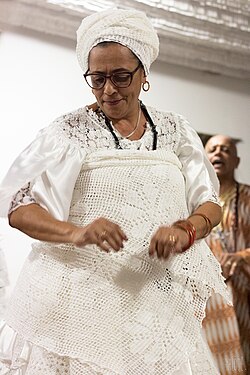
Umbanda (Portuguese pronunciation: [ũˈbɐ̃dɐ]) is a religion that emerged in Brazil during the 1920s. Deriving largely from Spiritism, it also combines elements from Afro-Brazilian traditions like Candomblé as well as Roman Catholicism. There is no central authority in control of Umbanda, which is organized around autonomous places of worship termed centros or terreiros, the followers of which are called Umbandistas.
Adherents of this monotheistic religion believe in a single God who is distant from humanity. Beneath this entity are powerful non-human spirits called orixás. In the more Spiritist-oriented wing of the religion, White Umbanda, these are viewed as divine energies or forces of nature; in more Africanised forms they are seen as West African deities and are offered animal sacrifices. The emissaries of the orixás are the pretos velhos and caboclos, spirits of enslaved Africans and of indigenous Brazilians respectively, and these are the main entities dealt with by Umbandistas. At Umbandist rituals, spirit mediums sing and dance in the hope of channeling these spirits, through whom the congregations receive guidance, advice, and healing. Umbanda teaches a complex cosmology involving a system of reincarnation according to the law of karma. The religion's ethics emphasise charity and social fraternity. Umbandistas also seek to reverse harm that they attribute to practitioners of a related tradition, Quimbanda.
Roman Catholicism was the dominant religion in early 20th-century Brazil, but sizeable minorities practiced Afro-Brazilian traditions or Spiritism, a French version of Spiritualism developed by Allan Kardec. Around the 1920s, various groups may have been combining Spiritist and Afro-Brazilian practices, forming the basis of Umbanda. The most important group was that established by Zélio Fernandino de Moraes and those around him in Niterói, Rio de Janeiro. He had been involved in Spiritism but disapproved of the negative attitude that many Spiritists held towards contact with pretos velhos and caboclos. Reflecting Umbanda's growth, in 1939 de Moraes formed an Umbandist federation and in 1941 held the first Umbandist congress. Umbanda gained increased social recognition and respectability amid the military dictatorship of 1964 to 1985, despite growing opposition from both the Roman Catholic Church and Pentecostal groups. Since the 1970s, Umbanda has seen some decline due to the resurgent popularity of Candomblé.
In Brazil, hundreds of thousands of people formally identify as Umbandistas, but the number who attend Umbandist ceremonies, sometimes on an occasional basis, is in the millions. In its heyday of the 1960s and 1970s, Umbanda was estimated to have between 10 and 20 million followers in Brazil. Reflecting a universalist attitude, practitioners are typically permitted to also follow other religious traditions. Umbanda is found primarily in urban areas of southern Brazil although has spread throughout the country and to other parts of the Americas.
Definitions
Formed in the state of Rio de Janeiro during the 1920s,1 Umbanda combines elements of Spiritism (Espiritismo) with ideas from Afro-Brazilian religions like Candomblé.2 Additional influences come from Roman Catholicism,3 as well as Asian religions like Hinduism and Buddhism.4 The religion's practitioners are called Umbandistas,5 while the term Umbanda itself may derive from the Portuguese language terms uma banda, meaning "one group".6
Umbanda is not a unified religion,7 having no central institutional authority,8 and being transmitted in a largely oral manner.9 It displays considerable variation and eclecticism,10 being highly adaptable,11 and taking various different forms.12 Much of this variation is regional.13 Several scholars deem it appropriate to talk about "Umbandas", in the plural, as much as a singular Umbanda.14 Reflecting a general universalist stance that encourages tolerance towards other traditions, Umbandistas are commonly permitted to also pursue other religions,15 with some also practising Roman Catholicism,16 Judaism,17 or Santo Daime.18
Reflecting its Spiritist origins, Umbanda has been labelled a Western esoteric tradition.19 It has also been called an Afro-Brazilian religion,20 although the scholar of religion Steven Engler cautioned that Africanised ritual elements are not present in all Umbandist groups and that the Spiritist influence is more significant across Umbanda as a whole.21 There are also Umbandist groups that have adopted Kabbalah,17 or New Age practices.22
Relation to Afro-Brazilian religions
Umbandist groups exist on a spectrum, from those emphasising Spiritist connections to those stressing links with Candomblé and related Afro-Brazilian religions.23 Groups taking the former position often refer to themselves as practicing Umbanda branca ("White Umbanda"),24 Umbanda pura ("Pure Umbanda"),25 or Umbanda limpa ("Clean Umbanda").26 The anthropologist Lindsay Hale referred to the more Africanist wing as "Afro-Brazilian Umbanda",27 while fellow anthropologist Diana Brown called it "Africanized Umbanda".28 Most Umbandist groups exist at points between these two poles.4

In practice, Afro-Brazilian religions often mix, rather than existing in pure forms,29 and thus scholars see them as existing on a continuum rather than being firmly distinct from each other.30 Brown noted that the boundary separating Umbanda from Candomblé was largely "a matter of individual opinion".31 She added that there was "no general consensus" as to what exactly Umbanda is and what it is not.32 In Rio de Janeiro, a tradition called Omolocô was established as an intermediate religion between Candomblé and Umbanda.33 Groups combining elements of Umbanda and Candomblé are sometimes termed "Umbandomblé", although this is rarely embraced by practitioners themselves.34 In the Porto Alegre area, it is common for groups to mix Umbanda with the Afro-Brazilian religion Batuque.35
Outsiders sometimes refer to Umbanda as Macumba, a pejorative term for Afro-Brazilian religions.36 While some Umbandistas have referred to themselves as macumbeiros, often in jest due to the term's negative connotations,37 Umbandist literature usually uses Macumba in a more restrictive sense to designate baixa espiritismo (low spiritism), traditions that work with lesser spirits for morally questionable purposes.38 Umbandistas often describe these practices as Quimbanda and emphasise their opposition to them, maintaining that Umbandistas work for good while Quimbandistas work for evil.39 The boundaries between Umbanda and Quimbanda are nevertheless not always clear, with various spirit mediums engaging or promoting practices associated with both.40 The anthropologist David J. Hess called the two religions "siblings".41
Beliefs
Various Umbandistas have claimed that theirs is not a new religion but an ancient tradition brought to Brazil from elsewhere. Some practitioners have claimed that it derives from ancient Egypt, India, or China, or from the Aztecs or Incas. Others have maintained that Umbanda's origins are either extraterrestrial or from Atlantis.42 These sorts of origin stories reflect the influence of Theosophy.26 Brown suggested that these explanations were adopted by Umbandistas eager to dismiss the possibility of their religion having Sub-Saharan African origin.26 In contrast, various practitioners of Africanised forms of Umbanda have maintained that the religion originally came from Africa.43
Theology and cosmology

Umbanda is monotheistic.44 It believes in a single God who is the creator and controller of the universe,44 an entity that presides over the astral world but who is distant from humanity.45 He is sometimes called Olorun,46 a name of Yoruba origin.47 Beneath God is a pantheon of spirits that reflect syncretic origins,47 assembled into what Brown called "a complex, impersonal bureaucracy",48 and it is these entities thought to intervene in humanity's daily lives.49
Although it has no authoritative source ensuring a standardised cosmological belief among practitioners,50 Umbanda has an elaborate cosmology.51 An important distinction is made between the material and the spiritual, with the latter considered far superior.52 Umbandist theology is largely Spiritist in basis, adopting the Spiritist emphasis on reincarnation and spiritual evolution,53 as well as the hierarchical ranking of spirits according to their "degree of evolution".54
Many Umbandistas believe in a three-part cosmos, divided between the astral spaces, the earth, and the underworld.55 The more highly evolved spirits dwell in the astral realm, spirits incarnated in physical form reside temporarily on earth, while malevolent and ignorant spirits inhabit the underworld.55 The barrier between these worlds is not impenetrable; spirits from both the astral and underworld realms can visit the earth.55 Umbandistas often refer to the plano astral (astral plane) as the além (beyond).56 Sometimes, the realm of the evolved spirits is also called Aruanda, a term that likely derives from Luanda, a port in modern Angola, but which in Umbanda has looser connotations of an area within the astral plane.57
The astral world is deemed to be divided into a hierarchy of seven vertical levels, the Sête Linhas de Umbanda (Seven Lines of Umbanda), although the specific identity of each line varies among Umbandistas.45 This seven-fold division may derive from Theosophy.58 Each of the Seven Lines is governed by an orixá, a highly evolved spirit who will also have an identity as a Roman Catholic saint.59 The underworld is also divided into Seven Lines, each of which is led by an exú spirit.48 Each Line is also internally divided into seven sub-lines; each of these is then divided into seven legions; these divide into seven sub-legions; these into seven falanges (phalanges); and these into seven sub-falanges.45 Umbandistas often liken this cosmological structure to the organization of an army, and it may reflect the prominent role that various military figures have played in Umbanda's history.45 The spirits inhabiting these groups are usually arranged on the basis of regional or racial origin.60
Orixás
At the top of Umbanda's hierarchy of spirits are the orixás,54 entities often regarded as deities.45 The term orixá derives from the Yoruba language of West Africa,61 as do the names of the various orixás themselves, which in Brazil are also employed in the Nagô or Ketu tradition of Candomblé.62 Although the names of the orixás are drawn from Candomblé, Umbandistas do not typically interpret these beings in the same way that Candomblé's practitioners do.53 There is nevertheless variation according to group; African-oriented Umbandistas place particular emphasis on the orixás, while they remain far less important in the rituals of White Umbandist groups.63
For Umbandistas, the orixás are God's intermediaries,44 and represent elemental forces of nature as well as humanity's primary economic activities.64 White Umbandist groups often perceive the orixás primarily as frequencies of spiritual energy, vibrations, or forces.65 They are regarded as beings so highly evolved that they have never incarnated in physical form.53 Like God, they are distant from humanity, permanently residing on the astral plane.48 Many Umbandistas rarely expect orixás to manifest during rituals, for the orixás are preoccupied with important spiritual matters.66 They are also thought too powerful for many humans to handle, meaning that their manifestation could be dangerous for the ritual's participants.66 Instead, the orixás send their emissaries, the caboclos and pretos velhos, to appear in their place.67

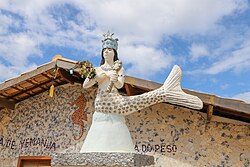
Nine orixás are commonly found in Umbanda, fewer than the 16 more usually present in Candomblé.68 The son of Olorun, Oxalá is associated with the sky and regarded as the creator of humanity.69 Iemanjá is a maternal figure associated with the sea.70 Nanã is also a maternal figure associated with water, but in her case the waters of the lake and swamp.64 Omolu is the orixá of sickness and healing.71 Xangô is linked to thunder and lightning, as well as to stone working and quarrying.72 Ogúm is the orixá of war, metalworking, agriculture, and transportation.73 Oxúm is associated with fertility and with flowing water, especially streams and waterfalls.74 Iansã is a female warrior who manifests in storms.74 Oxóssi is a hunter who lives in the forest.75 Exú is a trickster and the guardian of the crossroads, being the intermediary between the orixás and humanity.76 He will often be paid homage first during a ritual, to stop him being disruptive later in the rite.77
Each of the orixás is deemed to have their own desires and emotions.64 The orixás are also associated with particular colors; Oxúm with blue,74 for instance, and Oxóssi with green.74 Each is also linked to particular days of the week; Iansã with Wednesday,74 and Nanã with Tuesday, for example.78 They are also associated with a particular celestial body, such as Xangô with the planet Jupiter and Iemanjá with the moon.44
Each orixá is typically associated with a Roman Catholic saint.79 It is in this form that they are often represented on Umbandist altars,80 and these links are also reinforced in praise songs.81 Xangô, for instance, is often identified with Saint Geronimo,82 Nanã with Saint Anne,78 and Omolu with Saint Roch and Saint Lazarus.78 Many Umbandistas identify Exú with the Devil of Christian theology,83 and Oxalá with Jesus Christ.84 There is often regional variation in these associations; in Rio de Janeiro, Iemanjá is typically linked to Our Lady of Glory, while in Salvador she is associated with Our Lady of the Conception.85 There are nevertheless differences of opinion among Umbandistas as to the nature of the relationship between orixás and saints.85 Many Umbandistas regard the orixás and saints as manifestations of the same spiritual force rather than being exactly the same figure;86 some practitioners believe that these saints were once humans who were physical manifestations of the orixás.87
Relationships with the orixás
Umbanda often teaches that each person has a coroa (crown) of protective spirit entities.88 The most important of these is the orixá da frente ("the front orixá"), an orixá deemed to be that individual's spiritual parent.88 These entities are a person's protectors and patrons.89 They are also deemed to influence that individual's personality traits.88 Umbandistas believe that these entities are deserving of respect and that treating them well will improve a person's life.89 In Umbanda, it is usual for a medium to personally determine the identity of a person's spirit patrons.89 This is different from Candomblé, where the identity is more often ascertained through forms of divination;89 divination in general plays much less of a role in Umbanda than in Candomblé.90 Knowing the identity of these orixás is deemed to offer a person insights about themselves.89
Lesser evolved spirits
Although very different in tone from one another,91 the pretos velhos and the caboclos are together the most important spirit types in Umbanda.92 Umbanda departs from Spiritism over the value placed on these entities, with Umbandistas believing that Spiritists often negatively misjudge the pretos velhos and the caboclos because of their appearance.93 For Umbandistas, the caboclos and pretos velhos are "beings of light",39 entities who inhabit the lower echelons of the Seven Lines of the astral plane.45 In emphasising the spirits of these socially marginalised groups, Umbanda is sometimes characterised as having an egalitarian nature.94
Although they are only the emissaries of the orixás, the pretos velhos and caboclos take centre stage in Umbandist rituals.48 They are particularly prominent during rituals in which practitioners seek assistance with their problems,48 with Umbandistas approaching these entities in the hope of receiving advice and protection.95 In practice, Umbanda strongly emphasises practitioner's personal relationships with these spirit beings, with ritual homage given to them in exchange for cures and advice.96 This relationship bears similarities with that between devotees and the saints in popular Catholicism.96
Pretos Velhos

The pretos velhos ("old blacks") are usually, although not always, regarded as the spirits of deceased African slaves.97 They are usually conceived as being elderly, and thus referred to with respectful terms like vovô ("grandfather") and vovó ("grandmother").98 The pretos velhos are deemed to be kind, patient, and wise.99 Despite the suffering they endured in life, they are thought to preach forgiveness and love.99 They are regarded as healers and counsellors, spirits to whom Umbandistas can bring their problems.100 When a medium deems themselves possessed by one of the pretos velhos, they will often smoke a pipe.101
The names of these pretos velhos often reflect Catholic forenames followed by an African national affiliation, as with Maria Congo or Maria d'Aruanda.102 They will sometimes be addressed collectively as the povo de Bahia (people from Bahia) or as members of a particular nation, such as the povo da Congo (people from Congo).102 These spirits are commemorated on the feast of the old slaves, held on May 13, marking the day in 1888 when slavery was abolished in Brazil.103 Wayside shrines dedicated to the pretos velhos can be found in various places in Brazil,104 although in parts of Amazonia, Umbandist groups have often ignored the pretos velhos or subsumed them as a type of caboclo.105
Brown suggested that the portrayal of the pretos velhos reflected the stereotype of the "faithful slave" common in the writings of Brazilians like Castro Alves and Artur Azevedo. This literary trope had in turn been influenced by the popularity of Portuguese translations of the 1852 American novel Uncle Tom's Cabin.106
Caboclos

Caboclos are usually the spirits of indigenous Brazilians, especially those of the Amazon rainforest.107 In Umbanda, they are regarded as hunters and warriors who are highly intelligent and brave, but also vain and arrogant.108 Their power comes from the forces of nature, including the sun and moon, waterfalls, and the forest.108 Their individual names often reflect these links to nature, for instance Caboclo Mata Virgem (Caboclo Virgin Forest) or Caboclo Coral (Caboclo Coral Snake).108 They are often described as living in the forest, or alternatively in a paradisiacal city in the forest called Jurema.109
These spirits often have snakes as their companions,108 something alluded to in the songs sung about them,110 and which may derive from certain Afro-Brazilian traditions from northeast Brazil.111 The caboclos are deemed to have been people who roamed free, and thus can be contrasted with the pretos velhos, who in life were held in bondage.110 When mediums believe themselves possessed by caboclos, they often adopt stern expressions and make loud, piercing cries,112 also smoking and drinking alcohol.113 When these caboclo-possessed individuals perform healing on clients, they often blow cigar smoke over the latter as a means of cleansing and curing them.114
The caboclos do not derive from any prolonged contact that Umbanda's founders had with indigenous peoples, but instead reflect the popular Indianismo of Brazilian culture.106 Their portrayal often draws on the stereotype of Brazil's indigenous peoples being "noble savages",115 and reflect the heroic depiction of indigenous Brazilians that developed in the country's Romantic literature from the mid-19th century.91 The term caboclo may derive from the Tupi language term kari'boka ("deriving from the white").116 Although associated primarily with indigenous spirits, the term caboclo is also sometimes used for the spirits of cowboys or frontiersmen,117 or—in parts of northeast Brazil—Turkish kings.118
Other evolved spirits
Below the caboclos and pretos velhos in the Seven Lines of the astral realm are a large number of unidentified guias (spirit guides) and espíritos protetores (spirit protectors).119 Other types of spirit found in Umbanda include the boiadeiros (cowboys), crianças (children), marinheiros (sailors), malandros (rogues), ciganos (gypsies) and sereias (mermaids).120
The crianças are spirits of children and are valued largely for the joy and humor that they bring.95 Thought to be pure and innocent,121 they are deemed to enjoy sweets and toys just like living children.122 In Umbandist rites they are thought to often appear towards the end of proceedings, after tiring adult issues have been dealt with. Those mediums possessed by the crianças often giggle, sing nursery rhymes, and perform in a child-like fashion. Umbandistas often hold an annual birthday party for these spirits on the Roman Catholic feast day of the child martyr saints Cosmas and Damian.123 It is possible that the crianças derive in part from beliefs about the Ibeji twins, spirits venerated in parts of West Africa.124
Exús and pombagiras


In Umbanda, the exús are spirits yet to complete the process of karmic evolution.39 They are unevolved spirits of darkness which, by working for good, can gradually become spirits of light.39 Interpretations of these exús nevertheless differ among Umbandistas, with more African-oriented practitioners often taking a more positive attitude towards them.83 Exús are associated with Friday,125 and with the colors red and black.126 They are also linked to the obtaining of power, money, and sex.127 The term exú derives from the name of a Yoruba orisha spirit regarded as a trickster.128
Exús fall into two main categories. The exús da luz (exús of the light) or exús batizados (baptised exús) have repented for their sins and seek redemption and karmic advancement by serving the orixás. In life, the exús da luz were often sinners who performed immoral acts through noble intentions.129 The other type of exús are the exús das trevas (exús of the shadows), spirits who are unrepentant and who afflict and torment the living. They may act as "obsessors", finding a human victim and "leaning" (encostado) on them, causing the latter problems such as bad luck, compulsive behaviours, or addiction. The exús das trevas may do this due to their resentment of the living, or because they have been commanded to do so by a feiticeiro (sorcerer) practicing Quimbanda.130 These negative exús are sometimes also called Exú pagão (pagan exú), reflecting the influence of Christian thought.131 In Umbanda, the exús are often referred to with Christian-derived names like the Devil, Satan, or Lucifer, and are portrayed as being red with horns and tridents, reflecting Christian iconographical influence.132
The female counterparts of the exús,128 pombagiras are regarded as being the spirits of immoral women, such as prostitutes.133 Linked to marginal and dangerous places,134 they are associated with sexuality, blood, death, and cemeteries.135 They are often presented as being ribald and flirty, speaking in sexual euphemisms and double entendres.136 They wear red and black clothing,137 and only possess women and gay men,138 who will then often smoke or drink alcohol,139 using obscene language and behaving lasciviously.138 The term pombagira may derive from the Bantu word bombogira,140 the name of a male orixá in Candomblé's Bantu tradition.141 In Brazilian Portuguese, the term pomba is a euphemism for the vulva.133 When rituals focus on the exús and pombagiras, some Umbandistas will say that it constitutes Quimbanda.142
Mediumship
Central to Umbanda are the spirit mediums,143 individuals responsible for contacting the good spirits.104 According to Brown, these mediums represent "a sort of intermediate category of semi-specialists" within the religion.48 Umbandistas believe that the skill of mediumship, or mediunidade, is innate to certain individuals,144 those capable of vidéncia (seeing) spirit or sensing the spirits' presence through intuition.145 Umbandist mediums are typically called filhas and filhos de santo (daughters and sons of the saint).146 Several scholars who have studied the religion have noted that women predominate as spirit mediums.147 From her research in the late 1960s and 1970s, Brown found that around two-thirds of Umbandist mediums were female and a third were male.148 She noted that while a few were under the age of 18, this was generally discouraged.148

Most Umbandist mediums take on this role as a result of an initial personal crisis, often physical illness or emotional distress, that they come to believe is being caused by spirits as a means of alerting them.149 Often, they report that they initially resisted the call to become a medium but that the problems faced became too much and so they relented.150 Developing one's innate mediumistic abilities then takes training;144 in Umbanda, it may take seven years or more to train,151 a process known as desensolver mediunidade ("to develop mediumistic abilities").152 While a novice, the medium may be called a cambona or cambono.153 They will often be tasked with assisting established mediums during Umbandista rituals, for instance as ushers or scribes, writing down the messages from the spirits.154 Novice mediums may find their early possession experiences uncontrollable, but over time they learn to control it.155 To mark completion of this training, the medium may be given a necklace, the guia ("guide");154 henceforth, they are a medium com guia ("medium with a guide").156
Each of a medium's spirits will often have their own unique character.157 Expert mediums are thought to work with spirits from each of the Seven Lines.158 A medium's relationship with their exú or pombagira is considered close, and is mediated through the giving of gifts.159 Reciprocity is expected when engaging with the spirits, with those seeking their services often providing them with gifts.150 A person's misfortunes may be interpreted as a reminder that obligations to the spirits have not been met.160 Many Umbandistas believe that a good medium should maintain a healthy and pure body, for this reason avoiding smoking, over-eating, or drinking alcohol, especially on the night of an Umbandista session.156 Some Umbandista mediums operate out of their home, rather than running a centre.161
Reincarnation

Umbanda teaches that everyone has a spirit that survives bodily death.56 Umbandistas sometimes refer to living people as espíritos enćarnados (incarnate spirits).162 Like Spiritists, Umbandistas typically believe that each person has a perispirit, a transparent membrane around the body that mediates between the body and soul.163 They believe that disturbances in either body and soul can impact the perispirit.163
From Spiritism, Umbanda takes the ideas of reincarnation and karmic evolution;164 the terms reincarnação and karma were largely introduced to Brazilian Portuguese via the ideas of Spiritism's French founder, Allan Kardec.162 Umbandistas believe that the spirit survives bodily death and goes on successive reincarnations, seeking ever higher levels of spiritual evolution.52 Everyone is subject to karma,151 and a person can spiritually evolve through their incarnations.151
Reincarnation is a central idea for many Umbandistas.165 Practitioners believe that by serving the spirits and assisting the living they can build up their karmic credit. The higher a person's karmic credit, the higher their level on the astral plane, and then the better the status of their next incarnation. Umbandistas believe that disincarnate spirits can also build up karmic credit.162 Practitioners sometimes believe that the events of previous incarnations can influence a person, for instance generating certain irrational fears. Some Umbandistas think that the same spirits can meet repeatedly over successive incarnations.166
Morality, ethics, and gender roles
Umbandist morality places key emphasis on caridade (charity),167 something also evident in Spiritism,168 and which for both religions may derive ultimately from Roman Catholicism.96 As in Spiritism, for Umbandistas charity is regarded as a key motor for spiritual evolution.58 Practitioners for instance may give gifts and food to poor children to mark the festival of the crianças.169 Umbandistas also place value on humility.157 Umbandistas often believe that things happen for a reason, rather than being mere coincidence, and are part of a person's path in life.170 Brown suggested that Umbanda was "an essentially conservative religion", for it does not challenge the socio-economic status quo, and encourages "individual rather than collective responsibility and action".171
Brown argued that Umbanda inherited the Roman Catholic view that the world was a battleground between good and evil.172 Umbandistas often embody all the things that they oppose in the term Quimbanda.173 In the Umbandist view, Quimbanda is associated with evil, immorality, and pollution,172 and particularly with the use of exús.173 Given that Umbanda places focus on combating the harmful influences of exús, a common saying among Umbandistas is that "if it weren't for Quimbanda, Umbanda would have no reason to exist".174 Brown noted that Quimbanda represented "a crucial negative mirror image against which to define Umbanda",173 suggesting that it could also serve as an "ideological vehicle for expressing prejudices" towards African-derived and lower class religions.172 In Brazil, there are also individuals who call themselves Quimbandeiros and openly practice Quimbanda.126
Noting the predominance of women as spirit mediums, the scholar Patricia Lerch suggested that Umbanda offered Brazilian women a level of prestige and influence otherwise not offered by the low-paying jobs available to them.175 Engler noted that Umbanda, like Candomblé, offers "scope for the performance of alternative sexualities in a society governed by very conservative heterosexual gender roles."176 Afro-Brazilian religions are often stereotyped as attracting gay men, and to avoid this stereotype some male Umbandistas refuse to be possessed by female spirits.177 Based on research in the late 1960s and 1970s, Brown noted that a few centros had "an openly gay orientation" with a largely gay clientele,178 and in the 21st century some Umbandist priests have conducted same-sex marriages.179 The orixá Oxumaré, as an entity that spends six months being male and six months being female, is sometimes cited as a patron of gay and bisexual people.180
Practices
Umbandist practices often revolve around clients who approach practitioners seeking assistance, for instance in diagnosing a problem, healing, or receiving a blessing.13 In Umbanda, spiritual knowledge and ethical behaviour are generally seen as being more important than ritual action.181
Houses of worship

Umbandist places of worship are termed centros,182 or alternatively tendas (tents).183 Those adopting a more African-orientation are sometimes called terreiros; this term comes from Candomblé,184 and so is avoided by some practitioners of White Umbanda.185 Each centro will typically have its own Padroeiro, or patron spirit.186 They are often totally autonomous, although some are members of larger Umbandist federations.187 Due to their autonomous organization, some Umbandist leaders as of 2025 have been accused and arrested in insolated incidents, following allegations of "rape, sexual violence by fraud, sexual harassment, torture, extortion, threats, and bodily harm," and "concealment of evidence"188189190 among other cases of religious abuse.191192193 In 2024, an arrest was also made on similar allegations.194 Following one arrest, the Ceará Spiritist Union of Umbanda reiterated their "complete confidence in the innocence of our member".188189
A centro may occupy a purpose-built structure although may be based out of someone's home.49 Sometimes several centros will share the same structure, arranging their services at different times from each other.195 An insignia, the ponto riscado (sacred sign) may be on the exterior of the building to identify its function.196 Certain rituals may also be held outdoors, for instance beside a stream or the sea if that location is deemed particularly appropriate to the rite.197
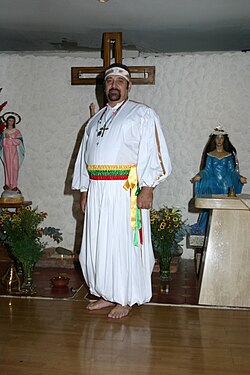
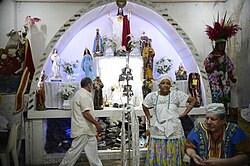
The main ritual space is called the barracão.198 Often this will face east, a direction deemed most conducive to astral forces.197 Sacred objects will often be buried beneath the floor, and these are termed axés.199 This main room will typically have paintings of the spirits on the walls, a space for practitioners to dance, and an altar.200 The altar will often have figurines of the caboclos, preto velhos, and orixás, the latter often in their form as Roman Catholic saints.201 Flowers and glasses of water are also often present to attract good forces, the latter a direct influence from Spiritism.201 Seating in rows to face the main ritual area is also common.200 Afro-Brazilian oriented terreiros may also have multiple outdoor shrines to different orixás.76
Centros have both formal and informal hierarchies.202 Each is typically led by an individual called the chefe ("chief"), a term borrowed from Spiritism,203 or alternatively the mãe-de-santo ("mother-of-saint") or pai-de-santo ("father-of-saint"), terms from Candomblé.204 In some groups, leaders may be called a babalaô, a term that may be borrowed from the Yoruba word babalawo, a diviner in the Ifá system.151 A chefe is usually a medium who receives the highest ranking spirits, and they will often lead group prayers and deliver sermons during services.146 Their leadership is often rooted in their individual charisma,205 and most have full-time jobs other than their role at the centro.206 Brown noted that, although women predominate as Umbandist mediums, most chefes were men.207 The second-in-command is the mãe pequena ("little mother").157 A centro may close on the death of this leader; alternatively, their leadership role will often be passed to a family member or, more rarely, to a non-related senior initiate.208

The chefe may refer to those under them as meus filhos do centros (my children of the centre), reflecting that they constitute a ritual godparent to them.209 Under the chefe will be the corpo mediúnico (ritual corps), the group of mediums active at that centro. These in turn divide into the médiums de consulta (consulting mediums) and the médiums em desenvolvimento (mediums in training).210 The latter are often expected to attend training sessions, the sessões de desenvolvimento, and to learn their ritual obligations to different spirits as well as the necessary ritual songs and the Umbandist cosmology.211 Advancement within the centro often relies on a person's development as a medium.211 In smaller centros, there may be between 10 and 60 members of the corpo mediúnico, while at larger centros there can be several hundred.146 These larger centros may therefore have further subdivisions within the corpo mediúnico as well as multiple sub-chefes.146 Mediums are often expected to abstain from alcohol or sex prior to a ceremony.104 The congregation of lay Umbandists who attend services at the centro are called the assistência.212
Some centros will also have a place for the mediums to change clothing,200 a kitchen,213 and an office.213 There is much work involved in running a Umbanda centro, for instance overseeing maintenance and paying bills.213 To gain legal registration with the Brazilian state, centros require an administrative system, often consisting of a board of directors, president, vice president, secretaries, and treasurers, although the size of this administration varies by centro.214 The centro is financed largely by its members, who consist of both its ritual corps and its regular lay attendees; they are expected to pay an initial registration and a monthly membership fee.215 Centros will sometimes also operate in a manner akin to mutual aid societies, offering their members social welfare services such as access to doctors and dentists or burial funds.216 The social activities common among Brazil's Christian churches, such as picnics, dances, and coffee mornings, are largely absent from Umbandist centros.217
Rituals and ceremonies

Umbandistas typically hold public ceremonies called sessões (sessions) several times a week.183 These take place in the centro; if an Umbandist group lacks one, it will instead be in rented premises or a private home.183 The purpose of these rituals is to invoke spirits to come to earth, where they may take possession of the mediums and thus offer spiritual consultations to the congregation.183 Brown described these Umbandist rituals as being livelier than Catholic or Spiritist ceremonies, but less so than those of Afro-Brazilian traditions or Quimbanda.218
Mediums and others engaged in Umbandist rituals typically wear white clothing;219 for men this often means white tee-shirts and trousers, for women layered white skirts, singlets, or blouses.220 This uniformity conveys an impression of equality among practitioners,221 and also distinguishes them from Candomblé practitioners, who may wear more complex and colorful attire.222 Umbandistas also usually remove their shoes on entering the ritual space,32 before genuflecting to the altar.200 To start a ceremony, a ritual purification using incense, the defumacão, is used to banish harmful spirits,200 with the exús often being placated and asked to remain absent.132 Offerings of food may be given to the spirits, typically consisting of fruit, rice, and coconut milk.223
A session may be begun with the recitation of a Roman Catholic prayer or the reading of passages from Kardec's writing.112 Singing often opens a session,112 with a song sung at such ceremonies being called a ponto,224 curimba,225 or ponto cantado.225 Usually sung in Portuguese,226 they typically involve "strophic song forms, couplets and quatrains with abeb rhyming schemes".225 The pontos celebrate the powers and exploits of the spirits,227 thereby inviting them to attend the ritual, where they can then engage in spirit possession.228 In a ritual, pontos will often be sung in honor of the leader of each of the Seven Lines.227 In White Umbandist groups, the singing will be accompanied by hand clapping, while more African-influenced groups often also employ drumming.229
Umbandist practice can often incorporate Roman Catholic elements. In São Paulo, for instance, it is common for Umbandist groups to recite the Lord's Prayer or Hail Mary during their rituals.185 Many Umbandist groups have also embraced New Age practices such as aromatherapy, crystal healing, numerology, tarot cartomancy, reiki, and chakra realignment.230 The ethnomusicologist Marc Meistrich Gidal suggested that Umbanda embraced change and innovation in liturgy and ritual much more readily than Afro-Brazilian religions like Candomblé and Batuque.231
Possession and consultations
The gira is a dance to celebrate the orixás;170 the members of the ritual corps will often dance in a procession.112 During the gira, some participants will become possessed, ceasing to dance and instead swaying and jerking rapidly.112 In Umbanda, the term incorporação (incorporation) is usually used to describe this possession.232 While possessed, the medium is considered a cavalos (horse),233 or sometimes an aparelhos (vehicle), for the possessing spirit.146 Their first act will sometimes be to bow before the altar to display respect for the orixás.112 The possessed medium's facial expressions and demeanour may change to reflect the entity within them, while attendants may dress them in a manner suited to this spirit, for instance with the giving of feathered headdresses to those possessed by caboclos.112 A possessing spirit may then "open the way" for others to follow it.234
Once all of the spirits are believed to have arrived, the singing and dancing will stop and the consultas (consultations) will begin.101 These consultas typically take up over half the ceremony's length.174 Those clients awaiting a consultation with the mediums will often have a numbered ficha (token), and will sit waiting until their number is called, at which they can approach a medium.235 The individual guiding the client to the medium in question may be called a porteiro ("usher") and in some cases is a medium-in-training.154 The possessed mediums will provide each client with a message, often in a coded ritual language;236 this message will then be written down by an assistant, the escrevedor (scribe),154 who may also interpret it for the client.236 Consultas form the principal link between Umbandist mediums and lay followers, and it is as a client at a session that most people first engage with Umbanda.237 Successful consultas attract converts and are a centro's main means of recruitment.238 Mediums who gain reputations to successful consultations gain prestige; in doing so, they may end up challenging the head of the centro.239 Such mediums might also split off to form their own centro.212

If exús possess a medium during the session, they will generally be exorcised.132 If a client is diagnosed as being harassed by exús, efforts will be made to tirar (pull out) this entity from the person's body. Sometimes, multiple mediums will do so, placing their hands on the patient and absorbing the exú into themselves; it is believed that they have the ability to defend themselves from its influence.236 In some instances, clients have also reported being possessed during the ceremony.236 Once the consultas are over, services often end with prayers and pontos.236 The practitioners will then change out of their ceremonial clothing and leave.236 Mediums who were possessed often report no memory of the events that transpired during the possession.144
In White Umbanda, consultations generally always take place as part of the public ceremony, thus emphasizing the idea that they are being offered to clients as a form of charity, rather than as a means of earning money.218 Umbandist mediums generally do not charge for working with the spirits, but clients will typically support them with material gifts.240 In more Africanised forms of Umbanda, as in Candomblé, private consultations will also be held outside of public ceremonies.218
Obrigações
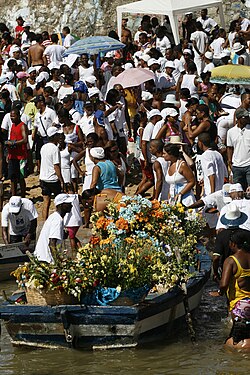
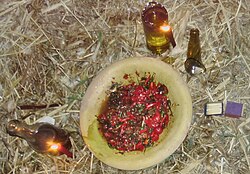
A particular orixá will be paid ritual homage on the saint's day that correlates with them.227 These acts of ritual homage are called obrigações (obligations) and will usually take place at a place in the natural environment associated with the orixá in question, for instance a pile of rocks for Xangô, at fresh water for Oxúm, or at salt water for Iemanjá.227 Ritual homage will also sometimes be made to exús, in which case it is usually done at the crossroads. Offerings to the exús typically include candles, cachaça, cigarettes, and sacrificed black chickens.132 Many Umbandists believe that performing a homage to these entities goes beyond the bounds of Umbanda and becomes Quimbanda.132
There are also specific festivals in the Umbandist calendar devoted to particular orixá. December 31 is for instance the Dia de Iemanjá, and sees thousands of Umbandistas and other participants amass on Rio's beaches.241 Umbandistas often also associate Brazil's Abolition Day, celebrated on May 13, as a reference to their pretos velhos.241 Certain Umbandist groups, particularly those of a more Africanist-orientation, have also organised public processions on the Catholic saint days that correspond to particular orixás. These processions are similar to those also held by Catholics.242
In Afro-Brazilian Umbanda
In Africanized Umbandista terreiros, ceremonies tend to take place on Saturday nights, beginning around 10pm and continuing until dawn.243 In contrast to the white clothing of White Umbandista groups, practitioners at these ceremonies will often be colorfully dressed.244 More African-oriented Umbandista groups will often feature practices like animal sacrifice, dancing, and drumming which are found in Afro-Brazilian religions like Candomblé.245 These are typically avoided by White Umbanda traditions,170 the practitioners of which sometimes regard such practices as primitive.246

The drumming is performed to summon the spirits to appear at the ceremony;247 different rhythms are often selected for different orixás.248 Amid the drumming, singing, and dancing in a circle, Umbandistas believe that the caboclos, as representatives of the orixás, will appear and possess one of the participants.249 Later in the ceremony, other caboclos, as well as pretos velhos, exús, and pomba giras, will appear and possess people to offer advice, protection, and healing.250
Animals sacrificed in these African-oriented terreiros are usually chickens, although sometimes guinea fowl, sheep, goats, or more rarely, bulls.247 Typically, the animal's throat will be cut,198 after which its corpse may be butchered and body parts placed on the altar.251 In White Umbanda, these sacrifices are deemed misguided, unnecessary, and cruel, with White Umbandistas believing that blood sacrifice attracts the lowest types of spirits and generate bad karma for those engaging in the sacrifice.252 Various White Umbandistas have also questioned why spiritual beings would require nourishment from physical blood.252
Healing
Clients typically approach Umbanda seeking assistance for problems to do with relationships, family, employment, finances, and especially health.94 Clients' problems are often, although not always, attributed to a spiritual cause;253 Umbandist healers then claim to treat the spiritual cause of the ailment, not just its biological symptoms.254 Common causes of harm can include malevolent and ignorant spirits from the underworld,55 karmic retribution from previous lifetimes,255 spiritual disequilibrium (desequilíbrio),254 a neglect of the orixás,254 or the curses of living humans, including from the evil eye.255 Sometimes, the client's problems are diagnosed as evidence that they are ignoring their own undeveloped powers as a medium.256
One treatment, descarrêgo, involves discharging negative energy from around the patient using the healer's hands, a technique deriving from the Spiritist passe.257 If a person believes they are being tormented by a malevolent spirit. Umbandist mediums will then cajole the spirit to leave.258 If a person is repeatedly attacked by spirits, Umbandistas may deem that individual to be especially sensitive to spirits and recommend that they become a medium themselves so as to learn to control the issue.259 To deal with harmful spirits, the medium may encourage their client to create an Umbandist altar in their home, or to light candles intended to dispel harmful spirits and attract good ones.260
Umbandist mediums may prescribe herbal or homeopathic remedies for their clients.261 Umbandistas often employ herbal baths or washes called banhos to cleanse and fortify themselves.262 Another type of herbal infusion, amacis, are more commonly found in Afro-Brazilian Umbanda and are often rooted in Afro-Brazilian medicinal traditions.263 Herbs used may be collected on specific days based on their astrological associations.197 Also found in Afro-Brazilian Umbandist groups is a complex healing rite termed the sacudimento (shaking), in which offerings are given to the spirits and prayers and songs are offered.264 There are also Umbandist groups that offer spiritual surgeries, in which tumours and other problems are allegedly cut from the body using etheric means.265
The use of spiritual healing does not mean that Umbandists dismiss mainstream medicine;266 practitioners of White Umbanda generally place great faith in the latter, reflecting the ideological positivism inherited from Spiritism.267 Umbandist mediums have for instance been involved in biomedical HIV prevention programs in Brazilian favelas.268 Practitioners will often see the two methods of healing as complementary,266 with the spirits dealing primarily with the spiritual aspects of illness rather than the physical ones.267 Umbandistas have sometimes explained that they are capable of offering certain levels of healing, for instance helping patients to better cope with their ailment, even if they cannot enact a total cure.269
History
Background
Umbanda derives from the combination of Afro-Brazilian religions with Spiritism.11 Amid the Atlantic slave trade, between 3.5 and 4 million enslaved Africans were transported to Brazil,270 with the numbers reaching their highest levels in the 19th century.271 The trade continued until 1851, with slavery ultimately being abolished in the country in 1888.270 In Brazil, enslaved Africans were allowed to join Roman Catholic religious brotherhoods, and it was within these that they privately continued the practice of African-derived religious traditions.272 Different names for Afro-Brazilian traditions arose in different parts of the country;273 in Salvador, Bahia, these traditions became Candomblé.274 The 19th century saw Rio de Janeiro become Brazil's economic hub, resulting in growing numbers of Afro-Brazilians moving there.275 Afro-Brazilian religious groups were first recorded in Rio de Janeiro in the early 20th century, although were probably present in the city beforehand.274 Candomblé was likely introduced to the city by migrants from Bahia.276 In the early decades of the 20th century, Candomblé was subject to considerable disapproval from the bourgeoise classes and the dominant Roman Catholic Church, with its terreiros often experiencing police repression.277 Umbanda departed from Candomblé in various ways; it reduced the pantheon of orixás found in Candomblé, dropped the practice of animal sacrifice, and simplified the initiation process.278
A variant of the American religion of Spiritualism, Spiritism was developed by the Frenchman Allan Kardec.279 Kardec's Spiritism combined Spiritualism's general emphasis on spirit mediumship with the Hindu ideas of karma and reincarnation, Christian ethical systems, and the social evolutionism and positivism of Auguste Comte.280 It placed emphasis on the idea of spirits progressing on a path of moral and intellectual evolution, meaning that there is a distinction between higher, or "evolved" spirits, as well as lesser ones.281 Spiritism arrived in Brazil c. 1857,282 where it was often called Kardecismo or Espiritismo.283 Brazil's Spiritists still often regarding themselves as Roman Catholics.281 Spiritism proved popular among the largely white Brazilian bourgeoisie,284 with Rio becoming the hub for Brazilian Spiritist activity.283 The first Brazilian Spiritist Federation forming in 1884 as an attempt to unify the movement.285 Throughout Latin America, Spiritism often hybridised with other religious traditions from the 1860s on.286 Brown noted that Umbanda was "deeply influenced" by Spiritism but "diverged from it in many important ways".287 Umbanda would make the spirits of African and Indigenous American people central to many of its rituals, but in Spiritism these entities were often perceived as being low on the level of spiritual evolution and thus avoided.288
Foundation

Umbanda is generally regarded as having emerged in the area around Rio de Janeiro during the 1920s.289 There is a lack of clear evidence regarding Umbanda's foundations and it is possible that it emerged from multiple origins around the same time,290 with various early 20th-century groups having combined Spiritist and Afro-Brazilian religious practices.291
A key figure was Zélio Fernandino de Moraes, founder of the first Umbandist group, the Centro Espírita Nossa Senhora da Piedade (Spiritism Center of Our Lady of Mercy). This initially operated in Niterói from the mid-1920s before moving to the centre of Rio de Janeiro in 1938.292 According to claims that gained prominence in the 1970s, in 1908, when he was 17 years old, Moraes had been cured of an illness by a highly evolved spirit. His parents then took him to a Spiritist ritual, where the spirit Caboclo Seven Crossroads (Caboclo das Sete Encruzilhadas) incorporated into him. This spirit defended the appearance of African and indigenous spirits that then incorporated in other mediums, despite the Spiritist prejudice towards them.293
Umbanda's founders were Kardecist Spiritists disappointed with Spiritist orthodoxy,294 and who were interested in the country's Afro-Brazilian religious traditions, which they deemed more exciting and dramatic than those of the Spiritists.295 They were mostly white men, largely occupied in middle-class professions involving commerce, government bureaucracy, and the military.296 Most were sympathetic to the reforms of President Getúlio Vargas, with de Moraes being a local pro-Vargas politician.297 Brown suggested that Umbanda could be seen as an attempt by middle-class white Brazilians to exert control over the popular religion of the lower classes,298 drawing comparison with how other lower class practices like samba, capoeira, and Carnival were also embraced as symbols of Brazilian national culture in the early 20th century.299 By combining Afro-Brazilian and European ideas, Umbanda was presented as a national religion for Brazil at a time when the country was increasingly being presented as a cultural melting pot.164
In 1939, Zélio de Moraes formed the first Umbandist federation, the Umbandist Spiritist Union of Brazil.300 In 1941, the Primeiro Congresso do Espiritismo de Umbanda (First Congress of the Spiritism of Umbanda) was held in Rio de Janeiro, representing a collective attempt to codify Umbandist teaching. The congress' proceedings were published in 1942 and highlight Umbanda's origins in Spiritism and the early Umbandistas' desire to distinguish themselves from Afro-Brazilian traditions.301 In turn, some Umbandist groups whose membership was predominantly Afro-Brazilian began maintaining that Umbanda was a religion with African origins,302 and that anyone not using drumming and animal sacrifice in their rites was not truly practicing Umbanda.303 In turn, White Umbandist leaders retorted that the Africanised traditions were in fact Quimbanda or Candomblé and were falsely using the term "Umbanda".304 This confusion may be explained if the term "Umbanda" had been adopted independently both by Zélio de Moraes' group and by practitioners of various Afro-Brazilian groups.305
After the Second World War
The collapse of Vargas' Estado Novo in 1945 allowed Umbanda to be practised more openly.306 Although it remained concentrated in the cities of southern Brazil, over the coming years Umbanda spread rapidly throughout the country,307 while in the 1950s and 1960s it also spread to Uruguay, Paraguay, and Argentina.308
In response to the growth of Umbanda, Spiritism, and Pentecostalism, Brazil's dominant Roman Catholic Church mounted a campaign against these minority religions, one later formally terminated due to the changes of the Second Vatican Council in the 1960s.309 In part to counter Catholic opposition, in the late 1950s Umbandistas began campaigns to get their co-religionists elected to office, typically rallying around Brazilian nationalism and calls for religious freedom.310 The first open Umbandista elected was Attila Nunes, who became a vereador (city councilman) in 1958 and Rio's state deputy in 1960.311 From the 1950s on, six new Umbandist federations formed in Rio, three of them open to more Africanised elements.312 The most important of these was the more African-focused Umbandist Spiritist Federation, founded in 1952 by Tancredo da Silva Pinto.312 For the second congress of Umbandistas in 1961, several thousand attendees met in a Rio football stadium.313
In 1964, a military dictatorship took power in Brazil.314 The military government largely protected Umbanda; many soldiers were Umbandistas and the military government regarded the religion as a counter to the influence of the Roman Catholic Church, which they perceived as having grown increasingly sympathetic to the political left since the 1950s.315 From 1965, Umbandist centros/terreiros were permitted to secure legal recognition with just a civil registration,316 while Umbanda also gained recognition as a religion on the Brazilian census.317 The 1960s and 1970s saw the rapid growth of middle-class participation in Umbanda.318 After the 1960s and 1970s, the number of Umbandistas declined.319 During the 1970s, Candomblé spread from Bahia into São Paulo, where it grew rapidly, largely at the expense of Umbanda.320 Some Umbanda temples transformed into Candomblé temples.321 Conversely, Umbanda saw growth in northern Brazil during this period.322 The 1970s also saw the rise in attempts to "re-Africanize" Umbanda by emphasising African elements, reflecting a broader revival of interest in African cultural heritage among Afro-Brazilians.323
Demographics

Diana Brown noted that by the 1970s, there were estimates that between 10 and 20 million people, as much as ten percent of Brazil's population, were practicing Umbanda.324 In 1969, there were estimates that 100,000 Umbandist centros were then active in Brazil.325 The number of Umbandistas declined following the 1970s,319 although in 1986 Brown suggested that Umbanda still had millions of followers in Brazil.4 These numbers are not reflected in the census data; in the 2000 Brazilian census, only 397,000 people identified as Umbandistas.326
These statistics do not account for those who attend Umbandist services but do not consider themselves Umbandistas.327 Brown noted that many who visit Umbandist centres do so only in emergencies, thus being "casual participants",238 with Hale suggesting that it was these "occasional participants" who ran into the millions.150 Although originally concentrated in Brazil's large southern cities, the religion has spread throughout the country.324 Brazilian immigrants have also taken the religion to other parts of Latin America like Uruguay as well as to the United States.328
Umbandistas come from across Brazil's racial and class spectrum,329 and centros vary in their racial and class demographic.330 Based on a research sample from different Rio de Janeiro centros in the late 1960s and 1970s, Brown found that 52 percent of practitioners were white, 29 percent mulatto, and 18 percent black.331 Conversely, writing in the early 21st century, Hale thought that most Umbandistas were people of color and were working or lower class.247 Brown also suggested that middle-class practitioners have been more influential in Umbanda's history;332 middle-class Umbandistas have included high-ranking military figures, journalists, and politicians.333 Brown believed that White Umbandist centros typically had a diverse socio-economic membership,334 while Africanized Umbandist terreiros had particular appeal for "people in the entertainment world and the arts," gay people, and those in "the upper sectors" of society who were interested in alternative lifestyles.243

Many of those who come to Umbanda were raised in a different religion.335 Brown's research found that most of those who started going to a centro learned of it through family or friends.336 The main reason that people get involved in Umbanda is because they have a problem and hope that the religion's spirits will be able to identify the cause and provide a remedy.337 Health concerns are the primary reason, but other issues are to do with love, family problems, unemployment, finances, or alcoholism.338 For many clients, visiting the centro will be a last resort after they have tried other methods of dealing with their problem.339 In some instances they turn to Umbanda because medical professionals have been unable to successfully diagnose their problem;340 alternatively, they approach Umbanda because they cannot afford professional medical treatment.94 Those involved often keep their practice discreet, sometimes not informing family members that they are Umbandistas.341
Some Umbandistas move on to join Candomblé, believing that the latter deals with more powerful supernatural forces and thus resolves problems more readily.342 Umbanda is sometimes described as an appropriate preparation for Candomblé,343 and the move from Umbanda to Candomblé can also bring greater prestige within Brazilian society.344 Umbandist mediums sometimes hold critical views of Candomblé, regarding it as authoritarian,345 and criticising the high prices charged for initiation into it.222 Other Umbandistas have left the religion for Pentecostalism.346
Reception and influence
Umbanda has faced opposition from other religions in Brazil. Spiritists have often looked down upon Umbanda because it deals with what they regard as less developed spirits.347 From the 1950s, Brazil's Roman Catholic establishment campaigned against Umbanda, portraying it as a primitive religion frequented by ignorant people.348
A 1961 book by the Franciscan friar Boaventura Kloppenburg, for instance, presented Umbanda as a heresy based on superstition which encouraged sexual permissiveness and harmed its practitioners' mental health.349 The religion has also been criticised by Protestant groups, which in Brazil are largely Pentecostal, and which see their own religion and Umbanda as mutually incompatible.17 Many Brazilian Pentecostals openly defined their religious identity in opposition to Umbanda and Candomblé,350 traditions they believe are associated with the Devil.351 Throughout much of the 20th century, Umbanda also faced hostility from Brazilian intellectuals on both the political left and right.352
Scholarly research into Afro-Brazilian religions began in the late 19th century, although for much of the 20th century the focus was on Candomblé and other traditions deemed to have a "purer" African origin than the more syncretic Umbanda.353 In the early 1960s, a group of sociologists at the University of São Paulo began to study Umbanda, the most prominent being Roger Bastide, who saw the religion as an expression of urban industrial change.348 Over following decades, research focused primarily among Afro-Brazilian Umbandistas, rather than White Umbandist groups.354 In 2016, following a study by the Instituto Rio Patrimônio da Humanidade (Rio Heritage of Humanity Institute), Umbanda became one of Rio de Janeiro's Intangible Cultural Heritages.355
Umbanda has also influenced some practitioners of Santo Daime,356 and a tradition called Umbandaime has emerged as a hybridized religion combining elements of both.357 Umbandist trance states have also been studied by Heathens seeking to create new forms of seiðr.358
References
References
Citations
- Brown & Bick 1987, p. 74; Hayes 2007, p. 307; Capone 2010, p. 103; Engler 2012, p. 16.
- Brown 1986, p. 1; Hale 2009, p. x; Engler 2020, p. 2.
- Brown 1986, pp. 1, 191; Brown & Bick 1987, p. 79; Engler 2009, p. 555; Engler 2020, p. 23.
- Brown 1986, p. 1.
- Hale 2009, p. xiv; Engler 2012, p. 16.
- Brown 1986, p. 51.
- Brown & Bick 1987, p. 77; Engler 2020, p. 25.
- Brown 1986, p. 133; Hale 2009, p. 56.
- da Silva 2005, p. 47.
- Brown 1986, p. 1; Engler 2012, p. 18.
- Hale 2009, p. x.
- Brown 1986, p. 37; Hale 2009, pp. ix–x; Capone 2010, p. 76.
- Engler 2020, p. 8.
- Engler 2009, p. 560; Hale 2009, p. 156.
- Brown 1986, p. 133; Stone 2015, p. 175.
- Lerch 1982, p. 238; Brown & Bick 1987, p. 79; Hale 2009, p. ix.
- Brown 1986, p. 135.
- Hale 2009, p. 55.
- Engler 2020, p. 2.
- Brown 1986, p. 1; Engler 2020, pp. 8–9.
- Engler 2020, pp. 22, 25.
- Hale 2009, p. 55; Stone 2015, p. 176; Engler 2020, p. 6.
- Engler 2009, p. 560; Brown 1986, p. 1.
- Brown 1986, p. 37; Hale 2009, p. xv; Engler 2020, p. 21.
- Brown 1986, p. 37; Brown & Bick 1987, p. 77.
- Brown 1986, p. 43.
- Hale 2009, p. xv.
- Brown 1986, p. 38.
- Capone 2010, p. 95.
- Capone 2010, pp. 8–9.
- Brown 1986, p. 88.
- Brown 1986, p. 87.
- Capone 2010, p. 105.
- Johnson 2002, p. 52; Capone 2010, p. 9.
- Gidal 2013, p. 233.
- Brown 1986, p. 6; Brown & Bick 1987, p. 77.
- Hale 2009, p. 42.
- Hayes 2007, p. 286.
- Capone 2010, p. 77.
- Hess 1992, pp. 138–139.
- Hess 1992, p. 136.
- Brown 1986, pp. 43, 50; Hale 2009, pp. 64–65; Engler 2020, p. 12.
- Brown 1986, p. 50.
- Dann 1979, p. 209.
- Brown 1986, p. 55.
- Dann 1979, p. 209; Hale 2009, p. 112.
- Dann 1979, p. 210.
- Brown 1986, p. 59.
- Brown & Bick 1987, p. 77.
- Hale 2009, p. 2.
- Hale 2009, p. xiii.
- Hale 2009, p. 141.
- Engler 2020, p. 21.
- Hale 2009, p. 7.
- Brown 1986, p. 54.
- Hale 2009, p. 5.
- Brown 1986, p. 67; Hale 2009, p. 5.
- Brown 1986, p. 62.
- Brown 1986, p. 55; Hale 2009, p. 6; Capone 2010, p. 76.
- Hale 2009, p. 6.
- Brown 1986, p. 72.
- Hale 2009, p. 60.
- Hale 2009, p. 125; Engler 2020, p. 21.
- Hale 2009, p. 113.
- Hale 2009, pp. xv, 125.
- Hale 2009, p. 102.
- Brown 1986, p. 59; Hale 2009, pp. 7, 101–102.
- Hale 2009, pp. 112–113.
- Hale 2009, pp. 41, 113.
- Hale 2009, pp. 24, 114.
- Hale 2009, pp. 41, 114.
- Hale 2009, pp. 25, 115.
- Dann 1979, p. 209; Hale 2009, p. 115.
- Hale 2009, p. 116.
- Dann 1979, p. 210; Hale 2009, p. 116.
- Hale 2009, p. 41.
- Hale 2009, p. 137.
- Hale 2009, p. 114.
- Hale 2009, pp. ix, 113.
- Brown 1986, p. 84; Hale 2009, p. 113.
- Hale 2009, p. 122.
- Hale 2009, p. 25.
- Capone 2010, p. 79.
- Dann 1979, p. 209; Brown 1986, p. 55; Hale 2009, p. 113.
- Hale 2009, p. 120.
- Hale 2009, pp. 120–121.
- Hale 2009, p. 121.
- Hale 2009, p. 118.
- Hale 2009, p. 119.
- Engler 2009, p. 557.
- Brown 1986, p. 69.
- Brown 1986, p. 64; Engler 2020, p. 8.
- Brown 1986, p. 42.
- Stone 2015, p. 176.
- Hale 2009, p. 8.
- Brown 1986, p. 63.
- Brown 1986, p. 67; Hale 2009, pp. 8, 77.
- Brown 1986, p. 67; Hale 2009, p. 77.
- Hale 2009, p. 77.
- Hale 2009, pp. 78–79.
- Brown 1986, p. 82.
- Brown 1986, p. 68.
- Hale 2009, p. 88.
- Dann 1979, p. 211.
- Engler 2012, p. 20.
- Brown 1986, p. 70.
- Dann 1979, p. 211; Brown 1986, p. 65; Hale 2009, p. 7.
- Brown 1986, p. 65.
- Brown 1986, pp. 66–67.
- Hale 2009, p. 98.
- Brown 1986, p. 66.
- Brown 1986, p. 81.
- Pinto 1991, p. 76.
- Brown 1986, p. 81; Hale 2009, p. 143; Stone 2015, p. 183.
- Brown 1986, p. 69; Hale 2009, p. 105.
- Wafer 1991, p. 55.
- Brown 1986, p. 77; Hale 2009, p. 14.
- Hale 2009, p. 97.
- Brown 1986, pp. 55, 59.
- Engler 2012, p. 16; Engler 2020, p. 8.
- Lerch 1982, p. 241.
- Lerch 1982, p. 241; Hale 2009, p. 9.
- Pinto 1991, pp. 82–84; Hale 2009, p. 8.
- Hale 2009, p. 9.
- Brown 1986, p. 90; Capone 2010, p. 84.
- Brown 1986, p. 90.
- Brown 1986, p. 91.
- Brown 1986, p. 74; Gidal 2013, p. 238.
- Hale 2009, p. 13.
- Hale 2009, p. 14.
- Brown 1986, p. 77.
- Brown 1986, p. 74.
- Hale 2009, p. 3.
- Capone 2010, p. 84.
- Capone 2010, p. 90.
- Hale 2009, pp. 3–4.
- Hale 2009, p. 3; Capone 2010, p. 84.
- Capone 2010, p. 85.
- Hale 2009, p. 4.
- Hale 2009, p. 3; Capone 2010, p. 90.
- Capone 2010, pp. 85–86.
- Gidal 2013, p. 242.
- Lerch 1982, p. 237.
- Lerch 1982, p. 245.
- Hale 2009, pp. 119–120.
- Brown 1986, p. 104.
- Brown 1986, p. 119; Lerch 1982, p. 237.
- Brown 1986, p. 119.
- Lerch 1982, p. 246; Hale 2009, p. 53.
- Hale 2009, p. 53.
- Dann 1979, p. 212.
- Lerch 1982, p. 246.
- Lerch 1982, p. 247; Brown 1986, p. 104.
- Lerch 1982, p. 247.
- Brown 1986, pp. 105–106.
- Lerch 1982, p. 248.
- Hale 2009, p. 45.
- Engler 2012, p. 16.
- Hale 2009, p. 149.
- Hale 2009, p. 54.
- Hale 2009, p. 52.
- Hale 2009, p. 16.
- Hale 2009, p. 142.
- Capone 2010, p. 75.
- Dann 1979, p. 209; Hale 2009, p. 16.
- Hale 2009, p. 17.
- Dann 1979, p. 212; Brown 1986, pp. 44, 84; Brown & Bick 1987, p. 79; Hale 2009, pp. 10, 45.
- Brown 1986, p. 21; Brown & Bick 1987, p. 79; Gidal 2013, p. 237.
- Hale 2009, p. 10.
- Hale 2009, p. 37.
- Brown 1986, p. 198.
- Brown 1986, p. 45.
- Brown 1986, p. 44.
- Brown 1986, p. 86.
- Lerch 1982, pp. 238, 254.
- Engler 2009, p. 561.
- Hale 2009, p. 83.
- Brown 1986, p. 122.
- "Diversidade Sexual e Umbanda". domtotal.com (in Brazilian Portuguese). Archived from the original on 1 December 2022. Retrieved 1 December 2022.
- Hale 2009, p. 125.
- Dann 1979, p. 216.
- Brown 1986, p. 3; Brown & Bick 1987, p. 77.
- Brown 1986, p. 79.
- Dann 1979, p. 215; Brown 1986, pp. 3, 79, 89.
- Engler 2020, p. 18.
- Brown 1986, pp. 189–190.
- Brown 1986, p. 196.
- "Vítimas de abuso sexual de pai de santo relatam momento do crime | G1". G1 (in Brazilian Portuguese). Retrieved 4 February 2026.
- "Pai de santo primo de Daniel Vorcaro é preso e afastado de terreiro | G1". G1 (in Brazilian Portuguese). Retrieved 4 February 2026.
- "Pai de santo é preso após denúncias, suspeito de usar a religião para cometer abusos". G1 (in Brazilian Portuguese). Retrieved 4 February 2026.
- "Pai de santo é preso após denúncias, suspeito de usar a religião para cometer abusos". G1 (in Brazilian Portuguese). Retrieved 4 February 2026.
- "Sete mulheres denunciam líder religioso por crimes sexuais no Ceará | G1". G1 (in Brazilian Portuguese). Retrieved 4 February 2026.
- Queiroz, Nathália (19 March 2025). "Horror no terreiro: o que se sabe sobre os casos de abuso e tortura". www.metropoles.com (in Brazilian Portuguese). Retrieved 4 February 2026.
- "Líder religioso condenado por crimes sexuais em SP". CNN Brasil (in Brazilian Portuguese). 10 September 2024. Retrieved 4 February 2026.
- Brown 1986, p. 110.
- Brown 1986, pp. 79–80.
- Dann 1979, p. 215.
- Hale 2009, p. 134.
- Hale 2009, p. 151.
- Brown 1986, p. 80.
- Brown 1986, pp. 80, 84.
- Dann 1979, p. 216; Hale 2009, p. 45.
- Brown 1986, pp. 79, 103, 235; Hale 2009, p. 45.
- Brown 1986, pp. 103, 235; Hale 2009, p. 45; Engler 2012, p. 18.
- Brown 1986, p. 196; Brown & Bick 1987, p. 78; Hale 2009, p. 76.
- Brown 1986, p. 176.
- Brown 1986, pp. 122–123.
- Brown 1986, p. 111.
- Brown 1986, p. 170.
- Brown 1986, pp. 103–104.
- Brown 1986, p. 105.
- Brown 1986, p. 107.
- Hale 2009, p. 51.
- Brown 1986, pp. 107–108.
- Brown 1986, p. 109.
- Brown 1986, p. 100; Brown & Bick 1987, p. 78.
- Brown 1986, p. 101.
- Brown 1986, p. 85.
- Brown 1986, p. 80; Capone 2010, p. 114; Stone 2015, p. 186.
- Stone 2015, p. 186.
- Brown 1986, p. 113.
- Capone 2010, p. 114.
- Dann 1979, p. 217.
- Dann 1979, p. 217; Brown 1986, p. 64; Gidal 2013, p. 239.
- Gidal 2013, p. 239.
- Brown 1986, p. 73; Gidal 2013, p. 239.
- Brown 1986, p. 73.
- Brown 1986, p. 81; Gidal 2013, p. 239.
- Brown 1986, p. 65; Hale 2009, p. 141; Gidal 2013, p. 239.
- Hale 2009, p. 158; Stone 2015, p. 185; Engler 2020, p. 20.
- Gidal 2013, p. 235.
- Schmidt 2014, p. 138.
- Dann 1979, p. 211; Brown 1986, p. 104; Hale 2009, p. 129.
- Hale 2009, p. 39.
- Brown 1986, p. 82; Stone 2015, pp. 186–187.
- Brown 1986, p. 83.
- Brown 1986, p. 93.
- Brown 1986, p. 94.
- Brown 1986, p. 95.
- Hale 2009, p. 47.
- Brown 1986, p. 165.
- Brown 1986, pp. 164–165.
- Brown 1986, p. 89.
- Brown 1986, p. 89; Brown & Bick 1987, p. 79.
- Hale 2009, pp. 22, 57.
- Hale 2009, p. 22.
- Hale 2009, p. 36.
- Hale 2009, p. 140.
- Hale 2009, p. 123.
- Hale 2009, pp. 123–124.
- Hale 2009, pp. 129–130.
- Hale 2009, pp. 135–136.
- Brown 1986, p. 97.
- Stone 2015, p. 177.
- Brown 1986, p. 97; Stone 2015, p. 177.
- Brown 1986, pp. 97–98; Stone 2015, p. 177.
- Stone 2015, pp. 185–186, 190.
- Hale 2009, p. 35.
- Hale 2009, pp. 35–36.
- Brown 1986, p. 98.
- Brown 1986, pp. 98–99; Stone 2015, p. 189.
- Hale 2009, p. 144; Stone 2015, p. 189.
- Hale 2009, p. 145.
- Hale 2009, pp. 145–148.
- Stone 2015, pp. 187–188.
- Stone 2015, p. 188.
- Hale 2009, p. 128.
- Nations & Auxiliadora de Souza 1997, p. 60.
- Stone 2015, p. 178.
- Hale 2009, p. 59.
- Brown 1986, p. 27.
- Brown 1986, p. 28; Hale 2009, p. 61.
- Brown 1986, p. 29.
- Hale 2009, p. 61.
- Brown 1986, p. 31.
- Brown 1986, pp. 31–32.
- Hale 2009, pp. 66–67.
- Capone 2010, p. 103.
- Capone 2010, pp. 69–70.
- Brown 1986, p. 17.
- Brown 1986, p. 19.
- Brown 1986, p. 15; Capone 2010, pp. 69–70.
- Brown 1986, p. 15.
- Brown 1986, p. 16; Hale 2009, p. x; Capone 2010, p. 69.
- Capone 2010, p. 70.
- Engler 2020, p. 23.
- Brown 1986, p. 21.
- Brown 1986, p. 20.
- Hayes 2007, p. 307; Capone 2010, p. 103; Engler 2012, p. 16.
- Engler 2012, p. 17.
- Hale 2009, p. 74.
- Brown 1986, p. 39; Hale 2009, p. 73; Capone 2010, pp. 70–71.
- Brown 1986, p. 39; Engler 2020, p. 12.
- Capone 2010, p. 69.
- Brown 1986, p. 40.
- Brown 1986, pp. 39–40.
- Brown 1986, p. 146.
- Brown 1986, pp. 9–10.
- Brown 1986, p. 206.
- Brown 1986, p. 148; Capone 2010, p. 104.
- Brown 1986, pp. 41–42, 148; Brown & Bick 1987, p. 80.
- Brown 1986, pp. 46–47.
- Brown 1986, p. 47.
- Brown 1986, p. 48.
- Brown 1986, p. 46.
- Brown 1986, p. 150.
- Brown 1986, pp. 2, 150.
- Gidal 2013, p. 248.
- Brown 1986, pp. 6–7, 159–162.
- Brown 1986, pp. 156, 159.
- Brown 1986, p. 152.
- Brown 1986, p. 154; Capone 2010, p. 104.
- Brown 1986, p. 157.
- Brown 1986, p. 162; Hale 2009, p. 32; Capone 2010, p. 105.
- Brown 1986, pp. 163–164; Brown & Bick 1987, p. 83; Capone 2010, p. 105.
- Brown 1986, pp. 3, 163.
- Brown 1986, pp. 3, 164; Brown & Bick 1987, p. 80; Capone 2010, p. 105.
- Hale 2009, p. 33.
- Engler 2020, p. 16.
- Capone 2010, pp. 105–106; Engler 2012, p. 19.
- Sansi 2018, p. 98.
- Engler 2012, pp. 19–20.
- Brown 1986, pp. 220–221; Brown & Bick 1987, p. 81; Engler 2009, p. 563.
- Brown 1986, p. 2.
- Dann 1979, p. 208.
- Engler 2009, p. 556; Engler 2012, p. 19.
- Engler 2009, p. 556; Engler 2012, p. 19; Schmidt 2014, p. 136.
- Brown 1986, pp. 2–3; Brown & Bick 1987, p. 74.
- Brown & Bick 1987, p. 73; Hale 2009, p. 37; Engler 2012, p. 14.
- Brown 1986, pp. 216–217; Hale 2009, p. xiv.
- Brown 1986, p. 130.
- Brown 1986, pp. 8–9.
- Brown 1986, p. 3.
- Brown 1986, p. 103.
- Brown 1986, p. 133.
- Brown 1986, pp. 140–141.
- Hale 2009, pp. ix, 34.
- Brown 1986, p. 96; Stone 2015, p. 176.
- Brown 1986, pp. 96–97.
- Stone 2015, p. 182.
- Brown 1986, p. 102.
- Capone 2010, p. 110.
- Capone 2010, p. 115.
- Capone 2010, pp. 111, 114.
- Capone 2010, p. 116.
- Contins 2010, p. 229.
- Brown 1986, p. 21; Gidal 2013, p. 244.
- Brown 1986, p. 7.
- Brown 1986, p. 160.
- Contins 2010, p. 223.
- Contins 2010, p. 228.
- Brown 1986, pp. 6, 7.
- Brown 1986, pp. 4–5.
- Engler 2020, p. 9.
- "Umbanda é declarada patrimônio imaterial do Rio". Rio de Janeiro (in Brazilian Portuguese). 8 November 2016. Retrieved 1 December 2022.
- Engler 2009, p. 563; Dawson 2012, p. 61; Engler 2020, p. 25.
- Engler 2009, p. 563; Engler 2020, p. 25.
- Magliocco 2004, pp. 226–227.
Sources
- Brown, Diana DeG. (1986). Umbanda: Religion and Politics in Urban Brazil. Ann Arbor: UMI Research Press. ISBN 0-8357-1556-6.
- Brown, Diana De G.; Bick, Mario (1987). "Religion, Class, and Context: Continuities and Discontinuities in Brazilian Umbanda". American Ethnologist. 14 (1): 73–93. doi:10.1525/ae.1987.14.1.02a00050.
- Capone, Stefania (2010). Searching for Africa in Brazil: Power and Tradition in Candomblé. Translated by Lucy Lyall Grant. Durham and London: Duke University Press. ISBN 978-0-8223-4636-4.
- Contins, Márcia (2010). "Umbanda, Candomblé, and Pentecostalism: Religious Frontiers in Brazil and in the United States". Afro-Hispanic Review. 29 (2): 223–236.
- Dann, Graham M. S. (1979). "Religion and Cultural Identity: The Case of Umbanda". Sociological Analysis. 40 (3): 208–225. doi:10.2307/3710239. JSTOR 3710239.
- da Silva, Denise Ferreira (2005). "Out of Africa? Umbanda and the "Ordering" of the Modern Brazilian Space". In Patrick Bellegarde-Smith (ed.). Fragments of Bone: Neo-African Religions in a New World. Urbana and Chicago: University of Illinois Press. pp. 32–51. ISBN 978-0-252-07205-5.
- Dawson, Andrew (2012). "Spirit Possession in a New Religious Context: The Umbandization of Santo Daime". Nova Religio: The Journal of Alternative and Emergent Religions. 15 (4): 60–84. doi:10.1525/nr.2012.15.4.60. JSTOR 10.1525/nr.2012.15.4.60.
- Engler, Steven (2009). "Umbanda and Hybridity". Numen. 56 (5): 545–577. doi:10.1163/002959709X12469430260084.
- Engler, Steven (2012). "Umbanda and Africa". Nova Religio: The Journal of Alternative and Emergent Religions. 15 (4): 13–35. doi:10.1525/nr.2012.15.4.13.
- Engler, Steven (2020). "Umbanda: Africana or Esoteric?". Open Library of Humanities. 6 (1) 25: 1–36. doi:10.16995/olh.469.
- Gidal, Marc Meistrich (2013). "Musical and Spiritual Innovation, Participation and Control in Brazil's Umbanda and Quimbanda Religions". Ethnomusicology Forum. 22 (2): 232–253. doi:10.1080/17411912.2013.812458. S2CID 145470978.
- Hale, Lindsay (2009). Hearing the Mermaid's Song: The Umbanda Religion in Rio De Janeiro. Albuquerque: University of New Mexico Press. ISBN 978-0-8263-4733-6.
- Hayes, Kelly E. (2007). "Black Magic and the Academy: Macumba and Afro-Brazilian "Orthodoxies"". History of Religions. 46 (4): 283–31. doi:10.1086/518811. JSTOR 10.1086/518811.
- Hess, David J. (1992). "Umbanda and Quimbanda Magic in Brazil: Rethinking Aspects of Bastide's Work". Archives de sciences sociales des religions (79): 135–153. doi:10.3406/assr.1992.1552.
- Johnson, Paul Christopher (2002). Secrets, Gossip, and Gods: The Transformation of Brazilian Candomblé. Oxford and New York: Oxford University Press. ISBN 9780195150582.
- Lerch, Patricia B. (1982). "An Explanation for the Predominance of Women in the Umbanda Cults Of Pôrto Alegre, Brazil". Urban Anthropology. 11 (2): 237–261.
- Magliocco, Sabina (2004). Witching Culture: Folklore and Neo-Paganism in America. Philadelphia: University of Pennsylvania Press. ISBN 978-0-8122-1879-4.
- Nations, Marilyn N.; Auxiliadora de Souza, Maria (1997). "Umbanda Healers as Effective AIDS Educators: Case Control Study in Brazilian Urban Slums (Favelas)". Tropical Doctor. 27: 60–66. doi:10.1177/00494755970270S118. PMID 9204729.
- Pinto, Tiago de Oliveira (1991). ""Making Ritual Drama:" Dance, Music, and Representation in Brazilian "Candomblé" and "Umbanda"". The World of Music. 33 (1): 70–88. JSTOR 43562778.
- Sansi, Roger (2018). "Culture, Nation, and the Struggle for Black Atlantic Religion". Journal of Africana Religions. 6 (1): 95–103. doi:10.5325/jafrireli.6.1.0095.
- Schmidt, Bettina E. (2014). "Spirit Possession in Brazil: The Perception of the (Possessed) Body" (PDF). Anthropos. 109 (1): 135–147. doi:10.5771/0257-9774-2014-1-135. JSTOR 43861689.
- Stone, Emma Francis (2015). "An Alternative Healing Paradigm: A Case Study of Spiritual Therapy in Umbanda". Luso-Brazilian Review. 52 (2): 174–194. doi:10.3368/lbr.52.2.174.
- Wafer, Jim (1991). The Taste of Blood: Spirit Possession in Brazilian Candomblé. Philadelphia: University of Pennsylvania Press. ISBN 978-0-8122-1341-6.
Further reading
Further reading
- Arakaki, Ushi (2014). "Becoming Brazilian in Japan: Umbanda and Ethnocultural Identity in Transnational Times". Transnational Faiths. Routledge.
- Brumana, Fernando; Martinez, Elda (1989). Spirits from the Margin: Umbanda in São Paulo. Stockholm, Sweden: Almqvist and Wiksell Int. ISBN 978-91-554-2498-5.
- DaMatta, Roberto (1991). "Religion and Modernity: Three Studies of Brazilian Religiosity". Journal of Social History. 25 (2): 389–406. doi:10.1353/jsh/25.2.389.
- Frigerio, Alejandro (2013). "Umbanda and Batuque in the Southern Cone: Transnationalization as Cross-Border Religious Flow and as Social Field". In Cristina Rocha and Manuel Arturo Vasquez (ed.). The Diaspora of Brazilian Religions. International Studies in Religion and Society. Leiden: Brill. pp. 163–195. doi:10.1163/9789004246034_008. ISBN 978-90-04-24603-4.
- Fry, Peter (1978). "Two Religious Movements: Protestantism and Umbanda". Stanford Journal of International Studies. 13.
- Hayes, Kelly E. (2008). "Wicked Women and Femmes Fatales: Gender, Power, and Pomba Gira in Brazil". History of Religions. 48 (1): 1–21. doi:10.1086/592152. S2CID 162196759.
- Krippner, Stanley (2008). "Learning from the Spirits: Candomblé, Umbanda, and Kardecismo in Recife, Brazil". Anthropology of Consciousness. 19 (1): 1–32. doi:10.1111/j.1556-3537.2008.00001.x.
- Markus, Wiencke (2020). "Social Dimensions of Health: Ritual Practice, Moral Orders, and Worlds of Meaning in Brazilian Candomblé and Umbanda Temples". Anthropology of Consciousness. 31 (2): 153–173. doi:10.1111/anoc.12123.
- Pröschild, Sybille (2009). Das Heilige in der Umbanda. Geschichte, Merkmale und Anziehungskraft einer afro-brasilianischen Religion. Kontexte. Neue Beiträge zur historischen und systematischen Theologie. Göttingen: Edition Ruprecht. ISBN 978-3-7675-7126-6.
- Queiroz, Gregorio José Pereira de (2015). "Umbanda, Music and Music Therapy". Voices: A World Forum for Music Therapy. 15 (1). doi:10.15845/voices.v1i1.780.
- Sadzio, Maik (2012). Gespräche mit den Orixás: Ethnopsychoanalyse in einem Umbanda Terreiro in Porto Alegre/Brasilien. München: Transkulturelle Edition. ISBN 978-3-8423-5509-5.
- Stone, Emma Francis (2015b). "Re-enchanting Late Modernity: The Role of Nature in Brazilian Umbanda". Journal for the Study of Religion, Nature & Culture. 9 (4). doi:10.1558/jsrnc.v9i4.20838.
- Stone, Emma Francis (2017). "Incorporating Spirit: Ritual Possession in Brazilian Umbanda". Body and Religion. 1 (2). doi:10.1558/bar.29112.
- Teisenhoffer, Viola (2018). "Assessing Ritual Experience in Contemporary Spiritualities: The Practice of 'Sharing' in a New Age Variant of Umbanda". Religion and Society. 9 (1). doi:10.3167/arrs.2018.090110. hdl:2268/334550.