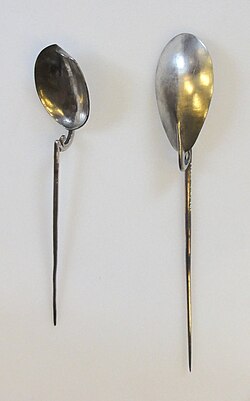
A cochlearium (plural cochlearia) was a small Roman spoon with a long tapering handle.
History
Cochlearia have been found in a number of Roman sites from the 4th and 5th centuries CE, including the Thetford1 and Hoxne Hoards.
The word cochlea literally means spiral or snail shell, leading many to conclude that the spoon was designed so that the handle could be used to extract snails or cockles out of the shell.2
The Roman terms cochlearium, cochlear, and cochleare denote a liquid measure of a spoonful.3 A cochlearium was also a place where snails could be bred for eating.2
In modern times, the cochlearium is used by boat bearers in the Latin Rite of the Catholic Church to transfer incense from the "boat" (navicula in Latin) to the thurible.
References
References
- British Museum retrieved 27 June 2010
- Rich, Anthony (1860), A dictionary of Roman and Greek antiquities: with nearly 2000 engravings on wood from ancient originals illustrative of the industrial arts and social life of the Greeks and Romans (2 ed.), Longmans, Green & Co., pp. 182–3
- Hussey, Robert (1836), An Essay on the ancient Weights and Money and the Roman and Greek liquid Measures: with an appendix on the Roman and Greek foot, Parker, p. 207