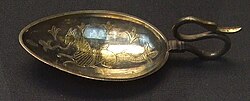
Cignus (Latin: cygnus, meaning 'swan'; pl. cigni) is a name used by archaeologists for a type of large Roman metal spoon1 with a short, curved, handle often formed as the neck and head of a swan. Cigni have been found in a number of Roman sites from the 4th and 5th centuries CE, including the Thetford and Hoxne Hoards in England.2 It is not known for certain what the Romans called these utensils, but there are references to cigni in Roman sources in appropriate contexts.
References
References
- Swift, Ellen (January 2014). "Design, function and use-wear in spoons: reconstructing everyday Roman social practice". Journal of Roman Archaeology. 27: 203–237. doi:10.1017/S1047759414001214. ISSN 1047-7594.
- British Museum retrieved 27 June 2010 (dead link 16 November 2022)
Further reading
Further reading
- Johns, Catherine (2010), The Hoxne Late Roman Treasure: Gold Jewellery and Silver Plate, British Museum Press, ISBN 978-0-7141-1817-8., pp. 98–106
- Harald Mielsch, 'Miszellen zur spätantiken Toreutik', in Archäologisches Anzeiger 1992, pp. 111–152.