
Candomblé (Portuguese pronunciation: [kɐ̃dõˈblɛ]) is an African diasporic religion that developed in Brazil during the 19th century. It arose through a process of syncretism between several of the traditional religions of West and Central Africa, especially those of the Yoruba, Bantu, and Gbe, coupled with influences from Roman Catholicism. There is no central authority in control of Candomblé, which is organized around autonomous terreiros (houses).
Candomblé venerates spirits, known varyingly as orixás, inkice, or vodun, which are deemed subservient to a transcendent creator god, Oludumaré. Deriving their names and attributes from traditional West African deities, the orixás are linked with Roman Catholic saints. Each individual is believed to have a tutelary orixá who has been connected to them since before birth and who informs their personality. An initiatory tradition, Candomblé's members usually meet in terreiros run by a mãe de santo (priestess) or pai de santo (priest). A central ritual involves practitioners drumming, singing, and dancing to encourage an orixá to possess one of their members, with whom congregants can then interact. The orixás are given offerings such as fruit and sacrificed animals, while their will is deciphered through divination. Offerings may also be given to lesser spirits, including caboclos and the spirits of the dead, the egun. Healing rituals and the preparation of amulets and herbal remedies also play a prominent role.
Candomblé developed among Afro-Brazilian communities amid the Atlantic slave trade of the 16th to 19th centuries. It arose through the blending of the traditional religions brought to Brazil by enslaved West and Central Africans, the majority of them Yoruba, Fon, and Bantu, with the Roman Catholicism of the Portuguese colonialists who then controlled the area. It primarily coalesced in the Bahia region during the 19th century. Following Brazil's independence from Portugal, the constitution of 1891 enshrined freedom of religion in the country, although Candomblé remained marginalized by the Roman Catholic establishment, which typically associated it with criminality. In the 20th century, growing emigration from Bahia spread Candomblé both throughout Brazil and abroad, while also influencing the development of another religion, Umbanda, in the 1920s. Since the late 20th century, some practitioners have emphasized a re-Africanization process to remove Roman Catholic influences and create forms of Candomblé closer to traditional West African religion.
The religion is divided into denominations, known as nations, based on which traditional African belief system has been its primary influence. The most prominent nations are the Ketu, Jeje, and Angola. Candomblé is centred in Brazil although smaller communities exist elsewhere, especially in other parts of South America. Both in Brazil and abroad Candomblé has spread beyond its Afro-Brazilian origins and is practiced by individuals of various ethnicities.
Definition and terminology

Candomblé is a "neo-African"1 or African American religion,2 and more specifically an Afro-Brazilian religion.3 It arose in 19th-century Brazil, where the imported traditional African religions of enslaved West Africans had to adapt to a slave colony in which Roman Catholicism was the official religion.4 It is thus one of several religions that emerged in the Americas through the interaction of West African and Roman Catholic traditions, and for this reason is considered a "sister religion" of Cuban Santería and Haitian Vodou.5
Candomblé's followers are called povo de santo (people of saint),6 or Candomblecistas.7 The term Candomblé itself probably derives from a Bantu word for dances, kandombele, which also developed into the term for a dance style in Argentina and Uruguay, Candombe.8 Another word sometimes applied to Candomblé is macumba;9 this generic term can be applied to Afro-Brazilian religions as a whole but is especially associated with sorcery or black magic,10 and thus some Candomblécistas distance themselves from it.11
Candomblé is not institutionalised,12 with no central authority to determine doctrine and orthodoxy,13 and no central sacred text.14 It is heterogenous,15 displaying regional variation in its beliefs and practices.16 Each lineage or community of practitioners is autonomous,17 approaching the religion in ways informed by their tradition and the choices of their leader.18
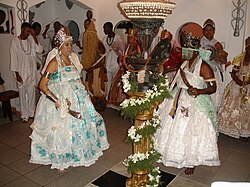
Most Candomblecistas also practice Roman Catholicism19—some priests and priestesses of Candomblé refuse to initiate anyone who is not a baptised Roman Catholic20—while other practitioners have also pursued Evangelical Protestantism,21 New Age practices,22 or Buddhism.22 Sometimes these non-Candomblist elements have been directly integrated into Candomblé itself; there are reports of a Brazilian practitioner including a statue of the Mahayana Buddhist deity Hotei on their altar,23 and of a Belgian Candomblé group that incorporated characters from Welsh and Slavic mythologies in their practice.24 Candomblé has sometimes also been influenced by Spiritism, a French variant of Spiritualism, although many Spiritists distinguish their religion from Afro-Brazilian traditions.25
Afro-Brazilian religions often mix with each other rather than existing in pure forms,26 with many scholars viewing them on a continuum rather than as wholly discrete entities.27 Candomblé shares the names of its deities, the orixás, with Umbanda,28 a religion formed in Rio de Janeiro in the 1920s.29 Umbandista groups exist on a spectrum from those emphasising connections to Spiritism to those stressing links with Afro-Brazilian religions like Candomblé;30 the anthropologist Diana Brown noted that the boundary separating Umbanda from Candomblé was largely "a matter of individual opinion".31 Omolocô was founded in Rio de Janeiro as an intermediate religion between Candomblé and Umbanda,32 with traditions merging these two systems sometimes labelled "Umbandomblé" by outsiders.33 There are also other Afro-Brazilian religions rooted largely in specific regions, including Babassuê in Pará, Batuque in Rio Grande do Sul, and Tambor de Mina in Maranhão and Pará.34
Nações
Candomblé divides into traditions known as nações (nations).35 The three most prominent are Nagô or Ketu (Queto), Jeje (Gege) or Mina-Jeje, and Angola or Congo-Angola;36 others include the Ijexá (Ijesha),37 Egba, Efan (Ekiti)38 and Caboclo.37 Each derives influence from a different African language group; Ketu uses Yoruba, Jeje adopts Ewe, and the Angola draws from the Bantu language group.25 Informed by these ethno-linguistic origins, each Candomblé nation has its own lexicon, chants, deities, sacred objects, and traditional knowledge.37 Although originating among ethnic differences, this has largely eroded over time, with members drawn to a nation for reasons other than ethnic heritage.37
An initiate can transfer from one nation to another, a process referred to as trocar as águas ("to change the waters").39 Attitudes between nations can be negative; those groups which emphasise claims to "African purity" have often denigrated other nations they deem more syncretic,40 with the Angola nation sometimes regarded as the most syncretic.41 The Nagô nation is the largest,42 reflecting how Yoruba traditional religion became the dominant West African influence within Afro-Brazilian religions in the 19th century,43 and even among nations other than the Nagô, Yoruba-derived terminology predominates widely.44
Beliefs
Olorun and the orixás
Candomblé teaches the existence of a supreme divinity called Olorun or Olodumare.45 This entity is regarded as the creator of everything but is thought distant and unapproachable, and thus not specifically worshipped in Candomblé.37
The orixás
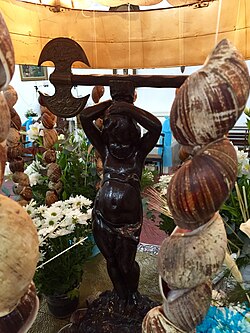
Candomblé revolves around spirits termed orixás (orishas)47 or santos ("saints").48 In the Angola tradition they are sometimes termed inkice,49 and in the Jeje tradition vodun.50 The males are termed aborôs,51 the females iabás.52 Believed to mediate between humanity and Olorun,53 the orixás have been varyingly conceived as ancestral figures,54 or embodiments of forces of nature.55 Their names may differ according to nation; in Nagô they commonly possess Yoruba names, but in the Jeje nation they are instead given Fon names.56
The orixás are deemed morally ambiguous, each with their own virtues and flaws,57 and are sometimes in conflict with each other.58 Each orixá is associated with specific colours, foods, animals, and minerals,59 favoring certain offerings.60 Each orixá is associated with a particular day of the week;61 the priesthood also states that each year is governed by a specific orixá who will influence the events taking place within it.62 Their personalities are informed by a key conceptual opposition in Candomblé, that of the cool versus the hot.63
Oxalá is the chief orixá,64 depicted as a frail old man who walks with a pachorô sceptre as a walking stick.65 Practitioners commonly believe that Olorun tasked him with creating humanity.66 In some accounts, all of the junior orixás are the children of Oxalá and one of his two wives, Nanã and Iemanjá.67 This trio are associated with water; Oxalá with fresh water, Nanã with the rain, and Iemanjá with the ocean.68 Other accounts present this cosmogony differently, for instance by claiming that Oxalá fathered all other orixás alone, having created the world from a mingau pudding.69 An alternative claim among practitioners is that Nanã is the grandmother of Oxalá and the mother of Iemanjá, the latter becoming both mother and wife to Oxalá.69

Xangô is the orixá associated with thunder and lightning;70 one of his wives is Obá, a warrior who has only one ear.71 Ogum is the orixá of battle and of iron, often depicted with a machete;72 his companion is Oxóssi, the male orixá of the hunt and forest.73 Obaluaiê or Omolu is the orixá associated with infectious disease and its cure,74 while Osanyin is associated with leaves, herbs, and herbal knowledge.71 Oya is the orixá of wind and storms.75 Oxumaré is regarded as both male and female and is portrayed as a serpent or a rainbow.76 Oxum is the orixá of love, beauty, wealth and luxury, and is associated with fresh water, fish, mermaids, and butterflies.77 She is married to Ifa, regarded as the orixá of divination.66
Tempo is the orixá of time;78 originating in the Angola nation, he is associated with trees.41 Due to the link with trees, he is sometimes equated with the Nagô orixá Loko.41 The orixá Exú is regarded as a capricious trickster;79 as the guardian of entrances,80 he facilitates contact between humanity and the other orixá,81 thus usually being honoured and fed first in any ritual.82 His ritual paraphernalia is often kept separate from that of other orixás,83 while the entrances to most terreiros will have a clay head, decorated with cowries or nails, that represents Exú and is given offerings.84
The orixás are regarded as having different aspects, known as marcas ("types" or "qualities"),85 each of which may have an individual name.86 Child forms of the orixás are termed erês.87 They are deemed the most uncontrollable spirits of all, associated with obscenities and pranks.88 The child forms of orixás have specific names; the erê of Oxalá is for instance called Ebozingo ("Little Ebô") and Pombinho ("Little Dove").65 The material image of an orixá is called an igbá.89
Saints
Each orixá equates with a Roman Catholic saint.90 For instance, Omolu, an orixa of sickness, is often equated with Saint Lazarus the leper.91 Oxalá has been conflated with Our Lord of Bonfim,69 Oxum with Our Lady of the Immaculate Conception,92 and Ogum with St Anthony of Padua.93 Due to his association with time, Tempo is sometimes equated with the Christian idea of the Holy Spirit.94 In Candomblé altars, the orixás are often represented with images and statues of Roman Catholic saints.95
This process may have begun as a subterfuge to retain the worship of African deities under European rule,96 although such syncretisms could have already been occurring in Africa prior to the Atlantic slave trade.97 From the later 20th century, some practitioners have attempted to distance the orixás from the saints as a means of re-emphasising the religion's West African origins.98 The anthropologist Robert A. Voeks observed that it was the priesthood and more formally educated practitioners who preferred to distinguish the orixás from the saints, whereas less formally educated adherents tended not to.99
Relationships with the orixás

In Candomblé, relationships are thought rooted in reciprocal obligations,100 and Candomblecistas see the relationship between the orixás and humanity as being one of interdependence.101 Practitioners seek to build harmonious relationships with the orixás,102 thus securing their protection.103
Candomblé teaches that everyone links to a particular orixá,104 one that influences that individual's personality.105 This is their dono da cabeça:8 the owner or master of the person's head.106 The gender of this tutelary orixá is not necessarily the same as their human's.107
The identity of a person's orixá can be ascertained through divination,108 and failing to know one's orixá is sometimes interpreted as the cause of mental illness.109 Depending on the orixá in question, an initiate may choose to avoid or to engage in certain activities, such as avoiding specific foods or wearing specific colours.59 Some practitioners also believe in further orixá linked to an individual; a second is known as the juntó,110 while a third is called the adjuntó, the tojuntó, or the dijuntó.111 Some believe that a person can also have a fourth orixá, inherited from a deceased relative.112
Exus and caboclos

Another spirit group in the Candomblé worldview are the exus,83 sometimes termed exuas when female,113 or exu-mirims when children.114 Deemed closer to humanity than the orixás and thus more accessible,115 the exus are often regarded as the "slaves" of the orixás.116 In common parlance they are often described as "devils",117 although in Candomblé are not regarded as a force for absolute evil but rather thought capable of both good and bad acts.115 Practitioners believe that the exus can "open" or "close" the "roads" of fate in one's life,118 bringing about both help and harm.119 Candomblé teaches that the exus can be induced to do a practitioner's bidding,118 although need to be carefully controlled.119 The exus are recorded as having been part of Candomblé since at least the 1930s and probably arose earlier.120
Also present in Candomblé are the caboclos,121 their name probably stemming from the Tupi language term kari'boka ("deriving from the white").122 These spirits are typically those of indigenous Americans or of boiadeiros ("cowboys" or "backwoodsmen"),123 although in rarer cases caboclos are portrayed as being from the sea or from foreign countries.122 Almost exclusively male,124 the caboclos are believed to dwell in a forest land called Aruanda,125 and are characterised as smoking cigars and favoring beer.126
The caboclos are particularly important in the Candomblé de Caboclo nation.127 This tradition has long been denigrated as inferior by other Candomblecistas, especially from the Nagô tradition.40 Many practitioners reject interaction with caboclos;128 this is the case for those who have tried to "re-Africanize" Candomblé since the late 20th century and who tend reject the caboclos as being of non-African derivation.129 As a result, some Candomblecistas have venerated orixás in the terreiro but only engaged with lesser spirits like the caboclos in the home.130 Where an individual has come to Candomblé via another Brazilian tradition like Umbanda, they are sometimes deemed to have brought caboclos or exus with them. In these instances, attempts are sometimes made to "Africanize" these spirits, ritually "seating" them in a material object, giving them an African-derived name, and then considering them a pledged slave of the orixás.131
Birth and the dead
Candomblé adopts its cosmology largely from Yoruba traditional religion.132 The material world of humanity is called aiê (or aiye);133 the realm of the spirits is termed orun,134 and is divided into nine levels.135 Death is personified in the figure of Iku.136 A person's inner head, in which their tutelary orixá is believed to reside, is called the ori.71
Spirits of the dead are called eguns.137 The recently deceased are termed aparacá;51 after they have been "educated" by receiving sacrifices they become babá.138 After death, the egun can enter orun, although the level they reach depends on the spiritual growth they attained in life.135 Sometimes, eguns will seek to help the living but inadvertently harm them;139 given this potential, Candomblé stresses precautions in dealing with these entities.140 Contact with the egun is accompanied by rituals to neutralise their harmful power or pollution.141 The contra-egun is an armband made of plaited raffia which is sometimes worn to ward off dead spirits.142 Although thought possible, possession by eguns is considered rare,143 and is generally discouraged by Candomblé groups, who deem it spiritually polluting, a viewpoint that distinguishes Candomblé from Umbanda.144
Axé
Candomblé teaches the existence of a force called ashe or axé,145 a central concept in Yoruba-derived traditions.146 The scholar Sheila Walker described axé as "the spiritual force of the universe",147 and the anthropologist Joana Bahia called it "sacred force."148 Jim Wafer termed it "vital force",149 while Voeks favored "vital energy".63 Scholar of religion Paul Johnson characterised it as "a creative spiritual force with real material effects."150
Practitioners believe axé can move,149 but can also concentrate in specific objects, such as leaves, roots, and specific body parts.151 Blood in particular is deemed to contain axé in its most concentrated form.152 Humans can accumulate axé, but also either lose or transfer it,153 with this force expressed through songs, prayers, and speech.154 Specific rituals and obligations are believed to maintain and enhance a person's axé,155 while other ritual acts are designed to attract or share this force.156 Dendê, a sacred palm oil used to cook ritual meals, is considered to be a materialized form of axé.157
Morality, ethics, and gender roles

Candomblé generally has no fixed ethical precepts,100 although its teachings influence the lives of Candomblecistas.158 Rather than stressing a dichotomy between good and evil, emphasis is placed on achieving equilibrium between competing forces.100 Problems that arise in a person's life are often interpreted as resulting from a disharmony in an individual's relationship with their tutelary orixá;109 harmony is ensured by following the orixá's euó (taboos) regarding issues like food, drink, and colors.159
Male/female polarity is a recurring theme throughout Candomblé.160 Many roles within the religion are gendered. For instance, animal sacrifice and the shaving of an initiate's head are usually reserved for male practitioners, while women are typically responsible for domestic duties in maintaining the ritual space.161 Such divisions mirror broader gender norms in Brazilian society.161 Restrictions are also placed on women while menstruating.162 However, women can still wield significant power as the heads of the terreiros;163 most terreiros in Bahia are led by women.164 Accordingly, it has been called a female-dominated religion,165 with scholarly debates taking place over whether it can be labelled matriarchal.166
There is evidence that Candomblé is more accepting of sexual and gender non-conformity than mainstream Brazilian society.167 Many gay men are followers168—in Rio de Janeiro many terreiros are integrated into the city's gay social network169—and a pervasive stereotype associates Candomblé with gay men.170 Homosexuals have described the religion as a more welcoming environment than Christianity,171 and have cited stories of relationships between male orixás, such as Oxôssi and Ossain, as affirming same-sex attraction.168 Some practitioners have involved themselves in political causes including environmentalism, indigenous rights, and the Black Power movement.172
Practices
Candomblé is a practice-oriented religion; ritual correctness is considered more important than belief.173 Rituals often focus on pragmatic issues regarding prosperity, health, love, and fecundity.174 Those engaging in Candomblé include various initiates of varying degrees and non-initiates who may attend events and approach initiates seeking help with various problems.175
Candomblé is an initiatory religion,176 one which is organized around a structured hierarchy based on initiatory status.177 Knowledge about Candomblé's beliefs and practices is referred to as the fundamentos ("foundations"),178 and is guarded by practitioners.179 It makes use of secrecy,180 and so Johnson has characterised it as a secret society.181 African-derived terms are used in ritual contexts;182 in general, words of Yoruba origin predominate in the Nagô nation, those from Ewe-Fon languages in Jeje nations, and words from the Bantu languages in the Angola nation.183
Houses of worship

Candomblé places of worship are called terreiros ("houses"),184 or ilês.185 Each terreiro is independent and operates autonomously.186 They range in size from small houses to large compounds,175 and also vary in terms of their wealth and fame.187 A terreiro's importance is generally regarded as being proportional to the number of initiates and clients that it has;188 the greater the number of initiates, the greater its own axé.147 Enmity often exists between terreiros,65 especially as they compete for members,189 with defection of individuals from one to another being common.190
A terreiro may be concealed, so as not to attract unwanted attention.179 The interior consists of a series of rooms, some off-limits to non-initiates.80 They contain an altar to the deities, a space to perform ceremonies, and accommodation for the priests or priestesses.175 The bakisse is the "room of the saints", a storeroom containing both ritual paraphernalia and the assentamentos, or seated objects, of the orixás,191 with most terreiros offering veneration to between twelve and twenty of these spirits.192 Another room, the roncó ("retreat room") or camarinha, is used during initiations,193 while the barracão ("big shed") is where public rituals, including divination, take place.194 Terreiros lacking a barracão may use a yard for public rites.195 The peji, or shrines to deities, will often be located around the perimeter of the barracão.196

The floor of the terreiro is deemed sacred, consecrated to the tutelary orixá of the house.197 The terreiro will often have a cumeeira, a central pole in the structure believed to link humanity's world with that of the orixás.198 This stands above the entoto ("foundation") of the terreiro,199 a space periodically "fed" with offerings.200 An outdoor enclosure may have a tree dedicated to Tempo,201 shrines to forest orixás like Oxossi and Ogun,202 and a balé, a place set aside for the souls of the dead.203 Plants used in rituals may also be grown in this outdoor area.202
Public ceremonies take place at the terreiros where both initiates and non-initiates can attend to celebrate the orixás.204 Participants are expected to wear white; women wear skirts.205 Ceremonies often begin long after the advertised starting time.206 At these, food is offered to specific orixás while the rest is shared among participants, with the latter thereby gaining some of the axé of the orixás.204 These public rites are both preceded and succeeded by a range of private ritual acts.204 Most of the rituals that take place at the terreiros are private and open only to initiates.204 Walker believed that it was these that represented "the real core of the religious life of the Candomblé community."204
Priesthood and congregation

The community of a terreiro is called an egbé.8 This is regarded as a "family",207 its initiates being "brothers" and "sisters" in the orixás (irmãos de Santo or irmãs de santo).208 Sexual or romantic relations between terreiro members is usually forbidden,67 although it does happen.209 Being initiated into a terreito connects an individual to the lineage of that house;210 this lineage is linked to the axé of the terreiro.163 The founders of a terreiro are called essas and their names are evoked in the padê.211
A priestess running a terreiro is a mâe de santo (mother of saints);212 a priest who does so is a pai de santo (father of saints).213 Specific terms also indicate which nation a person belongs to;214 in Nagô Candomblé, a male priest is called a babalorixá,215 a female priestess an iyalorixá.216 Serving as intermediaries between the orixás and humanity,175 this priesthood is responsible for all important functions, including educating novices, adjudicating disputes, and providing healing and divination services,217 these latter services often being their primary income.218 Not constrained by external religious authorities,219 these "parents of saints" often exert considerable control over their initiates.220 The latter are expected to submit to their authority,221 and to prostrate before them in an act called an iká;136 however, conflicts between these "parents" and their initiates are common.222 A terreiro will often disband when its chief priest or priestess dies.223

Assisting the mâe or pai de Santo is the iyakekerê ("little mother")224 or mãe pequena,225 and the "little father".226 Other roles in the terreiro include the iyabase, who prepares food for the orixás,136 and the alabê (musical director).219 Initiates, called the filhos (sons) and filhas de santo (daughters of the saints), assist as cooks, cleaners, and gardeners.217 Women initiates who do not enter trance but assist those who do are called ekedi; their male counterparts are termed ogan.227 The ogã are male members, often not initiated, whose role is largely honorific, consisting largely of contributing financially.217
An individual who has taken steps toward initiation but not yet undergone this process is termed an abiã or abian.228 An initiate of less than seven years is an iaô or iyawó;229 after seven years they may undergo the deká ceremony and thus be regarded as an ebomi, allowing them to open their own terreiro.230 Those who have performed seven years of initiatory rituals are called ebomi231 or ebame.113 At the end of the seven years, they "receive the decá" from their initiator, being given a tray of ritual objects; this enables them to go and form their own temple.232 If another such terreiro splinters off, it is believed that the axé of the mother-terreiro transfers to the new one.163
Shrines and otás

An altar to the orixás is called a peji.75 It contains an assemblage of objects termed the assentamento ("seat") or assento of the orixá;233 this is regarded as the house of the orixá.234 This usually consists of various items placed within an enamel, earthenware, or wooden vessel,235 itself often wrapped in a cloth.234 The assentamento can be stored in the initiate's home,200 or inside the terreiro's bakisse room,236 which is only opened by the priestess or priest in charge.234 There, the assentamentos of the initiates may be arranged on a multi-level altar decorated with ribbons, colored lights, and flowers.237
The key part of the assentamento is a sacred stone known as an otá.238 This otá possesses axé,239 and thus requires feeding.240 Each orixá is associated with a different kind of stone; those from the ocean or rivers are for instance linked to Oxum and Iemanjá, while those believed to have fallen from the sky are linked to Xangô.222 Practitioners are expected to find these stones, rather than buying them, after which they will be ritually consecrated, being washed, given offerings, and "seated" in their vessel.241 Alongside the otás, these spirit-vessels may contain ferramentos, or metal objects associated with specific orixás,242 cowrie shells,243 bracelets called idés,244 animal body parts,244 hair from the initiate who keeps it,200 statues of associated Roman Catholic saints,237 and a mix of water, honey, and herbal preparations.245
Objects used in ritual are often sanctified with a herbal infusion called amaci.51 Ritual objects are regarded as loci and accumulators of axé, although the supply of this force needs replenishing at various intervals.147 For this reason, they are given blood, to feed them with new axé.149 In Brazil, various stores specialise in paraphernalia required in Candomblé.246
Offerings and animal sacrifice

Offerings to spirits are known as ebós,247 and can consist of food, drink, fowl, and money;248 when animal sacrifice is not involved, a food offering is termed a comida seca.8 These offerings are believed to generate axé which then gives an orixá the power to aid their worshippers.152 When a ceremony starts, practitioners typically provide a padé, or propitiatory offering, to the orixá Exu.249
As well as being offered in the terreiro, food is often placed at an appropriate landscape location; offerings to Oxum are for instance often deposited by a freshwater stream.54 Specific foodstuffs are associated with each orixá;250 a mix of okra with rice or manioc meal, known as amalá, is considered a favourite of Xangô, Obá, and Iansã.251 When placed in the terreiro, food is typically left in place for between one and three days, sufficient time for the orixá to consume the food's essence.54 The ritual payment of money, often accompanying the sacrifices, is termed dinheiro do chão ("money for the floor"). As part of this, money is placed onto the floor and often splattered with blood, before being divided among the participants of the rite.64
Candomblé entails animal sacrifice,252 which is called matanças.217 The individual performing the sacrifice is known as an axogun253 (or axogum237) or sometimes as a faca (knife).217 Species typically used are chickens, guinea fowl, white doves, and goats.254 The animal will often have its neck cut with a knife,255 or in the case of birds, its head severed.256 After the animal is killed, its blood is spilled onto the altar; its organs are often removed and placed around the "seat" of the orixá.252 Following the sacrifice, is it common for divination to be performed to determine if the sacrifice has been accepted.255 Other body parts will then be consumed by the rite's participants; the exception is if the sacrifice was for eguns, which is instead left to rot or placed in a river.252 Some of the food may then be taken away, to be left in the forest, thrown into a body of water, or placed at a crossroads;257 this is referred to as "suspending a sacrifice".258 Outside Brazil, practitioners have faced challenges in performing animal sacrifice; in Germany, for instance, it is banned by law.259
Initiation

Initiation is known as fazer cabeça ("to make the head")8 or fazer o santo ("making the saint").260 This is usually very expensive.261 Initiates are known as filhos de santo ("children of the saints").262 At their initiation, they are given a new name, the nome de santo (saint's name), which usually indicates the identity of their tutelary orixá.263 Many feel that an orixá has demanded their initiation, with it being their obrigação ("duty").260 If a group of individuals are being initiated together, they are termed a barco ("boat").264
The length of the initiatory process varies between Candomblé houses but usually lasts from a few weeks to a few months.265 The initiate is first brought to the terreiro, where they are left for a period of relaxation, the descanso, so that they might become "cool".266 They are dressed in white clothing,267 and they will be given a string of beads associated with their tutelary orixá.59 The necklace is colored according to the latter; white for Oxalá, dark blue for Ogum, or red and white for Xangô, for instance.268 Washed and sprinkled with the blood of a sacrificed animal,269 these beads are sometimes believed to protect the wearer from harm.270
New initiates are secluded in a room in the terreiro called the roncô,271 where they sleep on a straw mat,272 eat only bland food,273 and are often forbidden to speak.273 During this period they are taught about their tutelary orixá, such as its likes and dislikes and its associated drum rhythms and dances.265 The time spent in isolation varies, although three weeks is typical.274 They will be bathed in water mixed with herbs,275 before being taken to the altar room, where drumming and singing takes place.274 Animals are sacrificed, including a four-legged animal, and blood may be touched on the initiate's body.276

The initiate's head is then shaved and two cuts made into the apex of it with a razor, allowing the orixá entry into it; blood and herbs may be mixed into the wounds.278 A cone of wax, the adoxu, may be placed on the cut to stem the bleeding;279 the head will then be wrapped in cloth.280 Depending on the terreiro, cuts may also be made on the initiate's tongue, back, upper arms, thighs, buttocks, and the soles of their feet.281 With the incisions made, the orixá is "seated" within the individual's head during the assentar o santo ritual.282
The new initiate may be presented to the rest of the community through the saida ceremony.283 Along with their white clothes, their body will often be covered in white spots.284 During this, they may be expected to give the name of the marca of their tutelary orixá, which they are supposed to have discovered via a dream.68 In the panán, the initiate is symbolically re-taught mundane tasks,256 a ritual sometimes followed by an auction in which the initiate is symbolically sold to their spouse or a member of their family, a reference to the era of slavery.256 On the following Friday, they attend mass in a Roman Catholic church,285 and finally, a senior terreiro member will lead them back to their home.256 Becoming an initiate implies a relationship of mutual responsibility between the individual and the orixás,175 with the tutelary orixá now forever inhabiting that individual's body.286Over the course of the following year, the initiate may conduct further "obligations" to build their relationship with the orixá.287
Candomblé includes additional, graded initiations, expected to take place one year, three years, and seven years after the original initiatory ceremony.288 Over the course of this they are expected to learn to receive all of their tutelary orixá.289 In practice, many adherents cannot afford these ceremonies at the specified time and they instead take place years after.288
Possession

Music and dance are fundamental elements of Candomblé.290 The drumming will often take place all night.291 In the Nagô tradition, three main types of drum are employed, the largest being the rum, the middle-sized being the rumpi, and the smallest being the lé.292 These drums are understood as living and need to be "fed".293 The head drummer is the alabê.294 Many terreiros maintain that women should not be involved in this ritual drumming, although others reject this tradition.295 In some rituals, practitioners will drink a concoction containing jurema, a mildly hallucinogenic plant, sometimes mixed with the blood of sacrificed animals.296
Although it is usually a dancer who becomes possessed, sometimes spectators will too.297 A possessed person is called a cavalo (horse);298 being possessed by the orixá is deemed a privilege.265 The state of vertigo signalling the onset of trance is known as barravento.138 As the trance begins, practitioners often experience a body spasm termed the arrepio ("shiver").51 Practitioners believe that when an individual is possessed by a spirit, they have no control over the latter's actions.299 A common way of referring to the possession is receber ("to receive").300 As it entails being "mounted", being possessed is regarded as being a symbolically female role,301 and some Candomblecistas believe that becoming a cavalo can turn a man homosexual.302
Practitioners may fully prostrate themselves before the possessed;303 this is termed a dobalé.8 After an individual becomes possessed, they may be led into an anteroom to be dressed in clothes associated with the possessing orixá; this usually includes brightly colored dresses, regardless of the gender of those involved.304 Those possessed by Ogun are for instance often given a metal helmet and axe, while those possessed by Oxum wear a crowd and carry a sword and the abebé fan.305
The style of speech adopted by the possessed will be influenced by the type of spirit believed to be possessing them.306 Those possessed by an orixá may rarely if ever speak,307 refusing to eat, drink, or smoke to emphasise their aristocratic disposition.308 When they dance, it will often be stylized and controlled.88 When they do speak, the person possessed by an orixá may deliver predictions and prophecies.309 Those deemed to be possessed by caboclos will often smoke cigars,310 while those possessed by the erês child spirits may roll around the floor and squabble.311 Once the possessing spirit departs, it is expected that the possessed person will have no memory of it.312
Public festivals

Although details of the liturgical calendar vary among terreiros, Candomblé features a yearly cycle of festivals or feasts to the orixás.313 These are sometimes private and sometimes open to the public.314 These are typically held on the Roman Catholic saint's day associated with the saint linked to a particular orixá.129 The main festival season begins in September, with the feast of Oxala, and continues through to February, when the feast of Iemanjá takes place.313 In the Nagô nation, the Waters of Oxala ritual is performed at the start of the liturgical year; it involves bringing fresh water, sometimes from a well, to the terreiro to purify and replenish the assamentos.313
In some cases, Candomblé festivals have become widely popular with the public, especially those of Oxala and Iemanjá.315 Hundreds of thousands of people congregate at the beach on Iemanjá's Day (2 February),254 where they often load offerings to her onto boats, which then take them out into the water and cast them overboard.316
Among terreiros that hold festivals for the caboclos, this usually happens on 2 July, the day which marks Bahia's independence from Portugal.317 Public festivals for exus are rarer.306 The tone of the event differs depending on which spirit category is being honoured; those for the orixás have more of a fixed structure and a greater formality, while those for the caboclos are more spontaneous and have greater interaction between the spirits and the human participants.318
Divination

Initiates engage in divination, often as a key source of income.319:The most common form of divination employed is the dilogun or jogo dos buzios ("shell game"), which is performed by both men and women.320 This entails throwing cowrie shells and drawing interpretation from their landing.321 16 shells are commonly thrown, with a further four to confirm the answer provided by the first throwing.322 Each configuration of shells is associated with certain odu, or mythological stories,323 then interpreted as having pertinence for the client's situation.324
Another common divinatory practice involves slicing an onion in two and dropping the pieces to the ground, drawing conclusions from the face onto which they fall;325 alternatively a kola nut may be cut into quarters and read in the same way.326 Ifá is another Yoruba divinatory system; however, by the start of the 21st century this was characterised as either extinct,327 or very rare in Brazil.328
Healing and amulet practices
Healing forms an important part of Candomblé.329 Priests and priestesses may offer healing for conditions ranging from obesity and hair loss to pneumonia and cancer;330 in this capacity they are often called curandeiros.331 In the Candomblé worldview, a person's problems may be caused by their disequilibrium with the spirit world,332 because they are lacking in axé and thus have an "open" body vulnerable to harmful influences,333 or because they are being punished by orixás.334 Alternatively, a person may be suffering because the spirit of a deceased person has attached itself to them,335 or because another human has wished them ill,333 either inadvertently, through the mau-olhado (evil eye),336 or through witchcraft and cursing.332

People with a problem often approach a priest or priestess, who will then use divination to ascertain the cause and the remedy.337 A common first step in the healing process is the limpeza, or spiritual cleansing.324 This often entails an offering to a particular orixá or lesser spirit; a sacudimento (leaf whipping), whereby leaves are wiped over the patient's body; or an abô (leaf bath), during which they are washed in water infused with various herbs and other ingredients.338 If the individual's general health needs boosting, they may undergo the bori ceremony, in which food is placed on the patient's head to feed their tutelary orixá.287
If an egum is thought to be troubling the person, they will often undergo the "cleansing of the body" rite.339 In the troca da cobeça rite, the sickness is transferred to another, especially a bird that may be wiped over the patient before being killed.340 Healing may also necessitate the patient's initiation into the religion.337 Staying healthy is then ensured by maintaining a state of equilibrium with the orixás, avoiding excess, and following lessons imparted in mythological tales.332 In addition to offering these treatments, a Candomblé healer may also recommend that the patient seek help from a medical professional.341
Candomblé healers are often well versed in herbalism,331 in which case they may be called a mâo de ofá.217 Herbs are deemed to contain axé which needs to be appropriately awakened:342 leaves should be fresh, not dried,342 and picked late at night or early in the morning to ensure maximum potency.342 If taken from the forest, permission should be sought from the overseeing orixá and offerings left, such as coins, honey, or tobacco;342 alternatively, healers often purchase them from the casas de folhas ("houses of leaves") in markets.343 Leaves may then be rubbed directly on the patient or brewed into a tea or other medicinal concoction;344 practitioners may also produce pó (powder), which may have a variety of uses, from healing to harming or attracting someone's romantic attention.345
Candomblecistas often wear amulets.346 Common examples include horns or the figa, a fist with the thumb in inserted between the index and middle finger.347 A patuá consists of a small cloth pouch containing various objects, plant parts, and texts.347 Sprigs of the arruda or laranja-da-terra plants may also be carried to protect against the evil eye.348 Specific plants, associated with a particular orixá, are often kept by doorways to prevent the entry of negative forces.348
Funerals and the dead
Following a senior initiate's death, their terreiro will conduct the axexé rituals; these transform the deceased into an ancestral spirit of the terreiro's own pantheon and ensures the dead person does not become a dangerous wandering spirit.349 Offerings, including sacrificed animals, are given to the deceased and to accompanying orixás during the axexé.350 A Roman Catholic mass will also be performed.351
History
Origins
Slavery was widespread in West Africa; most slaves were prisoners of war captured in conflicts with neighbouring groups, others were criminals or those in debt.352 Enslaved Africans first arrived in Brazil in the 1530s.353 These 16th-century arrivals came largely from the Guinea coast, but by the 17th century Angola and Congo populations had become dominant.354 Then, between 1775 and 1850, the majority of slaves were Yoruba and Dahomean, coming from the Gulf of Benin, largely in what is now Benin and Nigeria.355 After declaring itself independent from Portugal in 1822,356 Brazil abolished the slave trade in 1850,356 and then emancipated all slaves in 1888.357 In total, around four million Africans were transported to Brazil,358 more than to any other part of the Americas.359 In Brazil, they were concentrated predominantly in Bahia.42
On arriving in Brazil, slaves were divided into "nations" based largely on their port of embarkation.360 This meant that Africans of different cultural backgrounds, regions, and religions were included together under a unifying term;361 those from the Bight of Benin were for instance called "Nagô".360 As the Yoruba and Dahomean people made up the last wave of slaves, they became numerically dominant among Afro-Brazilians and their traditional cosmology became ascendant over that of longer established communities.362 The process of enslavement broke up the traditional links between African deities and specific regions, while also mixing deities from different peoples into a singular pantheon.363 Of the thousands of orishas venerated in West Africa, far fewer continued to be worshipped in Brazil;37 orisha associated with agriculture were abandoned, for instance, as slaves had little reason to protect the harvests of slave-owners.364 By the 18th century, accounts of African-derived rituals performed in Brazil were common,365 at which point they were referred to generically as calundu, a term of Bantu origin.366
In colonial Brazil, enslaved Africans were expected to give up their traditional religions for Roman Catholicism.367 The Roman Catholic nature of Brazilian colonial society, which allowed for a cult of saints, may have permitted greater leeway for the survival of traditional African religions than were available in Protestant-dominant areas of the Americas.368 Many of the slaves learned to classify their orixás in relation to the Roman Catholic saints and the calendar of saints' days.369 There is no evidence that the slaves simply used the cult of saints to conceal orixá worship, but rather that devotees understood the two pantheons as comprising similar figures with similar abilities to fix certain problems.370 Some in the Roman Catholic Church saw the syncretisation as a positive step in the process of converting the Africans to Christianity.371 The Christian teaching provided to enslaved Africans was often rudimentary.372 Slave owners often believed that allowing the slaves to keep their traditional customs would expend energies that might otherwise be directed toward rebellion.373
Formation and early history
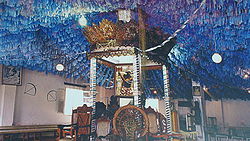
Although African religions had been present in Brazil since the 16th century, the "organized, structured liturgy and community of practice called Candomblé" only arose later.370 The earliest terreiros appeared in Bahia in the early 19th century.374 According to what the scholar Stefania Capone called "the founding myth of Candomblé",375 the first terreiro was the Ilê Axé Iyá Nassô Oká (also known as the Casa Branca or Engenho Velho), founded in Salvador in 1830, and from which the Nagô tradition descends.376
Various emancipated Yoruba began trading between Brazil and West Africa,377 and a significant role in the creation of Candomblé were several African freemen who were affluent and sent their children to be educated in Lagos.378
Brazil's republican Constitution of 1891 enshrined freedom of religion.379 However, Afro-Brazilian religious traditions continued to face legal issues; the Penal Code of 1890 included prohibitions on Spiritism, talismans, and much herbal medicine, impacting Candomblé.380 The authorities continued to shut down terreiros, claiming they were a threat to public health.381 The late 19th century saw the first terreiros open in Rio de Janeiro, a city then seeing a rapid expansion in its population.379 The period also saw various upper-class white Brazilians seeking out Candomblé.382
20th and 21st centuries

Candomblé became increasingly public in the 1930s, partly because Brazilians were increasingly encouraged to perceive themselves as part of a multi-racial, mixed society in the midst of President Getúlio Vargas' Estado Novo project.383 Vargas' Law Decree 1202 recognized the legitimacy of terreiros, while the Penal Code of 1940 offered them additional protections.384 The 1930s saw a proliferation of academic studies on Candomblé by scholars like Raimundo Nina Rodrigues, Edison Carneiro, and Ruth Landes,385 most focusing on the Nagô tradition.386 The growing literature, both scholarly and popular, helped document Candomblé while contributing to its greater standardisation.387
The religion spread during the 20th century. Growing Afro-Brazilian migration to São Paulo brought the rapid rise of Candomblé there; from virtually no terreiros until the 1960s, it had over 4000 by the century's end.388 Some practitioners became increasingly well known; the priestess Mãe Menininha do Gantois became nationally recognised.389 Various organizations emerged to represent the terreiros, notably the Bahian Federation of the Afro-Brazilian Cults, the National Institute and Supreme Sacerdotal Organ of Afro-Brazilian Culture and Tradition, and the Conference of the Tradition and Culture of the Orixás.223 Candomblé federations emerged in most Brazilian states,390 representing practitioners in their dealings with the government and society more broadly.391
Growing links were also established with other African diasporic and West African religions. Brazilians took part in the first International Congress of Orisha Tradition and Culture in Ifẹ, Nigeria in 1981; the second was held in Salvador in 1983.392 The late 20th century saw some practitioners—most famously Mãe Stella Azevedo393—try to "re-Africanise" Candomblé by removing Roman Catholic elements.394 This was an effort to attract prestige,395 and proved popular among white middle-class practitioners who had little standing with the predominantly Afro-Brazilian Bahian Candomblé establishment.396 Other practitioners rejected this approach, deeming Roman Catholic influences an important part of Candomblé.397
Candomblé was increasingly respectable by the late 20th century,398 a situation fuelled by well-educated Afro-Brazilians embracing their cultural heritage,399 by increased Brazilian trade with West Africa,400 and by the growing number of intellectual and white initiates.401 By the early 21st century, tourist literature increasingly portrayed Candomblé as an intrinsic part of Brazilian culture;402 Varig Airlines used the tagline "Fly with Axé."403 Conversely, the 2000s saw growing Evangelical Protestant opposition, including physical attacks on practitioners and terreiros,404 to which Candomblecistas responded with protest marches.405
Demographics

One census report indicated that around 1.3 percent of Brazil's population identified as Candomblé followers.406 This likely reflects only the number of initiates, with a larger body of non-initiates sometimes attending ceremonies or consulting initiates for healing and other services.406
Candomblé is centred largely in and around the city of Salvador,407 sometimes referred to as "Black Rome,"408 and regarded by some followers as a holy city.16 A 1997 census by the Bahian Federation of Afro-Brazilian Religions recorded 1,144 terreiros in Salvador.409 Practitioners in Rio de Janeiro and Sâo Paulo often regard Bahian terreiros as being more authentic.313 Candomblé has also spread to other parts of South America like Argentina and Uruguay, as well as to European countries like Portugal, Spain, France, Belgium, Germany, and Italy.410
In Brazil, Candomblé is a largely urban phenomenon,2 generally found among the poor,411 with most followers being black women.2 Membership is more diverse in southern Brazil, where there are large numbers of white and middle-class followers;412 there are also followers among Brazil's Japanese minority.413 Women predominate in the Ketu nation, although men dominate the Angola and Jeje nations.135
Many Candomblecistas have a family link to the tradition, with their parents or other relatives being initiates.169 Others convert to the movement without such connections, sometimes having already explored Pentecostalism, Spiritism, or Umbanda;414 some Umbandistas feel that they can go "deeper" by moving towards Candomblé.388 Many describe having been ill or plagued with misfortune prior to being initiated into Candomblé, having determined through divination that their ailments would cease if they did so.415 It has been argued that Candomblé offers a sense of empowerment to the socially marginalised,416 and has appeal for those who identify strongly with an African heritage;169 some black people in Germany, for instance, have been attracted to it because they feel it is more authentically African than Christianity or Islam.57
Reception and influence
Candomblé has been described as a much maligned religion.119 Practitioners have often encountered intolerance and religious discrimination:179 their religion is given the negative label macumba,417 terreiro leaders are often stereotyped as greedy and conniving,418 and terreiros have been attacked.419 In some isolated cases, terreiro leaders have been accused and/or arrested following accusations of emotional and psychological abuse, financial exploitation, rape, and harassment.420421422 However, the isolated controversies cannot be considered a generalization.
More extreme hostile views of Candomblé have regarded it as devil worship, while milder critical views see it as superstition that attracts the simple-minded and desperate.423 Brazil's Roman Catholics have mixed opinions of Candomblé and the attendance of its practitioners at mass,424 while evangelical and Pentecostal groups more uniformly target Candomblecistas as part of their "spiritual war" against Satan.425
Candomblé has elsewhere been seen as "a treasured symbol of Brazilian cultural identity and an icon of African Diaspora culture and politics".426 Various academics have sought to portray it in the best light possible to counter racist stereotypes about Afro-Brazilians.288 Academic studies have in turn influenced the way that the religion is practiced, helping to establish "correct practice" among divergent groups;427 many terreiros own copies of academic studies about the religion, sometimes to convey an image of authority.428
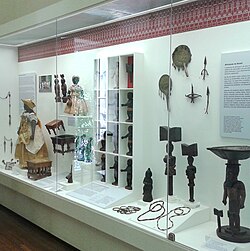
Since the 1960s, Candomblé has featured in films such as The Given Word (1962) and The Amulet of Ogum (1974), as well as documentaries like Geraldo Sarno's Iaô (1974).429 It has also influenced novelists, appearing in works by writers like Jorge Amado,430 and Toni Morrison.431 References to the religion also appeared in Brazilian popular music. For instance, Maria Bethânia and Gal Costa's song "Prayer to Mãe Menininha" made it into the country's chart.432 Objects associated with Candomblé first went on display in police museums but as the religion gained greater acceptance such material also begun to appear in museums devoted to folklore and Afro-Brazilian culture.433 From the 1990s, practitioners began establishing their own museums within their terreiros.434 For instance, the bedroom of Mãe Menininha do Gantois, located in her Bahia terreiro, was converted into a memorial in 1992 and then formally recognised as a heritage site in 2002.435
References
References
Citations
- Voeks 1997, p. 2.
- Álvarez López & Edfeldt 2007, p. 150.
- Wafer 1991, p. 4; Voeks 1997, p. xiv; Johnson 2002, pp. 151, 202; Sansi-Roca 2005, p. 140; Bahia 2014, p. 340.
- Johnson 2002, p. 41.
- Johnson 2002, p. 9; Álvarez López & Edfeldt 2007, p. 149.
- Selka 2010, p. 292; Selka 2013, p. 405.
- Selka 2010, p. 291; Engler 2012, p. 15.
- Johnson 2002, p. 202.
- Voeks 1997, p. 69; Capone 2010, p. 155.
- Hayes 2007, p. 284.
- Hayes 2007, pp. 285–286.
- Álvarez López & Edfeldt 2007, pp. 150–151.
- Wafer 1991, p. 57; Johnson 2002, p. 50.
- Walker 1990, p. 124; Álvarez López & Edfeldt 2007, p. 151.
- Bahia 2016, p. 16.
- Walker 1990, p. 103.
- Wafer 1991, p. 4; Álvarez López & Edfeldt 2007, p. 150.
- Capone 2010, p. 8.
- Wafer 1991, p. 15; Voeks 1997, p. 61; Johnson 2002, pp. 122–123.
- Walker 1990, p. 112; Voeks 1997, p. 61.
- Selka 2010, p. 291.
- Bahia 2016, p. 22.
- Wafer 1991, p. 10.
- Bahia 2014, p. 363.
- Wafer 1991, p. 5.
- Capone 2010, p. 95.
- Capone 2010, pp. 8–9.
- Johnson 2002, p. 52.
- Capone 2010, p. 103.
- Brown 1986, p. 1.
- Brown 1986, p. 88.
- Capone 2010, p. 105.
- Johnson 2002, p. 52; Capone 2010, pp. 9, 260.
- Engler 2012, p. 15.
- Pinto 1991, p. 71; Voeks 1997, p. 53.
- Wafer 1991, p. 5; Álvarez López & Edfeldt 2007, p. 157.
- Voeks 1997, p. 54.
- Fryer, Peter (2000). Rhythms of Resistance: African Musical Heritage in Brazil. Pluto Press. p. 18. ISBN 978-0-7453-0731-2. Retrieved 20 November 2024.
- Capone 2010, p. 267.
- Hayes 2007, p. 298.
- Wafer 1991, p. 166.
- Allen 2012, p. 19.
- Voeks 1997, p. 52.
- Wafer 1991, p. 125.
- Johnson 2002, pp. 125, 136.
- Wafer 1991, p. 167.
- Walker 1990, p. 108; Voeks 1997, p. 54; Johnson 2002, p. 14; Brazeal 2013, p. 105.
- Johnson 2002, p. 205; Sansi-Roca 2005, p. 141; Capone 2010, p. 267.
- Pinto 1991, p. 72; Capone 2010, p. 265.
- Pinto 1991, p. 72; Capone 2010, p. 268.
- Wafer 1991, p. 195.
- Wafer 1991, pp. 123, 199.
- Johnson 2002, p. 14; Capone 2010, p. 267.
- Johnson 2002, p. 36.
- Voeks 1997, p. 56; Johnson 2002, p. 14; Schmidt 2014, p. 142.
- Voeks 1997, p. 55.
- Bahia 2014, p. 355.
- Wafer 1991, p. 128.
- Walker 1990, p. 119.
- Voeks 1997, p. 57.
- Walker 1990, p. 105; Voeks 1997, p. 77.
- Walker 1990, p. 105.
- Voeks 1997, p. 56.
- Brazeal 2013, p. 114.
- Wafer 1991, p. 124.
- Johnson 2002, p. 125.
- Wafer 1991, p. 84.
- Wafer 1991, p. 123.
- Wafer 1991, p. 126.
- Wafer 1991, p. 203; Voeks 1997, p. 125; Johnson 2002, p. 205.
- Johnson 2002, p. 204.
- Wafer 1991, p. 24; Johnson 2002, p. 204.
- Voeks 1997, pp. 56, 126; Johnson 2002, p. 205.
- Wafer 1991, p. 113; Voeks 1997, pp. 79, 124; Capone 2010, pp. 82–83.
- Johnson 2002, p. 205.
- Wafer 1991, p. 126; Voeks 1997, p. 59; Johnson 2002, p. 205.
- Wafer 1991, p. 9; Johnson 2002, p. 205.
- Wafer 1991, p. 174.
- Voeks 1997, p. 126; Johnson 2002, p. 39; Capone 2010, p. 35.
- Johnson 2002, p. 49.
- Voeks 1997, p. 75; Capone 2010, p. 133.
- Wafer 1991, p. 4; Voeks 1997, p. 76; Johnson 2002, p. 39; Brazeal 2013, p. 112.
- Wafer 1991, p. 9.
- Capone 2010, p. 46.
- Wafer 1991, pp. 9, 122.
- Wafer 1991, p. 122.
- Wafer 1991, p. 124; Voeks 1997, p. 88; Capone 2010, p. 264.
- Wafer 1991, p. 63.
- Johnson 2002, p. 116.
- Walker 1990, pp. 111–112; Wafer 1991, p. 56; Voeks 1997, p. 59; Paula Adinolfi & Van de Port 2013, p. 290.
- Walker 1991, p. 46.
- Paula Adinolfi & Van de Port 2013, p. 291.
- Wafer 1991, p. 24; Voeks 1997, pp. 60–61.
- Wafer 1991, p. 173.
- Walker 1990, p. 112.
- Voeks 1997, p. 60.
- Voeks 1997, p. 59.
- Walker 1990, p. 113.
- Voeks 1997, p. 61.
- Selka 2010, p. 296.
- Walker 1990, p. 121; Johnson 2002, p. 136.
- Walker 1990, p. 125.
- Brazeal 2013, p. 106.
- Walker 1990, p. 117; Capone 2010, p. 122.
- Walker 1990, p. 117; Paula Adinolfi & Van de Port 2013, p. 290.
- Walker 1990, p. 117; Wafer 1991, p. 16; Capone 2010, p. 122.
- Walker 1991, p. 48; Voeks 1997, p. 74.
- Walker 1990, p. 117.
- Walker 1990, p. 118.
- Wafer 1991, p. 116; Johnson 2002, p. 203.
- Wafer 1991, p. 116.
- Wafer 1991, p. 16.
- Wafer 1991, p. 198.
- Wafer 1991, pp. 124, 198.
- Wafer 1991, p. 14.
- Wafer 1991, pp. 14, 198; Hayes 2007, p. 310.
- Wafer 1991, pp. 14, 198; Brazeal 2013, p. 106.
- Wafer 1991, p. 15.
- Brazeal 2013, p. 108.
- Hayes 2007, p. 311.
- Wafer 1991, p. 26; Capone 2010, pp. 12, 263; Brazeal 2013, p. 106.
- Wafer 1991, p. 55.
- Wafer 1991, p. 55; Brazeal 2013, p. 106.
- Wafer 1991, p. 106.
- Wafer 1991, pp. 63, 83.
- Wafer 1991, pp. 27, 83.
- Pinto 1991, p. 72.
- Schmidt 2014, p. 140.
- Wafer 1991, p. 58.
- Capone 2010, p. 131.
- Capone 2010, pp. 135–137.
- Voeks 1997, pp. 61, 63.
- Voeks 1997, p. 63; Johnson 2002, pp. 112, 201; Capone 2010, p. 263.
- Voeks 1997, p. 63; Johnson 2002, pp. 38, 112, 204; Capone 2010, p. 267.
- Voeks 1997, p. 63.
- Johnson 2002, p. 203.
- Voeks 1997, p. 63; Johnson 2002, p. 202; Capone 2010, pp. 80, 264; Bahia 2014, p. 335.
- Wafer 1991, p. 196.
- Wafer 1991, p. 114.
- Brazeal 2013, p. 117.
- Capone 2010, p. 121.
- Wafer 1991, p. 197.
- Wafer 1991, p. 183.
- Capone 2010, p. 12.
- Walker 1990, p. 123; Johnson 2002, p. 14.
- Voeks 1997, p. 73; Afolabi 2005, p. 108.
- Walker 1990, p. 123.
- Bahia 2016, p. 23.
- Wafer 1991, p. 19.
- Johnson 2002, p. 14.
- Voeks 1997, p. 73.
- Johnson 2002, p. 136.
- Walker 1990, p. 123; Voeks 1997, p. 73.
- Afolabi 2005, p. 110.
- Voeks 1997, p. 74.
- Walker 1990, p. 124; Johnson 2002, pp. 105–106.
- Varela 2017, pp. 102.
- Walker 1990, p. 124.
- Voeks 1997, p. 76.
- Johnson 2002, p. 43.
- Allen 2012, p. 22.
- Álvarez López & Edfeldt 2007, p. 159.
- Johnson 2002, p. 48.
- Voeks 1997, p. 51.
- Álvarez López & Edfeldt 2007, p. 151.
- Allen 2012, p. 20; Hartikainen 2017, p. 366.
- Álvarez López & Edfeldt 2007, p. 160; Allen 2012, p. 20.
- Allen 2012, p. 20.
- Johnson 2002, p. 55.
- Selka 2010, p. 297; Allen 2012, p. 21.
- Selka 2010, p. 297; Allen 2012, p. 20.
- DeLoach & Petersen 2010, p. 45.
- Johnson 2002, pp. 12, 105.
- Voeks 1997, p. 69; Johnson 2002, p. 36.
- Walker 1990, p. 116.
- Álvarez López & Edfeldt 2007, p. 157.
- Johnson 2002, p. 157; Capone 2010, p. 117; Selka 2010, p. 294.
- Johnson 2002, pp. 31, 202; Hartikainen 2017, p. 369.
- Hartikainen 2017, p. 369.
- Johnson 2002, p. 146.
- Johnson 2002, p. 27.
- Álvarez López & Edfeldt 2007, pp. 156–157.
- Wafer 1991, p. 5; Álvarez López & Edfeldt 2007, p. 161.
- Walker 1990, p. 104; Wafer 1991, p. 4; Johnson 2002, pp. 13, 205; Bahia 2016, p. 18.
- Bahia 2014, p. 334; Johnson 2002, p. 203.
- Voeks 1997, p. 129; Johnson 2002, p. 35; Capone 2010, p. 31.
- Voeks 1997, p. 133.
- Capone 2010, p. 10.
- Wafer 1991, p. 24; Voeks 1997, p. 129; Johnson 2002, p. 50.
- Wafer 1991, p. 149.
- Wafer 1991, pp. 112, 122.
- Johnson 2002, p. 37.
- Wafer 1991, p. 112; Voeks 1997, p. 67; Johnson 2002, pp. 124, 205.
- Wafer 1991, pp. 26, 196; Voeks 1997, p. 67; Johnson 2002, pp. 49, 202; Capone 2010, pp. 57, 263.
- Wafer 1991, p. 26.
- Voeks 1997, p. 67.
- Brazeal 2013, p. 115.
- Wafer 1991, p. 142; Johnson 2002, p. 112.
- Wafer 1991, p. 142.
- Wafer 1991, p. 132.
- Wafer 1991, pp. 174–175.
- Walker 1991, p. 47.
- Wafer 1991, pp. 183, 196.
- Walker 1990, p. 121.
- Walker 1991, p. 48; Bahia 2016, p. 24.
- Johnson 2002, p. 165.
- Wafer 1991, p. 146.
- Wafer 1991, p. 147; Johnson 2002, p. 109.
- Wafer 1991, p. 141.
- Brazeal 2013, p. 111.
- Capone 2010, pp. 59, 264.
- Wafer 1991, p. 6; Voeks 1997, p. xvi; Johnson 2002, pp. 112, 203; Bahia 2014, p. 334.
- Wafer 1991, p. 6; Voeks 1997, p. xvi; Johnson 2002, p. 205; Bahia 2014, p. 334; Bahia 2016, p. 17.
- Álvarez López & Edfeldt 2007, p. 164.
- Voeks 1997, p. 63; Johnson 2002, p. 201; Álvarez López & Edfeldt 2007, pp. 163–164; Capone 2010, p. 263.
- Voeks 1997, p. 63; Johnson 2002, p. 203; Álvarez López & Edfeldt 2007, pp. 163–164; Capone 2010, pp. 263, 265.
- Voeks 1997, p. 65.
- Voeks 1997, p. 98.
- Johnson 2002, p. 50.
- Wafer 1991, p. 38.
- Sansi-Roca 2005, p. 142; Brazeal 2013, p. 106.
- Sansi-Roca 2005, p. 142.
- Johnson 2002, p. 159.
- Wafer 1991, p. 131; Johnson 2002, pp. 50, 203; Capone 2010, p. 266.
- Voeks 1997, p. 65; Capone 2010, p. 266.
- Wafer 1991, p. 131.
- Johnson 2002, p. 202; Conner 2005, p. 155; Capone 2010, pp. 264, 266.
- Wafer 1991, p. 195; Johnson 2002, p. 201; Capone 2010, p. 263.
- Johnson 2002, p. 31; Álvarez López & Edfeldt 2007, p. 165; Capone 2010, p. 266.
- Capone 2010, p. 264.
- Johnson 2002, pp. 109–110.
- Wafer 1991, pp. 16–17.
- Wafer 1991, p. 28; Johnson 2002, p. 201; Sansi-Roca 2005, p. 142.
- Sansi-Roca 2005, p. 143.
- Wafer 1991, p. 130; Sansi-Roca 2005, p. 142.
- Wafer 1991, p. 122; Johnson 2002, p. 116.
- Wafer 1991, p. 130.
- Wafer 1991, pp. 19, 130; Voeks 1997, p. 77; Sansi-Roca 2005, p. 139.
- Wafer 1991, p. 19; Johnson 2002, p. 123.
- Johnson 2002, pp. 116–117.
- Sansi-Roca 2005, pp. 142–143.
- Wafer 1991, p. 130; Johnson 2002, p. 117.
- Sansi-Roca 2005, p. 152.
- Sansi-Roca 2005, p. 153.
- Johnson 2002, p. 117.
- Johnson 2002, p. 162.
- Johnson 2002, pp. 136, 202; Selka 2010, p. 294; Brazeal 2013, p. 104; Bahia 2016, p. 28.
- Brazeal 2013, p. 109.
- Voeks 1997, p. 76; Johnson 2002, pp. 134, 205; Capone 2010, p. 267; Brazeal 2013, p. 112.
- Johnson 2002, p. 133.
- Johnson 2002, p. 201.
- Brazeal 2013, p. 116.
- Voeks 1997, p. 65; Johnson 2002, pp. 45, 201.
- Voeks 1997, p. 81.
- Wafer 1991, p. 42.
- Johnson 2002, p. 121.
- Wafer 1991, pp. 42, 128; Johnson 2002, p. 130.
- Wafer 1991, p. 203.
- Bahia 2014, p. 362; Bahia 2016, pp. 22–23.
- Sansi-Roca 2005, p. 141.
- Capone 2010, p. 114.
- Johnson 2002, pp. 13, 202.
- Álvarez López & Edfeldt 2007, pp. 161–162.
- Wafer 1991, p. 196; Johnson 2002, p. 202.
- Walker 1990, p. 120.
- Johnson 2002, pp. 110–112, 202.
- Wafer 1991, p. 122; Johnson 2002, p. 118.
- Wafer 1991, p. 112; Voeks 1997, p. 77; Johnson 2002, pp. 108–109.
- Walker 1990, p. 119; Wafer 1991, p. 112.
- Walker 1990, p. 104.
- Walker 1990, p. 12; Johnson 2002, pp. 117–118.
- Johnson 2002, p. 115.
- Johnson 2002, p. 118.
- Johnson 2002, p. 119.
- Walker 1990, p. 120; Johnson 2002, p. 117.
- Wafer 1991, p. 150; Johnson 2002, p. 119.
- Wafer 1991, p. 137.
- Wafer 1991, p. 111; Johnson 2002, p. 119.
- Wafer 1991, p. 137; Johnson 2002, p. 119.
- Wafer 1991, p. 121.
- Wafer 1991, pp. 145–146.
- Walker 1990, p. 119; Johnson 2002, p. 108.
- Walker 1990, p. 122; Wafer 1991, p. 202.
- Wafer 1991, pp. 137, 142; Johnson 2002, p. 126.
- Wafer 1991, p. 162; Johnson 2002, pp. 121–122.
- Schmidt 2014, p. 144.
- Walker 1990, p. 122.
- Johnson 2002, p. 16.
- Wafer 1991, p. 17.
- Bahia 2016, p. 25.
- Bahia 2016, p. 24.
- Pinto 1991, p. 88; Johnson 2002, pp. 112, 203, 205.
- Johnson 2002, p. 112.
- Wafer 1991, pp. 130–131, 195; Johnson 2002, p. 201.
- Wafer 1991, p. 136.
- Wafer 1991, p. 79.
- Pinto 1991, p. 74.
- Capone 2010, p. 265.
- Wafer 1991, p. 102.
- Pinto 1991, p. 74; Wafer 1991, p. 101.
- Johnson 2002, p. 44.
- Johnson 2002, p. 45.
- Wafer 1991, p. 175.
- Walker 1991, p. 49; Voeks 1997, p. 86.
- Voeks 1997, p. 86.
- Wafer 1991, p. 44.
- Wafer 1991, p. 62; Johnson 2002, p. 175.
- Wafer 1991, p. 62.
- Wafer 1991, p. 165.
- Wafer 1991, p. 64.
- Pinto 1991, p. 84.
- Walker 1991, p. 49.
- Johnson 2002, p. 137.
- Bahia 2014, p. 343.
- Walker 1991, p. 45; Voeks 1997, p. 81; Johnson 2002, p. 158.
- Walker 1991, p. 45; Johnson 2002, p. 145.
- Wafer 1991, p. 53.
- Wafer 1991, p. 45.
- Voeks 1997, pp. 89–90.
- Voeks 1997, p. 89; Johnson 2002, pp. 12, 203; Capone 2010, pp. 43, 264.
- Wafer 1991, pp. 113–114.
- Wafer 1991, p. 114; Voeks 1997, p. 90.
- Voeks 1997, p. 90.
- Voeks 1997, p. 91.
- Wafer 1991, pp. 42, 46.
- Brazeal 2013, p. 112.
- Capone 2010, p. 43.
- Johnson 2002, pp. 125, 203.
- DeLoach & Petersen 2010, p. 44.
- Voeks 1997, p. 102.
- Voeks 1997, p. 97.
- Voeks 1997, p. 70.
- Johnson 2002, p. 126.
- Voeks 1997, p. 89.
- Voeks 1997, pp. 113–114.
- Voeks 1997, pp. 97, 105.
- Brazeal 2013, p. 105.
- Voeks 1997, p. 91; Brazeal 2013.
- Wafer 1991, p. 143.
- Wafer 1991, p. 7; Voeks 1997, p. 114; Brazeal 2013, p. 116.
- Voeks 1997, pp. 95–97.
- Voeks 1997, p. 94.
- Voeks 1997, p. 134.
- Voeks 1997, p. 99.
- Voeks 1997, pp. 112–113.
- Voeks 1997, p. 107; Hartikainen 2017, pp. 369–370.
- Voeks 1997, p. 107.
- Voeks 1997, p. 106.
- Brazeal 2013, pp. 104–105.
- Brazeal 2013, p. 110.
- Brazeal 2013, p. 118.
- Castillo & Parés 2010, p. 3.
- Johnson 2002, p. 61.
- Voeks 1997, p. 148.
- Voeks 1997, p. 149; Johnson 2002, p. 62.
- Johnson 2002, p. 77.
- Voeks 1997, p. 153; Johnson 2002, p. 77; Capone 2010, p. 97.
- Voeks 1997, p. 148; Johnson 2002, p. 62.
- Johnson 2002, p. 61; Álvarez López & Edfeldt 2007, p. 149; Desplande 2008, p. x.
- Johnson 2002, p. 64.
- Johnson 2002, p. 66.
- Voeks 1997, p. 150.
- Johnson 2002, pp. 66–67.
- Voeks 1997, pp. 55–56.
- Voeks 1997, pp. 46–47.
- Capone 2010, p. 71.
- Walker 1991, p. 44.
- Walker 1991, p. 42; Johnson 2002, p. 70.
- Voeks 1997, p. 157; Johnson 2002, p. 70.
- Johnson 2002, p. 73.
- Johnson 2002, p. 71.
- Voeks 1997, p. 156.
- Johnson 2002, p. 75.
- Voeks 1997, p. 51; Johnson 2002, p. 55.
- Capone 2010, p. 214.
- Johnson 2002, p. 75; Capone 2010, pp. 178, 213; Castillo & Parés 2010, pp. 1, 18.
- Voeks 1997, p. 154.
- Castillo & Parés 2010, p. 18.
- Johnson 2002, p. 81.
- Johnson 2002, pp. 82–83; Hayes 2007, p. 291; Capone 2010, p. 178.
- Johnson 2002, p. 90.
- Johnson 2002, p. 91.
- Johnson 2002, p. 80.
- Johnson 2002, p. 95.
- Johnson 2002, pp. 80–81.
- Hayes 2007, p. 297.
- Johnson 2002, p. 161.
- Johnson 2002, p. 156.
- Johnson 2002, p. 158; Capone 2010, p. 109.
- Wafer 1991, p. 4.
- Wafer 1991, p. 199.
- Capone 2010, pp. 233–234.
- Wafer 1991, p. 56; Johnson 2002, p. 71; Capone 2010, p. 247; Hartikainen 2017, p. 374.
- Walker 1990, pp. 114–115; Capone 2010, p. 246.
- Capone 2010, p. 229.
- Johnson 2002, p. 176.
- Brown 1986, p. 223; Brown & Bick 1987, p. 87; Johnson 2002, p. 72.
- Walker 1990, p. 106; Voeks 1997, p. 105.
- Walker 1990, p. 108.
- Capone 2010, pp. 108–109.
- Walker 1991, p. 44; Capone 2010, p. 11.
- Johnson 2002, p. 33.
- Johnson 2002, pp. 33, 158.
- Hartikainen 2017, pp. 371–372.
- Hartikainen 2017, pp. 360, 375–377.
- Selka 2010, p. 294.
- Wafer 1991, p. 197; Hartikainen 2017, p. 357.
- Selka 2013, p. 404.
- Capone 2010, p. 6.
- Bahia 2014, p. 329.
- Wafer 1991, p. 95; Walker 1991, p. 43; Marouan 2007, p. 121.
- Hartikainen 2017, p. 357.
- Capone 2010, pp. 160, 295.
- Johnson 2002, p. 54.
- Johnson 2002, pp. 54–55.
- Álvarez López & Edfeldt 2007, p. 167.
- Voeks 1997, p. 69; Selka 2010, p. 296.
- Selka 2010, p. 297.
- Selka 2010, p. 298; Selka 2013, p. 410.
- Coelho, Gabi (2025-07-03). "Vítimas relatam abusos por lideranças de terreiro de candomblé em Belo Horizonte (MG)". Agência Pública (in Brazilian Portuguese). Retrieved 2026-02-04.
- "Pai de santo primo de Daniel Vorcaro é preso e afastado de terreiro | G1". G1 (in Brazilian Portuguese). Retrieved 2026-02-04.
- "Vítimas de abuso sexual de pai de santo relatam momento do crime | G1". G1 (in Brazilian Portuguese). Retrieved 2026-02-04.
- Voeks 1997, p. 69.
- Johnson 2002, p. 122.
- Johnson 2002, p. 53; Contins 2010, p. 228; Hartikainen 2017, p. 372.
- Hale 2009, p. 48.
- Johnson 2002, p. 11.
- Johnson 2002, pp. 11, 160.
- Johnson 2002, p. 163.
- Walker 1990, p. 106.
- Marouan 2007, pp. 111, 118.
- Paula Adinolfi & Van de Port 2013, p. 292.
- Paula Adinolfi & Van de Port 2013, pp. 288–289.
- Paula Adinolfi & Van de Port 2013, p. 289.
- Paula Adinolfi & Van de Port 2013, pp. 284–285.
Sources
- Afolabi, Niyi (2005). "Axé: Invocation of Candomblé and Afro-Brazilian Gods in Brazilian Cultural Production". In Patrick Bellegarde-Smith (ed.). Fragments of Bone: Neo-African Religions in a New World. Urbana and Chicago: University of Illinois Press. pp. 108–123. ISBN 978-0-252-07205-5.
- Allen, Andrea Stevenson (2012). ""Brides" without Husbands: Lesbians in the Afro-Brazilian Religion Candomblé". Transforming Anthropology. 20 (1): 17–31. doi:10.1111/j.1548-7466.2011.01141.x. S2CID 144349076.
- Álvarez López, Laura; Edfeldt, Chatarina (2007). "The Role of Language in the Construction of Gender and Ethnic-Religious Identities in Brazilian-Candomblé Communities". In Allyson Jule (ed.). Language and Religious Identity: Women in Discourse. Oxford: Palgrave Macmillan. pp. 149–171. ISBN 978-0230517295.
- Bahia, Joana (2014). "Under the Berlin Sky: Candomblé on German Shores". Vibrant: Virtual Brazilian Anthropology. 11 (2). Translated by Christiano S. do V. Silva: 327–370. doi:10.1590/S1809-43412014000200012.
- Bahia, Joana (2016). "Dancing with the Orixás: Music, Body and the Circulation of African Candomblé Symbols in Germany". African Diaspora. 9: 15–38. doi:10.1163/18725465-00901005. S2CID 152159342.
- Brazeal, Brian (2013). "Coins for the Dead, Money on the Floor: Mortuary Ritual in Bahian Candomblé". In Roger Sansi-Roca (ed.). Economies of Relation: Money and Personhood in the Lusophone World. Portuguese Literary and Cultural Studies. Tagus Press at the University of Massachusetts. pp. 103–124. ISBN 978-1933227146.
- Brown, Diana DeG. (1986). Umbanda: Religion and Politics in Urban Brazil. Ann Arbor: UMI Research Press. ISBN 0-8357-1556-6.
- Brown, Diana De G.; Bick, Mario (1987). "Religion, Class, and Context: Continuities and Discontinuities in Brazilian Umbanda". American Ethnologist. 14 (1): 73–93. doi:10.1525/ae.1987.14.1.02a00050.
- Capone, Stefania (2010). Searching for Africa in Brazil: Power and Tradition in Candomblé. Translated by Lucy Lyall Grant. Durham and London: Duke University Press. ISBN 978-0-8223-4636-4.
- Castillo, Lisa Earl; Parés, Luis Nicolau (2010). "Marcelina da Silva: A Nineteenth-Century Candomblé Priestess in Bahia". Slavery & Abolition. 31 (1): 1–27. doi:10.1080/01440390903481639. S2CID 143675040.
- Conner, Randy P. (2005). "Rainbow's Children: Diversity of Gender and Sexuality in African-Diasporic Spiritual Traditions". In Patrick Bellegarde-Smith (ed.). Fragments of Bone: Neo-African Religions in a New World. Urbana and Chicago: University of Illinois Press. pp. 143–166. ISBN 978-0-252-07205-5.
- Contins, Márcia (2010). "Umbanda, Candomblé, and Pentecostalism: Religious Frontiers in Brazil and in the United States". Afro-Hispanic Review. 29 (2): 223–236.
- DeLoach, Chanté D.; Petersen, Marissa N. (2010). "African Spiritual Methods of Healing: The Use of Candomblé in Traumatic Response". The Journal of Pan African Studies. 3 (8): 40–65.
- Desplande, Michel (2008). Bastide on Religion: The Invention of Candomblé. Key Thinkers in the Study of Religion. London: Equinox. ISBN 978-1-84553-366-3.
- Engler, Steven (2012). "Umbanda and Africa". Nova Religio: The Journal of Alternative and Emergent Religions. 15 (4): 13–35. doi:10.1525/nr.2012.15.4.13.
- Hale, Lindsay (2009). Hearing the Mermaid's Song: The Umbanda Religion in Rio De Janeiro. Albuquerque: University of New Mexico Press. ISBN 978-0-8263-4733-6.
- Hartikainen, Elina I. (2017). "Chronotopic Realignments and the Shifting Semiotics and Politics of Visibility in Brazilian Candomblé Activism". Signs and Society. 5 (2): 356–389. doi:10.1086/693784. S2CID 158979230.
- Hayes, Kelly E. (2007). "Black Magic and the Academy: Macumba and Afro-Brazilian "Orthodoxies"". History of Religions. 46 (4): 283–31. doi:10.1086/518811. JSTOR 10.1086/518811.
- Johnson, Paul Christopher (2002). Secrets, Gossip, and Gods: The Transformation of Brazilian Candomblé. Oxford and New York: Oxford University Press. ISBN 9780195150582.
- Marouan, Maha (2007). "Candomblé, Christianity, and Gnosticism in Toni Morrison's Paradise". In Theodore Louis Trost (ed.). The African Diaspora and the Study of Religion. New York: Palgrave Macmillan. pp. 111–127. ISBN 978-1403977861.
- Paula Adinolfi, Maria; Van de Port, Mattijs (2013). "Bed and Throne: The "Museumification" of the Living Quarters of a Candomblé Priestess". Material Religion. 9 (3): 282–303. doi:10.2752/175183413X13730330868915. S2CID 162385683.
- Pinto, Tiago de Oliveira (1991). ""Making Ritual Drama:" Dance, Music, and Representation in Brazilian "Candomblé" and "Umbanda"". The World of Music. 33 (1): 70–88. JSTOR 43562778.
- Sansi-Roca, Roger (2005). "The Hidden Life of Stones: Historicity, Materiality and the Value of Candomblé Objects in Bahia". Journal of Material Culture. 10 (2): 139–156. doi:10.1177/1359183505053072. S2CID 144497398.
- Schmidt, Bettina E. (2014). "Spirit Possession in Brazil: The Perception of the (Possessed) Body". Anthropos. 109 (1): 135–147. doi:10.5771/0257-9774-2014-1-135. JSTOR 43861689.
- Selka, Stephen (2010). "Morality in the Religious Marketplace: Evangelical Christianity, Candomblé, and the Struggle for Moral Distinction in Brazil". American Ethnologist. 37 (2): 291–307. doi:10.1111/j.1548-1425.2010.01256.x.
- Selka, Stephen (2013). "Cityscapes and Contact Zones: Christianity, Candomblé, and African Heritage Tourism in Brazil". Religion. 43 (3): 403–420. doi:10.1080/0048721X.2013.798163. S2CID 143213938.
- Voeks, Robert A. (1997). Sacred Leaves of Candomblé: African Magic, Medicine, and Religion in Brazil. Austin, TX: University of Texas Press. ISBN 9780292787315.
- Wafer, Jim (1991). The Taste of Blood: Spirit Possession in Brazilian Candomblé. Philadelphia: University of Pennsylvania Press. ISBN 978-0-8122-1341-6.
- Walker, Sheila (1990). "Everyday and Esoteric Reality in the Afro-Brazilian Candomblé". History of Religions. 30 (2): 103–128. doi:10.1086/463217. JSTOR 1062896. S2CID 161240664.
- Walker, Sheila (1991). "A Choreography of the Universe: The Afro-Brazilian Candomble as a Microcosm of Yoruba Spiritual Geography". Anthropology and Humanism Quarterly. 16 (2): 42–50. doi:10.1525/ahu.1991.16.2.42.
- Varela, Sergio González (2017). Power in Practice: The Pragmatic Anthropology of Afro-Brazilian Capoeira. Berghahn Books. ISBN 9781785336355.
Further reading
Further reading
- Alonso, Miguel (2014). The Development of Yoruba Candomblé Communities in Salvador, Bahia, 1835 – 1986. New York: Palgrave Macmillan. ISBN 978-1137485380.
- Bramley, Serge (1979) [1975]. Macumba: The Teachings of Maria-José, Mother of the Gods. Brazil: Avon. ISBN 978-0-380-42317-0.
- Góis Dantas, Beatriz (2009). Nagô Grandma and White Papa: Candomblé and the Creation of Afro-Brazilian Identity. Translated by Stephen Berg. Chapel Hill: University of North Carolina Press. ISBN 978-1458761279.
- Harding, Rachel (2000). A Refuge in Thunder: Candomblé and Alternative Spaces of Blackness. Bloomington: Indiana University Press. ISBN 978-0253337054.
- Jensen, Tina Gudrun (1999). "Discourses on Afro-Brazilian Religion: From de-Africanization to re-Africanization". In Christian Smith and Joshua Prokopy (ed.). Latin American Religion in Motion: A Documentary History. New York: Routledge. pp. 265–283. ISBN 978-1570756795.
- Landes, Ruth (1947). The City of Women. Macmillan Co. ISBN 978-0-8263-1556-4.
{{cite book}}: ISBN / Date incompatibility (help) - Matory, James Lorand (2005). Black Atlantic Religion: Tradition, Transnationalism, and Matriarchy in the Afro-Brazilian Candomblé. Princeton: Princeton University Press. ISBN 978-0-691-05943-3.
- Omari-Tunkara, Mikelle S. (2005). Manipulating the Sacred: Yoruba Art, Ritual, and Resistance in Brazilian Candomble. Wayne State University Press. ISBN 978-0814328521.
- Parés, Luis Nicolau (2013). The Formation of Candomblé: Vodun History and Ritual in Brazil. Translated by Richard Vernon. Chapel Hill, NC: University of North Carolina Press. ISBN 978-1469610924.
- Reis, João José (2001). "Candomblé in Nineteenth-Century Bahia: Priests, Followers, Clients". In Mann, Kristina; Bay, Edna G. (eds.). Rethinking the African Diaspora: The Making of a Black Atlantic World in the Bight of Benin and Brazil. Routledge. ISBN 978-0714681580.
- Souty, Jérôme (2007). Pierre Fatumbi Verger: Du Regard Détaché à la Connaissance Initiatique. Maisonneuve et Larose. ISBN 978-2-7068-1983-4.
- van de Port, Mattijs (2014). Ecstatic Encounters: Bahian Candomblé and the Quest for the Really Real. Amsterdam: Amsterdam University Press. ISBN 978-9089642981.
- Verger, Pierre Fatumbi (1995) [1954]. Dieux d'Afrique. Culte des Orishas et Vodouns à l'ancienne Côte des Esclaves en Afrique et à Bahia, la Baie de Tous les Saints au Brésil. Paris: Revue Noire. ISBN 978-2-909571-13-3.