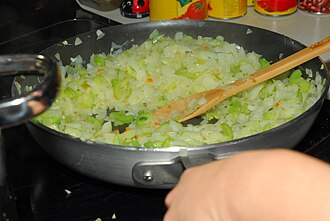
Sweating in cooking is the gentle heating of vegetables in a little oil or butter, with frequent stirring and turning to ensure that any emitted liquid will evaporate.1 Sweating usually results in tender, sometimes translucent, pieces.2 Sweating is often a preliminary step to further cooking in liquid;1 onions, in particular, are often sweated before including in a stew.a This differs from sautéing in that sweating is done over a much lower heat,2 sometimes with salt added to help draw moisture away, and making sure that little or no browning takes place.24
The sweating of vegetables has been used as a technique in the preparation of coulis.5
In Italy, this cooking technique is known as soffritto, meaning "sub-frying" or "under-frying".1 In Italian cuisine, it is a common technique and preliminary step in the preparation of risotto, soups and sauces.1
-
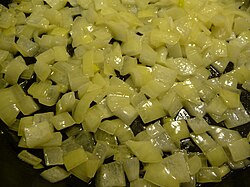 Close-up view of sweated onions
Notes
Notes
- "While European cooks start most stews by gently sweating aromatic vegetables such as onions, carrots, celery, and garlic as a gently flavored mirepoix or soffritto, most Indian cooks rely most heavily on onions. And instead of the gentle ..."3
References
References
- Ruhlman, M.; Ruhlman, D.T. (2011). Ruhlman's Twenty: 20 Techniques, 100 Recipes, A Cook's Manifesto. Chronicle Books LLC. p. 69. ISBN 978-1-4521-1045-5. Retrieved February 10, 2021.
- Marcus, J.B. (2019). Aging, Nutrition and Taste: Nutrition, Food Science and Culinary Perspectives for Aging Tastefully. Elsevier Science. p. 241. ISBN 978-0-12-813528-0. Retrieved February 10, 2021.
- Peterson, J. (2017). Sauces: Classical and Contemporary Sauce Making, Fourth Edition. HMH Books. p. pt800. ISBN 978-0-544-81983-2. Retrieved February 10, 2021.
- Kish, K.; Erickson, M. (2017). Kristen Kish Cooking: Recipes and Techniques. Crown Publishing Group. p. 28. ISBN 978-0-553-45976-0. Retrieved February 10, 2021.
- Chapelle, Vincent La (1733). The Modern Cook. N. Prevost. p. 92. Retrieved February 10, 2021.
External links
External links
- How to Sweat Ingredients on YouTube
- Definition Archived 2015-04-17 at the Wayback Machine
- How to Sweat Vegetables