Article · Wikipedia archive · Last revised Jul 16, 2026

Sphericity

Sphericity is a measure of how closely the shape of a physical object resembles that of a perfect sphere. For example, the sphericity of the balls inside a ball bearing determines the quality of the bearing, such as the load it can bear or the speed at which it can turn without failing. Sphericity is a specific example of a compactness measure of a shape.

Last revised
Jul 16, 2026
Read time
≈ 5 min
Length
1,198 w
Citations
1
Source
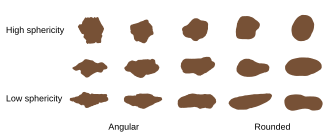
Schematic representation of difference in grain shape. Two parameters are shown: sphericity (vertical) and rounding (horizontal). source ↗

Sphericity is a measure of how closely the shape of a physical object resembles that of a perfect sphere. For example, the sphericity of the balls inside a ball bearing determines the quality of the bearing, such as the load it can bear or the speed at which it can turn without failing. Sphericity is a specific example of a compactness measure of a shape.

Sphericity applies in three dimensions; its analogue in two dimensions, such as the cross sectional circles along a cylindrical object such as a shaft, is called roundness.

Definition

Defined by Wadell in 1935,1 the sphericity, Ψ {\displaystyle \Psi } , of an object is the ratio of the surface area of a sphere with the same volume to the object's surface area:

Ψ = π 1 3 ( 6 V p ) 2 3 A p {\displaystyle \Psi ={\frac {\pi ^{\frac {1}{3}}(6V_{p})^{\frac {2}{3}}}{A_{p}}}}

where V p {\displaystyle V_{p}} is volume of the object and A p {\displaystyle A_{p}} is the surface area. The sphericity of a sphere is unity by definition and, by the isoperimetric inequality, any shape which is not a sphere will have sphericity less than 1.

Ellipsoidal objects

The sphericity, Ψ {\displaystyle \Psi } , of an oblate spheroid (similar to the shape of the planet Earth) is:

Ψ = π 1 3 ( 6 V p ) 2 3 A p = 2 a b 2 3 a + b 2 a 2 b 2 ln ( a + a 2 b 2 b ) , {\displaystyle \Psi ={\frac {\pi ^{\frac {1}{3}}(6V_{p})^{\frac {2}{3}}}{A_{p}}}={\frac {2{\sqrt[{3}]{ab^{2}}}}{a+{\frac {b^{2}}{\sqrt {a^{2}-b^{2}}}}\ln {\left({\frac {a+{\sqrt {a^{2}-b^{2}}}}{b}}\right)}}},}

where a and b are the semi-major and semi-minor axes respectively.

Derivation

Hakon Wadell defined sphericity as the surface area of a sphere of the same volume as the object divided by the actual surface area of the object.

First we need to write surface area of the sphere, A s {\displaystyle A_{s}} in terms of the volume of the object being measured, V p {\displaystyle V_{p}}

A s 3 = ( 4 π r 2 ) 3 = 4 3 π 3 r 6 = 4 π ( 4 2 π 2 r 6 ) = 4 π 3 2 ( 4 2 π 2 3 2 r 6 ) = 36 π ( 4 π 3 r 3 ) 2 = 36 π V p 2 {\displaystyle A_{s}^{3}=\left(4\pi r^{2}\right)^{3}=4^{3}\pi ^{3}r^{6}=4\pi \left(4^{2}\pi ^{2}r^{6}\right)=4\pi \cdot 3^{2}\left({\frac {4^{2}\pi ^{2}}{3^{2}}}r^{6}\right)=36\pi \left({\frac {4\pi }{3}}r^{3}\right)^{2}=36\,\pi V_{p}^{2}}

therefore

A s = ( 36 π V p 2 ) 1 3 = 36 1 3 π 1 3 V p 2 3 = 6 2 3 π 1 3 V p 2 3 = π 1 3 ( 6 V p ) 2 3 {\displaystyle A_{s}=\left(36\,\pi V_{p}^{2}\right)^{\frac {1}{3}}=36^{\frac {1}{3}}\pi ^{\frac {1}{3}}V_{p}^{\frac {2}{3}}=6^{\frac {2}{3}}\pi ^{\frac {1}{3}}V_{p}^{\frac {2}{3}}=\pi ^{\frac {1}{3}}\left(6V_{p}\right)^{\frac {2}{3}}}

hence we define Ψ {\displaystyle \Psi } as:

Ψ = A s A p = π 1 3 ( 6 V p ) 2 3 A p {\displaystyle \Psi ={\frac {A_{s}}{A_{p}}}={\frac {\pi ^{\frac {1}{3}}\left(6V_{p}\right)^{\frac {2}{3}}}{A_{p}}}}

Sphericity of common objects

Name Picture Volume Surface area Sphericity
Sphere 4 π 3 r 3 {\displaystyle {\frac {4\pi }{3}}\,r^{3}} 4 π r 2 {\displaystyle 4\pi \,r^{2}} 1 {\displaystyle 1}
Disdyakis triacontahedron 900 + 720 5 11 s 3 {\displaystyle {\frac {900+720{\sqrt {5}}}{11}}\,s^{3}} 180 179 24 5 11 s 2 {\displaystyle {\frac {180{\sqrt {179-24{\sqrt {5}}}}}{11}}\,s^{2}} ( ( 5 + 4 5 ) 2 11 π 5 ) 1 3 179 24 5 0.9857 {\displaystyle {\frac {\left(\left(5+4{\sqrt {5}}\right)^{2}{\frac {11\pi }{5}}\right)^{\frac {1}{3}}}{\sqrt {179-24{\sqrt {5}}}}}\approx 0.9857}
Tricylinder 16 8 2 r 3 {\displaystyle 16-8{\sqrt {2}}\,r^{3}} 48 24 2 r 2 {\displaystyle 48-24{\sqrt {2}}\,r^{2}} 36 π + 18 π 2 3 6 0.9633 {\displaystyle {\frac {\sqrt[{3}]{36\pi +18\pi {\sqrt {2}}}}{6}}\approx 0.9633}
Rhombic triacontahedron 4 5 + 2 5 s 3 {\displaystyle 4{\sqrt {5+2{\sqrt {5}}}}\,s^{3}} 12 5 s 2 {\displaystyle 12{\sqrt {5}}\,s^{2}} 455625 π 2 + 202500 π 2 5 6 15 0.9609 {\displaystyle {\frac {\sqrt[{6}]{455625\pi ^{2}+202500\pi ^{2}{\sqrt {5}}}}{15}}\approx 0.9609}
Icosahedron 15 + 5 5 12 s 3 {\displaystyle {\frac {15+5{\sqrt {5}}}{12}}\,s^{3}} 5 3 s 2 {\displaystyle 5{\sqrt {3}}\,s^{2}} 2100 π 3 + 900 π 15 3 30 0.9393 {\displaystyle {\frac {\sqrt[{3}]{2100\pi {\sqrt {3}}+900\pi {\sqrt {15}}}}{30}}\approx 0.9393}
Bicylinder 16 3 r 3 {\displaystyle {\frac {16}{3}}\,r^{3}} 16 r 2 {\displaystyle 16\,r^{2}} 2 π 3 2 0.9226 {\displaystyle {\frac {\sqrt[{3}]{2\pi }}{2}}\approx 0.9226}
Ideal bicone
( h = r 2 ) {\displaystyle (h=r{\sqrt {2}})}
2 π 3 r 2 h = 2 π 2 3 r 3 {\displaystyle {\frac {2\pi }{3}}\,r^{2}h={\frac {2\pi {\sqrt {2}}}{3}}\,r^{3}} 2 π r r 2 + h 2 = 2 π 3 r 2 {\displaystyle 2\pi \,r{\sqrt {r^{2}+h^{2}}}=2\pi {\sqrt {3}}\,r^{2}} 432 6 3 0.9165 {\displaystyle {\frac {\sqrt[{6}]{432}}{3}}\approx 0.9165}
Dodecahedron 15 + 7 5 4 s 3 {\displaystyle {\frac {15+7{\sqrt {5}}}{4}}\,s^{3}} 3 25 + 10 5 s 2 {\displaystyle 3{\sqrt {25+10{\sqrt {5}}}}\,s^{2}} 2080 + 928 5 6 9 π 3 5 30 0.9105 {\displaystyle {\frac {{\sqrt[{6}]{2080+928{\sqrt {5}}}}{\sqrt[{3}]{9\pi }}{\sqrt {5}}}{30}}\approx 0.9105}
Rhombic dodecahedron 16 3 9 s 3 {\displaystyle {\frac {16{\sqrt {3}}}{9}}\,s^{3}} 8 2 s 2 {\displaystyle 8{\sqrt {2}}\,s^{2}} 2592 π 2 6 6 0.9047 {\displaystyle {\frac {\sqrt[{6}]{2592\pi ^{2}}}{6}}\approx 0.9047}
Ideal torus
( R = r ) {\displaystyle (R=r)}
2 π 2 R r 2 = 2 π 2 r 3 {\displaystyle 2\pi ^{2}Rr^{2}=2\pi ^{2}\,r^{3}} 4 π 2 R r = 4 π 2 r 2 {\displaystyle 4\pi ^{2}Rr=4\pi ^{2}\,r^{2}} 18 π 2 3 2 π 0.8947 {\displaystyle {\frac {\sqrt[{3}]{18\pi ^{2}}}{2\pi }}\approx 0.8947}
Ideal cylinder
( h = 2 r ) {\displaystyle (h=2r)}
π r 2 h = 2 π r 3 {\displaystyle \pi \,r^{2}h=2\pi \,r^{3}} 2 π r ( r + h ) = 6 π r 2 {\displaystyle 2\pi \,r(r+h)=6\pi \,r^{2}} 18 3 3 0.8736 {\displaystyle {\frac {\sqrt[{3}]{18}}{3}}\approx 0.8736}
Octahedron 2 3 s 3 {\displaystyle {\frac {\sqrt {2}}{3}}\,s^{3}} 2 3 s 2 {\displaystyle 2{\sqrt {3}}\,s^{2}} 3 π 3 3 3 0.8456 {\displaystyle {\frac {\sqrt[{3}]{3\pi {\sqrt {3}}}}{3}}\approx 0.8456}
Hemisphere 2 π 3 r 3 {\displaystyle {\frac {2\pi }{3}}\,r^{3}} 3 π r 2 {\displaystyle 3\pi \,r^{2}} 2 2 3 3 0.8399 {\displaystyle {\frac {2{\sqrt[{3}]{2}}}{3}}\approx 0.8399}
Cube s 3 {\displaystyle \,s^{3}} 6 s 2 {\displaystyle 6\,s^{2}} 36 π 3 6 0.8060 {\displaystyle {\frac {\sqrt[{3}]{36\pi }}{6}}\approx 0.8060}
Ideal cone
( h = 2 r 2 ) {\displaystyle (h=2r{\sqrt {2}})}
π 3 r 2 h = 2 π 2 3 r 3 {\displaystyle {\frac {\pi }{3}}\,r^{2}h={\frac {2\pi {\sqrt {2}}}{3}}\,r^{3}} π r ( r + r 2 + h 2 ) = 4 π r 2 {\displaystyle \pi \,r(r+{\sqrt {r^{2}+h^{2}}})=4\pi \,r^{2}} 4 3 2 0.7937 {\displaystyle {\frac {\sqrt[{3}]{4}}{2}}\approx 0.7937}
Tetrahedron 2 12 s 3 {\displaystyle {\frac {\sqrt {2}}{12}}\,s^{3}} 3 s 2 {\displaystyle {\sqrt {3}}\,s^{2}} 12 π 3 3 6 0.6711 {\displaystyle {\frac {\sqrt[{3}]{12\pi {\sqrt {3}}}}{6}}\approx 0.6711}
See also

See also

References

References

  1. Wadell, Hakon (1935). "Volume, Shape, and Roundness of Quartz Particles". The Journal of Geology. 43 (3): 250–280. Bibcode:1935JG.....43..250W. doi:10.1086/624298.
External links