
In geometry, a bicone or dicone (from Latin: bi-, and Greek: di-, both meaning "two") is the three-dimensional surface of revolution of a rhombus around one of its axes of symmetry. Equivalently, a bicone is the surface created by joining two congruent right circular cones at their bases. A bicone has circular symmetry and orthogonal bilateral symmetry.
Geometry
For a bicone with radius and half-height , the volume is
and the surface area is
where
is the slant height.
| Bipyramid name |
Digonal bipyramid |
Triangular bipyramid |
Square bipyramid |
Pentagonal bipyramid |
Hexagonal bipyramid |
... | Apeirogonal bipyramid |
|---|---|---|---|---|---|---|---|
| Polyhedron image |

|

|
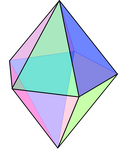
|
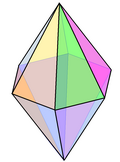
|
... | ||
| Spherical tiling image |

|
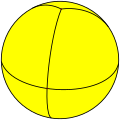
|

|

|

|
Plane tiling image |

|
| Face config. | V2.4.4 | V3.4.4 | V4.4.4 | V5.4.4 | V6.4.4 | ... | V∞.4.4 |
| Coxeter diagram |
   
|

|

|

|

|
... | 
|