| Shukra | |
|---|---|
Guru of the Asuras God of Venus | |
| Member of Navagraha | |
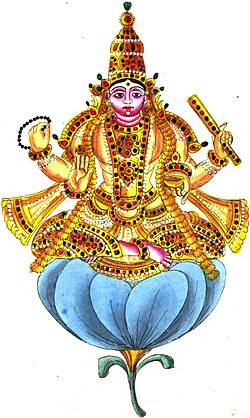 Depiction of Shukra from the 1842 book The Complete Hindoo Pantheon by E. A. Rodrigues | |
| Devanagari | शुक्र |
| Affiliation | Asuras, Daityas, Devas, Grahas |
| Abode | Patala Loka |
| Planet | Venus |
| Mantra |
Om drāṃ drīṃ drauṃ saḥ śukrāya namaḥa
|
| Day | Friday |
| Color | White1 |
| Number | 6 , 15 , 24 |
| Mount | White Horse |
| Genealogy | |
| Parents | |
| Consort | Jayanti, Urjjasvati, and Sataparva3 |
| Children | Devayani, Arā, Shanda, Tvasthadhar, and Marka2 |
Shukra (/ˈʃuːkrə/ SHOO-krə;4 Sanskrit: शुक्र, IAST: Śukra) is a Sanskrit word that means "clear" or "bright". It also has other meanings, such as the name of a sage who was the preceptor of the asuras and taught them the Vedas.5 In mythology and Hindu astrology, the word refers to the planet Venus, one of the Navagrahas.6
Hinduism
In Hinduism, Shukra is one of the sons of Bhrigu, one of the Saptarshis. He was the guru of the asuras and is also referred to as Shukracharya or Asuracharya in various Hindu texts. In another account found in the Mahabharata, Shukra divided himself into two, one half became the fount of knowledge for the devas (gods) and the other half became the knowledge source of the asuras (demons).6 Shukra, in the Puranas, is blessed by Shiva with Sanjeevini Vidhya after performing tapas to propitiate Shiva. Sanjeevini Vidhya is the knowledge of raising the dead back to life, which he used from time to time to restore life to the asuras. Later, this knowledge was sought by the devas and was ultimately gained by them.6
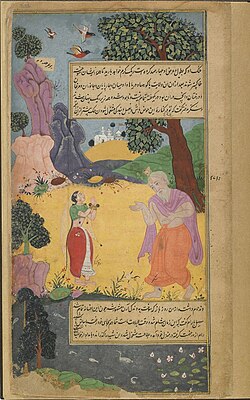
Vamana, the dwarf avatar of Vishnu, requests the asura king Mahabali for three steps of land. Mahabali acceded to the request and as was the practice, took up the kamandalu to pour water to symbolically signify the donation to Vamana. When Shukra, the asuras' guru, had realised Vamana's true identity, he tried to prevent the flow of water from the kamandalu by blocking the spout, Vamana pierced the spout with a stick, blinded Shukra.7
Shukra's mother was Kavyamata, whilst Shukra's wives were the goddesses Urjasvati, Jayanti, and Sataparva. Sometimes, Urjjasvati and Jayanti are considered to be one goddess.8 With her, Shukra produced many children, including Queen Devayani.9 Sataparva was childless.
In the Mahabharata, Shukracharya is mentioned as one of the mentors of Bhishma, having taught him political science in his youth.10
Astrology
In classical Vedic astrology or Jyotisha, Shukra is considered to be among the Navagrahas (Nine planets) that influence the pattern of life on earth. Shukra represents women, beauty, wealth, luxury, and sex. According to classical astrological texts, a powerfully placed Shukra, aspected by benefic planets such as Jupiter, and in favourable signs and houses in the birth chart, ensures material well-being. Its beej mantra is "Om Draam Dreem Draum Sah Shukraya Namaha". It is associated with Friday, and the gem diamond. The classical shastras ordain that the best method to attain the blessings of Shukra is to respect the women in one’s life.
It is also popularly propitiated through Devi Aradhana or worshipping the goddess Lakshmi.
Planet
Shukra as a planet appears in various Hindu astronomical texts in Sanskrit, such as the 5th century Aryabhatiya by Aryabhatta, the 6th century Romaka by Latadeva and Panca Siddhantika by Varahamihira, the 7th century Khandakhadyaka by Brahmagupta and the 8th century Sisyadhivrddida by Lalla.1112 These texts present Shukra as one of the planets and estimate the characteristics of the respective planetary motion.11 Other texts such as Surya Siddhanta dated to have been complete sometime between the 5th century and 10th century present their chapters on various planets with deity mythologies.11
The manuscripts of these texts exist in slightly different versions, present Shukra's motion in the skies, but vary in their data, suggesting that the text were open and revised over their lives.131415
The 1st millennium CE Hindu scholars had estimated the time it took for sidereal revolutions of each planet including Shukra, from their astronomical studies, with slightly different results:16
| Source | Estimated time per sidereal revolution16 |
| Surya Siddhanta | 224 days, 16 hours, 45 minutes, 56.2 seconds |
| Siddhanta Shiromani | 224 days, 16 hours, 45 minutes, 1.9 seconds |
| Ptolemy | 224 days, 16 hours, 51 minutes, 56.8 seconds |
| 20th century calculations | 224 days, 16 hours, 49 minutes, 8.0 seconds |
Calendar and zodiac
The weekday Shukravara in Hindu calendar, or Friday, has roots in Shukra (Venus). Shukravara is found in most Indian languages, and Shukra Graha is driven by the planet Venus in Hindu astrology. The word "Friday" in the Greco-Roman and other Indo-European calendars is also based on the planet Venus.
Shukra is a part of the Navagraha in the Hindu zodiac system. The Navagraha developed from early works of astrology over time. Deifying planetary bodies and their astrological significance occurred as early as the Vedic period and was recorded in the Vedas. The classical planets, including Venus, were referenced in the Atharvaveda around 1000 BCE. The planet Venus was deified and referred to as Shukra in various Puranas.
See also
See also
References
References
- Jordan, Michael (14 May 2014). Dictionary of Gods and Goddesses (2nd ed.). Infobase Publishing. p. 295. ISBN 978-1-4381-0985-5.
- "Shukra, Śukrā, Śukra: 39 definitions". 24 June 2012.
- Mani, Vettam (1975). Puranic encyclopaedia : a comprehensive dictionary with special reference to the epic and Puranic literature. Robarts - University of Toronto. Delhi : Motilal Banarsidass. p. 760. ISBN 978-0-8426-0822-0.
{{cite book}}: CS1 maint: publisher location (link) - "Shukra". Google Dictionary. Retrieved 9 August 2025.
- Charles Russell Coulter; Patricia Turner (2013). Encyclopedia of Ancient Deities. Routledge. p. 108. ISBN 978-1-135-96390-3.
- Roshen Dalal (2010). Hinduism: An Alphabetical Guide. Penguin Books India. pp. 387–388. ISBN 978-0-14-341421-6.
- https://web.archive.org/web/20050207221439/http://www.pichu.info/nav.htm, Suryanar Koil
- Dikshitar, V. R. Ramachandra (31 January 1996). The Purana Index. Motilal Banarsidass Publishers. ISBN 978-81-208-1273-4.
- Dikshitar, V. R. Ramachandra (31 January 1996). The Purana Index. Motilal Banarsidass Publishers. ISBN 978-81-208-1273-4.
- Subramaniam, Kamala (2007). "Adi Parva". The Mahabharata. Bharatiya Vidya Bhavan India. ISBN 978-81-7276-405-0.
- Ebenezer Burgess (1989). P Ganguly, P Sengupta (ed.). Sûrya-Siddhânta: A Text-book of Hindu Astronomy. Motilal Banarsidass (Reprint), Original: Yale University Press, American Oriental Society. pp. vii–xi. ISBN 978-81-208-0612-2.
- Bina Chatterjee (1970). The Khandakhadyaka (an astronomical treatise) of Brahmagupta: with the commentary of Bhattotpala (in Sanskrit). Motilal Banarsidass. pp. 72–74, 40, 69. OCLC 463213346.
- Lionel D. Barnett (1994). Antiquities of India: An Account of the History and Culture of Ancient Hindustan. Asian Educational Services. pp. 190–192. ISBN 978-81-206-0530-5.
- Ebenezer Burgess (1989). P Ganguly, P Sengupta (ed.). Sûrya-Siddhânta: A Text-book of Hindu Astronomy. Motilal Banarsidass (Reprint), Original: Yale University Press, American Oriental Society. pp. ix–xi, xxix. ISBN 978-81-208-0612-2.
- J Fleet (1911). "Arbhatiya". Journal of the Royal Asiatic Society of Great Britain and Ireland. Cambridge University Press for the Royal Asiatic Society: 794–799.
- Ebenezer Burgess (1989). P Ganguly, P Sengupta (ed.). Sûrya-Siddhânta: A Text-book of Hindu Astronomy. Motilal Banarsidass (Reprint), Original: Yale University Press, American Oriental Society. pp. 26–27. ISBN 978-81-208-0612-2.
Further reading
Further reading
- Pingree, David (1973). "The Mesopotamian Origin of Early Indian Mathematical Astronomy". Journal for the History of Astronomy. 4 (1). SAGE: 1–12. Bibcode:1973JHA.....4....1P. doi:10.1177/002182867300400102. S2CID 125228353.
- Pingree, David (1981). Jyotihśāstra : Astral and Mathematical Literature. Otto Harrassowitz. ISBN 978-3447021654.
- Yukio Ohashi (1999). Johannes Andersen (ed.). Highlights of Astronomy, Volume 11B. Springer Science. ISBN 978-0-7923-5556-4.