| Pachysandra | |
|---|---|
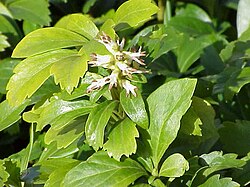
| |
| Pachysandra terminalis | |
Scientific classification 
| |
| Kingdom: | Plantae |
| Clade: | Embryophytes |
| Clade: | Tracheophytes |
| Clade: | Spermatophytes |
| Clade: | Angiosperms |
| Clade: | Eudicots |
| Order: | Buxales |
| Family: | Buxaceae |
| Genus: | Pachysandra Michx. |
| Species | |
|
See text | |
Pachysandra /ˌpækiˈsændrə/1 is a genus of five species of evergreen perennials or subshrubs, belonging to the boxwood family Buxaceae. The species are native to eastern Asia and southeast North America, some reaching a height of 20–45 cm (7.9–17.7 in), with only weakly woody stems. The leaves are alternate, leathery, with a coarsely toothed margin, and are typically 5–10 cm (2.0–3.9 in) long. The small uni-sexual blooms are greenish-white and produced in late spring or early summer.2

Etymology
Pachysandra is derived from the Ancient Greek word παχύς (pachýs, 'thick') and the Neo-Latin -androus ('of or pertaining to stamens'), and is a reference to the thick stamens.34
Species
- Pachysandra axillaris - China
- Pachysandra coriacea (sometimes classified as Sarcococca coriacea) - India, Nepal, Myanmar
- Pachysandra procumbens - Allegheny Pachysandra (southeast United States)
- Pachysandra stylosa - China (sometimes treated as a variety of P. axillaris5)
- Pachysandra terminalis - China, Japan678
Cultivation and uses
Pachysandra can grow in deep-shade areas and is thus well-suited and popular as ground cover for shade gardens. There are several varieties used in the garden landscape, all of which are deer-resistant:
- The most commonly used species is P. terminalis, or Japanese spurge, which is an aggressively spreading evergreen ground cover.
- 'Variegata' has leaves attractively variegated green and creamy white, with a slower growth/spreading rate as P. terminalis.
- 'Green Sheen' Pachysandra has extra glossy dark green leaves and slowly spreads.
- 'Green Carpet' Pachysandra has deeper semi glossed green leaves than the common P. Terminalis, with prominent veining, more toothed serrations to the leaf edge, and a shorter more compact growth habit.8
All species in this genus prefer a well-drained soil with a high humus content.
References
References
- Sunset Western Garden Book, 1995, pp.606–607.
- RHS A-Z encyclopedia of garden plants. United Kingdom: Dorling Kindersley. 2008. p. 1136. ISBN 978-1405332965.
- Gledhill, David (2008). "The Names of Plants". Cambridge University Press. ISBN 9780521866453 (hardback), ISBN 9780521685535 (paperback). pp 63, 287
- "pachysandra". Merriam-Webster.com Dictionary. Merriam-Webster. OCLC 1032680871.
- 2b. Pachysandra axillaris var. stylosa (Dunn) M. Cheng, Flora of China
- GRIN Species Records of Pachysandra, GRIN Taxonomy for Plants
- 3. Pachysandra A. Michaux, Flora of China
- "Pachysandra Terminalis Ground Cover". Peekskill Nurseries. Retrieved 2025-03-26.
External links
External links