| Sarcococca | |
|---|---|
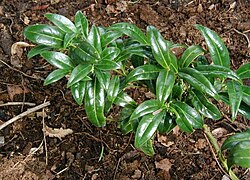
| |
| Sarcococca humilis | |
Scientific classification 
| |
| Kingdom: | Plantae |
| Clade: | Embryophytes |
| Clade: | Tracheophytes |
| Clade: | Spermatophytes |
| Clade: | Angiosperms |
| Clade: | Eudicots |
| Order: | Buxales |
| Family: | Buxaceae |
| Genus: | Sarcococca Lindl. |
| Species | |
|
See text | |
Sarcococca, nicknamed sweet box or Christmas box,12 is a genus of flowering plants in the family Buxaceae. native to eastern and southeastern Asia, and the Himalayas, with one species native to Central America. They are slow-growing, monoecious, evergreen shrubs 1–2 m (3–7 ft) tall. The leaves are borne alternately, 3–12 cm long and 1–4 cm broad.
Distribution and habitat
As of January 2025, the genus Sarcococca contains 15 accepted species.34 The genus is predominantly native to Asia, with more than half of the Sarcococca species native to China,5 however one species (Sarcococca conzattii) is native to southern Mexico (Oaxaca) and Guatemala.67
Physical characteristics
The plants bear fragrant white flowers, often in winter. The fruit is a red or black drupe containing 1–3 seeds. Some species are cultivated as groundcover or low hedging in moist, shady areas.8 The basic chromosome number for the genus is 14 (2n = 28).9
Name origin
The genus name Sarcococca comes from the Greek σάρξ (sárx) and κόκκος (kókkos) for "fleshy berry", referring to the black fruit.10
Selected species
- Sarcococca confusa Sealy – Sweet box
- Sarcococca conzattii (Standl.) I.M.Johnst.
- Sarcococca hookeriana Baill.
- Sarcococca humilis Stapf
- Sarcococca longifolia M. Cheng
- Sarcococca longipetiolata M. Cheng
- Sarcococca orientalis C. Y. Wu
- Sarcococca pruniformis (Saracodine courier)
- Sarcococca ruscifolia Stapf
- Sarcococca saligna (D. Don) Mull.-Arg.
- Sarcococca vagans Stapf
- Sarcococca wallichii Stapf
- Sarcococca zeylanica Baill.
References
References
- The Plant List: http://www.theplantlist.org/tpl1.1/search?q=sarcococca
- Hilliers Manual of Trees and Shrubs, Redwood Burn, 1998
- "Sarcococca Lindl. | Plants of the World Online | Kew Science". Plants of the World Online. Retrieved 2025-01-15.
- "Sarcococca Lindl". www.worldfloraonline.org. Archived from the original on 2023-03-17. Retrieved 2025-01-15.
- "Sarcococca in Flora of China @ efloras.org". www.efloras.org. Retrieved 2025-01-15.
- "Sarcococca conzattii (Standl.) I.M.Johnst. | Plants of the World Online | Kew Science". Plants of the World Online. Retrieved 2025-01-15.
- Shipunov, Alexey; Lee, Hye Ji; Choi, Jinhee; Pay, Kyle; DeSpiegelaire, Sarah; Floden, Aaron (2020-08-07). "Not out of the box: phylogeny of the broadly sampled Buxaceae". bioRxiv 10.1101/2020.08.03.235267.
- RHS A-Z encyclopedia of garden plants. United Kingdom: Dorling Kindersley. 2008. p. 1136. ISBN 978-1-4053-3296-5.
- Kubitzki, Klaus (2007). The Families and Genera of Vascular Plants. Vol. 9. Flowering Plants. Eudicots: Berberidopsidales, Buxales, Crossosomatales, Fabales p.p., Geraniales, Gunnerales, Myrtales p.p., Proteales, Saxifragales, Vitales, Zygophyllales, Clusiaceae Alliance, Passifloraceae Alliance, Dilleniaceae, Huaceae, Picramniaceae, Sabiaceae. Springer Science & Business Media. p. 43. ISBN 978-3540322191.
For Sarcococca, diploids with 2n=28 (less frequently, tetraploids) are recorded.
- Coombes, Allen J. (2012). The A to Z of plant names. USA: Timber Press. pp. 312. ISBN 978-1-60469-196-2.