 | |
 | |
| Clinical data | |
|---|---|
| Other names | MBT; N-Methyl-N-butyltryptamine |
| Routes of administration | Oral1 |
| Drug class | Serotonergic psychedelic; Hallucinogen |
| ATC code |
|
| Pharmacokinetic data | |
| Duration of action | 4–6 hours1 |
| Identifiers | |
| |
| CAS Number | |
| PubChem CID | |
| ChemSpider | |
| UNII | |
| CompTox Dashboard (EPA) | |
| Chemical and physical data | |
| Formula | C15H22N2 |
| Molar mass | 230.355 g·mol−1 |
| 3D model (JSmol) | |
| |
| |

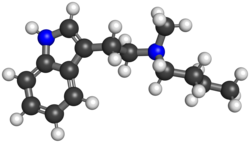
Methylbutyltryptamine (MBT), also known as N-methyl-N-butyltryptamine, is a lesser-known psychedelic drug of the tryptamine family related to dimethyltryptamine (DMT).1
Use and effects
In his book TiHKAL (Tryptamines I Have Known and Loved), Alexander Shulgin lists the dose of MBT as 250 to 400 mg orally and the duration as 4 to 6 hours.1 MBT produces a heavy body load with dehydration, and causes visuals similar to those of DMT.1 Very little data exists about the pharmacological properties, metabolism, and toxicity of MBT.1
Interactions
Chemistry
Synthesis
The chemical synthesis of MBT has been described.1
Analogues
Analogues of MBT include 4-HO-MBT, 5-MeO-MBT, methylethyltryptamine (MET), methylpropyltryptamine (MPT), methylisopropyltryptamine (MiPT), methylallyltryptamine (MALT), among others.1
MSBT
TiHKAL mentions that a structural isomer of MBT exists, with the butyl group attached at the nitrogen atom.1 It is known as N-sec-butyl-N-methyltryptamine, or MSBT.1 However, little is known about its psychoactivity.1
References
References
- Shulgin, Alexander; Shulgin, Ann (September 1997). TiHKAL: The Continuation. Berkeley, California: Transform Press. ISBN 0-9630096-9-9. OCLC 38503252.