 | |
 | |
| Clinical data | |
|---|---|
| Other names | MPT; N-Methyl-N-propyltryptamine |
| Routes of administration | Oral1 |
| Drug class | Serotonergic psychedelic; Hallucinogen |
| ATC code |
|
| Identifiers | |
| |
| CAS Number | |
| PubChem CID | |
| ChemSpider | |
| UNII | |
| Chemical and physical data | |
| Formula | C14H20N2 |
| Molar mass | 216.328 g·mol−1 |
| 3D model (JSmol) | |
| |
| |

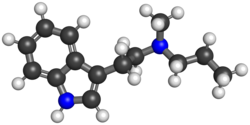
Methylpropyltryptamine (MPT), also known as N-methyl-N-propyltryptamine, is a psychedelic drug of the tryptamine family. It is a homologue of methylethyltryptamine (MET).1
Use and effects
In his book TiHKAL (Tryptamines I Have Known and Loved), Alexander Shulgin described MPT's effects as being unknown and its dose as being greater than 50 mg orally.1
Interactions
Chemistry
Detection
An analytical method for MPT's detection has been reported.2
Crystal structure
In 2019, Chadeayne et al. published the crystal structure of MPT.3 The authors describe the structure as "...a single molecule in the asymmetric unit, with an indole group that demonstrates a mean deviation from planarity of 0.015 A°."
Analogues
Analogues of MPT include 4-HO-MPT, 5-MeO-MPT, methylethyltryptamine (MET), ethylpropyltryptamine (EPT), ethylisopropyltryptamine (EiPT), and dipropyltryptamine (DPT), among others.1
Society and culture
Legal status
Canada
MPT is not a controlled substance in Canada as of 2025.4
United States
MPT is not an explicitly controlled substance in the United States.5 However, it is an isomer of diethyltryptamine (DET), which is a schedule I controlled substance in this country, and so may be considered a controlled substance in the United States similarly.56
References
References
- Shulgin A, Shulgin A (September 1997). TiHKAL: The Continuation. Berkeley, California: Transform Press. ISBN 0-9630096-9-9. OCLC 38503252.
- Brandt SD, Freeman S, Fleet IA, Alder JF (September 2005). "Analytical chemistry of synthetic routes to psychoactive tryptamines. Part III. Characterisation of the Speeter and Anthony route to N,N-dialkylated tryptamines using CI-IT-MS-MS". The Analyst. 130 (9): 1258–1262. Bibcode:2005Ana...130.1258B. doi:10.1039/b504001a. PMID 16096671.
- Chadeayne AR, Golen JA, Manke DR (2019-07-28). "N -Methyl- N -propyltryptamine (MPT)". IUCrData. 4 (7) x190962. Bibcode:2019IUCrD...490962C. doi:10.1107/S2414314619009623. ISSN 2414-3146.
- "Controlled Drugs and Substances Act". Department of Justice Canada. Retrieved 19 January 2026.
- Orange Book: List of Controlled Substances and Regulated Chemicals (January 2026) (PDF), United States: U.S. Department of Justice: Drug Enforcement Administration (DEA): Diversion Control Division, January 2026
- Drug Enforcement Administration (3 December 2007). "Definition of "Positional Isomer" as It Pertains to the Control of Schedule I Controlled Substances". Federal Register.