 | |
 | |
| Clinical data | |
|---|---|
| Other names | MALT; N,N-Methylallyltyptamine |
| Routes of administration | Oral, smoking, vaping1 |
| Drug class | Serotonin receptor modulator; Serotonergic psychedelic; Hallucinogen |
| ATC code |
|
| Legal status | |
| Legal status |
|
| Pharmacokinetic data | |
| Onset of action | Unknown12 |
| Duration of action | Unknown12 |
| Identifiers | |
| |
| CAS Number | |
| PubChem CID | |
| ChemSpider | |
| UNII | |
| CompTox Dashboard (EPA) | |
| Chemical and physical data | |
| Formula | C14H18N2 |
| Molar mass | 214.312 g·mol−1 |
| 3D model (JSmol) | |
| |
| |
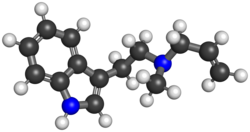
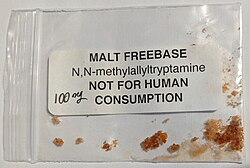
Methylallyltryptamine (MALT), also known as N-methyl-N-allyltryptamine, is a lesser-known psychedelic drug from the tryptamine family.1 It is a novel compound with very little history of human use.1 It is closely related to methylpropyltryptamine (MPT).1 The drug has been sold online as a designer drug.1 Very little information on the pharmacology or toxicity of MALT is available.
Use and effects
MALT was not included in Alexander Shulgin's 1997 book TiHKAL (Tryptamines I Have Known and Loved).2 However, years after the book's publication, he described MALT as having important unexplored potential as a psychedelic drug.3 Subsequently, MALT was encountered as a novel designer drug.1 It has been reported to have been used at doses of 25 to 50 mg via routes including oral, smoking, or vaping.1 The drug's effects have been described as comparable to those of methylpropyltryptamine (MPT) but less pronounced.1
Interactions
Pharmacology
Pharmacodynamics
MALT is a serotonin receptor modulator and has been found to interact with the serotonin 5-HT1A, 5-HT2A, and 5-HT2C receptors.4
Chemistry
Analogues
Analogues of MALT include 4-HO-MALT, 4-AcO-MALT, 5-MeO-MALT, diallyltryptamine (DALT), methylpropyltryptamine (MPT), and methylisopropyltryptamine (MiPT), among others.
History
MALT was first described in the scientific literature by Niels Jensen of the University of Göttingen by 2004.4 The drug was subsequently first encountered as a novel designer drug by 2018.1
Society and culture
Legal status
MALT is not explicitly scheduled in any countries; however, it could be considered a psychoactive substance under the United Kingdom Psychoactive Substances Act, which requires the prosecutor to prove that the substance is psychoactive in order for a person to be charged with an offense.5 It could also be considered a structural analogue of a scheduled substance under the United States Federal Analogue Act due to its similarity to scheduled tryptamines. It is not a controlled substance in Canada as of 2025.6
References
References
- "MALT". АИПСИН (in Russian). Retrieved 2 January 2026.
- Shulgin A, Shulgin A (September 1997). TiHKAL: The Continuation. Berkeley, California: Transform Press. ISBN 0-9630096-9-9. OCLC 38503252.
- Morris H (2014). "Alexander Shulgin (1925–2014)". The Fabulist. No. 5.
On that day in 2010, Alexander Shulgin was sitting outside under a parasol in his front yard surrounded by admirers, looking very happy, and talking discursively about the unexplored potential in 5-ethoxylated tryptamines and asymmetrical N-allyl-tryptamines such as MAlT, EAlT, PAlT, and iPAlT
- Jensen N (2004). Tryptamines as Ligands and Modulators of the Serotonin 5‑HT2A Receptor and the Isolation of Aeruginascin from the Hallucinogenic Mushroom Inocybe aeruginascens (PDF) (Thesis). Georg-August-University Göttingen. doi:10.53846/goediss-2111.
- "Psychoactive Substances Act Guidance" (PDF). The Crown Prosecution Service. Retrieved 2021-09-23.
- "Controlled Drugs and Substances Act". Department of Justice Canada. Retrieved 19 January 2026.