| Kuki-Chin | |
|---|---|
| Kuki-Chin-Mizo, Kukish, South Central Tibeto-Burman, South Central Trans-Himalayan | |
| Geographic distribution | India, Myanmar, Bangladesh |
| Ethnicity | Zo |
| Linguistic classification | Sino-Tibetan
|
Early form | |
| Subdivisions | |
| Language codes | |
| Glottolog | kuki1246 Kuki-Chin |
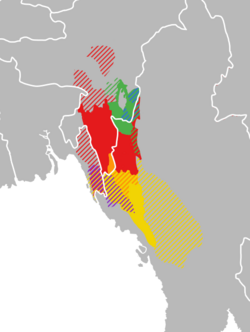
The Kuki-Chin languages (also called Kukish2 or South-Central Tibeto-Burman languages) are a branch of the Sino-Tibetan language family spoken in northeastern India, western Myanmar and southeastern Bangladesh. Most notable Kuki-Chin-speaking ethnic groups are referred to collectively as the Zo people which includes the Mizo, Kuki, Chin and Zomi people.
Kuki-Chin is alternatively called South-Central Trans-Himalayan (or South Central Tibeto-Burman) by Konnerth (2018), because of negative connotations of the term "Kuki-Chin" for many speakers of languages in this group.3
Kuki-Chin is sometimes placed under Kuki-Chin–Naga, a geographical rather than linguistic grouping.
Geographical distribution
- Northwestern ("Old Kuki"): Chandel district of Manipur, India; Tamu Township of Sagaing Region, Myanmar.
- Northeastern ("Kuki-Zo"): Chandel district, Churachandpur district, Kangpokpi district, Noney district, Tamenglong district, and Tengnoupal districts of Manipur, India; Tedim Township of Chin State, Myanmar; Tamu Township of Sagaing Region, Myanmar.
- Central: whole state of Mizoram, India; Pherzawl district of Manipur, India; parts of Cachar district and parts of Karbi Anglong district of Assam, India; parts of East Jaintia Hills district of Meghalaya, India; Falam Township, Hakha Township, and Thantlang Townships of Chin State, Myanmar; Kalay Township and Khampat area of Sagaing Region, Myanmar, parts of Chittagong Hill Tracts of Bangladesh.
- Maraic: majority of Siaha district of Mizoram, India; parts of Matupi Township of Chin State, Myanmar.
- Southern: Kanpetlet Township, Matupi Township, Mindat Township, Paletwa Townships of Chin State, Myanmar; parts of the Arakan Range of Rakhine State, Myanmar; parts of Chittagong Hill Tracts of Bangladesh.
- Khomic: Paletwa Township of Chin State, Myanmar; parts of Chittagong Hill Tracts of Bangladesh.
Internal classification
The Karbi languages may be closely related to Kuki-Chin, but Thurgood (2003) and van Driem (2011) leave Karbi unclassified within Sino-Tibetan.45
The Kuki-Chin branches listed below are from VanBik (2009), with the Northwestern branch added from Scott DeLancey, et al. (2015),6 and the Khomic branch (which has been split off from the Southern branch) from Peterson (2017).7
- Kuki-Chin
- Central: Mizo (Duhlian), Bawm (Sunthla and Panghawi), Falam (Hallam, Ranglong, Darlong, Hauhulh, Simpi, Hualngo, Chorei), Thor (Tawr), Hmar, Hrangkhol, Biate (Biete), Hakha (Lai/Pawi, Mi-E, Zokhua), Pangkhua, Saihriem, Laizo/Tlaisun, Khualsim, Zanniat, Zahau, Sim
- Maraic: Mara (Tlosai {Siaha and Saikao}, Hawthai {Lyvaw, Sizo, and Lochei}, Hlaipao {Zyhno, Heima, and Lialai}), Zophei, Senthang, Zotung (Lungngo, Calthawn, Innmai), Lautu
- Northeastern (Northern): Suantak-Vaiphei, Zo (Zou), Paite, Tedim, Thado (Kuki), Gangte, Simte, Vaiphei, Sizang, Ralte, Ngawn
- Southern: Shö (Asho/Khyang, Chinbon), Thaiphum, Daai (Nitu), Mün, Yindu, Matu, Welaung (Rawngtu), Kaang, Laitu, Rungtu, Songlai, Sumtu
- Khomic: Khumi (Khumi proper and Khumi Awa), Mro, Rengmitca, etc.
- Northwestern ("Old Kuki"): Monsang, Moyon, Lamkang, Aimol, Anal, Tarao, Koireng (Kolhreng), Chiru, Kom, Chothe, Purum,7 Kharam,7
Darlong and Ranglong are unclassified Kuki-Chin language.
The recently discovered Sorbung language may be mixed language that could classify as either a Kuki-Chin or Tangkhul language.8
Anu-Hkongso speakers self-identify as ethnic Chin people, although their language is closely related to Mru rather than to Kuki-Chin languages. The Mruic languages constitute a separate Tibeto-Burman branch, and are not part of Kuki-Chin.7
VanBik (2009)
Kenneth VanBik classified the Kuki-Chin languages based on shared sound changes (phonological innovations) from Proto-Kuki-Chin as follows.9
- Kuki-Chin
- Central: *k(ʰ)r-, *p(ʰ)r- > *t(ʰ)r-; *k(ʰ)l-, *p(ʰ)l- > *t(ʰ)l-; *y- > *z-
- Maraic: *kr- > *ts-; *-ʔ, *-r, *-l > -Ø; *-p, *-t, *-k > *-ʔ; *θ- > *s-
- Mara
- Tlosai
- Saikao
- Siaha
- Hlaipao
- Heima
- Lialai
- Vahapi/Zyhno
- HawThai
- Sizo
- Ngaphepi
- Sabyu
- Chapi
- Lyvaw
- Lochei
- Tisih
- Phybyu
- Sizo
- Tlosai
- Lautu
- Hnaro
- Chawngthia
- Zophei
- Vytu
- Sate/Awsa
- Senthang
- Khuapi
- Surkhua
- Zotung *h- > *f-; *kr- > *r-; *khl- > *kh-, *l-; *c(h)- > *t(h)-/*s-; *y- > *z-/*z(h)-; *w- > *v-
- Calthawng
- Innmai
- Lungngo/Tinpa
- Mara
- Peripheral: *r- > *g-
Peterson (2017)
David A. Peterson's internal classification of the Kuki-Chin languages is as follows.10
- Kuki-Chin
- Northwestern ("Old Kuki"): Purum, Koireng, Monsang, etc.
- Central
- Peripheral
Peterson's Northeastern branch corresponds to VanBik's Northern branch, while Peterson's Northwestern corresponds to the Old Kuki branch of earlier classifications.
References
References
- VanBik 2009.
- Burling, Robbins (2003). "The Tibeto-Burman languages of Northeastern India". In Thurgood, Graham; LaPolla, Randy J. (eds.). The Sino-Tibetan Languages (1st ed.). Routledge. pp. 169–191. ISBN 0-7007-1129-5.
- Konnerth, Linda (2018). "The historical phonology of Monsang (Northwestern South-Central/"Kuki-Chin"): A case of reduction in phonological complexity". Himalayan Linguistics. 17 (1): 19–49. doi:10.5070/H917134878.
...many language activists among the speakers of languages of the South-Central branch has made it clear to me that using the "Kuki-Chin" label is very insensitive.
- Thurgood, Graham (2003). "A subgrouping of the Sino-Tibetan languages: The interaction between language contact, change, and inheritance". In Thurgood, Graham; LaPolla, Randy J. (eds.). The Sino-Tibetan languages. London: Routledge. pp. 13–14. ISBN 0-7007-1129-5.
- van Driem, George L. (2011). "Tibeto-Burman subgroups and historical grammar". Himalayan Linguistics Journal. 10 (1): 31–39. Archived from the original on 12 January 2012.
- DeLancey, Scott; Boro, Krishna; Konnerth, Linda; Teo, Amos (14 May 2015). Tibeto-Burman Languages of the Indo-Myanmar borderland. 31st South Asian Languages Analysis Roundtable.
- Peterson 2017.
- Mortenson, David; Keogh, Jennifer (2011). "Sorbung, an Undocumented Language of Manipur: its Phonology and Place in Tibeto-Burman" (PDF). Journal of the Southeast Asian Linguistics Society. 4 (1): 64–114.
- VanBik 2009, p. 23.
- Peterson 2017, p. 206.
Bibliography
Bibliography
- van Driem, George (2001). Languages of the Himalayas: An Ethnolinguistic Handbook of the Greater Himalayan Region. Brill. ISBN 978-90-04-12062-4.
- Peterson, David A. (2017). "On Kuki-Chin subgrouping". In Ding, Picus Sizhi; Pelkey, Jamin (eds.). Sociohistorical linguistics in Southeast Asia: New horizons for Tibeto-Burman studies in honor of David Bradley. Leiden: Brill. pp. 189–209. doi:10.1163/9789004350519_012. ISBN 978-90-04-34983-4.
- VanBik, Kenneth (20 October 2009). Proto-Kuki-Chin: a reconstructed ancestor of the Kuki-Chin languages (PDF). Berkeley: University of California. ISBN 0-944613-47-0. Archived (PDF) from the original on 2 July 2013.
Further reading
Further reading
- Button, Christopher (2011). Proto Northern Chin (PDF). STEDT Monograph. Vol. 10. ISBN 0-944613-49-7. OCLC 1013268663.
- Hill, Nathan W. (2014). "Proto-Kuki-Chin initials according to Toru Ohno and Kenneth VanBik". Journal of the Southeast Asian Linguistics Society. 7: 11–30.
- Lam Thang, Khoi (2001). A Phonological Reconstruction of Proto Chin (PDF) (MA thesis). Chiang Mai: Payap University.
- Mann, Noel; Smith, Wendy (2008). "Chin bibliography" (PDF). Chiang Mai: Payap University. Archived from the original (PDF) on 23 April 2019.
- Dal Sian Pau, S. (2014). The comparative study of Proto-Zomi (Kuki-Chin) languages. Lamka, Manipur, India: Zomi Language & Literature Society. – Comparative word list of Paite, Simte, Thangkhal, Zou, Kom, Paite or Tedim, and Vaiphei
- Smith, Wendy; Mann, Noel (2009). "Chin bibliography with selected annotations" (PDF). Chiang Mai: Payap University. Archived from the original (PDF) on 30 October 2019.