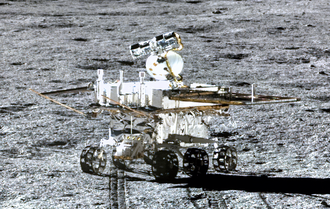
 Yutu-2 rover on the Moon as seen by the Chang'e 4 lander | |
| Mission type | lunar rover |
|---|---|
| Operator | CNSA |
| Mission duration | 3 months (planned)1 Current: 2714 days |
| Spacecraft properties | |
| Launch mass | Rover: 140 kg2 |
| Landing mass | 140 kg |
| Dimensions | 1.5 × 1.0 × 1.0 m3 |
| Start of mission | |
| Launch date | 7 December 2018, 18:23 UTC4 |
| Rocket | Long March 3B5 |
| Launch site | Xichang Satellite Launch Center |
| Lunar rover | |
| Landing date | 3 January 2019, 02:26 UTC6 |
| Landing site | Von Kármán crater in the South Pole-Aitken Basin |
| Distance driven | 1.613 km (1.002 mi) as of 19 September 20247 |
Yutu-2 (Chinese: 玉兔二号; pinyin: Yùtù Èrhào) is the robotic lunar rover component of CNSA's Chang'e 4 mission to the Moon, launched on 7 December 2018 18:23 UTC, it entered lunar orbit on 12 December 2018 before making the first soft landing on the far side of the Moon on 3 January 2019. Yutu-2 is currently operational as the longest-lived lunar rover8 after it eclipsed (on 20 November 2019) the previous lunar longevity record of 321 Earth days held by the Soviet Union's Lunokhod 1 rover.
Yutu-2 is the first lunar rover to traverse the far side of the Moon. By January 2022, it had travelled a distance of more than 1,000 metres (3,300 ft) along the lunar surface.910 Data from its ground penetrating radar (GPR) has been used by scientists to put together imagery of multiple layers deep beneath the surface of the far side of the Moon.11 As of September 2025, the Yutu-2 was still active,12 after a period of immobility, images from the LRO in September 2025 showed that it made small movements on the surface in the last lunar days (for a total of over 1,600 meters, about a mile).13
Overview
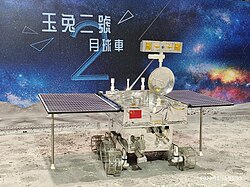
The total landing mass is 1,200 kg (2,600 lb).2 Both the stationary lander and Yutu-2 rover (literally: "Jade Rabbit") are equipped with a radioisotope heater unit (RHU) to maintain their subsystems during the long lunar nights,14 while electrical power is generated by solar panels.
After landing, the lander extended a ramp to deploy the Yutu-2 rover to the lunar surface.15 The rover measures 1.5 × 1.0 × 1.0 m (4.9 × 3.3 × 3.3 ft) with a mass of 140 kg (310 lb),23 and is propelled by six wheels. Yutu-2 was manufactured in Dongguan, Guangdong province.14 The rover is an improvement of the first Yutu rover from 2013; while its nominal operating time is three months,1 Chinese mission engineers hoped it would operate for "a few years", extending beyond its original planned mission.16
The landing craft touched down at 02:26 UTC on 3 January 2019, becoming the first spacecraft to land on the far side of the Moon, and the rover deployed about 12 hours later.17
Science payloads
- Panoramic Camera (PCAM), is installed on the rover's mast and can rotate 360°. It has a spectral range of 420 nm–700 nm and it acquires 3D images by binocular stereovision.18
- Lunar penetrating radar (LPR), is a ground penetrating radar with a probing depth of approximately 30 m with 30 cm vertical resolution, and more than 100 m with 10 m vertical resolution.18
- Visible and Near-Infrared Imaging Spectrometer (VNIS), for imaging spectroscopy that can then be used for identification of surface materials and atmospheric trace gases. The spectral range covers visible to near-infrared wavelengths (450 nm – 950 nm).
- Advanced Small Analyzer for Neutrals (ASAN), is an energetic neutral atom analyzer provided by the Swedish Institute of Space Physics (IRF). It will reveal how solar wind interacts with the lunar surface, which may help determine the process behind the formation of lunar water.19
Cost
According to Wu Yanhua, the deputy director of the project, the cost of the entire mission was "close to building one kilometer of subway", which can vary from 500 million yuan (about 72.6 million U.S. dollars) to 1.2 billion yuan (about 172.4 million dollars).20
Landing site
The landing site is within the Von Kármán crater21 (180 km or 110 mi diameter) in the South Pole-Aitken Basin on the far side of the Moon, which was previously unexplored by landers.2223 The site has symbolic as well as scientific value: Theodore von Kármán was the PhD advisor of Qian Xuesen, the founder of the Chinese space program.24
Operations and results

A day after landing, Yutu-2 went into hibernation for its first lunar night and it resumed activities on 10 January 2019, with all instruments operating nominally. During its first full lunar day, the rover travelled 120 m (390 ft), and on 11 February 2019 it powered down for its second lunar night.2526 In May 2019, it was reported that Chang'e 4 has identified what appear to be mantle rocks on the surface, its primary objective.272829
In November 2019, Yutu 2 broke the lunar longevity record previously held by the Soviet Union's Lunokhod 1 rover8 which operated on the lunar surface for eleven lunar days (321 Earth days).30
In February 2020, Chinese astronomers reported, for the first time, a high-resolution image of a lunar ejecta sequence, and, as well, direct analysis of its internal architecture. These were based on observations made by the rover's Lunar Penetrating Radar (LPR).3132
Data from its two-channel ground penetrating radar (GPR) has constructed an image of multiple layers beneath the surface to a depth of 300 meters.11
Gel-like Substance
In September 2019, the Yutu-2 rover found a mysterious, unusual "gel-like" substance on the lunar surface inside a small crater in the central region of the Von Kármán crater on the south pole of the far side of the Moon.33 Further analysis found that the substance resembled rock melted by a lunar impact, and the research indicates that the bright, green material is a rock that was melted by the heat generated by a meteorite impact.34
Mystery Hut
In December 2021, the rover pictured what appeared to be a particularly prominent boulder, dubbed the "Mystery Hut" (神秘小屋), or "Moon Cube",3536 which it was intended to explore in the following lunar days (Earth months).3738 On 7 January 2022, news reported that the rover reached the "Mystery Hut" after traveling for a month, and found it to be "irregularly shaped rock";39 resembling a rabbit, with a smaller nearby rock like a carrot, making a fitting discovery for the Yutu (Jade Rabbit).40
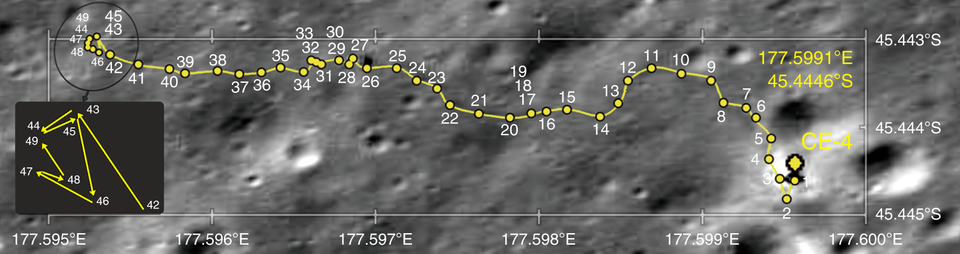
As of September 2025, Yutu-2 is moving, after a long break in 2024. According to images from LRO, the rover began to slow down in 2023, before coming to a complete stop in March 2024 and remaining motionless for several months.41 The rover has been working on the far side of the Moon for 7 years and 5 months, covering a total distance of 1,613 m (1.002 mi). It has exceeded its 3-month design lifespan and currently holds the record for the longest working time on the Moon.
See also
See also
References
References
- China says it will launch 2 robots to the far side of the moon in December on an unprecedented lunar exploration mission Archived 9 December 2018 at the Wayback Machine. Dave Mosher, Business Insider. 16 August 2018.
- Chang'e 3, 4 (CE 3, 4) Archived 20 March 2018 at the Wayback Machine. Gunter Dirk Krebs, Gunter's Space Page.
- This is the rover China will send to the 'dark side' of the Moon Archived 31 August 2018 at the Wayback Machine. Steven Jiang, CNN News. 16 August 2018.
- "CNSA". China National Space Administration (in Chinese (China)). Archived from the original on 10 December 2018. Retrieved 8 December 2018.
- Launch Schedule 2018 Archived 16 August 2018 at the Wayback Machine. SpaceflightNow, 18 September 2018.
- Barbosa, Rui (3 January 2019). "China lands Chang'e-4 mission on the far side of the Moon". Nasaspacefight. Archived from the original on 3 January 2019. Retrieved 3 January 2019.
- "China's Yutu 2 rover still going strong after nearly 6 years on the far side of the moon (Video)". Space.com. 19 September 2024. Archived from the original on 28 April 2025. Retrieved 23 April 2025.
- David, Leonard (18 December 2019). "China's Farside Moon Rover Breaks Lunar Longevity Record". Space.com. Archived from the original on 24 December 2020. Retrieved 21 December 2019.
- "Moon 'mystery hut' is just a rabbit-shaped rock, Chinese rover finds". Space.com. 11 January 2022. Archived from the original on 12 January 2022. Retrieved 12 January 2022.
- "China's lunar rover Yutu 2 is on a mission to investigate mystery object on far side of the moon". 5 December 2021. Archived from the original on 20 December 2021. Retrieved 6 December 2021.
- "China's Yutu 2 rover reveals deep layers below far side of the moon". Space.com. 24 August 2023.
- Jones, Andrew (19 September 2024). "China's Yutu 2 rover still going strong after nearly 7 years on the far side of the moon". Space.com. Archived from the original on 15 October 2024. Retrieved 20 October 2024.
- "Chang'e-4 lunar operations". forum.nasaspaceflight.com. Archived from the original on 30 December 2025. Retrieved 9 October 2025.
- China Shoots for the Moon's Far Side Archived 4 January 2019 at the Wayback Machine. (PDF) IEEE.org. 2018.
- Xu, Luyuan (15 June 2018). "How China's lunar relay satellite arrived in its final orbit". The Planetary Society. Archived from the original on 17 October 2018.
- China's Chang'e 4 spacecraft to try historic landing on far side of Moon 'between January 1 and 3' Archived 2 January 2019 at the Wayback Machine. South China Morning Post. 31 December 2018.
- "China's Chang'e-4 probe makes historic landing on moon's far side". China National Space Administration. 1 March 2019. Retrieved 23 May 2026.
- The scientific objectives and payloads of Chang'E−4 mission Archived 19 August 2019 at the Wayback Machine. (PDF) Yingzhuo Jia, Yongliao Zou, Jinsong Ping, Changbin Xue, Jun Yan, Yuanming Ning. Planetary and Space Science. 21 February 2018. doi:10.1016/j.pss.2018.02.011
- Andrew Jones (16 May 2016). "Sweden joins China's historic mission to land on the far side of the Moon in 2018". GBTimes. Archived from the original on 6 October 2018. Retrieved 12 January 2018.
- "China's latest Moon mission costs about as much as building 1 km of subway – Headlines, features, photo and videos from ecns.cn|china|news|chinanews|ecns|cns". Archived from the original on 19 March 2023. Retrieved 14 June 2020.
- China's Journey to the Lunar Far Side: A Missed Opportunity? Archived 9 December 2018 at the Wayback Machine Paul D. Spudis, Air & Space Smithsonian. 14 June 2017.
- Ye, Peijian; Sun, Zezhou; Zhang, He; Li, Fei (2017). "An overview of the mission and technical characteristics of Change'4 Lunar Probe". Science China Technological Sciences. 60 (5): 658. Bibcode:2017ScChE..60..658Y. doi:10.1007/s11431-016-9034-6. S2CID 126303995.
- "China Plans First Ever Landing on the Lunar Far Side". Space Daily. 22 May 2015. Archived from the original on 26 May 2015. Retrieved 26 May 2015.
- "Hsue-Shen Tsien". Mathematics Genealogy Project. Archived from the original on 9 December 2018. Retrieved 7 December 2018.
- Jones, Andrew (11 February 2019). "Chang'e-4 powers down for second lunar night". SpaceNews. Retrieved 1 August 2019.
- Caraiman, Vadim Ioan (11 February 2019). "Chinese Lunar Probe, Chang'e-4, Goes Standby Mode For The Second Lunar Night on The Dark Side of The Moon". Great Lakes Ledger. Archived from the original on 16 February 2019. Retrieved 1 August 2019.
- Ouyang, Ziyuan; Zhang, Hongbo; Su, Yan; Wen, Weibin; Shu, Rong; Chen, Wangli; Zhang, Xiaoxia; Tan, Xu; Xu, Rui (May 2019). "Chang'E-4 initial spectroscopic identification of lunar far-side mantle-derived materials". Nature. 569 (7756): 378–382. Bibcode:2019Natur.569..378L. doi:10.1038/s41586-019-1189-0. ISSN 1476-4687. PMID 31092939. S2CID 205571018.
- Strickland, Ashley (15 May 2019). "Chinese mission uncovers secrets on the far side of the moon". CNN. Archived from the original on 16 May 2019. Retrieved 16 May 2019.
- Rincon, Paul (15 May 2019). "Chang'e-4: Chinese rover 'confirms' Moon crater theory". BBC News. Archived from the original on 18 June 2019. Retrieved 1 August 2019.
- Howell, Elizabeth (19 December 2016). "Lunokhod 1: 1st Successful Lunar Rover" Archived 15 December 2019 at the Wayback Machine, Space.com. Retrieved 31 May 2018.
- Chang, Kenneth (26 February 2020). "China's Rover Finds Layers of Surprise Under Moon's Far Side – The Chang'e-4 mission, the first to land on the lunar far side, is demonstrating the promise and peril of using ground-penetrating radar in planetary science". The New York Times. Archived from the original on 26 February 2020. Retrieved 27 February 2020.
- Li, Chunlai; et al. (26 February 2020). "The Moon's farside shallow subsurface structure unveiled by Chang'E-4 Lunar Penetrating Radar". Science Advances. 6 (9) eaay6898. Bibcode:2020SciA....6.6898L. doi:10.1126/sciadv.aay6898. PMC 7043921. PMID 32133404.
- Andrew Jones (3 September 2019). "China's Lunar Rover Just Found Something Weird on the Far Side of the Moon". livescience.com. Archived from the original on 7 December 2021. Retrieved 8 December 2021.
- P. Rabie (11 July 2020). "Scientists finally figured out what that gel-like stuff is on the Moon". Inverse. Archived from the original on 12 July 2024. Retrieved 12 July 2024.
- Shannon Stirone (8 December 2021). "Moon Cube and Mysteries of the Solar System". The New York Times. Retrieved 27 December 2021.
- Kelvey, Jon (8 December 2021). "Look: Chinese Rover Spots a "Moon Cube," and Opens a New Lunar Mystery - While almost certainly a boulder or two, the enigmatic Moon Cube is nevertheless fascinating, and could help scientist understand how to live on the Moon". Inverse. Archived from the original on 27 December 2021. Retrieved 27 December 2021.
- Jones, Andrew (5 December 2021). "China's Yutu 2 rover spots cube-shaped 'mystery hut' on far side of the moon". Space.com. Archived from the original on 12 January 2022. Retrieved 6 December 2021.
- Kooser, Amanda (5 December 2021). "China moon rover will investigate cube-shaped 'mystery' object on lunar far side - Is that a boulder? Or something else?". CNET. Archived from the original on 20 December 2021. Retrieved 6 December 2021.
- Dvorsky, George (7 January 2022). "'Mysterious Hut' Spotted on Far Side of the Moon Is a Huge Disappointment - It took China's Yutu 2 rover a full month to reach its underwhelming destination". Gizmodo. Retrieved 7 January 2022.
- Chang, Kenneth (7 January 2022). "Moon Cube Mystery: Chinese Rover Finds It's Just a Rock - A blurry image thatJChina's space program had called the "mystery hut" was a result of camera angle, light and shadow". The New York Times. Archived from the original on 7 January 2022. Retrieved 7 January 2022.
- Jones, Andrew (14 January 2025). "Yutu-2 rover likely immobile on the moon after historic lunar far side mission". SpaceNews. Retrieved 8 October 2025.
External links
External links
- CLEP
- Data Release and Information Service System of China's Lunar Exploration Program Archived 10 June 2021 at the Wayback Machine
- Website of Aerospace Information Research Institute (CAS)
- Chang'e-4 Yutu-2 rover starts exploring the Von Karman Crater (Youtube-Video)
- China lands Chang'e-4 mission on the far side of the Moon