  | |
| Observation data Epoch J2000 Equinox ICRS | |
|---|---|
| Constellation | Ophiuchus |
| Right ascension | 17h 21m 00.37452s1 |
| Declination | −21° 06′ 46.5710″1 |
| Apparent magnitude (V) | 4.392 |
| Characteristics | |
| Evolutionary stage | main sequence1 |
| Spectral type | F2V3 |
| U−B color index | −0.064 |
| B−V color index | +0.414 |
| Astrometry | |
| Radial velocity (Rv) | −8.73±0.121 km/s |
| Proper motion (μ) | RA: +265.543 mas/yr1 Dec.: −202.584 mas/yr1 |
| Parallax (π) | 57.0820±0.1851 mas1 |
| Distance | 57.1 ± 0.2 ly (17.52 ± 0.06 pc) |
| Absolute magnitude (MV) | 3.192 |
| Details5 | |
| A | |
| Mass | 1.30 M☉ |
| Radius | 1.59±0.06 R☉ |
| Luminosity | 4.429±0.0356 L☉ |
| Surface gravity (log g) | 4.15±0.10 cgs |
| Temperature | 6,611±80 K |
| Metallicity [Fe/H] | −0.27±0.07 dex |
| Rotational velocity (v sin i) | 20.2±0.7 km/s |
| Age | 9167 Myr |
| Other designations | |
| Aggia, ξ Oph, 40 Oph, BD−20°4731, FK5 917, GC 23423, GJ 670, HD 156897, HIP 84893, HR 6445, SAO 185296, CCDM J17210-2107AB, WDS J17210-2107AB, LTT 69088 | |
| Database references | |
| SIMBAD | A |
| B | |
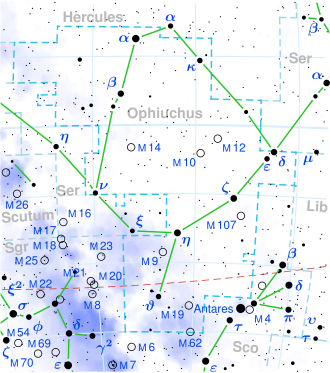
Xi Ophiuchi (Latinized from ξ Ophiuchi, abbreviated ξ Oph) is a visual binary star9 system in the equatorial constellation of Ophiuchus.2 It has a yellow-white hue and is faintly visible to the naked eye with a combined apparent visual magnitude of 4.39.2 The system is located approximately 57.1 light-years (17.5 parsecs) away from the Sun based on parallax, but is drifting closer with a radial velocity of -9 km/s.1
The magnitude 4.4010 primary, designated component A, is an ordinary F-type main-sequence star with a stellar classification of F2V.3 It is 9167 million years old and is rotating with a projected rotational velocity of 20 km/s. The star has 1.3 times the mass of the Sun and 1.6 times the Sun's radius.5 It is radiating 4.46 times the luminosity of the Sun from its photosphere at an effective temperature of 6,611 K.5
The system is a source of X-ray emission.11 The orbiting companion, component B, is a magnitude 8.9 star at an angular separation of 4.1″ along a position angle of 26° from the primary, as of 2016. A magnitude 10.8 visual companion, component C, lies at a separation of 10.8″, as of 2004.10
According to Richard H. Allen's Star Names: Their Lore and Meaning (1899), ξ Oph together with θ Oph formed the Sogdian Wajrik "the Magician", the Khorasmian Markhashik "the Serpent-bitten" and with η Oph the Coptic Tshiō, "the Snake", and Aggia, "the Magician".12 The name Aggia for this star appears in some NASA publications: a 1971 list of named stars13 and a 2023 list of target stars for the Habitable Worlds Observatory.14 as of 2026 it does not appear in the IAU Catalog of Star Names.15
References
References
- Vallenari, A.; et al. (Gaia collaboration) (2023). "Gaia Data Release 3. Summary of the content and survey properties". Astronomy and Astrophysics. 674: A1. arXiv:2208.00211. Bibcode:2023A&A...674A...1G. doi:10.1051/0004-6361/202243940. S2CID 244398875. Gaia DR3 record for this source at VizieR.
- Anderson, E.; Francis, Ch. (2012). "XHIP: An extended hipparcos compilation". Astronomy Letters. 38 (5): 331. arXiv:1108.4971. Bibcode:2012AstL...38..331A. doi:10.1134/S1063773712050015. S2CID 119257644. Vizier catalog entry
- Gray, R. O.; Corbally, C. J.; Garrison, R. F.; McFadden, M. T.; Bubar, E. J.; McGahee, C. E.; O'Donoghue, A. A.; Knox, E. R. (2006). "Contributions to the Nearby Stars (NStars) Project: Spectroscopy of Stars Earlier than M0 within 40 pc--The Southern Sample". The Astronomical Journal. 132 (1): 161–170. arXiv:astro-ph/0603770. Bibcode:2006AJ....132..161G. doi:10.1086/504637. S2CID 119476992.
- Mallama, A. (2014). "Sloan Magnitudes for the Brightest Stars". The Journal of the American Association of Variable Star Observers. 42 (2): 443. Bibcode:2014JAVSO..42..443M.Vizier catalog entry
- Fuhrmann, K.; Chini, R.; Kaderhandt, L.; Chen, Z. (2017). "Multiplicity among Solar-type Stars". The Astrophysical Journal. 836 (1): 139. Bibcode:2017ApJ...836..139F. doi:10.3847/1538-4357/836/1/139.
- Brown, A. G. A.; et al. (Gaia collaboration) (August 2018). "Gaia Data Release 2: Summary of the contents and survey properties". Astronomy & Astrophysics. 616. A1. arXiv:1804.09365. Bibcode:2018A&A...616A...1G. doi:10.1051/0004-6361/201833051. Gaia DR2 record for this source at VizieR.
- David, Trevor J.; Hillenbrand, Lynne A. (2015). "The Ages of Early-Type Stars: Strömgren Photometric Methods Calibrated, Validated, Tested, and Applied to Hosts and Prospective Hosts of Directly Imaged Exoplanets". The Astrophysical Journal. 804 (2): 146. arXiv:1501.03154. Bibcode:2015ApJ...804..146D. doi:10.1088/0004-637X/804/2/146. S2CID 33401607. Vizier catalog entry
- "ksi Oph". SIMBAD. Centre de données astronomiques de Strasbourg. Retrieved 2019-10-08.
- Eggleton, P. P.; Tokovinin, A. A. (September 2008). "A catalogue of multiplicity among bright stellar systems". Monthly Notices of the Royal Astronomical Society. 389 (2): 869–879. arXiv:0806.2878. Bibcode:2008MNRAS.389..869E. doi:10.1111/j.1365-2966.2008.13596.x. S2CID 14878976.
- Mason, Brian D.; et al. (200). "The 2001 US Naval Observatory Double Star CD-ROM. I. The Washington Double Star Catalog". The Astronomical Journal. 122 (6): 3466. Bibcode:2001AJ....122.3466M. doi:10.1086/323920. Vizier catalog entry
- Haakonsen, Christian Bernt; Rutledge, Robert E. (September 2009). "XID II: Statistical Cross-Association of ROSAT Bright Source Catalog X-ray Sources with 2MASS Point Source Catalog Near-Infrared Sources". The Astrophysical Journal Supplement. 184 (1): 138–151. arXiv:0910.3229. Bibcode:2009ApJS..184..138H. doi:10.1088/0067-0049/184/1/138. S2CID 119267456.
- Allen, R.H. (1899), Star Names: Their Lore and Meaning, p. 297
- Rhoads, Jack W. (November 15, 1971), Technical Memorandum 33-507-A Reduced Star Catalog Containing 537 Named Stars (PDF), Jet Propulsion Laboratory, California Institute of Technology.
- Mamajek, Eric; Stapelfeldt, Karl (January 2023). NASA Exoplanet Exploration Program (ExEP) Mission Star List for the Habitable Worlds Observatory (2023) (PDF) (Report). arXiv:2402.12414. JPL CL#23-0611.
- "IAU Catalog of Star Names". Retrieved 7 January 2026.