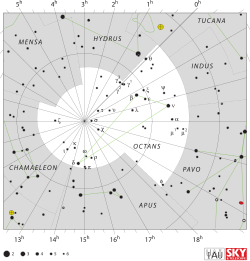
  | |
| Observation data Epoch J2000.0 Equinox J2000.0 (ICRS) | |
|---|---|
| Constellation | Octans |
| Right ascension | 22h 50m 22.8139s1 |
| Declination | −80° 07′ 25.842″1 |
| Apparent magnitude (V) | 5.32 - 5.362 |
| Characteristics | |
| Evolutionary stage | main sequence3 |
| Spectral type | B6 V4 (B5/7 V)5 |
| U−B color index | −0.4867 |
| B−V color index | −0.136 |
| Variable type | SPB8 |
| Astrometry | |
| Radial velocity (Rv) | 22.1±0.59 km/s |
| Proper motion (μ) | RA: +20.003 mas/yr1 Dec.: −12.607 mas/yr1 |
| Parallax (π) | 6.35±0.0644 mas1 |
| Distance | 514 ± 5 ly (157 ± 2 pc) |
| Absolute magnitude (MV) | −0.5710 |
| Details | |
| Mass | 4.02±0.053 M☉ |
| Radius | 3.0±0.511 R☉ |
| Luminosity | 360+24 −223 L☉ |
| Surface gravity (log g) | 4.0911 cgs |
| Temperature | 14,05012 K |
| Metallicity [Fe/H] | −0.112 dex |
| Rotational velocity (v sin i) | 3013 km/s |
| Age | 46+25 −1614 Myr |
| Other designations | |
| ξ Oct, 77 G. Octantis, CD−80°828, CPD−80°1055, GC 31821, HD 215573, HIP 112781, HR 8663, SAO 2589461516 | |
| Database references | |
| SIMBAD | data |
Xi Octantis, Latinized from ξ Octantis, is a solitary17 variable star in the southern circumpolar constellation Octans. It has an apparent magnitude of about 5.3, allowing it to be faintly seen with the naked eye; however, this varies slightly. Located 514 light-years away, the object is receding with a heliocentric radial velocity of 22 km/s.

Xi Octantis has a stellar classification of B6 V,4 indicating that it is an ordinary B-type main-sequence star. Hintler et al. gives it a luminosity class IV (subgiant)19 while Houk and Cowley gives a classification intermediate between a B5 and B7 dwarf.5 Nevertheless, it has 4 times the mass of the Sun3 and is 3 times larger.11 It shines with a luminosity of 360 L☉3 from its photosphere at an effective temperature of 14,050 K,12 giving it a whitish blue glow. Xi Octantis is 46 million years old14—64.8% through its short main-sequence lifetime12—and spins modestly with a projected rotational velocity of 30 km/s.13
When the Hipparcos catalogue was released in 1997, Xi Octantis was found to vary in magnitude20—ranging from 5.32 to 5.36 based on data from the International Variable Star Index.2 It has since been classified as a slowly pulsating B-dwarf with a period of 1.78 days.2
References
References
- Brown, A. G. A.; et al. (Gaia collaboration) (2021). "Gaia Early Data Release 3: Summary of the contents and survey properties". Astronomy & Astrophysics. 649: A1. arXiv:2012.01533. Bibcode:2021A&A...649A...1G. doi:10.1051/0004-6361/202039657. S2CID 227254300. (Erratum: doi:10.1051/0004-6361/202039657e). Gaia EDR3 record for this source at VizieR.
- Watson, C. L.; Henden, A. A.; Price, A. (May 2006). "The International Variable Star Index (VSX)". Society for Astronomical Sciences Annual Symposium. 25: 47. Bibcode:2006SASS...25...47W.
- Zorec, J.; Royer, F. (January 2012). "Rotational velocities of A-type stars. IV. Evolution of rotational velocities". Astronomy and Astrophysics. 537: A120. arXiv:1201.2052. Bibcode:2012A&A...537A.120Z. doi:10.1051/0004-6361/201117691. ISSN 0004-6361. S2CID 55586789.
- Cucchiaro, A.; Macau-Hercot, D.; Jaschek, M.; Jaschek, C. (October 1977). "Spectral classification from the ultraviolet line features of S2/68 spectra. II. Late B-type stars". Astronomy and Astrophysics Supplement Series. 30: 71–79. Bibcode:1977A&AS...30...71C. ISSN 0365-0138.
- Houk, N.; Cowley, A. P. (1975). University of Michigan Catalogue of two-dimensional spectral types for the HD stars. Volume I. Declinations -90_ to -53_ƒ0. Bibcode:1975mcts.book.....H.
- Høg, E.; Fabricius, C.; Makarov, V. V.; Urban, S.; Corbin, T.; Wycoff, G.; Bastian, U.; Schwekendiek, P.; Wicenec, A. (March 2000). "The Tycho-2 catalogue of the 2.5 million brightest stars". Astronomy and Astrophysics. 355: L27–L30. Bibcode:2000A&A...355L..27H. ISSN 0004-6361.
- Reed, B. Cameron (May 2003). "Catalog of Galactic OB Stars". The Astronomical Journal. 125 (5): 2531–2533. Bibcode:2003AJ....125.2531R. doi:10.1086/374771. eISSN 1538-3881. ISSN 0004-6256.
- Samus', N. N.; Kazarovets, E. V.; Durlevich, O. V.; Kireeva, N. N.; Pastukhova, E. N. (January 2017). "General catalogue of variable stars: Version GCVS 5.1". Astronomy Reports. 61 (1): 80–88. Bibcode:2017ARep...61...80S. doi:10.1134/S1063772917010085. ISSN 1063-7729. S2CID 255195566.
- Gontcharov, G. A. (November 2006). "Pulkovo Compilation of Radial Velocities for 35 495 Hipparcos stars in a common system". Astronomy Letters. 32 (11): 759–771. arXiv:1606.08053. Bibcode:2006AstL...32..759G. doi:10.1134/S1063773706110065. ISSN 1063-7737. S2CID 119231169.
- Anderson, E.; Francis, Ch. (May 2012). "XHIP: An extended hipparcos compilation". Astronomy Letters. 38 (5): 331–346. arXiv:1108.4971. Bibcode:2012AstL...38..331A. doi:10.1134/S1063773712050015. ISSN 1063-7737. S2CID 255204555.
- De Cat, P.; Aerts, C. (October 2002). "A study of bright southern slowly pulsating B stars". Astronomy & Astrophysics. 393 (3): 965–981. Bibcode:2002A&A...393..965D. doi:10.1051/0004-6361:20021068. eISSN 1432-0746. ISSN 0004-6361.
- Smith, K. C.; Dworetsky, M. M. (July 1993). "Elemental abundances in normal late-B and HgMn stars from co-added IUE spectra. I. Iron-peak elements". Astronomy and Astrophysics. 274: 335–355. Bibcode:1993A&A...274..335S. ISSN 0004-6361.
- Levato, H.; Grosso, M. (June 2004). "New Projected Rotational Velocities of All Southern B-type Stars of the Bright Star Catalogue". Astronomical Society of the Pacific. 215: 51. Bibcode:2004IAUS..215...51L.
- Grosbol, P. J. (June 1978). "Space velocities and ages of nearby early-type stars". Astronomy and Astrophysics Supplement Series. 32: 409–421. Bibcode:1978A&AS...32..409G. ISSN 0365-0138.
- "ksi Oct". SIMBAD. Centre de données astronomiques de Strasbourg. Retrieved 9 June 2022.
- Gould, Benjamin Apthorp (1878). "Uranometria Argentina : brillantez y posicion de las estrellas fijas, hasta la septima magnitud, comprendidas dentro de cien grados del polo austral : con atlas". Resultados del Observatorio Nacional Argentino. 1. Bibcode:1879RNAO....1.....G.
- Eggleton, P. P.; Tokovinin, A. A. (11 September 2008). "A catalogue of multiplicity among bright stellar systems". Monthly Notices of the Royal Astronomical Society. 389 (2): 869–879. arXiv:0806.2878. Bibcode:2008MNRAS.389..869E. doi:10.1111/j.1365-2966.2008.13596.x. eISSN 1365-2966. ISSN 0035-8711.
- "MAST: Barbara A. Mikulski Archive for Space Telescopes". Space Telescope Science Institute. Retrieved 24 September 2022.
- Hiltner, W. A.; Garrison, R. F.; Schild, R. E. (July 1969). "MK Spectral Types for Bright Southern OB Stars". The Astrophysical Journal. 157: 313. Bibcode:1969ApJ...157..313H. doi:10.1086/150069. eISSN 1538-4357. ISSN 0004-637X.
- Perryman, M. A. C.; Lindegren, L.; Kovalevsky, J.; Hoeg, E.; Bastian, U.; Bernacca, P. L.; Crézé, M.; Donati, F.; Grenon, M.; Grewing, M.; Leeuwen, van; Marel, van der; Mignard, F.; Murray, C. A.; Poole, Le; Schrijver, H.; Turon, C.; Arenou, F.; Froeschlé, M.; Petersen, C. S. (July 1997). "The HIPPARCOS Catalogue". Astronomy and Astrophysics. 323: L49–L52. Bibcode:1997A&A...323L..49P. ISSN 0004-6361.