  | |
| Observation data Epoch J2000.0 Equinox J2000.0 (ICRS) | |
|---|---|
| Constellation | Centaurus1 |
| Right ascension | 13h 06m 54.639s2 |
| Declination | −49° 54′ 22.49″2 |
| Apparent magnitude (V) | 4.303 + 9.384 |
| Characteristics | |
| Spectral type | B1.5 V5 or B2 IV6 + F7 V4 |
| U−B color index | −0.8103 |
| B−V color index | −0.1973 |
| Astrometry | |
| Radial velocity (Rv) | +14.3±4.17 km/s |
| Proper motion (μ) | RA: −27.118 mas/yr2 Dec.: −12.808 mas/yr2 |
| Parallax (π) | 6.7962±0.1797 mas2 |
| Distance | 480 ± 10 ly (147 ± 4 pc) |
| Absolute magnitude (MV) | −1.511 |
| Orbit8 | |
| Period (P) | 7.6497 d |
| Eccentricity (e) | 0.35 |
| Periastron epoch (T) | 2418077.493 JD |
| Argument of periastron (ω) (secondary) | 308.6° |
| Semi-amplitude (K1) (primary) | 38.8 km/s |
| Details | |
| ξ2 Cen A | |
| Mass | 8.1±0.15 M☉ |
| Luminosity (bolometric) | 1,7029 L☉ |
| Surface gravity (log g) | 4.11±0.039 cgs |
| Temperature | 20,790±3359 K |
| Rotational velocity (v sin i) | 2510 km/s |
| Age | 11.5±3.75 Myr |
| ξ2 Cen B | |
| Mass | 1.259 M☉ |
| Luminosity | 2.49 L☉ |
| Temperature | 6,1949 K |
| Other designations | |
| ξ2 Cen, CD−49°7644, FK5 489, HD 113791, HIP 64004, HR 4942, SAO 22390911 | |
| Database references | |
| SIMBAD | data |
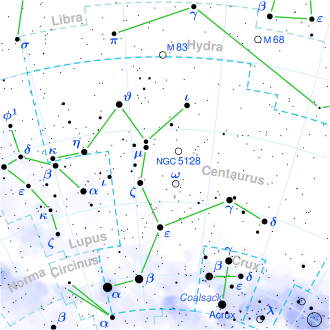
Xi2 Centauri is a triple star12 system in the southern constellation of Centaurus. Its name is a Bayer designation that is Latinized from ξ2 Centauri, and abbreviated Xi2 Cen or ξ2 Cen. This system is visible to the naked eye as a point of light with a combined apparent visual magnitude of 4.30,3 and forms a wide optical double with the slightly dimmer ξ1 Centauri.13 Based upon an annual parallax shift of 6.80 mas, Xi2 Centauri lies roughly 480 light years from the Sun. At that distance, the visual magnitude is diminished by an interstellar extinction factor of 0.32 due to intervening dust.14
This system was discovered to be a single-lined spectroscopic binary in 1910 by American astronomer Joseph Haines Moore.1516 The pair, component A, orbit each other with a period of 7.6497 days and an eccentricity of 0.35.8 The primary is a B-type star with a stellar classification of B1.5 V5 or B2 IV,6 depending on the source. This indicates it may be a main sequence star or a more evolved subgiant star. It has about 8.1 times the mass of the Sun5 and radiates 1,702 times the solar luminosity from its outer atmosphere at an effective temperature of 20,790 K.9 It is a hybrid pulsator and shows variations in both g and p modes.17
A third star, component B, is a magnitude 9.38 F-type main sequence star with a classification of F7 V. It has 1.259 times the mass of the Sun and radiates 2.49 times the solar luminosity at an effective temperature of 6,1949 K. It lies at an angular separation of 25.1 arc seconds from the inner pair.4 They share a common proper motion, indicating they may be gravitationally bound with an orbital period of around 41,000 years.18
The system has a peculiar velocity of 16.2±4.2 km/s.7 It belongs to the Scorpius–Centaurus association and appears to be a member of the Gould's Belt.19
References
References
- Anderson, E.; Francis, Ch. (2012), "XHIP: An extended hipparcos compilation", Astronomy Letters, 38 (5): 331, arXiv:1108.4971, Bibcode:2012AstL...38..331A, doi:10.1134/S1063773712050015. XHIP record for this object at VizieR.
- Vallenari, A.; et al. (Gaia collaboration) (2023), "Gaia Data Release 3. Summary of the content and survey properties", Astronomy and Astrophysics, 674: A1, arXiv:2208.00211, Bibcode:2023A&A...674A...1G, doi:10.1051/0004-6361/202243940, S2CID 244398875. Gaia DR3 record for this source at VizieR.
- Gutierrez-Moreno, Adelina; Moreno, Hugo (June 1968), "A photometric investigation of the Scorpio-Centaurus association", Astrophysical Journal Supplement, 15: 459, Bibcode:1968ApJS...15..459G, doi:10.1086/190168.
- Gahm, G. F.; et al. (January 1983), "A study of visual double stars with early type primaries. I - Spectroscopic results", Astronomy and Astrophysics Supplement Series, 51: 143–159, Bibcode:1983A&AS...51..143G.
- Tetzlaff, N.; et al. (January 2011), "A catalogue of young runaway Hipparcos stars within 3 kpc from the Sun", Monthly Notices of the Royal Astronomical Society, 410 (1): 190–200, arXiv:1007.4883, Bibcode:2011MNRAS.410..190T, doi:10.1111/j.1365-2966.2010.17434.x, S2CID 118629873.
- Hohle, M. M.; et al. (April 2010), "Masses and luminosities of O- and B-type stars and red supergiants", Astronomische Nachrichten, 331 (4): 349, arXiv:1003.2335, Bibcode:2010AN....331..349H, doi:10.1002/asna.200911355, S2CID 111387483.
- Bobylev, V. V.; Bajkova, A. T. (August 2013), "Galactic kinematics from a sample of young massive stars", Astronomy Letters, 39 (8): 532–549, arXiv:1307.1677, Bibcode:2013AstL...39..532B, doi:10.1134/S106377371308001X, S2CID 118568203.
- Pourbaix, D.; et al. (2004), "SB9: The ninth catalogue of spectroscopic binary orbits", Astronomy & Astrophysics, 424 (2): 727–732, arXiv:astro-ph/0406573, Bibcode:2004A&A...424..727P, doi:10.1051/0004-6361:20041213, S2CID 119387088.
- Gerbaldi, M.; et al. (November 2001), "Binary systems with post-T Tauri secondaries", Astronomy and Astrophysics, 379: 162–184, Bibcode:2001A&A...379..162G, doi:10.1051/0004-6361:20011298.
- Wolff, S. C.; et al. (2007), "Rotational Velocities for B0-B3 Stars in Seven Young Clusters: Further Study of the Relationship between Rotation Speed and Density in Star-Forming Regions", The Astronomical Journal, 133 (3): 1092–1103, arXiv:astro-ph/0702133, Bibcode:2007AJ....133.1092W, doi:10.1086/511002, S2CID 119074863.
- "ksi02 Cen", SIMBAD, Centre de données astronomiques de Strasbourg, retrieved 2017-01-09.
- Eggleton, P. P.; Tokovinin, A. A. (September 2008), "A catalogue of multiplicity among bright stellar systems", Monthly Notices of the Royal Astronomical Society, 389 (2): 869–879, arXiv:0806.2878, Bibcode:2008MNRAS.389..869E, doi:10.1111/j.1365-2966.2008.13596.x, S2CID 14878976.
- Backyard Astronomy, The Guides, Fog City Press, 2003, p. 248, ISBN 1877019321.
- Gontcharov, G. A. (November 2012), "Spatial distribution and kinematics of OB stars", Astronomy Letters, 38 (11): 694–706, arXiv:1606.09028, Bibcode:2012AstL...38..694G, doi:10.1134/S1063773712110035, S2CID 119108982.
- Moore, Joseph Haines (1910), "Ten stars having variable radial velocities", Lick Observatory Bulletin, 6 (182): 55–59, Bibcode:1910LicOB...6...55M, doi:10.5479/ADS/bib/1910LicOB.6.55M.
- Neubauer, F. J. (1931), "The orbit of the spectroscopic binary ξ2 Centauri", Lick Observatory Bulletin, 15: 107–108, Bibcode:1931LicOB..15..107N, doi:10.5479/ADS/bib/1931LicOB.15.107N.
- Sharma, Awshesh N.; et al. (2022), "Pulsating B stars in the Scorpius–Centaurus Association with TESS", Monthly Notices of the Royal Astronomical Society, 515 (1): 828–840, arXiv:2203.02582, Bibcode:2022MNRAS.515..828S, doi:10.1093/mnras/stac1816.
- Tokovinin, A. (September 2008), "Comparative statistics and origin of triple and quadruple stars", Monthly Notices of the Royal Astronomical Society, 389 (2): 925–938, arXiv:0806.3263, Bibcode:2008MNRAS.389..925T, doi:10.1111/j.1365-2966.2008.13613.x, S2CID 16452670.
- Bobylev, V. V.; Bajkova, A. T. (September 2007), "Kinematics of the Scorpius–Centaurus OB association", Astronomy Letters, 33 (9): 571–583, arXiv:0708.0943, Bibcode:2007AstL...33..571B, doi:10.1134/S1063773707090010, S2CID 15785349.