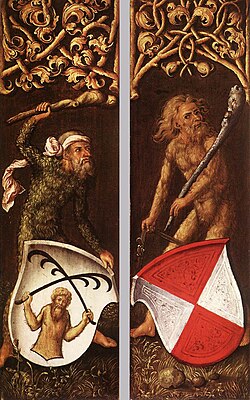
The wild man (German: Wilder Mann, der Wilde Mann), or wild man of the woods, is a mythical figure and motif resembling a hairy human that appears in the art and literature of medieval Europe. Generally they are considered a large-statured race of humans who are hairy all over their body, and live in the wilderness or woodlands. They are often thought to be covered with moss, or wear green or vegetative clothing, and iconically wield a club or hold an uprooted tree as a staff. They also occur in female versions as wild women.
The Wilde Mann (Middle High German: wilde man) is attested in Middle High German literature, particularly German heroic epics,a while the female Wilde Weib (wildez wîp) figures in the Arthurian works,b typically appear as adversaries. These beings are also called by names meaning "wood men"c and in older forms of the language, "wood maiden",d "wood wife",e or "wood woman".f In Middle English a corresponding term for the wild man is woodwose or wodewose.23
In the folklore of German-speaking areas collected mainly in the 19th century, there are especially the Alpine wild men and wild women. These beings could be man-hunters or otherwise be sinister, but could also endow luck or bounty, exhibiting aspects of woodland spirits.
The folklore that had developed in the mining areas around Harz or Ore Mountains by the 16th century regarded the wild man of the mines (also known as "mountain monk"g) as potentially both dangerous and beneficent, guiding humans to the discovery of ore deposits. The house of the Princes of Brunswick-Wolfenbüttel (Brunswick-Lüneburg), which controlled one of the silver mines, minted silver thaler ('dollar') coinage with the wild man in their coat-of-arms, starting 1539.
These wild men had already frequently appeared in European family heraldic devices since the latter half of the 15th century.h It also became commonplace to depict the wild man as shield-bearers of the family coat of arms (e.g., within a portrait painting by Albrecht Dürer, cf. image right).i This period also roughly coincides with the popularization of the concept of the "noble wild man" or "noble savage" as can already be seen in Hans Sachs's "Lament of the Wild Men" (1530), and also reflected in artistic depictions of the wild folk from this period onward.
The wild man or wild woman in folklore was believed to be the protector of the (sustainability of) wild game, especially the chamois (German: Gemse), and stories tell of the hunter who breached the taboo being knocked off a precipice or turned into stone.
The defining characteristic of the figure is its "wildness"; iconography from the 12th century onward has consistently depicted the wild man as being covered with hair. Around the same transition period, biblicalj or other humans afflicted with madness came to be conventionally depicted with hairiness, and subsequently, literary figures who temporarily lose sanity and live in the wild (Merlin, Ywain) also came to be associated with wild men.
Terminology
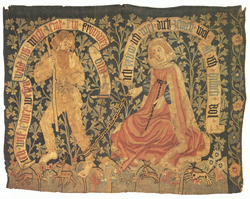
"Wild man" is a technical term in use since the Middle Ages, applied to a hairy human-like creature with certain animal-like traits but which has not quite descended to the level of ape; it may have hairless spots around the face, palms, feet, sometimes elbows and knees, and around the breasts in case of the female "wild woman". If the creature exhibits additional animal-like traits, it may not be a wild man in question, but rather the satyr, faun, or the devil (Bernheimer's definition).4
"Wild man" and its cognates in some languages are the common terms for the creature in most modern languages;5 it appears in German as wilder Mann, in French as homme sauvage. However, in Italian, uomo selvatico ("forest man") is often used6 (var. selvaggio7).
The German wild man (Der Wilde) also occurs in a more modern folklore tradition, localized in a region spanning from Switzerland to Carinthia, Austria (and often Hesse in Germany) according to the Handwörterbuch des deutschen Aberglaubens (HdA),8 registered under such names as wilde Frau,910 Wildfrau, -en,1112 wilde Fraulein, Wildfräulein13 wilder Mann,14 Wildmannli,1516 wilde Männle,17 Wildmännlein.18 Plural forms are: wilde Männer,19 or wilde Leute2017 or wilde Menschen.21 Females are also called wildes Weib (pl. wilde Weiber).22
The "wild man" is attested in Middle High German as wilde man in the 13th century, once in a lyrical poemk alluding to the story of the giant Sigenot,23 i.e., an epic featuring both giant and wild man, from the Dietrich von Bern cycle.24l Another attestation occurs in the Arthurian romance Wigamur which gives wilde man (v. 203),26 as well as the female form wildez wîp (vv. 112, 200, 227ff.)27 (For additional examples in MHG literature cf. § German epics below).
In Old High German, the term wildaz wîp (lit. 'wild wife, wild woman') together with holzmuoja, holzmoia (lit. 'wood maiden')m occurs in a glossary under the heading of the Latin term lamia (female monster).n The same glossary under the heading of Latin ulula (lit. 'screech owl' but here understood to be equivalent to strix of mythology32) gives the gloss wildiu wîp.o343533 There are also the forms holzwib (holzwîb36),41pq as well as holzvrouwe4436 and numerous others.4546
Another old example is the mention of "ad domum wildero wîbo" ("house of the wild women"), a piece of landmark or toponymy somewhere in Hessen,48 mentioned in Codex Eberhardi (c. 1150) by the monk Eberhard of Fulda or a redaction given by Johann Pistorius the Younger (d. 1608).525354r
Wood-folk type synonyms
The wild man is referred to as waltluoder in Wolfdietrich,s56 and in the same work, the title hero must deal with the advances of Rauhe Else ("Shaggy Else"), classified as a wild woman (cf. § German epic below).
In the epic Laurin the wild man is referred to as a waltmann (lit. 'wood man').56 The same term waltman is used in Iwein to characterize the herdsman as a wild man, and he is also described as being as hairy as a walttôren (lit. 'wood fool'57)58 (Cf. Iwein discussed below under § Medieval iconography).
A group of OHG glosses for wild woman (lamia, etc.) was already discussed above. In MHG, an attested synonym for wild woman is holz-wîp (lit. 'wood wife').6061
In modern regional folklore, the creatures with sylvan (wood-related) names that correspond to the Alpine wild folk are the Holzleute or Moosleute (wood- or moss people) of Central Germany, Franconia, and Bavaria;62 Holzfräulein aka Waldfräulein, Waldweiblein of the Bohemian Forest and the Upper Palatinate;62 the Waldweiblein and Moosweiblein (lit. 'moss maiden') of the Harz mountains region;62 the Lohjungfer (lit. 'grove maiden'; pl. Lohjungfern) of Halle further east in Saxony;63 and the Buschweiblein (lit. 'bush maiden') of Westphalia.64 Usage of names such as Lohjungfer, Holzfräulein, Mossweibchen extends further south in Saxon Vogtland.65
Waldfänke is synonymous to wilder Mann,67 which is an exception, since Fang(e) and its extensions (cf. Fänge below) generally refer to females.68 The variant form Waldfenken-Geißler is also given in commentary.69 As for Geißler ("goatherd") or Kühler ("cowherd"), the wild man may be designated by the name of his profession in a narrative where he is engaged in the herding of livestock.70
Cf. also the etymological relation between the term "sylvan" ("of the woods"), the French term sauvage meaning "wild", and the Sal- group of names for the wild men used in the Italian Alps (Trentino-Alto Adige/Südtirol) region under § Other aliases below. Cf. also "woodwose" under § English terms.
Other aliases
Folklore in Tyrol and German-speaking Switzerland into the 20th century refers to the wild woman called Fänge (var. Fängge/Faengge, Fankke, Fang, Fange, Fangge, Fangga, Fanggin), commented as being equivalent to Selige Fräulein (Salige Frau)7168 This name is thought to be post-medieval neologism deriving from the Latin fauna, the feminine form of faun.5 The wild women of the Alpine region are "identical to or closely related to" the Fänggen or the Salige (Salige Frauen).64 The extended form Wild-Fang is considered a male noun (ein Wild-fang), but Wild-fang (var. Wildfangg) is still applied to a female.68t
The wild man is called a Bilmonu (corruption of "wild man"), Salvadegh, or Salvanel in Wälsch-Tirol (present-day Trento Province),74 which may be spelt Salvan or Salvang,75 with usage extending to Lombardy.5 The wild man is called l'om salvadegh by Ladin language-speakers in Folgrait (Folgaria) and Trambileno; this is readily recognizable as equivalent to French l'homme sauvage, where Old French salvage derives from Latin silvāticus "sylvan, pertaining to forest".74 Hence the names in this grouping are related to Silvanus, the Roman tutelary god of gardens and the countryside.5 The (medieval Latin) term silvaticus was in fact used in the sense of "wild woman" by Burchard of Worms in the 10th century,76 and it has been suggested he was referring to beings who would have been called Selvang in dialect according to modern-day folklore.77
The local name Frauberte or Frau Berta was supposedly current either in Ronchi near Ala, or the aforementioned Folgrait and Trambileno areas.7478v Likewise there are a sort of wild women known as Berchtra or Perchta (diminutive: Perchtel) in Carinthia.w79
It is contended that the Norgg81 or Orke or Orge;82x Lorgg81 or Lorge;yz or Nörglein,82aa Nörkel, Örggele in folklore from parts of the Alps, particularly Tyrol, also may correspond to the wild man,8384 with the proviso that these (especially diminutives) are names for "wild dwarf people".8587 This appears to be connected to Italian orco (Neapolitan: huorco, pl. orci) in the sense of "subterraneans"ab (≈dwarfs88 or gnomes89),82 or perhaps rather a "harmless wild folk" version of the orco such as appears in the literary fairy tales of the Pentamerone.90 The Italian orco is cognate to French ogre,91 as is modern literary orcs,92 and is related to Orcus, a Roman and Italic god of death.935ac
The Rüttelweib, Rittelweibe (lit. 'shaking wife'; pl. Rüttelweiberad) of the Giant Mountains is also considered another regional fabulous being corresponding to the wild woman of the Alpine Region.62
English terms
In Old English/Anglo-Saxon there has been recorded the term wude-wāsa meaning "satyr" or "faun",95 a compound of wude "woodland, forest" and wasa of uncertain etymology,296 though perhaps meaning "forest dweller";97 or else it may perhaps be a compound formed from *wāsa "being", from the verb wesan, wosan "to be, to be alive".98
From it has derived Middle English woodwose, wodewose, woodehouse.965 Variant spellings include wodewese, etc.2 The ME term wodehose was ambiguously singular or plural.99101 The (modern) pronunciation of woodwose varies, and may end in an s-like or z-like stress.3
As for examples of usage, Wycliffe's Bible (after 1382 [to 1395]), in Isaiah 13:21, used wodewoos (pl. wodewoosis103ae rather than the King James Version's "satyr"104 to translate the original Hebrew שעיר (pronounced sa'ir, meaning "hairy [one]"). Latin translation gave pilosi, and LXX rendered as δαιμόνια (daimon).
In Sir Gawain and the Green Knight (c. 1390), Gawain is said to have fought with worms (dragons) as well as a "wodwos" that lived in the craggy rocks;107 this wild man (woodwose) has no relation to the Green Knight, but is just another enemy whom Sir Gawain happens to encounter in journey.108
The Middle English word is first attested for the 1340s in the context of a decorative piece of art depicting a wild man, namely a piece of tapestry of the Great Wardrobe of Edward III,109af but as a surname it is found as early as 1251, of one Robert de Wudewuse.96 The Middle English term wodewose meaning "wild man" is found embedded in the Anglo-Norman caption to a painting in the Taymouth Hours (14th century)110 (cf. § Manuscript illuminations).
There has been continued use in modern English for "woodwose, woodhouse", though now obsolete,2 displaced in modern usage by "wild man". The surnames Wodehouse or Woodhouse may derive straightforwardly from "house in the woods", or as a corruption of woodwose.111
Medieval literature
Verbal descriptions of the wild folk in medieval literature will be mainly discussed here. Visual depictions during the medieval period will be discussed under § Iconography.
German epic
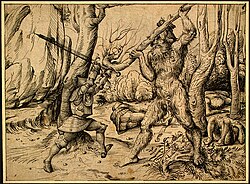
That the German epic Sigenot (cf. image right) featuring both the giant named Sigenot and the wild man24 was certainly known in the 13th century, as the minnesinger Heinrich Frauenlob sings "Wa kam mit Parcivale /ris' Sigenot unt der wilde man? (Where came the giant Sigenot and the Wild Man, with Parzival?)",23 but the actual so-called elder Sigenot (13th century) is lost except in a fragmentary state, so the attestations come from the Younger Sigenot112 (15th century mss. and printed editions) as "wilde man, wild man.113
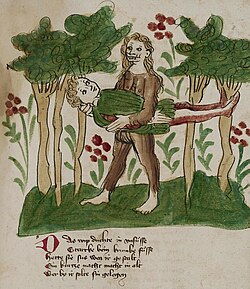
The female character Rauhe Else ("Shaggy Else") in Wolfdietrich is also considered a wild woman example. She is a hairy woman crawling on all fours trying to get Wolfdietrich to marry her, but when he does not comply, casts a spell that turns him into a madman roaming the woods. God commands her to reverse the spell, and Wolfdietrich is now willing to marry her ("so long as the wild woman gets baptized"114). Fortunately for Wolfdietrich, when she dips into a spring she sheds her furry skin and transforms into a beautiful maiden, now calling herself Sigeminne.115116117118ag She (Rauch Elss, christened Sygemin) is also mentioned as being the first wife of Wolfdietrich in the Anhang zum Heldenbuch.121120
In the Arthurian Wigamur there is the wildez wîp (wild woman) who dwells in a hole in a rock.27 In another Arthurian epic Wigalois, the dwarf named Karriôz is explicitly stated to have a wildez wîp as his mother.56 In Wigalois there also appears a monstrous female of the woods named Rûel (cf. image right) as an adversary to the title hero, and though she is also described as a "wild woman" by modern commentators, she is not to be confused with Karriôz's mother.122
French epic
In the epic Renaud de Montauban, the title hero Renaud turns rebel against Charlemagne, and as fugitives living in the Ardennes forest, they have turned "black and hairy like a bear [on a chain]",123124125127 so that "neither stone nor rock could scathe" them.128126 Renaud's band thus became chevalier sauvage ("savage knights")126 or wild men, in the sense that in medieval society, the outcast consigned to live in forests separating settlements were regarded as a sort of wild man.129130131
The romance of Valentine and Orson, about a civilized brother separated from his bearlike brother Orson living in the wild, may count as an example of a wild man's tale,132 however, this might be more recognizable as a fictional treatment of the feral child.133
Welsh and Irish literature
For the Myrddin Wyllt (mad Merlin) Suibhne Geilt (Mad Sweeney) driven to live in the wilderness and interpreted by some modern commentators as exhibiting the Wild Man of the Woods motif, cf. § Celtic mythology (under §Medieval parallels) below.
Medieval to Renaissance transition
As the name implies, the main characteristic of the wild man is his wildness. Civilized people regarded wild men as beings of the wilderness, the antithesis of civilization. Such had been the medieval view through the High Middle Ages.134 That is to say, the wild man had been something that civilized people strove to reject.135
The regard for the wild man as such an abominable fearsome character began to blunt, and by the 14th century in the example of the Bal des Sauvages held by King Charles VI of France (cf. § In dance and festival) the wild man was being employed in costume, not so much as embodiment of evil and savagery, but as a toything of court nobles.136
The paradigm had reversed and the Wild Man became the Noble Savage by the time of Spenser's The Faerie Queene (1590, 1596)ah and Hans Sachs's Klag der wilden holtzleut uber die ungetrewen welt ("Lament of the Wild Men about the Unfaithful World", 1530) and it became an iconic model.ai139140 Bernheimer analyzes this as a backlash reaction by the nobility of having to live within the constraints of aristocratic conventions and chivalric code.141
Although emergence of the concept of the "Noble Savage" (French: bon sauvage) had occurred post-discovery of the Americas, according to one observer142 not inconsistent with the foregoing 16th century examples, much of the scholarship on the Noble Savage pertains to thinking of the Enlightenment Period (18th century). The coinage of the term "noble savage" itself has often been (falsely) attributed to Jean-Jacques Rousseau, 143 though refuted;144 as Rousseau never actually used that term himself, even though the philosopher did profusely use the construct of "savage" to critique various aspects of civilized society.145
Modern folklore
The purported nature of these wild folk or wood people in folklore, like the lore of demons in general, is highly ambiguous, unpredictable and mutable.64
When the wild men appear in solitary fashion, they are similar to giants and ogres, while the women tend to be more goddess-like.62
Physical characteristics
Giants or dwarfs
The wild people can be dwarfish or be gigantic in size.146 And this may not necessarily be regional variations: the wild folk of Bernhardswald (in Schlüchtern Hesse) are purported to be giants or dwarfs depending on the season.aj148
Widlman subtypes/aliases such as the Fankkenmanli of the highest Alpine regions or the Orgen and noerglein (Nörglein) of Tyrol (called by names on the diminutive case) are usually conceived of as dwarfs.149 Similar to the Orgen are the Dorgi, Doggi of Switzerland and the Doggele of Alsace, all supposedly corruptions of the name Orc/Ogre.150
They can be of different temperaments, but they may exact vengeance on those who are frightened by them 152 or mock them. 154 In that case, the smaller wild folk are more easily appeased, while the giant types will tear their tormentors apart155 or curse them with "seven times seven generations of curses and woe".156
Friedrich Ranke argues that the legends concerning the wild people in Central Germany became less frightening because the forests themselves shed much of their eeriness due to development and deforestation, so that only the low rolling hills remained. Thus in these regions, the folklore concerned the wild little folk of "harmless good nature".ak157
Attire
The wild man stereotypically carries an uprooted fir tree,159160 or an iron club161 or an iron pole,162 etc.
Alpine wild man
There are also the Alpine wild men recorded by modern folklorists, whose lore is generally found in the lore of Alps (mountainous Italian Tyrol, Valtellina and Italian and German-speaking parts of Grisons, Switzerland). The wild men of the Alps had the reputation of abducting women and devouring humans, particularly children. In Grisons, they are also accused of depositing their changeling child, swapping it with a human baby.163 Allegedly peasants in the Grisons tried to capture the wild man by getting him drunk and tying him up in hopes that he would give them his wisdom in exchange for freedom.164 This is noted as paralleling the capture of Silenus already described by Xenophon (d. 354 BCE),164 with Silenus being described as a satyr which Midas caught by getting him drunk with wine.165al
Legend also has it that humans were able to capture it once by getting it drunk, thereby learning the manufacture of cheese.am74 The Salvanel is also considered to be a thief of milk, but who has taught humans how to produce butter and cheese in return.166
A legend from Folgrait (Folgaria) has it that a certain man heard the noise of the wild man hunting, and called out to him in rhymed couplet to give him a share,an and received half a human corpse at his doorstep, subsequently having to take the trouble to have the hunter take back the unwanted gift.16774 There are also variant versions with different rhymes from Ritten and Barbian.169ao However, in a cognate tale from Vallarsa, the wild hunter is not specified as a "wild man".170 It is comparable to a similar wild hunter myth from Northern Germany, that if anyone calls out to heckle the hunt, the hunter forces a "half portion" (Halb Part) of foul-smelling game or human part, reciting a couplet that if you join in the hunt, you must help out with the chewing.172
A legend held that Wildmannli dwelled in the Gross Windgällen mountain in the canton of Uri, Switzerland that disapproved of humans hunting on Sundays, and a hunter who breached the taboo and shot a chamois was turned to stone.173 They were also styled Wildmandli, and according to another telling from the canto of Uri, these wild folk lived in areas called Ruosstalbalm (aka Heidenbalm) or Hornefeli in Isenthal. According to legend they provided chamois cheese that would grow back to size if not completely used up, but were driven away by advent of hunters who preyed on their chamois. They are said to have feet pointing backwards.175 Another tale from an informant of Isental told that a certain hunter had been promised by the Wildmandli he would be provided by a fresh buck every Saturday hung right as his door, in exchange for ceasing to hunt the chamois on his own. The hunter (which the informant insisted must have been an outsider, probably from the Canton of Nidwalden) broke the promise, and went hunting, and as punishment the man was bound up in white clothe by the Wildmandli and hurled down the cliff.176 According to lore, Wilde Mandl appear in high altitude regions of Tyrol, in the valleys of Ötztal, Stubaital, Zillertal, Tauerntal, and have spread to the The Dolomites.177
Alpine wild woman
Meanwhile, the Tyrolian and Swiss Fängge (Faengge, Fankke)71 as well as the Austrian Salige Frau are (subtypes or aliases of the) wild woman.179
The wild woman basically matches the female version of the wild man in appearance, and notably has drooping breasts18018135 (for which the Tyrolean wild woman has earned the nickname Langtüttin182183) however, she may appear in the form of beautiful women.184
The wild woman, the Fängge, and the Salige Frau are all associated with protecting alpine game, especially the chamois.ap185186 The legendary protectress called Kaiserfrau of Nachtberg (a peak situated between Thiersee and Brandenberg, Austria) is not explicitly called a wild woman in the original telling,187 but is classified as such.188 In the tale, the tall woman dressed in a green robe commands a shepherd to kill all poachers, otherwise she will destroy his entire flock. He obliges, and due to the reputation that the Kaiserfrau harms hunters, the stock of game in the forest rebounds.187
The wild women of Styria, Austria were said to reside mostly on Mt. Schöckl. They have a hollow or troughaq-like back (hence comparable to the skogsnuva of Sweden190), so they can pretend to be old tree trunks instantly by turning their backs, even when a hiker senses the presence of the beautiful wild woman. The wild women of Schöckl are said to be hunted by the Wild Hunt that travels on flying sleds carrying demons.191ar
Central German wild folk
Some of the wild man lore around the Harz Mountain, Lower Saxony are associated with silver mining industry are discussed under § Numismatics below.
One folktale from Wilhelmsdorf, Thuringia tells of a Waldweibchen who dwelled with a peasant woman, and performed various chores of the maid, tending the fire, and baking the bread, but no sooner than delivering the baked loaves to their spot, the wood-womankin would be somewhere munching away at a fresh loaf. And if the peasant woman was boiling Knösse (dumplings) it would snatch away as much as half the pot when the woman turned her back. Finally the peasant woman could tolerate no more, and decided to "pip" (poke finger-holes in the dough193) the entire lot (Mandel of 15) of bread and put caraway seeds in them, full knowing the forest spirited sang a little song indicating she abhorred that sort of bread. As expected, the pipped caraway bread disgusted the Waldweibchen which ran off, predicting ruin for the peasant woman, and surely enough, the woman's family became so poor they were wanting for any bread at all, seedless or otherwise.195
Slavic folkore
Wild people of Russian folklore are called Russian: дикие (dikiye, lit. '"wild [ones"'; sing. дикий dikiy) or div'i (Russian: дивьи, дивы, plural only). The names derive from two related proto-Slavic roots *dik- and *div- that combine the meanings of "wild" and "amazing, strange". The latter (div- form) names especially are given to mythical forest creatures in the pan-Slavic folk demonology, and their cognates are Ukrainian: дивий (dyvyy); Bulgarian: див (div); Polish: dźiwy; Czech: divi;196197 Slovak: diva žena, diva zona ("wild forest woman"); Moravian dialects: divížena (female) divižák (male).198as There is some latitude in the descriptions of this group, often close to the boginka of the West Slavs and vila of the South Slavs.198at
Wild people of the former (dik-) group are of somewhat different character.198 The wild man of this group are identifiable by such names as Дикарь, дикий, дикой (dikar, dikiy, dikoy) or дикенький мужичок, (dikenkiy muzhichok. "wild little fellow"), perhaps equitable or comparable to the leshy.196198 In fact, dikar, dikoy, dikenkiy muzhichok are among the circumlocutions to refer to "leshy", which is taboo to name directly, according to ethnographer Dmitri Zelenin.200 This type according to the lore of the Saratov Oblast is a short man with a big beard and tail;196198 which resembles the appearance of the Ukrainian лісови люди (lisovi lyudi) – old men with overgrown hair who give silver to those who rub their noses.196 These may also be compared to the дикий черт (dikiy chert, dikiy chort, "wild evil") of the Kostroma Oblast.196
In the old Vyatka Governorate (now in Kirov Oblast) the диконький (dikonkiy) was an unclean spirit that causes paralysis; the Ukrainian лыхый дыв (lihiy div, "evil div") was a marsh spirit blamed for outbreaks of fever; the Ukrainian and Carpathian діка баба (transl|dika baba) was an evil seductress captivating men with her allure; she also wore seven-league boots, stealing children and drinking their blood, while leaving changelings behind.196 The Belarusians of the Vawkavysk district tell of the дзікія людзі (dzikija ľudz, "wild people") which are "single-eyed and large-eared, tailed mythical creatures that eat people" dwelling over the sea,198196 while Belarusians of Sokolsky Uyezd (around Sokółka) similarly told of the дзикий народ (dzikij narod, "wild folk") living overseas who are covered in fur, have a long tail and ears like an ox, and cannot speak, but only squeal.196
East Slavic folklore of these mythical beings often coincide with accounts of the дивии люди (divyi lyudi "wondrous folk") found in the medieval romance of Alexander the Great. Russians from the Ural region believe that the divyi lyudi are short, beautiful, have a pleasant voice, live in caves in the mountains, and can predict the future.196
Among the Bohemian populace, the wild man is known as lesní muž (pl. lesní mužove, lit. 'forest man'), who abducts a girl to forcibly make her his married wife.201 The Bohemian wood woman (lesní panna; pl. panny) is also called or divý žena (var. divá žena pl. divé ženy). When she performs, her music is the storm song and her dance the whirlwind. According to one story, she abducted a girl who loved to dance, and danced with her from midday to sunset, three days in a row, but at the end of the ordeal, recompensed this girl by endowing her an inexhaustible supply of yarn.au But had this dancing partner been a boy, the wood woman would have tickled him to death.201
Iconography
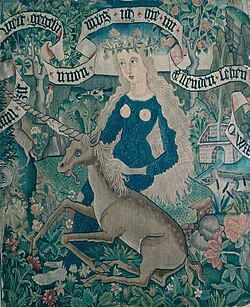
In art, the wild man was depicted as completely covered with hair, except of the face, hands and feet; the wild woman likewise except her breasts were also stereotypically hairless (cf. fig. right).130 By the 12th century the wild folk were almost invariably described in this way, as hairy all over.202 To be more precise, the wild men were bearded but hairless above the chin, whereas the females bare-chinned (beardless) as well as having bared breasts.203
Around the same 12th century, the conventions of hairiness came to be extended to certain legendary personages in mentally altered states.204aw A prime example was the biblical Nebuchadnezzar II of Babylon who went mad and was no longer depicted as a smooth-bodied human but as a hairy creature. Other examples were ascetic saintsax (cf. § Christian parallels) or literary hermits such as the Merlin of the Welsh (cf. § Celtic mythology) or Arthurian Ywain who were overcome by a spell of madness or lovelorn dementia (cf. § Celtic mythology).207208
Bernheimer asserts that medieval paintings of Nebuchadnezzar came to be conventionally depicted as a wild man in crouching positions as according to contemporary ideas, even though that image contradicted the verbal biblical description in Daniel 4 (Book of Daniel, 2nd century BCE), which ascribed feather-like growths of hair like eagles, and bird-like claws.209
The wild man was used as a symbol of mining in late medieval and Renaissance Germany. The town of Wildemann in the Upper Harz was founded during 1529 by miners;210 and the town was supposedly named after certain thieves discovered the wild man and wife clad in nothing but fir branches and moss living in the caves of a Harz mountain range.211212 (For usage as heraldic devices in this town, this German mining area or elsewhere, cf. § Heraldry below.)
In costumery for dances and balls, this was simulated by wearing tights with numerous pieces of feathers or rags glued onto them (cf. Bal des Ardents)213ay Masks in costumes were used to portray wild men in popular drama,214 also including the patrician mummers who participated in the Nuremberg Schembart Carnival214 (cf. § In dance and festival)
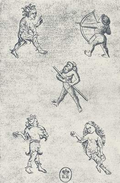
Some early sets of playing cards have a suit of Wild Men, including a pack engraved by the Master of the Playing Cards (active in the Rhineland c. 1430–1450), some of the earliest European engravings.215216 A set of four miniatures on the estates of society by Jean Bourdichon of about 1500 includes a wild family, along with "poor", "artisan" and "rich" ones.217218
In medieval art
Manuscript illuminations
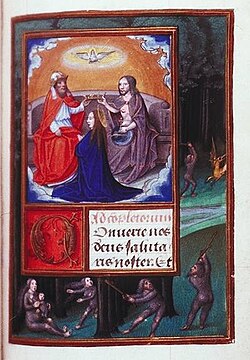
The wild folk are featured in the marginal paintings (drollery) in a number of illuminated manuscripts. There are wild men and women painted in the narrative border around the miniature of the Coronation of the Blessed Virgin Mary in the Book of hours at Syracuse University Library (cf. fig. left).219
In the Taymouth Hours (14th century), there are a series of miniatures (bas-de-page illustrations) recounting a story of a wild man abducting a maiden. Though the captions in this work are written in Anglo-Norman French, the wild man is called wodewose, which is a Middle English term.110221
There is also the drollery of a wild man being baited by three dogs, in the Queen Mary Psalter (14th century).223224225
Murals
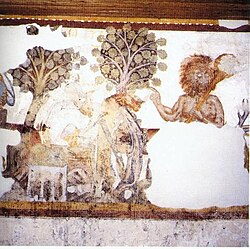
The herdsman character who is only a mere peasant (vilain) in Chrétien's Old French Yvain, the Knight of the Lion (though described as a "wild man" in modern scholarship226) is literally a wild man (waltman, "man of the woods") in Hartmann's Middle High German Iwein.58 The wild herdsman is depicted as a club-carrying wild man on one of the early 13th century227 fresco murals of the Iwein cycle at Rodenegg Castle (Castello di Rodengo) in South Tyrol (cf. image right).228 The wild man is similarly painted on the mural at Schmalkalden Castle (Wilhelmsburg Castle). The man wears a skin with two paws attached to it, perhaps the influence of the Greek hero Hercules (wearing the lion skin).229
There is a giantess room series among the Runkelstein Castle (Castel Roncolo) fresco murals, and the label "Fraw Riel" suggests identification with the female Rûel of Wigalois (mentioned above as being categorized as wild woman by some modern commentators).230az The Runkelstein frescos are themed on a set of triads: three heroes, three giantesses, three giants, etc. The giant Schrutan is one of them,230 who figures in the epic Rosengarten zu Worms as one of the single combat participants.ba233231 Although clad in knightly armor, he holds an uprooted tree, and the Schrutan in this painting is "encoded as a giant-wild man hybrid" according to one art critic.234
Engravings
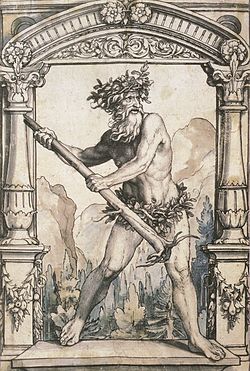
Albrecht Dürer depicts the wild man pursuing the maiden in his "Coat of Arms of Death" (1503), of which it is commented that the wild man springs to life from the conventional immobile role as shield-bearer of heraldic device (cf. also another of his work discussed under § Wild Men as shield-bearer below).235236
English examples
A carved image of a group of wild men (woodwoses) engaged in battle with a beast form a roof boss in Canterbury Cathedral, and is grouped among a number of Green Man bosses present in the cathedral.237bb There is also a furry wild man depicted in the crypt of the Canterbury Cathedral.bc239240 The visual artistic depictions of the English wild man (woodwose) and the green man merged during the Middle Ages to form a single type.240
Classical influences
There are instances where medieval depiction of satyr or faunus lose their beastly traits (hooves and horns), turning into creatures not so far apart from wild men.241
Medieval myth and art also adopted a convention of depicting the Greek hero Heracles, clad in lion skin and carrying a club as a wild man, sometimes of a more conventional typebd or more outlandishly as a tailed monster with clawed feet.be243 (e.g. painting at Schmalkalden, described above)
Gallery
-
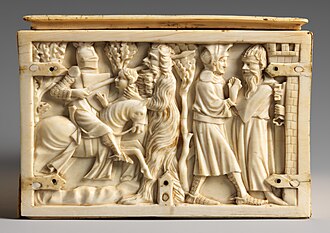 Knight saving a woman from a wild man, ivory casket, 14th century
 -
!["Wild Man", c. 1521/22, bronze by Paulus Vischer [wikidata]](/weird-wikipedia/img/c/bf/bf6534366181299b.jpg) "Wild Man", c. 1521/22, bronze by Paulus Vischer
"Wild Man", c. 1521/22, bronze by Paulus Vischer -
![Tapestry: Wild Men and Moors, c. 1440 (Museum of Fine Arts Boston)[244]](/weird-wikipedia/img/c/90/900296cb1da107aa.jpg)
-
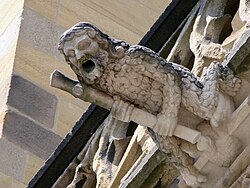 Gargoyle, Moulins Cathedral
 -
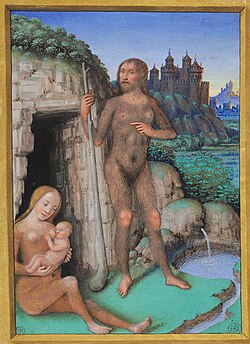 Wild family, miniature by Jean Bourdichon, from a set showing The Four States of Society
Heraldry
Wild Men as shield-bearer
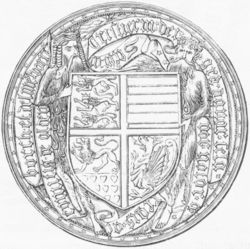
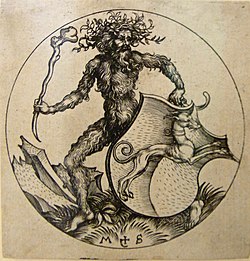
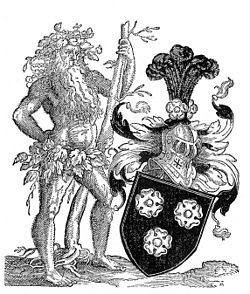
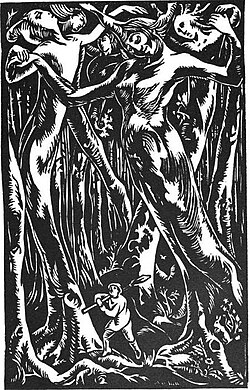
By the second half of the fifteen century, it became widely conventional to have engravings made of a wild man holding up a shield (escutcheon) bearing the family's coat of arms (cf. images left).245235 Particular examples include the Princes of Brunswick-Wolfenbüttel (cf. also § Numismatics below) and later by the royals of Brandenburg–Prussia.246
To avail themselves to this needs, the engravers came up with the idea of having a prototype or template at hand of a wild man holding up a blank shield, so that the proper emblem can be filled in to cater to the particular patron. Martin Schongauer was one such engraver,247 four heraldic shield engravings of the 1480s which depict wild men holding heraldic shield (emblems of moor, greyhound, stag, and lion).bf
Dürer in his Portrait of Oswald Krell (1499) drew two wild men supporting family heraldic shields. The one on the left wears a green garment made of moss, the one on the right is hairy all over (see image at top of page).1
The wild man appears in the coats of arms of e.g. Naila248 and of the aforementioned town of Wildemann.249
-
![The coat of arms of the city of Lappeenranta, Finland features the "wild man";[250] since the Swedish name of the city Villmanstrand[bg] stood for ("Vildman strand", i.e., "wildman's strand").[251][252][bh]](/weird-wikipedia/img/c/b7/b7715c8dd8ac4b92.png)
-
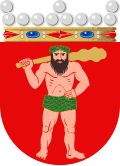 Coat of arms of the Finnish historical province, Lapland
 -
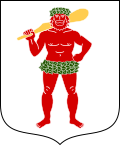
-
![The city of Antwerp introduced supporters for its coat of arms during 1881, with a "wild woman" and a wild man[253]](/weird-wikipedia/img/c/26/267179816f07e109.png)
-
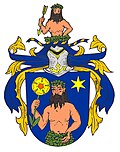 Arms of Kostelec nad Černými lesy, Central Bohemia
 -
![The German Glücksburg dynasty adopted Heracles into its coat-of-arms in 1863 when they became the royal family of Greece; the stylization of Heracles following the common usage of "wild man" in heraldry all over Europe.[254]](/weird-wikipedia/img/c/74/74eef622f173a265.png) The German Glücksburg dynasty adopted Heracles into its coat-of-arms in 1863 when they became the royal family of Greece; the stylization of Heracles following the common usage of "wild man" in heraldry all over Europe.254
The German Glücksburg dynasty adopted Heracles into its coat-of-arms in 1863 when they became the royal family of Greece; the stylization of Heracles following the common usage of "wild man" in heraldry all over Europe.254 -
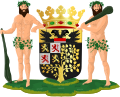 Coat of arms of the Dutch municipality of 's-Hertogenbosch (den Bosch), capital of the province of North Brabant
 -
![Half-figure of a wild man or "demi-savage", on crest of Scottish clan Murray (Duke of Atholl)[255]](/weird-wikipedia/img/c/9a/9a8d60c8d06d48fd.png)
Numismatics
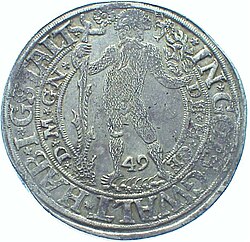
The so-called Wildemannstaler was a type of taler (thaler, "dollar") denomination coins featuring a standing wild man on the reverse, first struck by Duke Henry the Younger of Brunswick-Wolfenbüttel in 1539,257258 using the silver mined from the Upper Harz mountains.259 Thus, much of this wild man is really part of silver-mining folklore, rather than alpine or forest region folklore.260 The standing wild man on the early coin (and some heraldic illustrations) depicts a wild man holding a club (uprooted tree261) and a clump of burning flame in the other hand (cf. photo right).257 The folkloric explanation of the flame is that it represents a light source or beacon of light to guide humans through the dark mine tunnels to the ore source or silver vein, as clarified by the work of Gerhard Heilfurth and Ina-Maria Greverus (1967).262 Heilfurth regards the wild man in this context to be a type of Berggeist or "mountain spirit" (which is really a generic term or class used by modern folklorists), better known as Bergmönch or "mountain monk" in the folklore of the Harz mountains. The explanation of the "monk" name comes from the historical fact that the neighboring Walkenried Monastery held control of the workings of the Harz mining operation at one time.263
The lore of the mining spirit type wild man (or the Bergmönch264) was localized mainly in the Harz and the Ore Mountains.265 The folklore is attested in the following piece of 16th century writing, which stated that in the community of Wildemann (town named after "wild man"):
helt man dafür, daß daß Closter von Walckenred sonderlichen den Wildemanner Zog inne gehabt, beleget vnd gebawet hat, weil sich der Daemon Metallicus, der Bergteuffel, den die Bergleut daß Berg Mänlein nennen, in einer gestalt eines großen Mönchs hat sehen laßen, fürnemlich auff der Zechen Wildemann, da viel guter leute denselbigen gesehen, auch offtmals großen schaden gethan vnd angericht.
(It is believed that the Walkenried Monastery held, occupied, and built upon the Wildemann mine in particular, since the Daemon Metallicus or mountain devil, whom the miners call the "mountain manikin" (Bergmännlein, i.e. gnome), appeared in the form of a large monk, especially at the Wildemann mine, where many good people saw him, and he often caused great damage and destruction.
There is also the political and polemical interpretation of the wild man and flame emblem, namely, Henry the Younger was insinuating threat of violence, even the burning down of townships.257267 When Henry's less quarrelsome son Julius succeeded as duke, the flame on the coin was replaced by a candle or taper, and these coins are known as the Lichttaler or "Light taler" among numismatists. Later, Julius added other objects, the skull, the hourglass, and eyeglasses to the composition.268269
In dance and festival
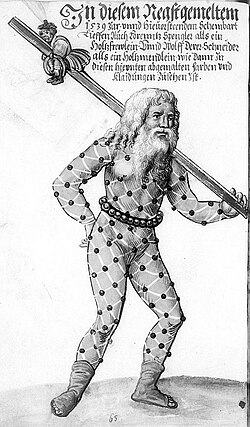
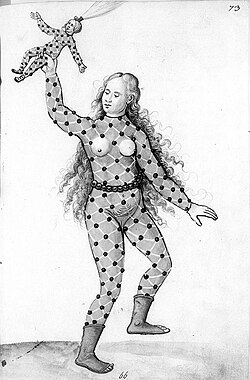
Aspects of German folk traditions about the wild man were preserved in performances of Wildemannspiel ("wild man play") and Wildemanntanz (dance), which tended to be held during Shrovetide/Carnival season.271272273
In the Morgestraich of the Carnival of Basel a wild man would take the first dance alongside other masked figures; this wild man held an uprooted tree in hand, and was entwined with leaves around the head and loins.274 There is a 1435 account of the wild man dance in Basel featuring 23 such wild men (uomini selvatici).275
In the 15th century Fastnachtspiel (carnival play) "Ein spil von holzmennern", two men of the woods quibble over the female (holzweip) of their kind.276277 The Wildemannspiel has been traditionally performed in Etschland (Etschtal),bi Ulten,bj and Vinschgau in South Tyrol.279. An example given of the Wildemannspiel conducted at Marling in South Tyrol: a youth and two younger boys are dressed up in beard moss hair with a jangling chain of snail shells and holding a young tree as staff, they waited in a cave towards St. Felix and dressed up schoolgirls were tasked to enter the forest and find the three of them.280
More examples come from civic celebrations or processions. At the Schembart Carnival (Schembartlaufen) of Nuremberg there were participants (German: Läufer lit. 'runners'bk) dressed up as wild men (Holtzmendlein282) holding up a dwarf (on a stick) as captive, together with a wild woman (Holtzfrewlein) (cf. image right).bl283284 The bare-breasted "Wild Woman" in the procession was likely impersonated by a man.286 The Wild Woman may also throw her "baby" (a doll) into the crowd, and this is meant as a gesture of bestowing fertility (performer can retrieve the doll by tugging on the string tied to it, so that this schtick can be repeated).287
In Swiss locales of Vitznau, Weggis, Gersau, and Küssnacht, there is the Schämeler or Tschämeler (dialect name for a "schemer" "disguiser" etc.) who enacts the wild man,288 i.e., the local folk dressing up using moss, bark, leaves, etc. and holding a whole tree as staff.289
Outside of German-speaking regions, the (magnus) ludus de homine salvatico, a large-scale Pentecostal play about the wild man was put on in Padua, Italy in the year 1208 and 1224; not much is known about these except they featured giants (gigantibus). Another ludus was held in the canton of Aargau, Switzerland in 1399.290


It also became fashionable at one time for participants in the carousels at court festivals to dress up as club-carrying wild men (cf. image right).291
King Charles VI of France and five of his courtiers were dressed as wild men and chained together for a masquerade at the tragic Bal des Ardents (Bal des Sauvages) which occurred in Paris at the Hôtel Saint-Pol, 28 January 1393 (cf. image left). They were suited up "six quilts of fabric coated with pitch then stuck with flax (linen) fibers in the form and shape of hair", making themselves out to be "hommes sauvages, covered in hair from head right up to the soles of their feet".294295 A careless torch set the costumers aflame, and all but one of the courtiers died; the king's own life saved by his aunt the Duchess of Berry, who covered him with her dress.1296297 There exist paintings of this scene in copies of Froissart's Chroniques (as green men;1 compare similar image right).299 It is supposed that "dyed tufted flax" was used295 to simulate the hair.
England's Henry VIII held a wild man dance on the Twelfthnight at the Great Hall of Greenwich in 1515.300
The Burgundian court celebrated a pas d'armes known as the Pas de la Dame Sauvage ("Passage of arms of the Wild Lady") in Ghent in 1470. A knight held a series of jousts with an allegoric meaning in which the conquest of the wild lady symbolized the feats the knight must do to merit a lady.
Medieval parallels
While the schrat (q.v.) tended to denote a sort of household spirit in later periods, the creature known as schrat, scrato or scrazo in Old High German were glossed as equivalent to the fauni, silvestres, or pilosi in Latin, thus indicating that the earlier notion of the schrat had been close to hairy woodland beings, i.e., the wild men of the woods.5
Versions of the divyi lyudi "wondrous folk") from the medieval Russian romance of Alexander the Great appear in later folklore, as aforementioned.196
Celtic mythology
There are medieval Welsh,301302 Irish,303302 and Scottish mythical narratives about men going mad and living in the wilderness, considered as part of the Celtic Wildman tradition according to scholars.302
The Welsh tradition regarding Myrddin Wyllt ("mad Merlin")bm is that he went mad after the Battle of Arfderydd which took place in 573 CE in the wake of the battle that resulted in the death of Gwenddoleu ap Ceidio who was the king he served. It is recorded as such in the annals, though it may not be historically accurate.304 Myrddin then fled to the forest, living life as a man of the woods, according to Giraldus Cambrensis (12th century).305 The battleground (Arfderydd) became identified as a place near the Scottish border, making plausible the legend that Merlin's flight took him to the Caledonian Forest in Scotland.304 Geoffrey of Monmouth recounts the Myrddin Wyllt legend in his Latin Vita Merlini of about 1150,306 and the attachment of the madness motif may or may not have been Geoffrey's invention.301
The legend of the Scottish Lailoken who lost his wits in battle is so similar in background to the Myrddin legend, it is considered a version of the same myth,302 and in fact, there is an aside comment that Lailoken might have been Merlin of Britain though that cannot be ascertained in the source itself,301 namely the Lailoken fragment302 or more precisely the Latin fragmentary The Life of Saint Kentigern.301 There is also a geographical proximity of the battlegrounds involved,307 pinpointable as present-day Arthuret in Cumbria, England.304301
The Irish analogue308304 is the legend of Suibhne Geilt ("mad Sweeny"), a king bn of the Dál nAraidi who himself went mad during the combat of the Battle of Mag Rath of 637 CE304309 The legend is accounted for in Buile Shuibhne (The Frenzy of Sweeney, 9th century310).304312
It is commented by James George O'Keeffe (1913) that the Welsh and Irish versions exhibit the dispersed Wild Man (of the Woods) tradition.303
In Chrétien's Arthurian Romance Yvain, there is the development where the title hero (shocked by his estrangement from his lover Laudine) loses his wits and lives in the wilderness; this has been characterized as a wild man episode by modern commentators.226313 Bernheimer lists Yvain, Lancelot, and Tristan among the Arthurian knights who chose to live as wild men in the aftermath of mental anguish having earned the disfavor of their beloved lady.208
The fragmentary 16th-century Breton text An Dialog Etre Arzur Roe D'an Bretounet Ha Guynglaff (Dialog Between Arthur and Guynglaff) tells of a meeting between King Arthur and Guynglaff ("a sort of wild man of the woods"), who predicts events which will occur as late as the 16th century.314
King's mirror
The notion of the Irish geilt, gelt (madness), which Grimm's notes glosses as equivalent to wilder mann or waldmann,bo315 is discussed in the Old Norse Konungs skuggsjá (Speculum Regale or "the King's Mirror", written in Norway about 1250),317 which points to the Northmen having learned about the Suibhne legend from Ireland.318
Ancient parallels
Figures similar to the European wild man occur worldwide from very early times. The earliest recorded example of the type is the character Enkidu of the ancient Mesopotamian Epic of Gilgamesh.319320
Classical parallels
Classical wild races
"Classical antiquity like the Middle Ages, had its wild men", according to Bernheimer.321 This included savage races of (sometimes hairy321) humans supposedly found in exotic places. Herodotus (c. 484 – c. 425 BCE),'s wild men and wild women supposedly lived in western Ancient Lybia (a vast region west of the Nile, not just the present-day nation) where there also lived marvels such as men with eyes in their chest (headless men) and dog-faced humanoids (cynocephaly).322 Ctesias'sbp Indika (fl. 5th century BCE) and Alexander the Great (d. 323 BCE)'s conquest influenced Europeans into thinking that such wild men (and the marvelous prodigies toobq) lived rather in the East, in the Indian subcontinent.322
Megasthenesbr (died c. 290 BCE), wrote of two kinds of men to be found in India whom he explicitly describes as wild: first, a creature brought to court whose toes faced backwards; second, a tribe of forest people who had no mouths and who sustained themselves with smells.323 Both Quintus Curtius Rufus and Arrian (1st and 2nd centuries CE) refer to Alexander himself meeting with a tribe of fish-eating savages while on his Indian campaign.324
The wild man races described in erudite writings of ancient historians may have had influence on the Medieval wild man folklore but establishing the degree would be difficult given the separation in time. But one can catalogue which ancient pieces of writing were accessible to medieval men.bs321
Distorted accounts of apes may have contributed to both the ancient and medieval conception of the wild man. In his Natural History Pliny the Elder describes a silvestres or forest tribe called the Choromandæ (Chromandi) in India, who had humanoid bodies but a coat of fur, fangs, and no capacity to speak325 – a description that fits gibbons indigenous to the area.323 The ancient Carthaginian explorer Hanno the Navigator (fl. 500 BCE) reported an encounter with a tribe of savage men and hairy women in what may have been Sierra Leone; their interpreters called them "Gorillae," a story which much later originated the name of the gorilla species and could indeed have related to a great ape.323326 Similarly, the Greek historian Agatharchides describes what may have been chimpanzees as tribes of agile, promiscuous "seed-eaters" and "wood-eaters" living in Ethiopia.327
Silvanus
The medieval wild man lends itself to easy comparison with a number of classical woodland divinities. However, the aforementioned definition laid out by Bernheimer clearly distinguishes the faun and satyr from the wild man.4 Grimm states that the German shaggy wood-sprite schrat answers to the classical faun, satyr, and perhaps even Silvanus.328 Old High or Middle High German glossaries equating forms of the word schrat with faunus or sylvestri hominus.315 Grimm speculates on the possibility schrat might have been a being of larger stature in olden times.329
The medieval wild man typically depicted holding an uprooted tree may have derived from the classical Silvanus who is lord of the gardens and uprooter of trees, though the latter is more prone to be holding a cypress sapling he is about to transplant.241 The centaur is more likely to hold a club, though this creature is of course, half horse.241
Christian parallels
Early Christian writings on Desert Fathers as found in the Apophthegmata Patrum ("Sayings of the Desert Fathers") are similar, but less outlandish: typically their head of hair has grown long enough to cover their naked bodies.142 A general term to describe such ascetics living in the wilderness was Grazers (Ancient Greek: βοσκοί, romanized: boskoí) coined among the Greek or Eastern Christians.bt There is the hypothesis that the notion of the "noble wild man" that emerged in the 15th century (after the European discovery of the Americas) may have been influenced by the notion of these "grazers".142
Although not authentically the stuff of antiquity, regarding the Christian Saint John Chrysostom (died 407),332 there developed an apocryphal legend in the Late medieval period (15th century) that he began as a soul of a child in purgatory taken into tutelage by the Pope, but considering himself unworthy went to live a life of austerity in the wilderness. Later, in a fateful meeting with the emperor's daughter who had gone astray, he succumbs to temptation and not only has carnal knowledge with her but pushes her off a ravine in the aftermath, for the penance of this sin and crime, he lives life on all fours, eventually developing body hair (with vegetation growing about his body as well), when he is captured in order to perform a baptism for the Imperial prince, upon which the accumulated hair, etc. drops off.206125 Accompanying illustrations may contradict the text and show a smooth, naked man on all fours, e.g., the Günther Zainer edition of Leben der Heiligen, vol. II (1471).333 Whereas Anton Koberger's edition of Leben der Heiligen (1488) depicts the crawling saint as a hairy man.334
Werewolf syndrome

Petrus Gonsalvus (Pedro González, born 1537, cf. image right) was referred to by Ulisse Aldrovandi as "the man of the woods" or "wild man of the woods" and it was believed that a whole race of such hairy people lived in the Canary Islands, though his hairiness is presumed to be due to his condition, hypertrichosis (aka Ambras syndrome), by modern commentators. His daughter Antonietta or Magdalena inherited the trait.335336337
The story of Pedro González and his marriage to the lady Catherine may have inspired the fairy tale Beauty and the Beast.337
In modern fiction
In Shakespeare's The Winter's Tale (1611), the dance of twelve "Satyrs" conflates wild men and satyrs.338 The dance is held at the rustic sheep-shearing (IV.iv), described by a servant:
Masters, there is three carters, three shepherds, three neat-herds, three swine-herds, that have made themselves all men of hair, they call themselves Saltiers,bu and they have a dance which the wenches say is a gallimaufreybv of gambols...bw
The term wood-woses or simply Woses is used by J. R. R. Tolkien to describe a fictional race of wild men, the Drúedain, in his books on Middle-earth. According to Tolkien's legendarium, other men, including the Rohirrim, mistook the Drúedain for goblins or other wood-creatures and referred to them as Púkel-men (Goblin-men). He allows the fictional possibility that his Drúedain were the "actual" origin of the wild men of later traditional folklore.339340
British poet Ted Hughes used the form wodwo as the title of a poem and a 1967 volume of his collected works.341
The fictional character Tarzan from Edgar Rice Burroughs' 1912 novel Tarzan of the Apes has been described as a modern version of the wild man archetype.319
See also
See also
Explanatory notes
- Such as Sigenot.
- i.e., Wigamur and Wigalois.
- Middle High German: waltman.
- Old High German: holzmuoja.
- Old High German: holzwîb.
- Old High German: holzvrouwe.
- German: Bergmönch.
- Cf. Christian I of Denmark's coat of arms (1449), with wild man as shield-supporter.
- Cf. also Martin Schongauer's works during the 1480s, described below.
- Prime example: Nebuchadnezzar II of Babylon who went mad.
- By Heinrich Frauenlob, cf. § German epic below for further information
- The older form of Sigenot (c. 1250) only survived in fragments, hence the contents are only known from later versions called Younger Sigenot (jüngerer Sigenot)25 in manuscripts and printed editions from the 15th century, which therefore is not a Middle High German attestation.
- Where muoja is cognate to Gothic mawi meaning "girl".28 Bernheimer came up with his own etymology that -muoia/-moia was related to Latin maia hence also connected to Maia, a Greco-Roman fertility goddess.5 In this connection, Bernheimer mistakenly read <rite of goddess Maia> where actually <May festival> ("Kalendas Maias") in a 9-10th century penitential, as can be clarified by comparison with a variant text, and the connection he made with wild woman or holzmoia are pointed out to be invalid,29 though Russell conjectures animal pelts may have been worn.29
- The glossary source given as "Gloss. mons." or "Gloss monst." by Grimm; a 10th century glossary from Mondsee in Austria according to Bernheimer. This is presumably ÖNB 2723, similar in content to ÖNB 2732, another biblical glossary compiled at Salzburg.30 Under the heading of "Lamia", this codex 2732 (abbreviated d) lists "holzmuoia ꝉ vuildazvuip".31
- Grimm explains ululae to be "funereal birds, death-boding wives, still called in later times klagefrauen.. resembling the prophetic Berhta" (Perchta, for which cf. Frau Berta below), and altogether as denoting "she who wails or moos (German: muhende) in the forest". Lexer's definition of holzmuoje gives either a wood specter (Gespenst) or wood owl (Eule).33
- The other mention by Bernheimer is "vvidiz vvip" which matches "Lamia" glossed as holzethmugi vel vvîdiz vvîp in Glossae Salmonis d = Clm. 2349642
- "Ulula" is glossed holzmugi in Glossae Salmonis a1 sigla i = Cms. 17152,43
- Rushing (2016), endnote 54 to Chapter 1, considers this mention of the wilde Weib as the oldest references, relying on Mannhardt's dating of 10th century.
- MHG luoder is glossed as mod. German Luder meaning "bait, enticement" or "hussy".55
- Also used figuratively to denote a headstrong or carefree hussey ("young unruly creature,.. frolicsome girl").72
- var. Bedelmon, Bildemon.73
- It is not clear if this Ronchi near Ala refers to Ronchital=Valle dei Ronchi that lies further east than Ala, Folgrait (Folgaria), or Trambileno.
- Called Pechtra or Pechtra-baba by the Carinthian Slovenes according to Graber, but only the -baba is a pan-Slavic stem.
- Definite or possibly diminutive forms: Orken, Orgen.
- Altered to Lorke by Bernheimer
- Definite or possibly diminutive form: Lorgen.
- Transliterated as Noerglein by Bernheimer.
- German: Unterirdischen.
- Importantly to Bernheimer, Orcus was associated with Maia in a dance celebrated late enough to be condemned in the aforementioned penitential,94 but the document is about May Festival not Maia's festival, and the phrase exercere Orcum may mean no more than a "hellish" exercise.29
- pl. var. Rüttelweibern, Rittelweibern.
- Incidentally, "ostrich" here is rendered "siren" in LXX and Vulgate.
- The latinized term diasprez perhaps should be read as "diapered" meaning "embroidered" according to Warton, Thomas (1840) The history of English poetry; Wharton here also provides quoted Latin text, naming the source as Ex comp. J. Coke clerici, Provisor. Magn. Garderob. ab ann. xxi. Edw. III. de 23 membranis, ad ann. xxiii. memb. x.
- There is further complication of different recensions. Instead of shaggy Else who appears in Wolfdietrich B, a water spirit or mermaid (meerwîp, meerminne) appears in Wolfdietrich A.119120
- The character Sir Satyrane, a satyr's son cast in the role of a noble wild man. He ministers to a wounded knight using herbs, etc.137
- Assessment that Sachs articulates the nobility of the wild man more clearly than the Englishman, Spenser, followed by details.138
- They walk high atop mountains and shake the treetops during stormy nights with flashes of lightning. They walk (as dwarfs) among the horsetails (de:Schachtelhalme) when the Arum (Aaronspflanze) are in bloom.147
- Ranke (1924), p. 184, German: "harmlose Gutmütigkeit".
- The works of Ovid, Pausanias, and Claudius Aelianus also write of the motif of shepherds who caught a forest being (Faunus, etc.) in the same manner and for the same purpose.164
- And if they were able to detain him longer, would have learned how to make wax from milk. This motif of getting the wild man drunk to extract knowledge was seen above in the lore of the Grisons, with the Silenus parallel noted.
- "Wilder Mann, Glück und Hual, / Pring mir auch mein Thual!" where Hual should be read as Heil ("hail, health") and Thual as Teil ("part, portion").
- Zingerle's tale No. 124 is cited by Schneller for comparison.
- Cf. Fänggen § General description and Salige Frau § Guardians of the chamois.
- he term muldenartige — Mulde is vague, meaning shallow container or trough, but historically it refers to a Backtrog or bread trough.
- Cf. Salige Frau also said to be preyed on by the Wild Hunt.192
- Valentsova (2019) is a useful source in English, but derives much of its info from Belova (1999), which is cited as SD=Slavjanskije drevnosti.
- It might be worth noting that a mythical pagan creature called Div which cries out an omen of doom in the The Tale of Igor's Campaign is conceived of as bird.199
- A motif seen with the moss woman, as Mannhardt points out. Cf. also the legend of the Salk under Salige Frau.
- Note she is hairy except around her breasts and knees, as according to wild woman defined by Bernheimer.4
- There was some basis to this according to the shifting medieval scholarship. While Isidore of Seville (d. 636) had explained mental states in terms of the well-known Four humors (melancholia caused by black bile), Arnaldus de Villa Nova (d. 1311) would state that while mania was caused by the humour of choler, it could exhibit symptoms of animal-like physical transformations, and indeed, the medieval lay-person of that period believed that madman assumed shaggy forms.205
- Example of Saint John Chrysostom (died 407), described further below. Late medieval legends developed claiming he was overgrown with hair all over his body when recaptured.206125
- Cf. feather tights of angels
- However, the fresco has this giantess holding Nagelring (Dietrich von Bern's sword) thus some confounding of names is involved.230
- Schrûtân is killed by Heime.231232 Schrûtân is also uncle to a pair of giants named Ortwîn (4) and Pûsolt231233
- The scene appears to be one of either a hunt or a baiting. Charles John Philip Cave reporting on animal themes in roof bosses reports that "bull-baiting is in the nave aisle at Winchester Cathedral; in the Canterbury cloisters a bull is tossing a wild man".238
- Bernheimer guesses this might be a depiction of the Ichthyophagi from the Alexander Romance.
- Hercules as a wild man, illustrated in a manuscript containing poems by Robert de Blois (fl. second third of the 13th century.242 ).
- 14th century illuminated manuscript of Seneca's Hercules Furens.
- Each image is confined within an approximately 78 mm circular composition which is not new to Schongauer's oeuvre. In Wild Man Holding a Shield with a Hare and a Shield with a Moor's Head, the wild man holds two parallel shields, which seem to project from the groin of the central figure. The wild man supports the weight of the shields on two cliffs. The hair on the apex of the wild man's head is adorned with twigs which project outward; as if to make a halo. The wild man does not look directly at the viewer; in fact, he looks down somberly toward the bottom right region of his circular frame. His somber look is reminiscent of that of an animal trapped in a zoo as if to suggest that he is upset to have been tamed. There is a stark contrast between the first print and Shield with a Greyhound, held by a Wild Man as this figure stands much more confidently. Holding a bludgeon, he looks past the shield and off into the distance while wearing a crown of vines. In Schongauer's third print, Shield with Stag Held by Wild Man, the figure grasps his bludgeon like a walking stick and steps in the same direction as the stag. He too wears a crown of vines, which trail behind into the wind toward a jagged mountaintop. In his fourth print, Wild Woman Holding a Shield with a Lion's Head, Schongauer depicts a different kind of scene. This scene is more intimate. The image depicts a wild woman sitting on a stump with her suckling offspring at her breast. While the woman's body is covered in hair her face is left bare. She also wears a crown of vines. Then, compared to the other wild men, the wild woman is noticeably disproportionate. Finally, each print is visually strong enough to stand alone as individual scenes, but when lined up it seems as if they were stamped out of a continuous scene with a circular die.
- Originally spelled as Viltmanstrand
- An example of a canting arms which visually hints at the name of its owner.
- Italian: Val d'Adige.
- Italian: Ultimo.
- Informally called "mummers" by Bernheimer; "mummer's play" in German is Mummenschanz, which is glossed as a synonym of the Schembartlaufen.281
- Cf. illustrations of participants of Schembart from a 16th century codex.270
- Cf. also name glossary on Myrdding Gwyllt in: Bromwich, Rachel (2014) [1961]. Trioedd Ynys Prydein: The Triads of the Island of Britain (4 ed.). Cardiff: University Of Wales Press. pp. 458–459. ISBN 9781783161461. Cf. also notes to Triad #61, Tri Thar6 Ellyl (Three Bull-Spectres) of Britain.
- Not a historically recorded king, thus he was no more than lord.
- Grimm also says it compares to Myrddin Gwyllt.
- Former Persian court physician. His sources concerning India were essentially Persian.
- India to be "swarming" with the aforementioned cynocephali and headless men.322
- Seleucus I Nicator's ambassador to Chandragupta Maurya.
- Bernheimer actually speaks of "legends from the Mediterranean past" exerting "influence of these upon folklore, art, and imaginative literature". As to visual art § Classical influence was discussed above under §Iconography.
- They were viewed as saints in Byzantine society, and the hagiographical accounts about their lives were spread in all of Christianity, possibly influencing later authors.142330331
- Sault, "leap".
- Gallimaufrey, "jumble, medley".
- The account Shakespeare may have been inspired by the episode of Ben Jonson's masque Oberon, the Faery Prince (performed 1 January 1611), where the satyrs have "tawnie wrists" and "shaggy thighs"; they "run leaping and making antique action".338
References
References
Citations
- Eisler, Robert (2023) [1951]. "158. Green Men". Man into Wolf: An Anthropological Interpretation of Sadism, Masochism and Lycanthropy. New York: Routledge. ISBN 9781000784534.
- "woodwose". Oxford English Dictionary (Online ed.). Oxford University Press. (Subscription or participating institution membership required.); Murray, James A. H. ed. (1908) A New English Dictionary on Historical Principles X, Part 2, s.v. "woodwose"
- OED online for "woodwose" gives Britsh pronunciations of /ˈwʊdwəʊs/ WUUD-wohss or /ˈwʊdwəʊz/ and US pronunciations of /ˈwʊdˌwoʊs/ WUUD-wohss or /ˈwʊdˌwoʊz/ WUUD-wohz102
- Bernheimer (1952), pp. 1–2 quoted by Strasenburgh (1975), p. 286
- Bernheimer (1952), p. 42.
- Bernheimer (1952), p. 20.
- Busk (1874), p. 408.
- Schwarz (1941), pp. 968–969.
- Vonbun, Franz Joseph [in German], ed. (1889). Die Sagen Vorarlbergs: Nach schriftlichen und muendlichen (in German). Innsbruck: Wagnersche Univ.-Buchhandlung. p. 56.
- Mannhardt (1904), 1: 113.
- Vonbun (1889), p. 38.
- Mannhardt (1904), 1: 120.
- Heyl (1897) Tirol p. 518 (Nr. 86. Die wilden Bergfräulein in Martell); Ranke (1924) Volkssagen p. 180 apud HdA
- Golther Mythol. p. 188: Grimm (1875), 1: 402; Grimm & Stallybrass tr. (1883), 2: 486, Mannhardt (1904), 1: 112, etc., apud HdA
- Baumberger, Georg (1903) Sankt Galler Land, Sankt Galler Volk p. 189, apud HdA.
- Vernaleken, Theodor [in German], ed. (1858). Alpensagen: Volksüberlieferungen aus der Schweiz, aus Vorarlberg, Kärnten, Steiermark, Salzburg, Ober- und Niederösterreich. Wien: L. W. Seidel. p. 282.
- Reiser, Karl August [in German], ed. (1895b). Sagen, gebräuche und sprichwörter des Allgäus: aus dem munde des volkes (in German). Vol. 2. Kempten: Josef Kösel. pp. 404–405.
- Meyer, Elard Hugo (1891). Germanische Mythologie (in German). Berlin: Mayer & Müller. p. 122. apud HdA
- Mannhardt (1904), 1: 87.
- Vonbun (1889), p. 143.
- Rochholz, Ernst Ludwig [in German], ed. (1856a). "Part V. B. Zwergensagen aus andern Schweizerkantoneß. Nr. 228 47) Der Geißler von Klosters". Schweizersagen aus dem Aargau. Vol. 1. Aarau: H. R. Sauerländer. pp. 319–320.
- Schwarz (1941), p. 968.
- Clifton-Everest, J. M. (1979). The Tragedy of Knighthood: Origins of the Tannhäuser Legend. Medium Aevum monographs, n.s. 10. Oxford: Society for the Study of Mediaeval Languages and Literature. p. 16. ISBN 9780950595535.
- Boyer, Tina Marie (2016). The Giant Hero in Medieval Literature. Leiden: BRILL. p. 57. ISBN 9789004316416.
- Boyer (2016), pp. 54, pp.55 n.
- Grimm (1875), 1: 399; Grimm & Stallybrass tr. (1883), 2: 482–483.
- Grimm (1875), 1: 360; Grimm & Stallybrass tr. (1880), 1: 433–434.
- Herrmann, Paul [in German] (1906). Deutsche Mythologie in gemeinverständlicher Darstellung (2te, neuarbeitete ed.). Leipzig: Wilhelm Engelmann. p. 317.
- Russell, Jeffrey Burton (2019). Witchcraft in the Middle Ages. Cornell University Press. p. 310, endnote 22 to Ch. 4. ISBN 9781501720314.
- Blom, Alderik H. [in German] (2017). "15. Glossaries". Glossing the Psalms: The Emergence of the Written Vernaculars in Western Europe from the Seventh to the Twelfth Centuries. London: Walter de Gruyter GmbH & Co KG. ISBN 9783110498264.
- Steinmeyer, Elias von; Sievers, Eduard, eds. (1879), Die althochdeutschen Glossen, vol. 1, Berlin: Weidmann, p. 609
- Mayhew, A. L. (14 June 1884). "Correspondence: The word 'Hag'". The Academy. 25 (632): 424.
- Lexer (1872) s.v. "holz-muoje, -muowe" (also ib. holz-muoje@woerterbuchnetz)
- Grimm (1875), 1: 360; Grimm & Stallybrass tr. (1880), 1: 432, 433.
- Bernheimer (1952), p. 35.
- Hansen & Franck (1901), p. 624.
- Steinmeyer, Elias von; Sievers, Eduard, eds. (1895), Die althochdeutschen Glossen, vol. 3, Berlin: Weidmann, p. 337
- Hansen & Franck (1901), p. 619.
- Steinmeyer & Sievers (1898), 4: 557–558.
- Bernheimer (1952), p. 35 and note27 citing "Hansen, p. 718".
- "Lammia" is glossed holzwib in Heinrici Summarium liber XI g.= Clm. 17151, 17153, 17194.3738 these 3 codices (and Cms. 17152 as well as others) were compiled at "Scheftlarn",39 whereas Bernheimer refers to one compiled at Schäftlarn.40
- Steinmeyer, Elias von; Sievers, Eduard, eds. (1898), Die althochdeutschen Glossen, vol. 4, Berlin: Weidmann, p. 171
- Steinmeyer & Sievers (1898), 4: 109.
- Steinmeyer & Sievers (1895), 3: 244.
- Hansen & Franck (1901), pp. 618–619.
- Lecouteux, Claude (2010-12-31). "Lamia – holzmuowa – holzfrowe – Lamîch". Euphorion (in German). 75: 363.
- Mannhardt (1875), p. 87.
- Folklore identifies the wild women's house as the gigantic slabs of basalt along the Kinzig river, in Bernhardswald near Schlüchtern.47
- Dronke, Ernst Friedrich Johann, ed. (1844). "Ex codice eberhardi monachi. Kap. 15. De dedicatione et terminatione ecclesie in Salchenmunster secundum antiquos". Traditiones et antiquitates Fuldenses (in Latin and German). Fulda: C. Müller'sche Buchhandlung (G.F. Euler). p. 56.
- Pistorius, Johann (1726). Struve, Burkhard Gotthelf (ed.). Rerum Germanicarum scriptores (in Latin). Ratisbonae [Regensburg]: Sumptibus Joannis Conradi Peezii. p. 544.
- Roth, Karl, ed. (1850). Kleine Beiträge zur deutschen Sprach-, Geschichts- und Ortsforschung (in German). München: Christian Kaiser. p. 231.
- Grimm cites Dronke ed. (1844) Ex codice eberhardi monachi. Capitulum XV on Salchenmunster (Salmünster), p. 544, but this is incorrect. Dronke (1844), p. 56 has a lacuna after "Ellenstein. inde in iazaha" therefore fails to mention the wild wives' den in question,49 and the omission needs be supplemented by the unbroken text in Pistorius (1726), p. 544, which reads "..ellenstein usque in jazaha, & sic sursum, in herlihenbrunnen ad ad domum wilderouuibo".50 Alternate forms such as "domum uuildero uuibo" or "domum wilderouuibo" are given in redactions by modern editors.51
- Grimm (1875), 1: 358–359; Grimm & Stallybrass tr. (1880), 1: 432.
- Mannhardt (1875), p. 87; Mannhardt (1904), 1: 87.
- Lexer (1872) s.v. "luoder" (also ib. luoder@woerterbuchnetz)
- Grimm (1875), 1: 399; Grimm & Stallybrass tr. (1883), 2: 483.
- Lexer (1876) s.v. "tôre" (also ib. tôre@woerterbuchnetz), mod. German: Tor
- Rushing (2016), endnote 57 to Chapter 1
- Grimm (1878), 3: 121; Grimm & Stallybrass tr. (1888), 4: 1405–1406.
- Otn. Cod. Dresd. 277 (Ortnit).59
- Lexer (1872) s.v. "holz-wîp" (also ib. holz-wîp@woerterbuchnetz)
- Schwarz (1941), p. 969.
- Schwarz (1941), pp. 969–970.
- Schwarz (1941), p. 970.
- Richter, Albert [in German] (1870). Deutsche Heldensagen des Mittelalters (in German). Illustrated by Wilhelm Georgy (2 ed.). Liepzig: Friedrich Brandstetter. p. 100.
- Vonbun, Franz Josef [in German] (1862). "II. Elbische wesen. 3. Fänken". 1862 (in German). Chur: Leonhard Hitz. pp. 44–65.
- Vonbun (1862) Beiträge pp. 46, 47,66
- Sanders, Daniel Hendel (1885) Wörterbuch der Deutschen Sprache, s.v. "Fang III"
- Vonbun (1889), p. 41.
- HdA n66, citing Fient Präftigau p. 142; Mannhardt (1904), 1: 96; Rochholz Nr. 228 "Geißler von Klosters";21 Vonbun (1889) Sagen, pp. 41, 61; etc.
- Bernheimer (1952), pp. 33–34.
- Flügel-Schmidt-Tangür German-English 6th ed. (1902), s.v. "Wildfang"
- Busk (1874), p. 413.
- Mannhardt (1875), p. 112.
- Salvang in usage around Fassa Valley, Enneberg (Mareo), Heiligkreuzkofel (Sas dla Crusc) according to HdA.64
- Cited and quoted by Grimm: "agrestes feminas quas silvaticas vocant, et quando voluerint ostendunt se suis amatoribus, et cum eis dicunt se oblectasse, et item quando voluerint abscondunt se et evanescunt (The wild women whom they call sylvans; and they show themselves as they wish, to see their lovers or tell them they have delighted themselves with them, and when they wish to hide, they disappear)".53
- Mannhardt (1875), pp. 112–113, cited by Rushing (2016), endnote 54 to Chapter 1.
- Schneller (1867) "I. Bertasagen", p. 209. A. Aus Folgareit. B. Aus Trambileno. C. Aus Ronchi (bei Ala), pp. 209–212.
- Graber (1914), pp. 89–92, "110. Berchtra und dei Wile Jagd oder die Klage"; "111. Von der Berchtra".
- Fink, Hans [in German] (1990). "Der Wilde namens Beatrìk". Der Schlern (in German). 64: 563.
- Hans Fink (1990): "Der Wilde begegnet uns unter verschiedenen Namen, so z. B. als Loter, Pettl, Lorgg, Norgg oder Gletschmann"80
- Meyer, Elard Hugo (1903). Mythologie der Germanen (in German). Strassburg: Karl J. Trübner. p. 198. apud HdA
- Bernheimer (1952), pp. 42–43 citing [von der] Leyen & Spamer (1910), p. 22.
- Schwarz (1941), p. 970 citing Heyl (1897), p. 230, "43. Von den Örggelen in Sarnthal" and E. H. Meyer Germ. Mythol. (recté Myth. der Germanen, 1903)82
- Leyen & Spamer (1910), p. 22: "wildes Zwergvolk".
- Zingerle, Ignaz Vincenz (1870). "Purzingele". Kinder- und Hausmärchen aus Tirol (2 ed.). Gera: Eduard Amthor. p. 184.
- Zingerle in Purzinigele (a Rumpelstiltskin type tale), also glosses the diminutive Nörglein as "Zwerg, Wachtelmännchen (dwarf, quail-manikin[?])".86
- Ranke (1924), pp. 135, 138, 142 recognizing Unterirdischen as Zwerg.
- Sanders, Daniel (1910) Handwörterbuch der deutschen sprache s.v. Unterirdisch
- Leyen & Spamer (1910), p. 22 on harmless orco: "harmlose Wildleutevölkchen der orco (neapolitanisch: huorco) hervor, wie es in Basiles Pentamerone", alluded to in Bernheimer (1952), p. 42.
- Bernheimer (1952), pp. 42–43.
- Tolkien, J. R. R. (1994). Christopher Tolkien (ed.). The War of the Jewels. Boston: Houghton Mifflin. p. 391. ISBN 0-395-71041-3.
- Grimm (1875), 1: 402; Grimm & Stallybrass tr. (1883), 2: 486.
- Bernheimer (1952), p. 43.
- Bosworth. Anglo-Saxon Dictionary s.v. "wude-wāsa"
- Lewis, Robert E. ed.-in-chief (1952) Middle English Dictionary Part W.7, University of Michigan, s.v. "wode=wose", pp. 825–826
- Harte (2021), § The Man With a Wolf's Skin
- Robert Withington, English Pageantry: An Historical Outline, vol. 1, Ayer Publishing, 1972, ISBN 978-0-405-09100-1, p. 74
- OED: "sometimes taken for or construed as pl."2
- Skeat, Walter William, ed. (1886). The Wars of Alexander: An Alliterative Romance Translated Chiefly from the Historia Alexandri Magni de Preliis. E.E.T.S. Extra series 47 (in Middle English and English). English Text Society. p. 85.
- Presumably plural in "full [of] wodwos & oþer wylde bestes" (The Wars of Alexander v. 1540,100 Also plural (tr. "wild men") in Sir Gawain and the Green Knight below.
- "woodwose (n.)". Oxford English Dictionary (Online ed.). Oxford University Press. doi:10.1093/OED/17425165990. (Subscription or participating institution membership required.)
- Wycliffe (a1392) ther shuln dwelle there ostricchis & wodewoosis;96
- KJV "owls shall dwell there, and satyrs shall dance there".
- Representative Poetry Online, ANONYMOUS (1100–1945)Archived 2007-01-19 at the Wayback Machine, Sir Gawain and the Green Knight, line 720
- Stone, Brian tr. 2nd edition. (1974) [1959] Sir Gawain and the Green Knight, p. 48.
- Gawain vv. 720–721 "Sumwhyle wyth wormez he werrez.. /Sumwhyle wyth wodwos þat woned in þe knarrez".2105 ("[warred] with dragons.. [and] wild men who dwelt among the crags")106
- Brewer, Derek (1997). "The Colour Green". In Brewer, Derek; Gibson, Jonathan (eds.). A Companion to the Gawain-Poet. London: Boydell & Brewer Ltd. p. 182. ISBN 9780859914338.
- Quoted as "diasprez per totam campedinem cum wodewoses" from Wardrobe Acc. Edw. III (1).96
- Miniature scenes on 62r, 62v, 63r, 63v. The caption on 62v reads "Ce vient le wodewose et ravist l'un des damoyseles coillaunt des fleurs" (The wild man attempts to ravish the damsel, who clings to a tree).220
- Hanks, Patrick, Coates, Richard, McClure, Peter edd. (2016). The Oxford Dictionary of Family Names in Britain and Ireland s.v. "Woodhouse" variants: Wodehouse, Woodus, Wooders, Widdas, Widders.
- Boyer (2016), pp. 54–55, n5, n7.
- Schoener, A. Clemens ed. (1928), Der jüngere Sigenot, Str. 33, p. 32.
- Grundtner, Nora (2025). Tiere tragen: Fell, Pelz und Körperhaar in der Literatur des Mittelalters (in German). New York: Walter de Gruyter. ISBN 9783111572000.
Die Raue Else fragt daraufhin Wolfdietrich noch einmal, ob er sie ehelichen möge. Wolfdietrich willigt ein, sofern sich die wilde Frau taufen lässt.
- Mannhardt (1875), pp. 108–110.
- Bernheimer (1952), p. 37.
- Grimm (1875), 1: 359; Grimm & Stallybrass tr. (1883), 2: 433.
- Note that Grimm discusses "rauhe Els" under the Waldfrauen ("wood-wives") section (p. 433 of tr.), though he does not recognize her as a named character.59
- Puckett, Hugh Wiley (1916). "Elementargeister as Literary Characters in rthe Middle High German Epic". The Journal of English and Germanic Philology. 15: 187–190.
- Gillespie, George T. (1973). "Else". Catalogue of Persons Named in German Heroic Literature, 700-1600: Including Named Animals and Objects and Ethnic Names. Oxford: Oxford University. p. 36. ISBN 978-0-19-815718-2.
- Grimm, Wilhelm (1889) [1829]. "134. Anhang des Heldenbuchs". Die deutsche Heldensage. Gütersloh: C. Bertelsmann. pp. 330–331. (Göttingen: Dieterich 1829 edition, p. 293)
- Fasbender, Christoph [in German] (2010). Der 'Wigalois' Wirnts von Grafenberg. Eine Einführung (in German). New York: Walter de Gruyter. ISBN 9783110196597.
- (in French) – via Wikisource. v. 3336: "Noir somes et velu com ours enchaiené"
- Moncrieff, A. Robert Hope (1913). "I.ii Romance of Charlemagne". Romance & Legend of Chivalry. Myth and Legend in Literature and Art. London: Gresham Publishing Company. p. 121. (Reprint: New York: Bell Pub. Co., 1978)
- Bernheimer (1952), p. 17.
- Sciancalepore, Antonella (2017). "Renaud et Rinaldo: négation et retour du chevalier sauvage". In Careci, Maria; Menichetti, Caterina; Rachetta, Maria Teresa (eds.). The Arthurian Encyclopedia. New York: Viella Libreria Editrice. ISBN 9788867289059.
- Bernheimer's description is confusing, but in fact Renaud himself and his brothers, the Four Sons of Aymon, have taken on these bear-like characteristics (vv. 3234-3239) as well.126
- (in French) – via Wikisource. v. 3611: "De pieres ne de roches ne poi estre grevés"
- Bernheimer (1952), p. 16.
- Husband (1980), p. 1.
- Bartra (1997), p. 82.
- Bernheimer (1952), pp. 11, 17–18.
- Richmond, Velma Bourgeois (2014). Chivalric Stories as Children's Literature: Edwardian Retellings in Words and Pictures. McFarland. p. 131. ISBN 9781476617350.
- Yamamoto (2000), pp. 146 citing Husband (1980), p. 5. Also Yamamoto (2000), pp. 150–151
- Yamamoto (2000), pp. 146–147 citing and quoting White (1972), p. 5: "characterized by everything they hoped they were not".
- Husband (1980), p. 149.
- Bernheimer (1952), pp. 7, 100, 111–113.
- Bernheimer (1952), pp. 113–115.
- White (1972), p. 27.
- Bernheimer (1952), pp. 112–113.
- Bernheimer (1952), pp. 144–145ff and Huizinga (1967), The Waning of the Middle Ages, chs. 17 and 18, cited by White (1972), p. 28 notes 38, 39. White calls it "adoption of an antitype".
- Meunier, Bernard (2010-12-31). "Le désert chrétien, avatar des utopies antiques ?". Kentron (in French) (26): 88. doi:10.4000/kentron.1369. ISSN 0765-0590.
- Ellingson (2001), p. 1.
- Ellingson (2001), pp. 3–4.
- Ellingson (2001), p. 81.
- Schwarz (1941), pp. 970–971.
- Ranke (1924), p. 184.
- Ranke (1924), pp. 184–185.
- Bernheimer (1952), p. 45.
- Busk (1874), pp. 410–411.
- Reiser, Karl August [in German], ed. (1895a). Sagen, gebräuche und sprichwörter des Allgäus: aus dem munde des volkes (in German). Vol. 1. Kempten: Josef Kösel. pp. 143–144.
- HdA n25, citing Mannhardt (1904), 1: 111 Also Reiser151 cited below.
- Zingerle (1855), p. 199.
- HdA n26, citing Reiser Allgäu (145. Wilde Männle bei Hindelang, version 2)151 1, 143–144.; Rochholz Schweizersagen;21 ZfdMythol. 3. 199.,153 etc.
- HdA n28, citing Heyl (1897), p. 235, 49. Der wilde Mann zu Sulz.
- HdA n29, citing Heyl (1897), pp. 240, 52. Von den lehten Heiden und wilden Männern auf dem Ritten (Part 2).
- Ranke (1924), p. 184, cited by Schwarz (1941), p. 970
- Kuhn, Adalbert; Schwartz, Wilhelm [in German] (1848). Nordeutsche Sagen, Märchen und Gebräuche: aus Meklenburg, Pommern, der Mark, Sachsen, Thürigen, Braunschweig, Hannover, Oldenburg und Westfalen (in German). Leipzig: F. A. Brockhaus. pp. 211–212.
- Schwarz (1941), p. 971 at n46, citing Kuhn & Schwartz Nr. 211 "Kaiser Heinrich's Vogelheerd und der wilde Mann;158 Mannhardt (1904), I: 96, 105; Rochholz p. 319 Nr. 228;21 etc.
- An additional source cited by HdA is Vonbun (1862) Beiträge pp. 46, 47, which explains the waldfänke and wilde mann to be synonymous, and featured on a Graubünden Bluzger coin holding a flag and uprooted fir.66 Whereas Vonbun (1889), p. 41 describes the Waldfenken-Geißler "whose staff was a whole fir tree (dessen Stab eine ganze Tanne war)".
- Schwarz (1941), p. 971 at n47, citing Mannhardt (1904), I: 96, 105, etc.
- Schwarz (1941), p. 971 at n48, citing Heyl (1897), p. 342 Nr. 15 "Der wilde Mann in Deutschnoßen" and p. 346 : "Eisenstange, lang wie ein Baum" also a hunting staff.
- Bernheimer (1952), pp. 23–24.
- Bernheimer (1952), p. 25.
- Xenophon (1921). "Anabasis I. ii. 12–16". Xenophon: Hellenica, Books VI & VII. Anabasis, Books I–III. Loeb classical library (in Ancient Greek and English). Translated by Brownson, Carleton Lewis. London: William Heinemann. p. 257.
- Busk (1874), p. 412.
- Schneller (1867) "III. Wilder Mann, wilde Jäger, wilde Weiber" No. 1, p. 209.
- Zingerle (1859), p. 79; Zingerle (1891), No. 175, p. 107.
- Zingerle (1859) No. 124. "Schahi Schaha".168
- Schneller (1867), "III. Wilder Mann, wilde Jäger, wilde Weiber" No. 2, pp.209–210.
- Schwartz, W. F. (1850). "II. Sagen / III. Wilder Mann, wilde Jäger, wilde Weiber / 1, and 2.". Der heutige Volksglaube und das alte Heidenthum mit Bezug auf Norddetuschland und besonders die Marken (in German). Berlin: Wilhelm Hertz. p. 10. (2nd edition, Schwartz, F.L.W. (1862), Der heutige Volksglaube,.. besonders die Marken Brandenburg und Mecklenburg pp. 20–21)
- Schwarz[Schwartz], p. 110 (recte p. 10).171 cited by Schneller.
- "201. Das Wildmannli".16
- Müller, Joseph (1945). "XI. Zwerg-Sagen". In Wildhaber, Robert (ed.). Sagen Aus Uri. Schriften der Schweizerischen Gesellschaft für Volkskunde 28 (in German). Vol. III. Basel: CG. Krebs. pp. 193–213.
- "1335. Die wilden Leute in Isental".174
- "1336. Der Jäger und das Wildmandli", a).174
- Hummel, Karl-Heinz [in German] (2020). Berggeistersagen von A bis Z aus den bayerisch-tirolerischen Alpen. Illustriert von Bernd Wiedemann. University of Pennsylvania Press. p. 103. ISBN 9783962332204.
- Zaunert (1921), p. 72a.
- As aforementioned, the wild women "identical to or closely related to" the Fänggen or Salige.64
- HdA n59, citing ZfdMythol. 3. 199,153
- Mannhardt (1875), p. 147.
- Zingerle (1891), pp. 110–111, "181. Die Langtüttin"; "82. Der wilde Mann und die Langtüttin". Spelt Langtültin in Zingerle (1855), p. 199
- Mannhardt (1875), p. 147, n4.
- German: "wunderschöne Weibsbilder"; Vorarlbergerisch: "wunderschöni Wîbsbilder", HdA n60 citing Vonbun (1889) Sagen, p. 56, "11. Die wilden Frauen auf dem Tannberg" in Vorarlbergerisch (High Alemannic German), translated into standard German in Haiding, Karl (1965) Österreichs Sagenschatz, pp.54–55. Graber (1914), pp. 73–74 Kärnten "Nr. 83. Wilde Frauen"
- Zingerle (1859), p. 36, n1 to tale 46.
- Zaunert (1921), pp. 71–72.
- Zingerle (1859) No. 46. "Die Kaiserfrau am Nachtberg" (collected in Kirchbühel, possibly Kirchbichl in Unterinntal).189
- Zaunert (1921), pp. 72–73.
- Zingerle (1859), p. 36–37; Zingerle (1891), No. 78, pp. 51–52.
- Zaunert (1921), pp. 141–142, endnote to p. 71
- Zaunert (1921), p. 71.
- Zaunert (1921), pp. 70–71.
- Grimm (1875), 1: 401; Grimm & Stallybrass tr. (1883), 2: 484–485.
- Warner, George Frederic [in German], ed. (1866). Sagen aus Thüringen. Wien: Wilhelm Braumüller. pp. 213–215.
- "212. Das Waldweibchen im Bauerhause zu Wilhelmsdorf", from Börner, W. (1838) Volkssagen aus dem Orlagau Volkssagen aus dem Orlagau, p. 188ff.194
- Belova, O. V. [in Russian] (1999). "Dikiye (Div'i) Lyudi" Дикие (дивьи) люди [Wild (Divine) People]. In Tolstoy, Nikita Ilyich [in Russian] (ed.). Slavyanskiye drevnosti: Etnolingvisticheskiy slovar Славянские древности: Этнолингвистический словарь [Slavic Antiquities: Ethnolinguistic Dictionary]. Vol. 2. Moscow: Mezhdunarodnyye otnosheniya (The Institute for Slavic Studies of the Russian Academy of Sciences). pp. 92–93. ISBN 5-7133-0982-7.
- Murzayev, Eduard Makarovich [in Russian] (1984). "divy" дивы. Slovarʹ narodnyh geografičeskih terminov Словарь народных географических терминов [Dictionary of folk geographical terms]. Myslʹ. p. 182.
- Valentsova, Marina (2019). "Slovak mythological vocabulary on the Common Slavic background: Ethno-linguistic aspect". In Lajoye, Patrice (ed.). New Researches on the religion and mythology of the Pagan Slavs. Lisieux: LINGVA. p. 102.
- Vukcevich, Ivo (2001). Rex Germanorum, Populos Sclavorum: An Inquiry Into the Origin & Early History of the Serbs/Slavs of Sarmatia, Germania & Illyria: with Maps, Illustrations, Tombstone Inscriptions, Indo-Iranian/Serb-Slav Glossary, and Extended Bibliography. Santa Barbara, CA: University Center Press. p. 26. ISBN 9780970931962.
- Zelenin, Dmitry K. (1930), "Tabu slov u narodov vostochnoy Yevropy i severnoy Azii" Табу слов у народов восточной Европы и северной Азии [Verbal Taboos Among the Peoples of Eastern Europe and Northern Asia], Sbornik Muzeya antropologii i etnografii imeni Petra Velikogo pri Akademii nauk Soyuza Sovetskikh Sotsialisticheskikh respublik Сборник Музея антропологии и этнографии имени Петра Великого при Академии наук Союза Советских Социалистических республик [Collection of the Peter the Great Museum of Anthropology and Ethnography at the Academy of Sciences of the Union of Soviet Socialist Republics], vol. 9, Leningrad: Printing House of the Imperial Academy of Sciences, pp. 108–109
- Mannhardt (1875), pp. 86–87, 153.
- Husband (1980), p. 7.
- Yamamoto (2000), pp. 145, 163.
- Husband (1980), pp. 7–8 and 9–10.
- Husband (1980), p. 8.
- Husband (1980), p. 102.
- Husband (1980), pp. 9–10.
- Bernheimer (1952), p. 14.
- Bernheimer (1952), pp. 12–13: "Nebucharezzar".
- Stopp (1970), p. 212.
- Pröhle, Heinrich, ed. (1854). "Sagen der Bergstadt Wildemann. 1. Wilde Mann". Harzsagen, gesammelt auf dem Oberharz und in der übrigen Gegend von Hazeburg und Goslar etc (in German). Leipzig: Avenarius. p. 544.
- Lauder, Toofie (1881). "The Bergmönch and Wilder Mann". Legends and Tales of the Harz Mountains. London: odder and Stoughton. pp. 217–218.
- Bernheimer (1952), pp. 83–84.
- Bernheimer (1952), p. 50.
- Bernheimer (1952), pp. 6, 47 and Fig. 2
- Husband (1980), p. 168.
- Bernheimer (1952), p. 6.
- Husband (1980), p. 128–131.
- "Book of Hours". Syracuse University Library Digital Collections. Retrieved 2025-11-26.
- Smith, Kathryn A. (2012). The Taymouth Hours: Stories and the Construction of Self in Late Medieval England. University of Toronto Press. pp. x, 138–140, 306. ISBN 9781442644366.
- Bernheimer (1952), p. xii, fig. 26.
- Warner, George Frederic (1912). Queen Mary's Psalter: Miniatures and Drawings by an English Artist of the 14th Century, Reproduced from Royal Ms. 2 B. VII in the British Museum. London: Trustees, sold at the British Museum. pp. 41–42, and Pl. 201
- Queen Mary Psalter (British Library Royal 2 B VII), fol. 173 r.222
- Bernheimer (1952), p. xi, fig. 25.
- Husband (1980), p. 5, fig. 5.
- Saunders, Corinne J. (1993). The Forest of Medieval Romance: Avernus, Broceliande, Arden. Boydell & Brewer Ltd. pp. 70–71, 98. ISBN 9780859913812.
- Rushing (2016), p. 35.
- Rushing (2016), pp. 41–45 and Fig. 1-1.
- Rushing (2016), p. 102.
- Zingerle, Ignaz Vincenz (1878). "Die Fresken des Schlosses Runkelstein". Germania: Vierteljahrsschrift für deutsche Altertumskunde. 23: 28–30.
- Gillespie, George T. (1973). "Schrûtân (2)". Catalogue of Persons Named in German Heroic Literature, 700-1600: Including Named Animals and Objects and Ethnic Names. Oxford: Oxford University. p. 116. ISBN 978-0-19-815718-2.
- info Cod. Pal. germ. 359 fol. 34r
- Grimm (1889) DHS "91, Rosengarten A", pp. 272–273; Grimm (1829) pp. 247–249
- Pinkus, Assaf (2024). "1. Out of Scale: Naming and Identity of Late Medieval Giants". In O'Bryan, Robin; Else, Felicia (eds.). Giants and Dwarfs in European Art and Culture, ca. 1350-1750: Real, Imagined, Metaphorical. University of Amsterdam. fig. 1.2, pp. 80–81. doi:10.1353/book.122893. ISBN 978-90-485-5404-1. (Reprint: Routledge 2025 ISBN 978-1-040-78970-4)
- Tatlock (2015), p. 123.
- Bernheimer (1952), p. 183 and fig. 50.
- "Foliate Heads – where to find them". Canterbury Historical and Archaeological Society. 2025. Retrieved 2025-12-03., Image 10, captioned "known as woo[d]wose, cloister south walk". Cf. also "Green Men (Foliate Heads) Introduction"
- Cave, Charles John Philip (1948). Roof Bosses in Medieval Churches. Oxford: Cambridge University Press. p. 70.
- Bernheimer (1952), pp. 91–92.
- Stróbl, Erzsébet (2009). "The Figure of the Wild Man in the Entertainments of Elizabeth I". In Pincombe, Mike (ed.). Writing the Other: Humanism versus Barbarism in Tudor England. Cambridge Scholars Publishing. p. 66 and n27. ISBN 9781443814911.
- Bernheimer (1952), p. 94.
- Bernheimer (1952), pp. xii, 48.
- Bernheimer (1952), pp. 101–102.
- Bowersox, Jeff (13 February 2017). "Wild men and moors (ca. 1440) – Black Central Europe". Black Central Europe. Black Central European Studies Network. Retrieved 25 February 2024.
- Bernheimer (1952), p. 180.
- Tatlock (2015), pp. 121–122.
- Bernheimer (1952), p. 180 and Fig. 47
- Siebmacher (1885), p. 22 and Tafel 42.
- Siebmacher (1885), p. 118 andTafel 149
- "Vildmän". Nordisk familjebok (in Swedish). Vol. 32. 1921. p. 455.
- Rosberg, Johan Evert [in Swedish] (1922). Witchcraft in the Middle Ages. Helsingfors: Söderström. p. 43.
- Room, Adrian (2024). "Lappeenanta". Placenames of the World. Jefferson, North Carolina: McFarland. p. 212. ISBN 9781476603131.
- de Vries, Hubert (1995). Wapens van de Nederlanden. Amsterdam: J. Mets. pp. 71–76
- Xanthou, Maria G.; Kyrkopoulou, Kleoniki (2019). "Chapter 11 Reimagining Herakles: a Supporter of the Greek Revolution and a Defender of the Greek Crown". In Blanshard, Alastair J.L.; Stafford, Emma (eds.). The Modern Hercules: Images of the Hero from the Nineteenth to the Early Twenty-First Century. New York: Brill. pp. 250–252 and Fig. 11.6. doi:10.1163/9789004440067_013. ISBN 9789004440067.
- Adam, Frank (1924). "Murray of Athole". The Clans, Septs, and Regiments of the Scottish Highlands. London: W. & A. K. Johnston. p. 392. (cf. also drawing of coat-of-arms, with a demi-savage crest as well as wild man supporter at left)
- Same mintage is shown in (facsimile photograph) on Stopp (1970) plate 27b.(between p. 208–209)
- Bartra (1997), p. 46.
- Stopp (1970), pp. 201, 214.
- Stopp (1970), p. 211.
- As Heilfurth and Greverus has contextualized the material, as will be explained further.
- Stopp (1970), p. 213.
- Heilfurth, Gerhard [in German]; Greverus, Ina-Maria (1967). Bergbau und Bergmann in der deutschsprachigen Sagenüberlieferung Mitteleuropas. Marburg: Elwert. pp. 232–233. apud Stopp (1970), p. 214, n19
- Stopp (1970), p. 214.
- Heilfurth & Greverus (1967), p. 212.
- Husband (1980), p. 2.
- Quoted in Heilfurth & Greverus (1967), p. 350, in Section B.3 "Berggeist bringt Unheil und Tod", requoted in Stopp (1970), p. 216.
- Stopp (1970), pp. 215–216.
- Stopp (1970), p. 218, cf. plate 27d for 1569 coinage issued under Julius.
- Higgins, Frank C. (September 1904). "Sketches of European Continental History and Heraldry for the Use of Numismatists XV. Brunswick and Luneburg. The 'Middle' Duchies". Spink & Son's Numismatic Circular. XII (142): 7813–7815.
- Nürnbergisches Schembartbuch 1449-1539 - BSB Cgm 2083. n.d. fol. 72v–73r.
- Cf. Mannhardt (1904), I: 333–335
- Schwarz (1941), pp. 977–978 citing Fehrle (1916), pp. 35ff, etc.
- Bernheimer (1952), p. 59.
- Schwarz (1941), p. 978 and n156, citing Mannhardt (1904), I: 335
- Bernheimer (1952), p. 70.
- Keller, Adelbert von (1853). Fastnachtspiele aus dem fünfzehnten Jahrhundert. Bibliothek des Literarischen Vereins in Stuttgart 28–29 (in German). Stuttgart: Litterarischer Verein. pp. 391–392.
- Sumberg (1941), p. 101.
- Zingerle, Ignaz Vincenz (1871) [1852]. Sitten, Bräuche und Meinungen des Tiroler Volkes (2 ed.). Innsbruck: Wagnersche Universitäts-Buchhandlung. p. 134, Nr. 1192. = Zingerle 1st ed. (1852) p. 84, Nr. 683
- Mannhardt (1904), I: 333, reworded from Zingerle (1871), who gives "Burggrafenamt" and Vinschgau.278
- Mannhardt (1904), I: 333 after Zingerle (1855), pp. 200ff
- Götze, Alfred (1967) Frühneuhochdeutsches Glossar 7te Auflage. s.v. "schembartlaufen"
- Cf. Sumberg (1941), p. 99
- Sumberg (1941), pp. 103–105.
- Bernheimer (1952), p. 59 and obliquely by Schwarz (1941), p. 978 as "Hauptfiguren der Fastnacht waren auch in Nürnberg"
- Sumberg (1941), p. 104.
- As to the "Wildman's mate", Sumberg comments "There is no indication as to whether the guiser was really a woman, but it is not likely: we have seen that a female disguise was often worn by men. The Wild Woman is also covered with moss, except for her breasts, stomach, elbows, knees, and hands; a white cap fits tightly over her head, allowing no hair to be seen".285
- Sumberg (1941), pp. 104–105.
- Meuli, Karl [in German]; Heydt, Eduard von der (1943). Schweizer masken: 60 abbildungen und eine farbtafel nach masken der sammlung Eduard von der Heydt und aus anderem besitz (in German). Zürich: Atlantis-verlag. pp. 42, 43.
- Fehrle (1916), p. 40 and photograph, Abb. 9.
- Bernheimer (1952), p. 51.
- Tatlock (2015), pp. 121–122 citing Salatino, Kevin (1997) Incendiary art, p. 14; Brock, Alan St. H. (1949) A History of Fireworks, p. 32; Brock (1922) Pyrotechnics, p. 17; Fähler, Eberhard (1974). Feuerwerke des Barock. p. 27
- Longnon ed. (1925) Froissart, pp. 255–256
- Cf. Darmsteder, Mary (1895) Translated by E. Frances Poynter, Froissart, p. 96
- Froissart, "six coittes de toile.. enduites de poix..couverts de délie lin en forme et couler de cheveux, etc."292293 quoted by Eiseler.1 Other sources use the phrase "flax tow" or just "tow",293 while Barbara Tuchman has altered flax/linen to "frazzled hemp", and Eustace gave "strips of hemp".
- Husband (1980), pp. 147–149.
- Tuchman, Barbara W. (1987) [1978]. A Distant Mirror. Random House Publishing Group. p. 504. ISBN 9780345349576.
- Eustace, Frances (2016). "9. Dance and Gesture as Media for Dramatic Expression". In King, Pamela (ed.). Traditiones et antiquitates Fuldenses. Routledge. ISBN 9781317043652.
- Davidson, Clifford; Oosterwijk, Sophie (2021). John Lydgate, The Dance of Death, and its model, the French Danse Macabre. Leiden: BRILL. p. 54. ISBN 9789004442603.
- One miniature of British Library ms. Harley 4380, fol. 1r., reproduced on the cover of King ed. (2016), as noted by Eustace.297 Another miniature in the BnF, ms. Français 2646, fol. 176r298
- Bernheimer (1952), pp. 59, 71 also cited by Stróbl (2009), p. 64
- Bollard, John K. (2019). "2. The Earliest Myrddin Poems". In Lloyd-Morgan, Ceridwen; Poppe, Erich (eds.). Arthur in the Celtic Languages: The Arthurian Legend in Celtic Literatures and Traditions. Cardiff: University of Wales Press. pp. 42–44. ISBN 9781786833440.
- Thomas (2000), p. 28.
- O'Keeffe, James George, ed. (1913). Buile Suibhne (The Frenzy of Suibhne): Being the Adventures of Suibhne Geilt, a Middle Irish Romance (in Irish and English). London: Irish texts society. p. xxxv.
- Thomas (2000), p. 30.
- Thomas (2000), p. 27.
- According to Geoffrey, after Merlin witnessed the horrors of the battle:
... a strange madness came upon him. He crept away and fled to the woods, unwilling that any should see his going. Into the forest he went, glad to lie hidden beneath the ash trees. He watched the wild creatures grazing on the pasture of the glades. Sometimes he would follow them, sometimes pass them in his course. He made use of the roots of plants and of grasses, of fruit from trees and of the blackberries in the thicket. He became a Man of the Woods, as if dedicated to the woods. So for a whole summer he stayed hidden in the woods, discovered by none, forgetful of himself and of his own, lurking like a wild thing.
- Thomas (2000), p. 29: in both the Welsh and Scottish versions, the "Wild Man motif.. attached to.. Dark Age Cumbria"
- O'Keeffe (1913), p. xxxv.
- O'Keeffe (1913), pp. xxxi–xxxii, xxxiv–xxxv.
- O'Keeffe (1913), p. xxiii.
- Murphy, Maureen O'Rourke; MacKillop, James, eds. (1987) Irish literature: a reader, pp. 30–34, Syracuse University Press, ISBN 0-8156-2405-0.
- The Irish tale describes how Suibhne or Sweeney, the pagan king of the Dál nAraidi in Ulster, assaults the Christian bishop Ronan Finn and is cursed with madness as a result. He begins to grow feathers and talons as the curse runs its full course, flies like a bird, and spends many years travelling naked through the woods, composing verses among other madmen. In order to be forgiven by God, King Suibhne composes a beautiful poem of praise to God before he dies. There are further poems and stories recounting the life and madness of King Suibhne.311
- Jaeger, C. Stephen (2012). Enchantment: On Charisma and the Sublime in the Arts of the West. University of Pennsylvania Press. p. 164. ISBN 9781000440430.
- Lacy, Norris J. Lacy (2013) [1991]. "Dialog Etre Arzur Roe D'an Bretounet Ha Guynglaff, An". In Lacy, Norris J.; et al. (eds.). The Arthurian Encyclopedia. New York: Peter Bedrick. pp. 114–115. ISBN 9781136606335.
- Grimm (1878), 3: 138–139; Grimm & Stallybrass tr. (1888), 4: 1424–1425.
- Meyer, Kuno (1910). "The Irish Mirabilia in the Norse Speculum Regale". Ériu. IV: 11–12.; paper reprinted from Folklore: a fully peer-reviewed international journal of folklore (1894) 5:299–316
- Translation from the Norse by Kuno Meyer (a Celticist):
There is also one thing which will seem very wonderful about men who are called gelt. It happens that when two hosts meet and are arrayed in battle-array, and when the battle cry is raised loudly on both sides, that cowardly men run wild and lose their wits from the dread and fear which seize them. And then they run into a wood away from other men, and live there like wild beasts, and shun the meeting of men like wild beasts.–Speculum Regale, Chapter: Irish Mirabilia §18 (c. 1250) requoted by O'Keeffe (1913), p. xxxv, note 2, from Kuno Meyer's translation.316
- As noted by O'Keeffe (1913), p. xxxv, note 2, at the end after the quote of text. Meyer (1910), p. 16 (Meyer (1894), p. 316) concluded that the Northmen obtained the information orally from Ireland.
- Bernheimer (1952), p. 3.
- cf. Bollard (2019), p. 43
- Bernheimer (1952), p. 85.
- Bernheimer (1952), p. 86.
- Bernheimer (1952), p. 87.
- Bernheimer (1952), p. 88.
- Pliny, Historiae Naturalis, Rackham ed. tr. VII.ii.24–26
- Periplus of Hanno, final paragraph Archived 2017-03-14 at the Wayback Machine
- Bernheimer (1952), pp. 87–88.
- Grimm (1875), 1: 397; Grimm & Stallybrass tr. (1883), 2: 480.
- Grimm (1875), 1: 398; Grimm & Stallybrass tr. (1883), 2: 481.
- Paṭrikh, Yosef, ed. (2001). The Sabaite heritage in the Orthodox Church from the fifth century to the present. Orientalia Lovaniensia Analecta. Leuven: Peeters. ISBN 978-90-429-0976-2.
- Déroche, Vincent (2007-12-31). "Quand l'ascèse devient péché: les excès dans le monachisme byzantin d'après les témoignages contemporains". Kentron (23): 167–178. doi:10.4000/kentron.1752. ISSN 0765-0590.
- Husband (1980), p. 9.
- Husband (1980), pp. 102–104, incl. fig. 60.
- Husband (1980), pp. 104–105, incl. fig. 61.
- Leroi, Armand Marie (2005). "VIII A Fragile Bubble (On Skin)". Mutants: On Genetic Variety and the Human Body. Penguin Publishing Group. pp. 270–273. ISBN 9781101562765.
- Brooke-Hitching, Edward (2023). The Madman's Gallery: The Strangest Paintings, Sculptures and Other Curiosities from the History of Art. Chronicle Books LLC. pp. 122–123. ISBN 9781797222684.
- Burchard, Wolf (2021). Inspiring Walt Disney: The Animation of French Decorative Arts. Metropolitan Museum of Art. pp. 172–173. ISBN 9781588397416.
- Pafford, J. H. P., note at IV.iv.327f in The Winter's Tale, The Arden Shakespeare, 1963.
- Shippey, Tom (2005) [1982]. The Road to Middle-Earth (Third ed.). HarperCollins. pp. 74, 149. ISBN 978-0-261-10275-0.
- Tolkien, J. R. R., The Return of the King, Book 5, ch. 5, "The Ride of the Rohirrim".
- "Ted Hughes: Timeline". Retrieved 2009-05-21.
Bibliography
- Bartra, Roger (1997). The Artificial Savage: Modern Myths of the Wild Man. Ann Arbor: The University of Michigan Press. ISBN 9780472107575.
- Bernheimer, Richard (1952). Wild Men in the Middle Ages. Cambridge, MA: Harvard University Press; snippet; Reprint: New York : Octagon books, 1979, ISBN 0-374-90616-5
- Busk, Rachel Harriette (1874). The Valleys of Tirol: Their Traditions and Customs, and how to Visit Them. London: Longmans, Green and Company.
- Ellingson, Ter (2001). The Myth of the Noble Savage. University of California Press. pp. 115–138. ISBN 9780520925922.
- Fehrle, Eugen (1916). Deutsche Feste und Volksbräuche (in German). Leipzig: B.G. Teubner.
- Graber, Georg [in German], ed. (1914). "VII. Wildeleute. Die wilde Jagd. Berchta.". Sagen aus Kärnten (in German). Leipzig: Dieterich. pp. 73–95.
- Grimm, Jacob (1875). "XVI. Weise Frauen; XVII. Wichte und Elbe". Deutsche Mythologie (in German). Vol. 1 (4 ed.). Göttingen: W. Swan Sonnenschein & Allen. pp. 328–362, 363–428.
- Grimm, Jacob (1878). "(Anmerkung von) XVII. Wichte und Elbe". Deutsche Mythologie (in German). Vol. 3 (4 ed.). Göttingen: W. Swan Sonnenschein & Allen. pp. 122–149.
- Grimm, Jacob (1880). "XVII. Wise Women". Teutonic Mythology. Vol. 1. Translated by James Steven Stallybrass. W. Swan Sonnenschein & Allen. pp. 396–488.
- Grimm, Jacob (1883). "XVII. Wights and Elves §Elves, Dwarves". Teutonic Mythology. Vol. 2. Translated by James Steven Stallybrass. W. Swan Sonnenschein & Allen. pp. 439–517.
- —— (1888). "(Notes to) XVII. Wights and Elves §Elves, Dwarves". Teutonic Mythology. Vol. 4. Translated by James Steven Stallybrass. W. Swan Sonnenschein & Allen. pp. 1407–1436.
- Hansen, Joseph; Franck, Johannes (1901). "VII. Geschichte des wortes hexe". Quellen und untersuchungen zur geschichte des hexenwahns und der hexenverfolgung im mittelalter (in German). Bonn: C. Georgi. pp. 614–670.
- Harte, Jeremy (2021). "3. Forest Murmurs. Wood and Wild in the Making of England". In Cheeseman, Matthew; Hart, Carina (eds.). Folklore and Nation in Britain and Ireland. Routledge. ISBN 9781000440430.
- Heyl, Johann Adolf (1897). Volkssagen, Bräuche und Meinungen aus Tirol (in German). Berlin: Kath.-polit. Pressverein.
- Husband, Timothy (1980). The wild man: medieval myth and symbolism, Catalogue of an exhibition held at the Cloisters. with the assistance of Gloria Gilmore-House. New York: The Metropolitan Museum of Art. ISBN 9780870992544. (alt url@books.google).
- Leyen, Friedrich von der; Spamer, Adolf [in German] (1910). "III. Der Teppich der wilden Leute". Die altdeutschen Wandteppiche im Regensburger Rathause (in German). Regensburg: J. Habbel. pp. 16–32.
- Mannhardt, Wilhelm (1875). Der baumkultus der Germanen und ihrer nachbarstämme: Mythologische Untersuchungen (in German). Berlin: Gebrüder Borntraeger.
- Mannhardt, Wilhelm (1904) [1875]. Wald- und Feldkulte (in German). Vol. 1 (2 ed.). Berlin: Gebrüder Borntraeger. (reprint: Elibron Classics, 2005, ISBN 978-1-42124740-3)
- Ranke, Friedrich (1924). "7. Die wilden Waldleute". In Leyen, Friedrich von der (ed.). Die deutschen volkssagen. Vol. 4 (2 ed.). München: C. H. Becksche Verlagsbuchhandlung. pp. 176–195.
- Rushing, James A., Jr. (2016) [1875]. Images of Adventure: Ywain in the Visual Arts. University of Pennsylvania Press. ISBN 9781512809459.
- Schneller, Christian [in German], ed. (1867). "II. Sagen / III. Wilder Mann, wilde Jäger, wilde Weiber / 1, and 2.". Märchen und Sagen aus Wälschtirol (in German). Innsbruck: Wagner'sche Buchhandlung.
- Schwarz (1941). "Wilde". In Bächtold-Stäubli, Hanns [in German]; Hoffmann-Krayer, Eduard (eds.). Handwörterbuch des deutschen Aberglaubens. Vol. 9. Walter de Gruyter. pp. 968–980.
- Siebmacher, Johann [in German] (1885). Hefner, Otto Titan von [in German]; Clericus, Ludwig [in German] (eds.). Staedtewappen. J. Siebmacher's grosses und allgemaines Wappenbuch 1 (in German). Nürnberg: Bauer und Raspe (E. Küster). doi:10.11588/diglit.29231.(info digitized @ U. Heidelberg)
- Stopp, F. J. (1970). "Henry the Younger of Brunswick-Wolfenbüttel: wild men and werewolf in religious polemics, 1538-1544". Journal of the Warburg and Courtauld Institutes. 33: 200–234. doi:10.2307/750896. JSTOR 750896.
- Strasenburgh, Gordon R., Jr. (1975), "Perceptions and Images of the Wild Man", in Sprague, Roderick; Walker, Deward E., Jr. (eds.), Northwest Anthropological Research Notes, vol. 9, Moscow, Idaho: Northwest Anthropology, pp. 281–298
- Sumberg, Samuel Leslie (1941). The Nuremberg Schembart Carnival. New York: Columbia University Press. (google)
- Tatlock, Lynne (2015). "Communion at the Sign of the Wild Man". In Engelstein, Stefani; Niekerk, Carl (eds.). Contemplating Violence: Critical Studies in Modern German Culture. Cardiff: Rodopi. pp. 115–138. ISBN 9789042032958.
- Thomas, Neil (Spring 2000). "The Celtic Wild Man Tradition and Geoffrey of Monmouth's Vita Merlini: Madness or Contemptus Mundi?". Arthuriana. 10 (1/Essays on Merlin): 27–42. doi:10.1353/art.2000.0017. JSTOR 27869519.
- White, Hayden (1972). "The Forms of Wildness: Archaeology of an Idea". In Dudley, Edward; Novak, Maximillian E. (eds.). The Wild Man Within: An Image in Western Thought from the Renaissance to Romanticism. University of Pittsburgh Press. pp. 3–38. ISBN 9780822975991.
- Yamamoto, Dorothy (2000). The Boundaries of the Human in Medieval English Literature. Oxford: Oxford University Press. ISBN 9780198186748.
- Zaunert, Paul (1921). "5tes Buch. Der Wald/Die wilden Leute". Deutsche Natursagen: I. Von Holden und Unholden. Illustrated by Marie Braun. Jena: Eugen Dietrich. pp. 66–. (reprint: Paderborn: Salzwasser Verlag 2012, ISBN 978-3-84600253-7)
- Zingerle, Ignaz Vincenz (1855). "Einiges über den wilden Mann". Zeitschrift für deutsche Mythologie und Sittenkunde. 3: 196–203.
- Zingerle, Ignaz Vincenz, ed. (1859). Sagen, Märchen und Gebräuche aus Tirol (1 ed.). Innsbruck: Wagnersche Universitäts-Buchhandlung.
- Zingerle, Ignaz Vincenz, ed. (1891). Sagen aus Tirol (2 ed.). Innsbruck: Wagnersche Universitäts-Buchhandlung.
Further reading
Further reading
- Bartra, Roger (1994). Wild Men in the Looking Glass: The Mythic Origins of the European Otherness. Ann Arbor: The University of Michigan Press. ISBN 9780472104772.
- Bergholm, Anna Aune Alexandra. "King, Poet, Seer: Aspects of the Celtic Wild Man Legend in Medieval Literature". In: FF Network. 2013; Vol. 43. pp. 4–9.
- Martin, Rebecca. Wild Men and Moors in the Castle of Love: The Castle-Siege Tapestries in Nuremberg, Vienna, and Boston, Thesis (Ph.D.), Chapel Hill/N. C., 1983