As of 2026, there is no single official mascot to represent Wikipedia as a whole. Multiple characters have been designed and used unofficially by community members as mascots for the project since the site's early history.1 However, some of them have also been referenced or used temporarily by the Wikimedia Foundation (WMF).
Baby Globe
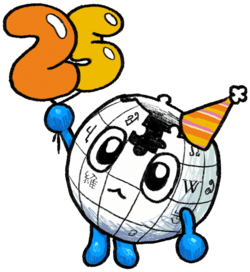
Baby Globe is the mascot of Wikipedia's 2026 25th anniversary.2 The character was originally a personal sketch drawn by Wikipedia editor Jonathan Ferreira during his daily BART commutes around the San Francisco Bay Area. He later shared his drawings with the Wikipedia community, initially referring to the character as "the little mascot".3 The mascot's design consists of the Wikipedia logo with a face, light blue arms, and in a style inspired by 1920s rubber hose animation.4
Baby Globe was officially introduced on January 15 as a brief cameo on the homepage of the site. This appearance was a teaser for a limited time "Birthday Mode", which was released on February 16th.5 When the mode was enabled, animated GIFs of the character would appear on a small selection of articles.6 According to WMF representative Chris Koerner, there are plans to use Baby Globe worldwide at anniversary events and community projects.5 He also announced a partnership with Makeship to make a limited edition plush toy of the character.7
Wikipe-tan

Wikipe-tan is a fan-made8 moe anthropomorphisation9 or gijinka10 of Wikipedia, taking inspiration from OS-tans. The idea of a moe mascot for Wikipedia was suggested in 2006 by an anonymous requester, and the visual design was then developed by Japanese Wikipedian, translator and artist Kasuga who posted the initial sketches to 2channel. Wikipe-tan is particularly used as the mascot of the English Wikipedia's Anime and Manga WikiProject.11 Fan art of Wikipe-tan has sometimes been used to illustrate different concepts in Wikipedia's articles.12 Wikipe-tan is commonly depicted in a dark blue hotel maid outfit and with teal twintails held by two puzzle piece-shaped hair ties. Other images may display different kinds of clothing or attributes symbolizing a particular role.13
While Wikipe-tan has been positively received, with some going as far as to cosplay her,1411 some have criticized the "potential lack of objectivity and neutrality" in her usage.12 One piece of fan art posted to Wikimedia Commons in 2007 depicting the character in a lolicon manner was deleted by Wikipedia co-founder Jimmy Wales, with him noting, "Pedophilic sexualization of a community mascot? No. Email me if you have questions."15 Wales later went on to say he personally does not like the character but is "not particularly agitated" by the fact that others do.12
Wikipede
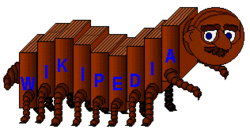
The Wikipede is a character that was proposed to be Wikipedia's logo during the site's early development.1 He is depicted as a brown centipede made out of books, with a flat, circular, mustachioed face and nine pairs of limbs. For April Fools' Day in 2026, the Wikimedia Instagram account jokingly said the character was going to become the new Wikipedia logo. Merchandise of the Wikipede was later introduced to the Wikipedia Store in May of that year.16
References
References
- Popkin (2026-01-22). "Early Wikipedia logo designs included a book centipede mascot". Boing Boing. Archived from the original on 2026-01-23. Retrieved 2026-05-21.
- "Wikipedia's new mascot is too cute for words". Creative Bloq. 2026-01-15. Archived from the original on 2026-01-15. Retrieved 2026-05-21.
- "Wikipedia Celebra Su 25 Cumpleaños Con Baby Globe | Control Publicidad". controlpublicidad.com (in Spanish). 2026-01-16. Archived from the original on 2026-02-12. Retrieved 2026-05-21.
- "Wikipedia celebra 25 anos com nova mascote: venha conhecer o Baby Globe" (in European Portuguese). 2026-01-16. Archived from the original on 2026-01-16. Retrieved 2026-05-21.
- R, T. (2026-01-19). "Kreatív Online - 25 éves a Wikipédia: megérkezett a "Baby Globe", az ünnepi kabalafigura". Kreatív Online (in Hungarian). Archived from the original on 2026-05-24. Retrieved 2026-05-21.
- Gorilla, Big (2026-01-17). "Wikipedia ฉลอง 25 ปี เปิดตัว Baby Globe แมสคอตโลกใบเล็กสุดน่ารักจากไอเดียสมาชิกชุมชน". Marketing Oops! (in Thai). Archived from the original on 2026-05-24. Retrieved 2026-05-21.
- "Wikipedia, 25. Yaşını "Baby Globe" Ile Kutluyor | Marketing Türkiye". marketingturkiye.com.tr (in Turkish). 2026-01-16. Archived from the original on 2026-01-17. Retrieved 2026-05-21.
- Petersen, Robert (2010-11-18). Comics, Manga, and Graphic Novels: A History of Graphic Narratives. Bloomsbury Publishing USA. p. 183. ISBN 978-0-313-36331-3.
- Toohey, Ellsworth (2025-12-16). "In Japan, anything can be an anime girl — even your washing machine". Boing Boing. Archived from the original on 2025-12-22. Retrieved 2026-05-21.
- Sousa, Ana Matilde. "Moe-Kei: notas sobre o conceito de moe como sistema compositivo na cultura cute japonesa" (PDF) (in European Portuguese) – via University of Lisbon. p. 305,307:
Dentro dos vestuários diversos, o moe gijinka é uma última corrente a referir. Por moe gijinka (literalmente, "personificação moe") entende-se um tipo de antropomorfização de animais, objetos inanimados, lugares o conceitos, com carácter humorístico, assente em características ou qualidades moe e kawaii que, frequentemente, se serve dos acessórios e da estética cosplay para aludir à condição pré-antropomórfica do objecto. [Figura 37,2.7]
- "维基娘代言人出展游戏展 - 21CN.COM - 游戏频道". game.21cn.com (in Chinese). Archived from the original on 2007-03-16. Retrieved 2026-05-21.
- "Meet the manga avatars of your favorite tech platforms". Hopes&Fears. Archived from the original on 2015-09-16. Retrieved 2026-05-21.
- hdl:2152/ETD-UT-2011-08-3903
Feldman, Ross Christopher (2011-09-21). Enchanting modernity : religion and the supernatural in contemporary Japanese popular culture (Thesis). University of Texas. Archived from the original on 2024-06-03.Many examples of the moe miko exist in Japanese popular culture, from the childlike to the polymorphous perverse. Wikipe-tan (Fig. 1), the mascot for the Japanese version of the online encyclopedia Wikipedia, appears as a young and cute girl-child in a number of guises including in the traditional outfit of a miko.
- hdl:1920/8161
Chau, Yi Pik (2013-07-31). The Ironic Performances of Internet Counter-Narratives Resisting Regime Censorship in China. The Ironic Performances of Internet Counter-Narratives Resisting Regime Censorship in China (Thesis). George Mason University. doi:10.13021/MARS/8067. Archived from the original on 2024-04-18. Retrieved 2026-05-24.An example of moe anthropomorphism is that of Wikipedia in figure 13, Wikipe-tan, a combination of the Japanese word for Wikipedia and the friendly suffix for children, -tan
- Finkelstein, Seth (2008-12-18). "Sting in the Scorpions tale is the exposure of Wiki's weakness". The Guardian. ISSN 0261-3077. Archived from the original on 2013-12-07. Retrieved 2026-05-24.
- Fear, Natalie (2026-05-20). "Wikipedia's most underrated logo finally gets the love it deserves". Creative Bloq. Archived from the original on 2026-05-20. Retrieved 2026-05-21.
External links
External links
- Meet the Wikimedian whose casual sketch inspired Wikipedia's 25th birthday mascot, Wikimedia Foundation