Article · Wikipedia archive·Last revised Jun 14, 2026
Weeping tree
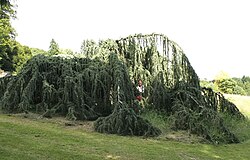
Weeping trees are trees characterized by soft, limp twigs. This characterization may lead to a bent crown and pendulous branches that can cascade to the ground. While weepyness occurs in nature, most weeping trees are cultivars. Because of their shape, weeping trees are popular in landscaping; generally they need a lot of space and are solitary so that their effect is more pronounced. There are over a hundred different types of weeping trees. Some trees, such as the cherry, have a variety of weeping cultivars. There are currently around 550 weeping cultivars in 75 different genera, although many have now disappeared from cultivation.
Weeping Atlas Cedar source ↗Golden weeping willow: Salix Sepulcralis Group 'Chrysocoma' source ↗
Weeping trees are trees characterized by soft, limp twigs.1 This characterization may lead to a bent crown and pendulous branches that can cascade to the ground. While weepyness occurs in nature, most weeping trees are cultivars.1 Because of their shape, weeping trees are popular in landscaping; generally they need a lot of space and are solitary so that their effect is more pronounced.2 There are over a hundred different types of weeping trees. Some trees, such as the cherry, have a variety of weeping cultivars.
There are currently around 5503 weeping cultivars in 75 different genera, although many have now disappeared from cultivation.4
Govaerts, R., Jablonski, E. & Michielsen, K. (2009). Hänge- oder Trauerformen von Gehölzen - unauffindbare Sorten - vielleicht wissen Sie etwas darüber ? Ginkgobätter 116: 24-27.