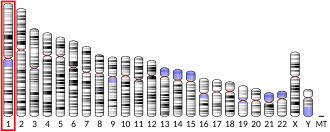
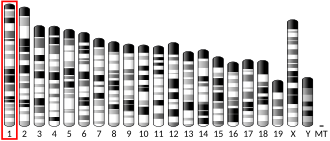
WD repeat-containing protein 26 is a protein that in humans is encoded by the WDR26 gene.5
Function
This gene encodes a member of the WD repeat protein family. WD repeats are minimally conserved regions of approximately 40 amino acids typically bracketed by gly-his and trp-asp (GH-WD), which may facilitate formation of heterotrimeric or multiprotein complexes. Members of this family are involved in a variety of cellular processes, including cell cycle progression, signal transduction, apoptosis, and gene regulation.5
Clinical significance
Pathogenic variants of the gene cause Skraban–Deardorff syndrome.6
References
References
- GRCh38: Ensembl release 89: ENSG00000162923 – Ensembl, May 2017
- GRCm38: Ensembl release 89: ENSMUSG00000038733 – Ensembl, May 2017
- "Human PubMed Reference:". National Center for Biotechnology Information, U.S. National Library of Medicine.
- "Mouse PubMed Reference:". National Center for Biotechnology Information, U.S. National Library of Medicine.
- "Entrez Gene: WDR26 WD repeat domain 26".
- Gross A, Müller J, Chrustowicz J, Strasser A, Gottemukkala K, Sherpa D, et al. (2024-04-04). "Skraban–Deardorff intellectual disability syndrome-associated mutations in WDR26 impair CTLH E3 complex assembly". FEBS Letters. 598 (9). Cambridge, England: Federation of European Biochemical Societies: 978–994. doi:10.1002/1873-3468.14866. ISSN 1873-3468. PMC 7616460. PMID 38575527.
Further reading
Further reading
- Olsen JV, Blagoev B, Gnad F, Macek B, Kumar C, Mortensen P, et al. (Nov 2006). "Global, in vivo, and site-specific phosphorylation dynamics in signaling networks". Cell. 127 (3): 635–648. doi:10.1016/j.cell.2006.09.026. PMID 17081983. S2CID 7827573.
- Higa LA, Wu M, Ye T, Kobayashi R, Sun H, Zhang H (Nov 2006). "CUL4-DDB1 ubiquitin ligase interacts with multiple WD40-repeat proteins and regulates histone methylation". Nature Cell Biology. 8 (11): 1277–1283. doi:10.1038/ncb1490. PMID 17041588. S2CID 22180568.
- Zhu Y, Wang Y, Xia C, Li D, Li Y, Zeng W, et al. (Oct 2004). "WDR26: a novel Gbeta-like protein, suppresses MAPK signaling pathway". Journal of Cellular Biochemistry. 93 (3): 579–587. doi:10.1002/jcb.20175. PMID 15378603. S2CID 86601953.
- Suzuki Y, Yoshitomo-Nakagawa K, Maruyama K, Suyama A, Sugano S (Oct 1997). "Construction and characterization of a full length-enriched and a 5'-end-enriched cDNA library". Gene. 200 (1–2): 149–156. doi:10.1016/S0378-1119(97)00411-3. PMID 9373149.
- Maruyama K, Sugano S (Jan 1994). "Oligo-capping: a simple method to replace the cap structure of eukaryotic mRNAs with oligoribonucleotides". Gene. 138 (1–2): 171–174. doi:10.1016/0378-1119(94)90802-8. PMID 8125298.