| Observation data Epoch J2000 Equinox ICRS | |
|---|---|
| Constellation | Microscopium1 |
| A | |
| Right ascension | 20h 55m 07.94435s2 |
| Declination | −34° 08′ 08.0075″2 |
| Apparent magnitude (V) | 10.13 |
| B | |
| Right ascension | 20h 55m 09.15767s4 |
| Declination | −34° 08′ 07.9138″4 |
| Apparent magnitude (V) | 10.53 |
| Characteristics | |
| A | |
| Evolutionary stage | main sequence2 |
| Spectral type | F83 |
| B | |
| Evolutionary stage | subgiant4 |
| Spectral type | F93 |
| Astrometry | |
| A | |
| Radial velocity (Rv) | −8.36±0.192 km/s |
| Proper motion (μ) | RA: +26.500 mas/yr2 Dec.: −44.971 mas/yr2 |
| Parallax (π) | 4.7498±0.0242 mas2 |
| Distance | 687 ± 3 ly (211 ± 1 pc) |
| B | |
| Radial velocity (Rv) | −8.30±0.204 km/s |
| Proper motion (μ) | RA: +26.191 mas/yr4 Dec.: −44.702 mas/yr4 |
| Parallax (π) | 4.7208±0.0165 mas4 |
| Distance | 691 ± 2 ly (211.8 ± 0.7 pc) |
| Details | |
| A | |
| Mass | 1.45±0.093 M☉ |
| Radius | 1.62+0.05 −0.043 R☉ |
| Luminosity | 3.25 L☉ |
| Surface gravity (log g) | 4.21±0.0116 cgs |
| Temperature | 6194±56 K |
| Metallicity [Fe/H] | +0.320±0.0046 dex |
| Rotation | 19.5 d3 |
| Rotational velocity (v sin i) | 4.2±0.53 km/s |
| Age | 2.3–2.86 Gyr |
| B | |
| Mass | 1.24±0.093 M☉ |
| Radius | 1.35±0.123 R☉ |
| Luminosity | 2.27 L☉ |
| Surface gravity (log g) | 4.30±0.0156 cgs |
| Temperature | 6112±66 K |
| Metallicity [Fe/H] | +0.305±0.0056 dex |
| Rotation | >45.5 d3 |
| Rotational velocity (v sin i) | <1.53 km/s |
| Age | 2.3–2.86 Gyr |
| Other designations | |
| CD−34 14724, WASP-94, HJ 5234 | |
| A: TOI-107, TIC 92352620, TYC 7466-1400-1, 2MASS J20550794-34080798 | |
| B: TIC 92352621, 2MASS J20550915-34080789 | |
| Database references | |
| SIMBAD | A |
| B | |
| Exoplanet Archive | data |
WASP-94 is a binary star system located about 690 light-years (210 parsecs) away in the constellation Microscopium. It consists of two F-type stars separated by 15″, corresponding to a projected separation of 2700 au. Both stars are known to host exoplanets.3
The binary system was first observed by John Herschel in 1834 and catalogued as HJ 5234. The designation WASP-94 comes from the Wide Angle Search for Planets, and has been used since the system was found to host planets in 2014.3 While the two stars have similar spectral types, they differ in elemental abundance – WASP-94A has fewer volatile elements and more refractory elements than WASP-94B.6
Planetary system
The two stars host a single known planet each. Both are hot Jupiters, gas giant planets completing orbits around their stars in just a few days.3
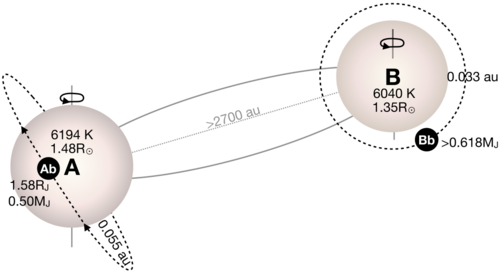
WASP-94Ab transits its host star, and it has also been detected by the radial velocity method.3 As a result, both its size and mass are known, which show that it is a low-density planet with a highly inflated radius. It has an equilibrium temperature of 1508±75 K.10 Its orbit is retrograde and misaligned with the rotation of its host star.11 The atmosphere of WASP-94Ab appears to be relatively free of clouds, with sodium,10 water vapor and carbon dioxide being detected.12
WASP-94Bb is a non-transiting planet that has been detected only by radial velocity, so it has no measured radius and true mass. Its minimum mass is 62% the mass of Jupiter.3
| Companion (in order from star) |
Mass | Semimajor axis (AU) |
Orbital period (days) |
Eccentricity | Inclination (°) |
Radius |
|---|---|---|---|---|---|---|
| b | 0.452+0.035 −0.032 MJ |
0.055±0.001 | 3.9501907+0.0000044 −0.0000030 |
<0.06413 | 88.7±0.7 | 1.72+0.06 −0.05 RJ |
| Companion (in order from star) |
Mass | Semimajor axis (AU) |
Orbital period (days) |
Eccentricity | Inclination (°) |
Radius |
|---|---|---|---|---|---|---|
| b | ≥0.618+0.028 −0.029 MJ |
0.0335+0.0006 −0.0005 |
2.00839±0.00024 | 0 | — | — |
See also
See also
Other systems with multiple planet-hosting stars:
References
References
- Roman, Nancy G. (1987). "Identification of a constellation from a position". Publications of the Astronomical Society of the Pacific. 99 (617): 695. Bibcode:1987PASP...99..695R. doi:10.1086/132034. Constellation record for this object at VizieR.
- Vallenari, A.; et al. (Gaia collaboration) (2023). "Gaia Data Release 3. Summary of the content and survey properties". Astronomy and Astrophysics. 674: A1. arXiv:2208.00211. Bibcode:2023A&A...674A...1G. doi:10.1051/0004-6361/202243940. S2CID 244398875. Gaia DR3 record for this source at VizieR.
- Neveu-VanMalle, M.; Queloz, D.; et al. (December 2014). "WASP-94 A and B planets: hot-Jupiter cousins in a twin-star system". Astronomy & Astrophysics. 572: A49. arXiv:1409.7566. Bibcode:2014A&A...572A..49N. doi:10.1051/0004-6361/201424744.
- Vallenari, A.; et al. (Gaia collaboration) (2023). "Gaia Data Release 3. Summary of the content and survey properties". Astronomy and Astrophysics. 674: A1. arXiv:2208.00211. Bibcode:2023A&A...674A...1G. doi:10.1051/0004-6361/202243940. S2CID 244398875. Gaia DR3 record for this source at VizieR.
- Ayres, Thomas (2023). "In the Trenches of the Solar-Stellar Connection. VII. Wilson-Bappu 2022". The Astrophysical Journal Supplement Series. 266 (1): 6. Bibcode:2023ApJS..266....6A. doi:10.3847/1538-4365/acb535.
- Teske, Johanna K.; Khanal, Sandhya; Ramírez, Ivan (March 2016). "The Curious Case of Elemental Abundance Differences in the Dual Hot Jupiter Hosts WASP-94A and B". The Astrophysical Journal. 819 (1): 19. arXiv:1601.01731. Bibcode:2016ApJ...819...19T. doi:10.3847/0004-637X/819/1/19.
- Yu, Jie; Khanna, Shourya; Themessl, Nathalie; Hekker, Saskia; Dréau, Guillaume; Gizon, Laurent; Bi, Shaolan (2023). "Revised Extinctions and Radii for 1.5 Million Stars Observed by APOGEE, GALAH, and RAVE". The Astrophysical Journal Supplement Series. 264 (2): 41. arXiv:2206.00046. Bibcode:2023ApJS..264...41Y. doi:10.3847/1538-4365/acabc8.
- "CD-34 14724A". SIMBAD. Centre de données astronomiques de Strasbourg. Retrieved 18 May 2025.
- "CD-34 14724B". SIMBAD. Centre de données astronomiques de Strasbourg. Retrieved 18 May 2025.
- Ahrer, E.; Wheatley, P. J.; et al. (March 2022). "LRG-BEASTS: Sodium absorption and Rayleigh scattering in the atmosphere of WASP-94A b using NTT/EFOSC2". Monthly Notices of the Royal Astronomical Society. 510 (4): 4857–4871. arXiv:2201.02212. Bibcode:2022MNRAS.510.4857A. doi:10.1093/mnras/stab3805.
- Ahrer, E.; Seidel, J. V.; et al. (May 2024). "Atmospheric characterization and tighter constraints on the orbital misalignment of WASP-94 A b with HARPS". Monthly Notices of the Royal Astronomical Society. 530 (3): 2749–2759. arXiv:2404.06550. Bibcode:2024MNRAS.530.2749A. doi:10.1093/mnras/stae1000.
- Ahrer, Eva-Maria; Gandhi, Siddharth; et al. (May 2025). "Tracing the formation and migration history: molecular signatures in the atmosphere of misaligned hot Jupiter WASP-94Ab using JWST NIRSpec/G395H". Monthly Notices of the Royal Astronomical Society. 540 (3): 2535–2554. arXiv:2505.11224. doi:10.1093/mnras/staf819.
- Bonomo, A. S.; Desidera, S.; et al. (June 2017). "The GAPS Programme with HARPS-N at TNG. XIV. Investigating giant planet migration history via improved eccentricity and mass determination for 231 transiting planets". Astronomy & Astrophysics. 602: A107. arXiv:1704.00373. Bibcode:2017A&A...602A.107B. doi:10.1051/0004-6361/201629882.