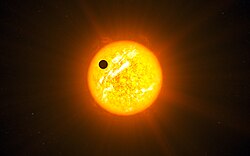
 Artist's impression of a star like WASP-8 | |
| Observation data Epoch J2000 Equinox ICRS | |
|---|---|
| Constellation | Sculptor1 |
| A | |
| Right ascension | 23h 59m 36.07119s2 |
| Declination | −35° 01′ 52.9236″2 |
| Apparent magnitude (V) | 9.873 |
| B | |
| Right ascension | 23h 59m 36.12827s4 |
| Declination | −35° 01′ 57.3448″4 |
| Apparent magnitude (V) | 9.873 |
| Characteristics | |
| WASP-8A | |
| Evolutionary stage | main sequence2 |
| Spectral type | G8V5 |
| WASP-8B | |
| Evolutionary stage | main sequence6 |
| Spectral type | M7 |
| Astrometry | |
| A | |
| Radial velocity (Rv) | −1.38±0.262 km/s |
| Proper motion (μ) | RA: +109.752 mas/yr2 Dec.: +7.615 mas/yr2 |
| Parallax (π) | 11.1052±0.0175 mas2 |
| Distance | 293.7 ± 0.5 ly (90.0 ± 0.1 pc) |
| B | |
| Radial velocity (Rv) | −1.38±0.264 km/s |
| Proper motion (μ) | RA: +110.322 mas/yr4 Dec.: +5.448 mas/yr4 |
| Parallax (π) | 11.1038±0.0197 mas4 |
| Distance | 293.7 ± 0.5 ly (90.1 ± 0.2 pc) |
| Position (relative to WASP-8A)7 | |
| Component | WASP-8B |
| Epoch of observation | 2016 |
| Angular distance | 4.520±0.005″ |
| Position angle | 170.9±0.1° |
| Projected separation | 408 AU |
| Details8 | |
| WASP-8A | |
| Mass | 1.093±0.024 M☉ |
| Radius | 0.976±0.020 R☉ |
| Luminosity | 0.79 L☉ |
| Surface gravity (log g) | 4.498±0.018 cgs |
| Temperature | 5600±80 K |
| Metallicity [Fe/H] | 0.29±0.03 dex |
| Rotational velocity (v sin i) | 1.90±0.056 km/s |
| Age | 0.3+0.9 −0.1 Gyr |
| WASP-8B | |
| Mass | 0.53±0.02 M☉ |
| Temperature | 3758+47 −43 K |
| Other designations | |
| CD−35 16019, CPD−35 9465, SAO 214901, PPM 304426, WDS J23596-3502A, TOI-191, TIC 183532609, WASP-8, TYC 7522-505-1, 2MASS J23593607-35015303 | |
| Database references | |
| SIMBAD | A |
| B | |
| Exoplanet Archive | data |
WASP-8 is a binary star system 294 light-years (90 parsecs) away. The star system is much younger than the Sun at 300 million to 1.2 billion years age, and is heavily enriched in heavy elements, having nearly twice the concentration of iron compared to the Sun.8
The primary, WASP-8A, is a magnitude 9.9 main-sequence yellow dwarf star. It is reported to be a G-type star with a temperature of 5600 K and has a mass 1.093±0.024, a radius 0.976±0.020 and a luminosity of 0.79 times that of the Sun. There is a companion star WASP-8B located 4.5 arcseconds away with the same proper motion, indicating a stellar binary system.9 The binarity was confirmed in 2020.7 The axis orientation of the primary star is uncertain, but it is close to pointing one of the poles to the Earth.6
Planetary system
The primary star is orbited by two known exoplanets, designated WASP-8b and WASP-8c. WASP-8b was discovered in 2010 by the astronomical transit method and was catalogued as part of the SuperWASP mission.9 WASP-8c was discovered in late 2013 with the radial velocity method.10
| Companion (in order from star) |
Mass | Semimajor axis (AU) |
Orbital period (days) |
Eccentricity | Inclination (°) |
Radius |
|---|---|---|---|---|---|---|
| b | 2.216±0.035 MJ | 0.0817±0.0006 | 8.158715(16)11 | 0.3057±0.004611 | 88.51±0.09 | 1.165±0.032 RJ |
| c | ≥9.45+2.26 −1.04 MJ |
5.28+0.63 −0.34 |
4323+740 −380 |
0 | — | — |
References
References
- Roman, Nancy G. (1987). "Identification of a constellation from a position". Publications of the Astronomical Society of the Pacific. 99 (617): 695. Bibcode:1987PASP...99..695R. doi:10.1086/132034. Constellation record for this object at VizieR.
- Vallenari, A.; et al. (Gaia collaboration) (2023). "Gaia Data Release 3. Summary of the content and survey properties". Astronomy and Astrophysics. 674: A1. arXiv:2208.00211. Bibcode:2023A&A...674A...1G. doi:10.1051/0004-6361/202243940. S2CID 244398875. Gaia DR3 record for this source at VizieR.
- "WASP-8". SIMBAD. Centre de données astronomiques de Strasbourg. Retrieved 5 November 2023.
- Vallenari, A.; et al. (Gaia collaboration) (2023). "Gaia Data Release 3. Summary of the content and survey properties". Astronomy and Astrophysics. 674: A1. arXiv:2208.00211. Bibcode:2023A&A...674A...1G. doi:10.1051/0004-6361/202243940. S2CID 244398875. Gaia DR3 record for this source at VizieR.
- Salz, M.; Schneider, P. C.; et al. (April 2015). "High-energy irradiation and mass loss rates of hot Jupiters in the solar neighborhood". Astronomy & Astrophysics. 576: A42. arXiv:1502.00576. Bibcode:2015A&A...576A..42S. doi:10.1051/0004-6361/201425243.
- Bourrier, V.; Cegla, H. M.; et al. (March 2017). "Refined architecture of the WASP-8 system: A cautionary tale for traditional Rossiter-McLaughlin analysis". Astronomy & Astrophysics. 599. A33. arXiv:1611.07985. Bibcode:2017A&A...599A..33B. doi:10.1051/0004-6361/201629973. S2CID 118864447.
- Bohn, A. J.; Southworth, J.; Ginski, C.; Kenworthy, M. A.; Maxted, P. F. L.; Evans, D. F. (2020), "A multiplicity study of transiting exoplanet host stars", Astronomy & Astrophysics, 635: A73, arXiv:2001.08224, Bibcode:2020A&A...635A..73B, doi:10.1051/0004-6361/201937127, S2CID 210861118
- Southworth, J.; Bohn, A. J.; Kenworthy, M. A.; Ginski, C.; Mancini, L. (2020), "A multiplicity study of transiting exoplanet host stars", Astronomy & Astrophysics, 635: A74, arXiv:2001.08225, Bibcode:2020A&A...635A..74S, doi:10.1051/0004-6361/201937334, S2CID 210860775
- Queloz, D.; et al. (2010). "WASP-8b: a retrograde transiting planet in a multiple system". Astronomy and Astrophysics. 517. L1. arXiv:1006.5089. Bibcode:2010A&A...517L...1Q. doi:10.1051/0004-6361/201014768. S2CID 35774603.
- Knutson, Heather A.; Fulton, Benjamin J.; Montet, Benjamin T.; Kao, Melodie; Ngo, Henry; Howard, Andrew W.; Crepp, Justin R.; Hinkley, Sasha; Bakos, Gaspar Á.; Batygin, Konstantin; Johnson, John Asher; Morton, Timothy D.; Muirhead, Philip S. (2013), "Friends of Hot Jupiters. I. A Radial Velocity Search for Massive, Long-Period Companions to Close-In Gas Giant Planets", The Astrophysical Journal, 785 (2): 126, arXiv:1312.2954, Bibcode:2014ApJ...785..126K, doi:10.1088/0004-637X/785/2/126, S2CID 42687848
- Bonomo, A. S.; Desidera, S.; et al. (June 2017). "The GAPS Programme with HARPS-N at TNG. XIV. Investigating giant planet migration history via improved eccentricity and mass determination for 231 transiting planets". Astronomy & Astrophysics. 602: A107. arXiv:1704.00373. Bibcode:2017A&A...602A.107B. doi:10.1051/0004-6361/201629882.
External links
External links
- WASP planets
- "Notes for star WASP-8". Extrasolar Planets Encyclopaedia. Archived from the original on 2008-08-03. Retrieved 2008-08-07.