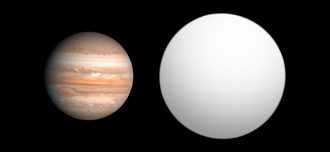
 Size comparison of WASP-4b with Jupiter | |
| Discovery1 | |
|---|---|
| Discovered by | Wide Angle Search for Planets |
| Discovery site | South African Astronomical Observatory |
| Discovery date | October 31, 2007 |
| Transit photometry | |
| Orbital characteristics2 | |
| 0.02239±0.00084 AU | |
| Eccentricity | <0.00333 |
| 1.338231587(22) d | |
| Inclination | 88.02°±0.69° |
| Semi-amplitude | 232.7+2.5 −2.2 m/s3 |
| Star | WASP-4 |
| Physical characteristics2 | |
| 1.312±0.045 RJ | |
| Mass | 1.164±0.082 MJ |
Mean density | 0.639±0.079 g/cm3 |
| Temperature | 1,957±68 K (1,684 °C; 3,063 °F)4 |
WASP-4b is an exoplanet, specifically a hot Jupiter, approximately 891 light-years away5 in the constellation of Phoenix.6
Discovery
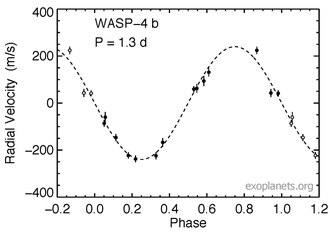
The planet was the discovered by the Wide Angle Search for Planets team using images taken with the SuperWASP-South project's eight wide-angle cameras located at the South African Astronomical Observatory.781 Analysis of over 4,000 images taken between May and November 2006 resulted in the detection of a transit occurring every 1.3 days. Follow-up radial velocity observations using the Swiss 1.2-metre Leonhard Euler Telescope confirmed that the transiting object was a planet.1
Characteristics
The planetary equilibrium temperature would be 1,650±30 K,9 but the measured dayside temperature is higher, with a 2015 study finding 1,900±100 K10 and a 2020 study finding 1,957±68 K.4
A study in 2012, utilizing the Rossiter–McLaughlin effect, determined the planetary orbit is probably aligned with the equatorial plane of the star, with misalignment equal to -1+14
−12°.11
The planet's orbital period appeared to be decreasing at a rate of 7.33±0.71 milliseconds per year, suggesting that its orbit is decaying with a decay timescale of 15.77±1.57 million years. The anomalously high rate of orbital decay of WASP-4b was poorly understood as of 2021.2 The orbital decay thought to be primarily driven by tidal interactions between the planet and its host star.12 However, in late 2025 it was determined that WASP-4b is not undergoing any orbital decay; all the data used to support it is instead explained by the light travel time effect of the wider-orbit planet WASP-4c.13
References
References
- Wilson, D. M.; et al. (2008). "WASP-4b: A 12th Magnitude Transiting Hot Jupiter in the Southern Hemisphere". The Astrophysical Journal Letters. 675 (2): L113–L116. arXiv:0801.1509. Bibcode:2008ApJ...675L.113W. doi:10.1086/586735.
- Turner, Jake D.; Flagg, Laura; Ridden-Harper, Andrew; Jayawardhana, Ray (2022), "Characterizing the WASP-4 System with TESS and Radial Velocity Data: Constraints on the Cause of the Hot Jupiter's Changing Orbit and Evidence of an Outer Planet", The Astronomical Journal, 163 (6): 281, arXiv:2112.09621, Bibcode:2022AJ....163..281T, doi:10.3847/1538-3881/ac686f, S2CID 245329747
- Bonomo, A. S.; Desidera, S.; et al. (June 2017). "The GAPS Programme with HARPS-N at TNG. XIV. Investigating giant planet migration history via improved eccentricity and mass determination for 231 transiting planets". Astronomy & Astrophysics. 602: A107. arXiv:1704.00373. Bibcode:2017A&A...602A.107B. doi:10.1051/0004-6361/201629882. S2CID 118923163.
- Wong, Ian; Shporer, Avi; Daylan, Tansu; Benneke, Björn; Fetherolf, Tara; Kane, Stephen R.; Ricker, George R.; Vanderspek, Roland; Latham, David W.; Winn, Joshua N.; Jenkins, Jon M.; Boyd, Patricia T.; Glidden, Ana; Goeke, Robert F.; Sha, Lizhou; Ting, Eric B.; Yahalomi, Daniel (2020), "Systematic Phase Curve Study of Known Transiting Systems from Year One of the TESS Mission", The Astronomical Journal, 160 (4): 155, arXiv:2003.06407, Bibcode:2020AJ....160..155W, doi:10.3847/1538-3881/ababad, S2CID 212717799
- Vallenari, A.; et al. (Gaia collaboration) (2023). "Gaia Data Release 3. Summary of the content and survey properties". Astronomy and Astrophysics. 674: A1. arXiv:2208.00211. Bibcode:2023A&A...674A...1G. doi:10.1051/0004-6361/202243940. S2CID 244398875. Gaia DR3 record for this source at VizieR.
- Roman, Nancy G. (1987). "Identification of a Constellation From a Position". Publications of the Astronomical Society of the Pacific. 99 (617): 695–699. Bibcode:1987PASP...99..695R. doi:10.1086/132034. Vizier query form
- Sherriff, Lucy (2007-10-31). "UK boffins ID three new exo-planets". The Register. Retrieved 2018-09-23.
- "Astronomer discovers new planets". BBC News. 2007-10-31. Retrieved 2018-09-23.
- Table 3, Improved parameters for the transiting hot Jupiters WASP-4b and WASP-5b, M. Gillon et al., Astronomy and Astrophysics 496, #1 (2009), pp. 259–267, doi:10.1051/0004-6361:200810929, Bibcode:2009A&A...496..259G.
- Zhou, G.; Bayliss, D. D. R.; Kedziora-Chudczer, L.; Tinney, C. G.; Bailey, J.; Salter, G.; Rodriguez, J. (2015). "Secondary eclipse observations for seven hot-Jupiters from the Anglo-Australian Telescope". Monthly Notices of the Royal Astronomical Society. 454 (3): 3002–3019. arXiv:1509.04147. Bibcode:2015MNRAS.454.3002Z. doi:10.1093/mnras/stv2138.
- Albrecht, Simon; Winn, Joshua N.; Johnson, John A.; Howard, Andrew W.; Marcy, Geoffrey W.; Butler, R. Paul; Arriagada, Pamela; Crane, Jeffrey D.; Shectman, Stephen A.; Thompson, Ian B.; Hirano, Teruyuki; Bakos, Gaspar; Hartman, Joel D. (2012), "Obliquities of Hot Jupiter Host Stars: Evidence for Tidal Interactions and Primordial Misalignments", The Astrophysical Journal, 757 (1): 18, arXiv:1206.6105, Bibcode:2012ApJ...757...18A, doi:10.1088/0004-637X/757/1/18, S2CID 17174530
- Baştürk, Ö; Kutluay, A. C.; Barker, A.; Yalçınkaya, S.; Southworth, J.; Barkaoui, K.; Wünsche, A.; Burgdorf, M. J.; Timmermans, M. (2025-06-17). "The Orbit of WASP-4 b is in Decay". Monthly Notices of the Royal Astronomical Society. 541 (2): 714–730. arXiv:2506.15022. doi:10.1093/mnras/staf1009.
- Winn, Joshua N.; Stefánsson, Guđmundur (2025-12-01). "Orbital Decay Candidates Reconsidered: WASP-4 b Is Not Decaying and Kepler-1658 b Is Not a Planet". The Planetary Science Journal. 6 (12): 300. arXiv:2510.05229. doi:10.3847/PSJ/ae21db. ISSN 2632-3338.
Further reading
Further reading
- Petrucci, R.; et al. (2013). "No Transit Timing Variations in Wasp-4". The Astrophysical Journal Letters. 779 (2). L23. arXiv:1311.2048. Bibcode:2013ApJ...779L..23P. doi:10.1088/2041-8205/779/2/L23. S2CID 118376692.
- Huitson, C. M.; et al. (2017). "Gemini/GMOS Transmission Spectral Survey: Complete Optical Transmission Spectrum of the Hot Jupiter WASP-4b". The Astronomical Journal. 154 (3). 95. arXiv:1707.06575. Bibcode:2017AJ....154...95H. doi:10.3847/1538-3881/aa7f72. S2CID 119415111.
- Bouma, L. G.; Winn, J. N.; et al. (June 2019). "WASP-4b Arrived Early for the TESS Mission". The Astronomical Journal. 157 (6): 217. arXiv:1903.02573. Bibcode:2019AJ....157..217B. doi:10.3847/1538-3881/ab189f.
External links
External links
Media related to WASP-4b at Wikimedia Commons
- "Transiting exoplanets from the Wide Angle Search for Planets". WASP Planets. Coel Hellier. Retrieved 2020-12-27.
- "UK planet hunters announce three new finds" (PDF). 2007-10-30. Archived from the original (PDF) on 2008-05-16. Retrieved 2008-07-02.