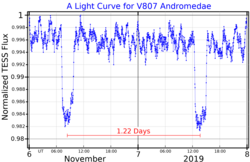
 A light curve for V807 Andromedae (HD 15082), plotted from TESS data.1 The deep minima are caused by the planet transits. | |
| Observation data Epoch J2000 Equinox J2000 | |
|---|---|
| Constellation | Andromeda2 |
| Right ascension | 02h 26m 51.0583s3 |
| Declination | +37° 33′ 01.736″3 |
| Apparent magnitude (V) | 8.34 |
| Characteristics | |
| Evolutionary stage | main sequence3 |
| Spectral type | kA5hA8mF45 |
| B−V color index | 0.276 |
| Variable type | δ Sct4+planetary transit |
| Astrometry | |
| Radial velocity (Rv) | −2.70±0.333 km/s |
| Proper motion (μ) | RA: −0.977(35) mas/yr3 Dec.: −8.895(34) mas/yr3 |
| Parallax (π) | 8.2238±0.0327 mas3 |
| Distance | 397 ± 2 ly (121.6 ± 0.5 pc) |
| Absolute magnitude (MV) | +2.852 |
| Details | |
| Mass | 1.495±0.0317 M☉ |
| Radius | 1.444±0.0347 R☉ |
| Luminosity | 6.63 L☉ |
| Surface gravity (log g) | 4.3±0.24 cgs |
| Temperature | 7,430±1007 K |
| Metallicity [Fe/H] | 0.1±0.28 dex |
| Rotational velocity (v sin i) | 864 km/s |
| Age | 1009 Myr |
| Other designations | |
| V807 And, BD+36 489, HD 15082, HIP 11397, SAO 55561, TOI-1599, TIC 129979528, WASP-33, 2MASS J02265106+373301710 | |
| Database references | |
| SIMBAD | data |
| Exoplanet Archive | data |
HD 15082 (also known as WASP-33) is a star located 397 light years away3 in the northern constellation of Andromeda.11 The star is a Delta Scuti variable12 and a planetary transit variable. A hot Jupiter type extrasolar planet, named WASP-33b or HD 15082b, orbits this star with an orbital period of 1.22 days. It is the first Delta Scuti variable known to host a planet.13
Properties
HD 15082 is an Am star, which makes its stellar classification challenging to discern. The hydrogen lines and effective temperature of the star are similar to spectral type A8, however the calcium II K line resembles that of an A5 star, and the metallic lines are more similar to an F4 star. The spectral type is written kA5hA8mF4.8 The star is about 1009 million years old and is spinning with a projected rotational velocity of 86 km/s.4 It has 1.558 times the mass of the Sun and 1.51 times the Sun's radius.14
The intrinsic variability of HD 15082 was discovered in 2011 by Enrique Herrero et al.4 Delta Scuti variables usually exhibit many pulsation modes, and HD 15082 is no exception, with 8 measured high frequency p-modes.12 Another proposed non-radial mode, which could be induced by tidal interactions with the planet, would make this star also a Gamma Doradus variable.8 This star has the GCVS variable star designation V807 Andromedae.15
Planetary system
In 2010, the SuperWASP project announced the discovery of an exoplanet, designated WASP-33b, orbiting the star. The discovery was made by detecting the transit of the planet as it passes in front of its star, an event which occurs every 1.22 days.8 It had first been identified as a planetary candidate in 2006.16
| Companion (in order from star) |
Mass | Semimajor axis (AU) |
Orbital period (days) |
Eccentricity | Inclination (°) |
Radius |
|---|---|---|---|---|---|---|
| b | 2.093±0.139 MJ | 0.0239±0.00063 | 1.21987089(15)17 | 0 | 86.63±0.03 | 1.593±0.074 RJ |
References
References
- "MAST: Barbara A. Mikulski Archive for Space Telescopes". Space Telescope Science Institute. Retrieved 8 December 2021.
- Anderson, E.; Francis, Ch. (2012). "XHIP: An extended hipparcos compilation". Astronomy Letters. 38 (5): 331. arXiv:1108.4971. Bibcode:2012AstL...38..331A. doi:10.1134/S1063773712050015.
- Vallenari, A.; et al. (Gaia collaboration) (2023). "Gaia Data Release 3. Summary of the content and survey properties". Astronomy and Astrophysics. 674: A1. arXiv:2208.00211. Bibcode:2023A&A...674A...1G. doi:10.1051/0004-6361/202243940. S2CID 244398875. Gaia DR3 record for this source at VizieR.
- Herrero, E.; et al. (February 2011). "WASP-33: the first δ Scuti exoplanet host star". Astronomy and Astrophysics. 526: L10. arXiv:1010.1173. Bibcode:2011A&A...526L..10H. doi:10.1051/0004-6361/201015875. S2CID 37446555.
- Grenier, S.; Baylac, M. -O.; Rolland, L.; Burnage, R.; Arenou, F.; Briot, D.; Delmas, F.; Duflot, M.; Genty, V.; Gómez, A. E.; Halbwachs, J. -L.; Marouard, M.; Oblak, E.; Sellier, A. (1999). "Radial velocities. Measurements of 2800 B2-F5 stars for HIPPARCOS". Astronomy and Astrophysics Supplement Series. 137: 451. Bibcode:1999A&AS..137..451G. doi:10.1051/aas:1999489.
- Høg, E.; Fabricius, C.; Makarov, V. V.; Urban, S.; Corbin, T.; Wycoff, G.; Bastian, U.; Schwekendiek, P.; Wicenec, A. (2000). "The Tycho-2 catalogue of the 2.5 million brightest stars". Astronomy & Astrophysics. 355: L27–L30. Bibcode:2000A&A...355L..27H.
- Chakrabarty, Aritra; Sengupta, Sujan (July 2019). "Precise Photometric Transit Follow-up Observations of Five Close-in Exoplanets: Update on Their Physical Properties". The Astronomical Journal. 158 (1): 39. arXiv:1905.11258. Bibcode:2019AJ....158...39C. doi:10.3847/1538-3881/ab24dd.
- Collier Cameron, A.; et al. (2010). "Line-profile tomography of exoplanet transits - II. A gas-giant planet transiting a rapidly rotating A5 star". Monthly Notices of the Royal Astronomical Society. 407 (1): 507. arXiv:1004.4551. Bibcode:2010MNRAS.407..507C. doi:10.1111/j.1365-2966.2010.16922.x. S2CID 11989684.
- Moya, A.; et al. (November 2011). "High spatial resolution imaging of the star with a transiting planet WASP-33". Astronomy & Astrophysics. 535: A110. arXiv:1110.3160. Bibcode:2011A&A...535A.110M. doi:10.1051/0004-6361/201116889. S2CID 54591538.
- "HD 15082". SIMBAD. Centre de données astronomiques de Strasbourg.
- "WASP-33 b". ETD - Exoplanet Transit Database. Retrieved 2010-04-28.
- von Essen, C.; Czesla, S.; Wolter, U.; Breger, M.; Herrero, E.; Mallonn, M.; Ribas, I.; Strassmeier, K. G.; Morales, J. C. (2014). "Pulsation analysis and its impact on primary transit modeling in WASP-33". Astronomy and Astrophysics. 561: A48. arXiv:1311.3614. Bibcode:2014A&A...561A..48V. doi:10.1051/0004-6361/201322453. S2CID 119213599.
- "Discovery Of A Pulsating Star That Hosts A Giant Planet". Science Daily. January 19, 2011.
- Goyal, Jayesh M.; Mayne, Nathan; Sing, David K.; Drummond, Benjamin; Tremblin, Pascal; Amundsen, David S.; Evans, Thomas; Carter, Aarynn L.; Spake, Jessica; Baraffe, Isabelle; Nikolov, Nikolay; Manners, James; Chabrier, Gilles; Hebrard, Eric (2018). "A library of ATMO forward model transmission spectra for hot Jupiter exoplanets". Monthly Notices of the Royal Astronomical Society. 474 (4): 5158. arXiv:1710.10269. Bibcode:2018MNRAS.474.5158G. doi:10.1093/mnras/stx3015. hdl:10871/30324. S2CID 55105931.
- "GCVS Query forms".
- Christian, D. J.; Pollacco, D. L.; Skillen, I.; Street, R. A.; Keenan, F. P.; Clarkson, W. I.; Collier Cameron, A.; Kane, S. R.; Lister, T. A.; West, R. G.; Enoch, B.; Evans, A.; Fitzsimmons, A.; Haswell, C. A.; Hellier, C.; Hodgkin, S. T.; Horne, K.; Irwin, J.; Norton, A. J.; Osborne, J. (November 2006). "The SuperWASP wide-field exoplanetary transit survey: candidates from fields 23 h < RA < 03 h". Monthly Notices of the Royal Astronomical Society. 372 (3): 1117–1128. Bibcode:2006MNRAS.372.1117C. doi:10.1111/j.1365-2966.2006.10913.x. hdl:10211.3/172060. Retrieved 10 November 2024.
- Zhang, Michael; et al. (2017). "Phase curves of WASP-33b and HD 149026b and a New Correlation Between Phase Curve Offset and Irradiation Temperature". The Astronomical Journal. 155 (2): 83. arXiv:1710.07642. Bibcode:2018AJ....155...83Z. doi:10.3847/1538-3881/aaa458. S2CID 54755276.