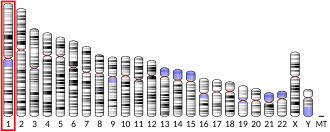
Tryptophanyl-tRNA synthetase, mitochondrial is an enzyme that in humans is encoded by the WARS2 gene.567
Function
Aminoacyl-tRNA synthetases catalyze the aminoacylation of tRNA by their cognate amino acid. Because of their central role in linking amino acids with nucleotide triplets contained in tRNAs, aminoacyl-tRNA synthetases are thought to be among the first proteins that appeared in evolution. Two forms of tryptophanyl-tRNA synthetase exist, a cytoplasmic form, named WARS, and a mitochondrial form, named WARS2. This gene encodes the mitochondrial tryptophanyl-tRNA synthetase. Two alternative transcripts encoding different isoforms have been described.7 According to recent research, mutations of the mitochondrial form of the enzyme are believed to express two different neurological disorders: A subtype of autosomal recessive intellectual disability and a syndrome of severe infantile‐onset leukoencephalopathy.8
References
References
- GRCh38: Ensembl release 89: ENSG00000116874 – Ensembl, May 2017
- GRCm38: Ensembl release 89: ENSMUSG00000004233 – Ensembl, May 2017
- "Human PubMed Reference:". National Center for Biotechnology Information, U.S. National Library of Medicine.
- "Mouse PubMed Reference:". National Center for Biotechnology Information, U.S. National Library of Medicine.
- Martinez-Dominguez MT, Justesen J, Kruse TA, Hansen LL (Mar 1999). "Assignment of the human mitochondrial tryptophanyl-tRNA synthetase (WARS2) to 1p13.3-->p13.1 by radiation hybrid mapping". Cytogenetics and Cell Genetics. 83 (3–4): 249–250. doi:10.1159/000015196. PMID 10072595. S2CID 28931531.
- Jorgensen R, Søgaard TM, Rossing AB, Martensen PM, Justesen J (June 2000). "Identification and characterization of human mitochondrial tryptophanyl-tRNA synthetase". The Journal of Biological Chemistry. 275 (22): 16820–16826. doi:10.1074/jbc.275.22.16820. PMID 10828066.
- "Entrez Gene: WARS2 tryptophanyl tRNA synthetase 2, mitochondrial".
- Burke EA, Frucht SJ, Thompson K, Wolfe LA, Yokoyama T, Bertoni M, et al. (March 2018). "Biallelic mutations in mitochondrial tryptophanyl-tRNA synthetase cause Levodopa-responsive infantile-onset Parkinsonism". Clinical Genetics. 93 (3): 712–718. doi:10.1111/cge.13172. PMC 5828974. PMID 29120065.
Further reading
Further reading
- Maruyama K, Sugano S (January 1994). "Oligo-capping: a simple method to replace the cap structure of eukaryotic mRNAs with oligoribonucleotides". Gene. 138 (1–2): 171–174. doi:10.1016/0378-1119(94)90802-8. PMID 8125298.
- Suzuki Y, Yoshitomo-Nakagawa K, Maruyama K, Suyama A, Sugano S (October 1997). "Construction and characterization of a full length-enriched and a 5'-end-enriched cDNA library". Gene. 200 (1–2): 149–156. doi:10.1016/S0378-1119(97)00411-3. PMID 9373149.
- Liu J, Shue E, Ewalt KL, Schimmel P (2004). "A new gamma-interferon-inducible promoter and splice variants of an anti-angiogenic human tRNA synthetase". Nucleic Acids Research. 32 (2): 719–727. doi:10.1093/nar/gkh240. PMC 373357. PMID 14757836.
- Oh JH, Yang JO, Hahn Y, Kim MR, Byun SS, Jeon YJ, et al. (December 2005). "Transcriptome analysis of human gastric cancer". Mammalian Genome. 16 (12): 942–954. doi:10.1007/s00335-005-0075-2. PMID 16341674. S2CID 69278.
- Guo LT, Chen XL, Zhao BT, Shi Y, Li W, Xue H, Jin YX (2007). "Human tryptophanyl-tRNA synthetase is switched to a tRNA-dependent mode for tryptophan activation by mutations at V85 and I311". Nucleic Acids Research. 35 (17): 5934–5943. doi:10.1093/nar/gkm633. PMC 2034488. PMID 17726052.
External links
External links