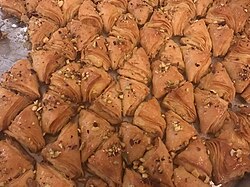
 A platter of warbat | |
| Alternative names | Shaabiyat,1 Şöbiyet |
|---|---|
| Type | Pastry |
| Course | Dessert |
| Region or state | Levant |
| Associated cuisine | Levantine cuisine |
| Serving temperature | Hot or room temperature |
| Main ingredients | Filo, custard or qishta, sugar syrup, ghee or butter |
| Variations | Filled with nuts or cream; sometimes topped with pistachios and petals |
| Other information | Popular during Ramadan |
Warbat (Arabic: وربات), also known as Shaabiyat (Arabic: شعيبيات,2 شعبيات3) and Şöbiyet,4 is a Levantine sweet pastry similar to baklava.1
Warbat consists of layers of phyllo dough filled with a semolina based custard,56 though it is sometimes also filled with pistachios, walnuts, almonds,7 or sweet cheese.8 The dessert is topped with a sweet syrup made from sugar, water, and lemon juice brought to a boil and then left to cool and thicken.910
When served with cream or qishta it is called warbat bi-qishteh or warbat be gishta. Warbat is often served during Ramadan.1112
In Jordan, warbat and knafeh are often the most sold desserts for celebrations, such as tawjihi exam results.1314
History
The Turkish Patent and Trademark Office states that Şöbiyet have been a part of the cuisine of Gaziantep "since ancient times".15 According to historian Nawal Nasrallah, kaymak-filled baklava are mentioned in the 19th-century works by Ottoman author Turabi Efendi.16
Shʻaybiyyāt (شعيبيات) are mentioned as a breakfast food in Arabic Aleppan texts from 1840-1875.1718 Late 19th-century proceedings by the International Congress of Orientalists described shaʻbīyah (شعبية) as a triangular cake filled with cream and pistachios.19 The 1885 Lebanese Arabic cookbook Ustadh al-Tabbakhin provided a recipe for shuʿaybāt (شعيبات) which called for filling square pieces of dough with baklava filling, baking them in a samneh-coated tray, then soaking them in qatir.20
Shaabiyat were popularized in Germany by refugees of the Syrian civil war.2122
Variations
"Lady's cheeks" (Arabic: خدود الست, called so because of its shape) is a version of warbat made from 2 circular layers of phyllo pastry around a layer of cream.23242526 This variation is common in Nablus city.2423
Turkish Şöbiyet (Antep Şöbiyeti) received official registration and geographical indication status from the Turkish Patent and Trademark Office on 6 April 2022 for the Gaziantep region.15 The patent specifies that they are made with 12 layers of phyllo pastry, a kaymak filling, and topped with syrup and pistachios.15 Şöbiyet are popular during Eid al-Fitr in Turkey.27
Syrian shaabiyat are made into a variety of shapes besides triangles with different fillings.22829
Etymology
According to one account, the dessert is attributed to a confectioner named Shuʿayb (شعيب), whose identity is otherwise unknown. Another explanation holds that the dessert was originally made in a large size sufficient to satisfy a person on its own, leading it to be called الشبعيّة (al-shabʿiyya), derived from the Arabic root ش ب ع (sh-b-ʿ), meaning “to be full or satiated”; the name was later phonologically altered to الشعيبيّة (al-shuʿaybiyya), with the plural form الشعيبيّات (al-shuʿaybiyyāt). 1830
According to the Etymological Dictionary of Contemporary Turkish by Sevan Nişanyan, the word Şöbiyet is derived from the Arabic word (shabʿiyyat).30
The name warbat is derived from the warbats triangular shape, the word warbat (وربات) means "corners" in Arabic.313218
Gallery
-
 Warbat in the Old City of Jerusalem.
 -
![Syrian shaabiyat[2]](/api/ext/img?url=https%3A%2F%2Fupload.wikimedia.org%2Fwikipedia%2Fcommons%2Fthumb%2F8%2F87%2FSyrian-Sweet-2013-07-07-1339.jpg%2F330px-Syrian-Sweet-2013-07-07-1339.jpg) Syrian shaabiyat2
Syrian shaabiyat2 -
 Syrian-style restaurant in Berlin serving shaabiyat
 -
 Turkish Şöbiyet, with baklava and kadayıf.
References
References
- "4 Muslim food creators share their go-to Eid dessert recipes". CBC. 27 Jun 2023. Retrieved 23 September 2025.
- "الحلويات تزيّن أجواء اليوم الأول من رمضان شمال حلب" [Sweets decorate the atmosphere of the first day of Ramadan in northern Aleppo.]. Enab Baladi (in Arabic). 27 May 2017. Retrieved 28 October 2025.
- "في سوريا.. لكل مدينة حلواها" [In Syria, every city has its own sweets.]. Asharq Al-Awsat (in Arabic). Retrieved 28 October 2025.
- "Şöbiyet Dessert". turkishwonders.com. Retrieved 23 July 2013.
- Faye, Yakir Levy \ (2012-07-26). "An 'iftar' feast - FoodIndex - Jerusalem Post". Jpost.com. Retrieved 2016-03-17.
- Madison Magazine. Consumer Publications, Limited. 1999.
- "The Sweets Story: When Syrians Come to Cairo". Huffingtonpost.com. 28 July 2014. Retrieved 2016-03-17.
- JOYCE SMITHThe Kansas City Star (2014-11-04). "Sultan's Bakery opens on 39th Street | The Kansas City Star". Kansascity.com. Retrieved 2016-03-17.
- Warbat
- "5 unmissable foods that unlock Jordan's culinary scene". National Geographic Travel. 23 September 2025. Retrieved 23 September 2025.
- Christa Salamandra (10 December 2004). A New Old Damascus: Authenticity and Distinction in Urban Syria. Indiana University Press. pp. 97–. ISBN 0-253-11041-6.
- Tamimi, Sami; Lewis, Tim; Wigley, Tara; Lewis, interview by Tim (15 March 2020). "'A love letter home' – recipes and stories of the Palestinian table". The Guardian. Retrieved 11 June 2025.
- "فرحة الأردنيين في التوجيهي .. الكنافة والوربات لفئات الشعب إلا البقلاوة" [The joy of Jordanians in the Tawjihi (high school graduation exam) results... Kunafa and Warbat for all segments of society, except for Baklava.]. Roya TV (in Arabic). 11 Aug 2021. Retrieved 9 November 2025.
- "صحيفة عمون : مبيعات قياسية .. نتائج التوجيهي تنعش سوق الحلويات" [Record Sales... Tawjihi Results Boost the Sweets Market]. Ammon News (in Arabic). 11 Aug 2024. Retrieved 9 November 2025.
- "Gaziantep Şöbiyeti / Antep Şöbiyeti". Turkish Patent and Trademark Office (in Turkish). Retrieved 9 November 2025.
- Nasrallah, Nawal (2019). Delights from the Garden of Eden: A Cookbook and History of the Iraqi Cuisine. Equinox Publishing Limited. pp. 428–434. ISBN 978-1-78179-883-6. Retrieved 9 November 2025.
- وثائق تاريخية عن حلب /: akhbār al-Siryān wa-mā ilayhim akhdan ʻan yawmīyat Naʻʻūm al-Bakhkhāsh wa-ghayrahā min al-makhṭūṭāt 1840-1875 [Historical Documents On Aleppo] (in Arabic). Catholic Press. 1958. pp. 62, 77, 112. Retrieved 20 December 2025.
- Khayr al-Din al-Asadi (1981). موسوعة حلب المقارنة [Comparative Encyclopedia of Aleppo] (in Arabic). p. 1688-1690. Retrieved 20 December 2025.
- Actes du huitième congrès international des orientalistes tenu en 1889 à Stockholm et à Christiania (in German). Brill. 1891. pp. 399–400. Retrieved 21 December 2025.
- Khalil Khattar Sarkis [in Arabic] (1885). كتاب تذكرة الخواتين واستاذ الطباخين (in Arabic). المطبعة الادبية. Retrieved 25 December 2025.
- "أبناء إدلب يصنعون حلوى الشعيبيات ببرلين" [Idlib residents make Sha'ibiyat sweets in Berlin]. Al-Jazeera (in Arabic). 23 May 2019. Retrieved 28 October 2025.
- "التفاصيل السورية تدخل إلى الحياة الألمانية.. وحلوى الشعيبيات نموذجاً" [Syrian details are entering German life... and the Sha'ibiyat dessert is an example.]. Orient News (in Arabic). 24 Oct 2017. Retrieved 28 October 2025.
- "'Ramadan Has Become My Measure of What We've Lost'". Institute for Palestine Studies. March 16, 2026. Retrieved 9 June 2026.
- "بالفيديو- مدينة نابلس الفلسطينية أم الحلويات الرمضانية.. مهنة الآباء والأجداد" [Video: Nablus, the Palestinian city known for its Ramadan sweets... a profession passed down through generations.]. Al-Jazeera (in Arabic). 18 Apr 2021. Retrieved 6 November 2025.
- "Palestinian lady cheeks". Delicious Magazine. 5 Mar 2018. Retrieved 6 November 2025.
- "من هي زينب التي نأكل أصابعها؟!" [Who is Zainab whose fingers we eat?!]. النجاح الإخباري (in Arabic). 15 June 2017. Retrieved 6 November 2025.
- "Ramazan Bayramı'nda yeni trend 'diyet baklava'" [The new trend for Ramadan Feast is 'diet baklava']. Anadolu Agency (in Turkish). 3 Jun 2019. Retrieved 9 November 2025.
- "حلويات شعبية مازالت شائعة في أريحا بإدلب لتوفر خبرات محلية" [Traditional sweets that are still popular in Ariha, Idlib, due to the availability of local expertise.]. North press agency (in Arabic). 8 January 2022.
- "الشعيبيات.. حلوى مقدسية سورية الأصل" [Sha'abiyat... a Jerusalemite sweet of Syrian origin]. فلسطين أون لاين (in Arabic). 26 April 2021. Retrieved 10 November 2025.
- "şöbiyet". Nişanyan Sözlük (in Turkish). Retrieved 23 September 2025.
- "ترجمة و معنى وربات بالإنجليزي". Almaany. Retrieved 20 December 2025.
- "ترجمة و معنى وربة بالإنجليزي". www.almaany.com. Retrieved 20 December 2025.