Wallace Ford | |
|---|---|
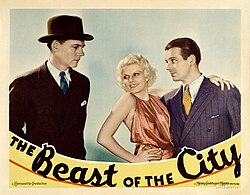
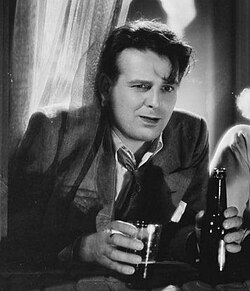 Ford in The Beast of the City (1932) | |
| Born | Samuel Grundy Jones (1898-02-12)12 February 1898 Bolton, Lancashire, England |
| Died | 11 June 1966(1966-06-11) (aged 68) Los Angeles, California, U.S. |
Resting place | Holy Cross Cemetery, Culver City |
| Occupations |
|
| Years active | 1918–1965 |
| Spouse |
Martha Haworth (m. 1922) |
| Children | 1 |
Wallace Ford (born Samuel Grundy Jones; 12 February 1898 – 11 June 1966) was an English–American vaudevillian, stage performer and screen actor. Usually playing wise-cracking characters, he combined a tough but friendly-faced demeanor with a small but powerful, stocky physique.
Early life
Ford was born Samuel Grundy Jones1 in Bolton, Lancashire, England, into a working-class family of limited means who left him in the care of an aunt and uncle. At the age of three, his uncle and aunt left him with Barnardo's orphanage because they were unable to maintain him and their own children. When he was seven, he and other children from similar backgrounds were shipped to Canada to new foster families as a part of the British Empire's ongoing programme to populate the territory.
Jones was adopted by a family in Manitoba. He was ill-treated and became a serial runaway, being resettled several times with different families by the Canadian authorities. According to his own account, at the age of 11 he ran away for the last time and joined a vaudeville traveling troupe touring Canada called the Winnipeg Kiddies, from which he acquired his initial training as a performer.2
In 1914, 16-year-old Jones and another youth named Wallace Ford decided to head south to the United States to seek their fortunes, riding a freight train illicitly. During the trip, Ford was killed beneath the wheels of a train. Later, Jones adopted as his stage name the name of his dead traveling companion.3
Acting career

Following his service as a trooper in the army at Fort Riley, Kansas, with the United States Cavalry during World War I,2 he became a vaudeville stage actor in an American stock company. In 1919, he performed in an adaptation of Booth Tarkington's Seventeen, which played to full houses in Chicago for several months, before transferring to a successful run on Broadway in New York City.4 Ford became a successful Broadway performer through the Roaring Twenties, appearing in multiple productions, including the lead role in the Broadway smash hit Abie's Irish Rose.25
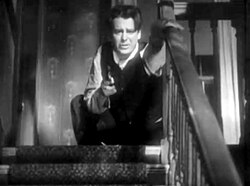
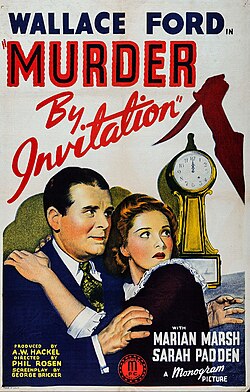
In motion pictures, Ford made his credited debut with Possessed in 1931, appearing with Clark Gable and Joan Crawford, and the next year he was given the lead in Metro-Goldwyn-Mayer's Freaks, directed by Tod Browning. Ford went on to have an extensive career over 30 years, appearing in more than 150 films, with lead roles in the 1930s and '40s in Hollywood B movies such as The Rogues' Tavern (1936), Murder by Invitation (1941), and Roar of the Press (1941) and supporting roles in larger feature films such as The Lost Patrol (1934), The Informer (1935), Shadow of a Doubt (1943), Spellbound (1945), and Dead Reckoning (1947).
In 1938, Ford returned to the Broadway stage to play the role of George in the original production of Of Mice and Men.5 In 1945, Ford appeared in the film Blood on the Sun alongside Jimmy Cagney, whose physique and acting style resembled his own. In the late 1940s and early 1950s, he transitioned into a character actor, appearing as a regular performer in the newly fashionable Western genre, and in multiple John Ford productions as one of his preferred support players.
In the latter stage of his career, during the 1950s and early 1960s, Ford performed increasingly on television. He had a recurring role in the Western series The Deputy starring Henry Fonda and his final appearance on the "small screen" was on The Andy Griffith Show in 1964, playing Roger Hanover, Aunt Bee's old flame, who unsuccessfully attempts to obtain a payoff from Andy by implying an engagement to Bee if Andy refuses. The next year, he appeared in A Patch of Blue, for which he received a Golden Laurel nomination. Ford's performance as Ole Pa in A Patch of Blue proved to be the final role of his extensive acting career. He died just six months after the film’s release.
Personal life
Ford became a naturalized United States citizen on 8 May 1942; by this act, he also legally changed his name from Samuel Grundy to Wallace Ford. He met his future wife, Martha Haworth, in 1922 while they were performing together on Broadway in Abie's Irish Rose, she being a chorus girl at the time. They had one child, a daughter named Patricia (1927–2005).2
After the death of his wife in February 1966, Ford moved into the Motion Picture & Television Country House and Hospital at Woodland Hills, California, and died in the hospital there of heart failure four months later.2 His body was buried in an unmarked grave at Culver City's Holy Cross Cemetery.6
Broadway credits
| Date | Title | Role | Notes |
|---|---|---|---|
| 29 August – September 1921 | The Poppy God | Higgins | Hudson Theatre, New York7 |
| 6 March–?, 1922 | Broken Branches | Arthur Weldon | 39th Street Theatre, New York8 |
| 22 October – November 1923 | Nobody's Business | Oliver Pratt | Klaw Theatre, New York9 |
| 14 January – February 1924 | Gypsy Jim | Tom Blake | 49th Street Theatre, New York10 |
| 31 March – May 1924 | Nancy Ann | Dan Dennis | 49th Street Theatre, New York11 |
| 1 September 1924 – June 1925 | Pigs | Thomas Atkins Jr. | Little Theatre, New York12 |
| 14 January – March 1929 | Gypsy | Mac | Klaw Theatre, New York13 |
| 14 October – November 1929 | The Nut Farm | Willie Barton | Klaw Theatre, New York14 |
| 23 November 1937 – May 1938 | Of Mice and Men | George | Music Box Theatre, New York15 |
| 26 December 1939 – 6 January 1940 | Kindred | Dermot O'Regan (Prologue) | Maxine Elliott Theatre, New York16 |
Filmography





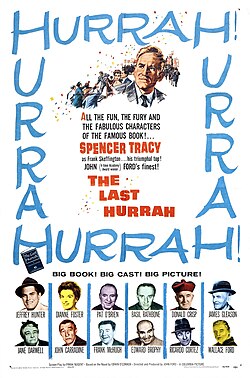
Select television credits

| Year | Title | Role | Notes |
|---|---|---|---|
| 1953 | The Motorola Television Hour | "Outlaw's Reckoning" (series debut) | |
| Goodyear Television Playhouse | "The Happy Rest" | ||
| Armstrong Circle Theatre | "The Marshal of Misery Gulch" | ||
| 1954 | Father Knows Best | Nick | "The Christmas Story” |
| Inner Sanctum | Photographer | "Dark of the Night" | |
| 1955 | Ford Theatre | Talker | "Sunday Mourn" |
| Damon Runyon Theatre | Lt. Harrigan | "Tobias the Terrible" | |
| 1957 | The Court of Last Resort | William Markham | "The Jim Thompson Case" |
| 1958 | Playhouse 90 | Mule Rogers | "The Last Man" |
| 1959–1961 | The Deputy | Marshal Herk Lamson | |
| 1960 | Tales of Wells Fargo | Marshal F.X. Murphy | "Dead Man's Street" |
| 1964 | The Andy Griffith Show | Roger Hanover |
References
References
- England and Wales Civil Registration Birth Index, January to March 1898, Bolton, Lancashire
- Boyd Magers. "Characters and Heavies: Wallace Ford". Retrieved 6 April 2017.
- Lest We Forget
- Hal Erickson, Allmovie biography on Wallace Ford
- Wallace Ford at the Internet Broadway Database
- Celebrities in Los Angeles Cemeteries
- "The Poppy God". Internet Broadway Database. Retrieved 14 July 2017.
- "Broken Branches". Internet Broadway Database. Retrieved 14 July 2017.
- "Nobody's Business". Internet Broadway Database. Retrieved 14 July 2017.
- "Gypsy Jim". Internet Broadway Database. Retrieved 14 July 2017.
- "Nancy Ann". Internet Broadway Database. Retrieved 14 July 2017.
- "Pigs". Internet Broadway Database. Retrieved 14 July 2017.
- "Gypsy". Internet Broadway Database. Retrieved 14 July 2017.
- "The Nut Farm". Internet Broadway Database. Retrieved 14 July 2017.
- "Of Mice and Men". Internet Broadway Database. Retrieved 14 July 2017.
- "Kindred". Internet Broadway Database. Retrieved 14 July 2017.
- "Wallace Ford". AFI Catalog of Feature Films. American Film Institute. Retrieved 10 July 2017.
- Goble, Alan (8 September 2011). The Complete Index to Literary Sources in Film. Walter de Gruyter. p. 319. ISBN 978-3-11-095194-3.
- Lubasch, Arnold H. (18 October 2012). Robeson: An American Ballad. Scarecrow Press. p. 92. ISBN 978-0-8108-8523-3.
- Nollen, Scott Allen (10 January 2014). Paul Robeson: Film Pioneer. McFarland. p. 110. ISBN 978-0-7864-5747-2.
- Pitts, Michael R. (19 April 2019). Astor Pictures: A Filmography and History of the Reissue King, 1933-1965. McFarland. p. 229. ISBN 978-1-4766-3628-3.
- Getz, Leonard (7 May 2015). From Broadway to the Bowery: A History and Filmography of the Dead End Kids, Little Tough Guys, East Side Kids and Bowery Boys Films, with Cast Biographies. McFarland. p. 80. ISBN 978-0-7864-8742-4.