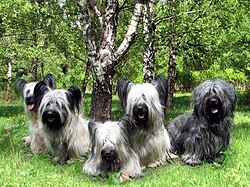

Vulnerable Native Breeds are a group of dog breeds originating in the United Kingdom and Ireland, and identified by The Kennel Club (KC) as having annual registration numbers of 300 puppies or fewer within the UK.1 The KC identified its need for such a list in June 2003, with research it conducted to identify the extent of the vulnerability and viability of each breed.1 It was a joint project, with the KC working with the British and Irish Native Breeds Trust,1 later to be known simply as the Native Dog Breeds Trust.2 The breeds on the list have been promoted at events such as Discover Dogs and Crufts, and by asking that owners of these breeds mate their dogs rather than having them spayed.3
The majority of the list comes from the Terrier Group, a group mostly derived from breeds with backgrounds in the British Isles. The most marked drop in popularity is that of the Sealyham Terrier, which registered 1,084 breeds in 1938, but by 2004 was registering only sixty dogs a year.1 In October 2011, British magazine Country Life highlighted the breed on its front cover, with the heading "SOS: Save our Sealyhams," and launched a campaign to save the breed.4 The Otterhound, popular during the time of Henry VIII, has registration numbers of less than a thousand world wide.3
The list was originally compiled in January 2006, and included 28 breeds. Later in 2006, the Miniature Bull Terrier was added. In 2007, after consultation with the breed clubs involved, the Bloodhound, Gordon Setter and King Charles Spaniel were re-classed as "Viable" rather than vulnerable.5 The English Setter is the newest addition to the list, having been added for the first time in 2012.6 However, during 2012 the number of English Setter puppies registered increased to 314, so the breed was moved to the Kennel Club's "At Watch" list, which is for breeds with registrations from 300-450.7 Breeds on the "At Watch" list included in 2013 the English Setter, the Old English Sheepdog, the Irish Terrier, the Irish Wolfhound, the Welsh Springer Spaniel, the Pembroke Welsh Corgi, and the Welsh Terrier.8
-
 The Otterhound
 -
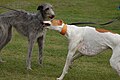 A Scottish Deerhound, and a Greyhound, two sighthounds on the list
 -
 An Irish Red and White Setter, and two Gordon Setters
Listed breeds
- Key
| *Former vulnerable breeds now viable breeds |
| **Former vulnerable breeds now watch list |
| ***Former vulnerable breed |
- Table
| Breed[A] | Group | 2002 Registrations | 2005 Registrations | 2011 Registrations | 2012 Registrations | 2013 Registrations | Ref |
|---|---|---|---|---|---|---|---|
| Bloodhound* | Hound Group | 80 | 104 | 59 | 50 | 51 | 89 |
| Bull Terrier (Miniature) | Terrier Group | 278 | 275 | 216 | 192 | 161 | 810 |
| Collie (Smooth) | Pastoral Group | 85 | 72 | 75 | 88 | 82 | 811 |
| Dandie Dinmont Terrier | Terrier Group | 148 | 149 | 98 | 120 | 105 | 810 |
| English Setter** | Gundog Group | 568 | 450 | 234 | 314 | 326 | 812 |
| English Toy Terrier (Black and Tan) | Toy Group | 56 | 103 | 95 | 126 | 115 | 813 |
| Foxhound | Hound Group | 5 | 9 | 0 | 11 | 814 | |
| Fox Terrier (Smooth) | Terrier Group | 167 | 212 | 137 | 94 | 122 | 810 |
| Glen of Imaal Terrier | Terrier Group | 48 | 45 | 67 | 57 | 55 | 810 |
| Gordon Setter* | Gundog Group | 250 | 309 | 306 | 273 | 1215 | |
| Greyhound | Hound Group | 24 | 49 | 14 | 30 | 40 | 89 |
| Harrier | Houng
Group |
12 | 38 | 9 | |||
| Irish Red and White Setter | Gundog Group | 99 | 120 | 119 | 89 | 82 | 812 |
| Irish Terrier** | Terrier Group | 198 | 270 | 277 | 306 | 362 | 810 |
| Kerry Blue Terrier | Terrier Group | 244 | 277 | 212 | 210 | 169 | 810 |
| King Charles Spaniel* | Toy Group | 150 | 193 | 180 | 217 | 169 | 813 |
| Lakeland Terrier | Terrier Group | 269 | 330 | 247 | 208 | 221 | 810 |
| Lancashire Heeler | Pastoral Group | 125 | 166 | 98 | 104 | 103 | 811 |
| Manchester Terrier | Terrier Group | 86 | 140 | 152 | 124 | 198 | 810 |
| Mastiff (English) | Working Group | 476 | 173 | 140 | 139 | 816 | |
| Norwich Terrier | Terrier Group | 153 | 131 | 158 | 170 | 194 | 810 |
| Otterhound | Hound Group | 54 | 50 | 38 | 37 | 42 | 89 |
| Retriever (Curly Coated) | Gundog Group | 79 | 82 | 62 | 71 | 118 | 812 |
| Scottish Deerhound | Hound Group | 231 | 264 | 237 | 260 | 236 | 89 |
| Sealyham Terrier | Terrier Group | 58 | 58 | 63 | 76 | 68 | 810 |
| Skye Terrier | Terrier Group | 59 | 30 | 44 | 42 | 17 | 810 |
| Soft Coated Wheaten Terrier*** | Terrier Group | 277 | 321 | 433 | 372 | 1017 | |
| Spaniel (Clumber) | Gundog Group | 170 | 192 | 271 | 151 | 247 | 812 |
| Spaniel (Field) | Gundog Group | 84 | 86 | 46 | 47 | 29 | 812 |
| Spaniel (Irish Water) | Gundog Group | 145 | 106 | 101 | 148 | 101 | 812 |
| Spaniel (Sussex) | Gundog Group | 82 | 77 | 52 | 74 | 55 | 812 |
| Welsh Corgi (Cardigan) | Pastoral Group | 56 | 77 | 108 | 94 | 102 | 811 |
| Welsh Terrier** | Terrier Group | 270 | 326 | 415 | 352 | 447 | 810 |
Notes
Notes
References
References
- "Vulnerable native breeds". www.thekennelclub.org.uk.
- "Native Dog Breeds Trust to close". OurDogs. Retrieved 24 April 2011.
- Eyre, Hermione (9 March 2008). "Canine crusaders: Meet the dog-handlers dedicated to saving the best of British breeds". The Independent.
- Hough, Andrew (26 October 2011). "Campaign launched to save Sealyham terriers 'from extinction'". The Daily Telegraph. Archived from the original on 26 October 2011. Retrieved 26 December 2011.
- "Native Vulnerable Breeds". The Kennel Club. 4 January 2007. Archived from the original on 9 March 2013. Retrieved 25 January 2012.
- Rincon, Paul (25 January 2012). "UK native dog breeds 'at risk of extinction'". BBC News. Retrieved 28 February 2012.
- "Registrations go down by six per cent". Dog World newspaper. Archived from the original on 13 March 2016. Retrieved 27 January 2013.
- "Tables of Registrations of Vulnerable breeds and Watch List for the Years 2004 to 2014" (PDF). The Kennel Club. Archived from the original (PDF) on 7 December 2013. Retrieved 3 August 2014.
- "Comparative Tables of Registrations for the Years 2002 to 2011 Inclusive (Hound Group)" (PDF). The Kennel Club. Archived from the original (PDF) on 10 August 2011. Retrieved 28 February 2011.
- "Comparative Tables of Registrations for the Years 2002 to 2011 Inclusive (Terrier Group)" (PDF). The Kennel Club. Archived from the original (PDF) on 31 January 2012. Retrieved 28 February 2011.
- "Comparative Tables of Registrations for the Years 2002 to 2011 Inclusive (Pastoral Group)" (PDF). The Kennel Club. Archived from the original (PDF) on 25 March 2012. Retrieved 28 February 2011.
- "Comparative Tables of Registrations for the Years 2002 to 2011 Inclusive (Gundog Group)" (PDF). The Kennel Club. Archived from the original (PDF) on 31 May 2012. Retrieved 28 February 2012.
- "Comparative Tables of Registrations for the Years 2002 to 2011 Inclusive (Toy Group)" (PDF). The Kennel Club. Archived from the original (PDF) on 25 March 2012. Retrieved 28 February 2011.
- "Comparative Tables of Registrations for the Years 2004 to 2014 Inclusive (Working Group)" (PDF). The Kennel Club. Archived from the original (PDF) on 8 March 2014. Retrieved 3 August 2014.
- "Table of Registrations for the Years 2013 to first quarter of 2014 (Gundog Group)" (PDF). The Kennel Club. Archived from the original (PDF) on 12 August 2014. Retrieved 3 August 2014.
- "Comparative Tables of Registrations for the Years 2004 to 2014 Inclusive (Working Group)" (PDF). The Kennel Club. Archived from the original (PDF) on 8 March 2014. Retrieved 3 August 2014.
- "Table of Registrations for the Years 2013 to first quarter of 2014 (Terrier Group)" (PDF). The Kennel Club. Archived from the original (PDF) on 12 August 2014. Retrieved 3 August 2014.
- "Judging - Breeds". Crufts. Archived from the original on 31 December 2011. Retrieved 8 January 2012.