| Void Indigo | |
|---|---|
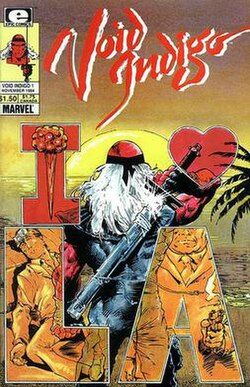 The cover of Void Indigo #1 (November 1984), art by Val Mayerik. | |
| Publication information | |
| Publisher | Marvel Comics (Epic Comics) |
| Format | Graphic novel Limited series |
| Genre | |
| Publication date | 1984 November 1984 – March 1985 |
| No. of issues | Graphic novel and 2 out of 6 issues |
| Main character | Jhagur |
| Creative team | |
| Written by | Steve Gerber |
| Artist | Val Mayerik |
| Letterer | Andy Kubert |
| Editor(s) | Laurie Sutton Archie Goodwin |
Void Indigo was a short-lived and controversial comic book series written by Steve Gerber and drawn by Val Mayerik. It was published — first as a graphic novel, followed by a truncated limited series — by Epic Comics from 1984 to 1985.
Void Indigo focuses on an alien named Jhagur who arrives on Earth with a spirit of vengeance against the four wizards who had tortured and killed him in his previous life. The title was noted for its combination of metaphysical themes with graphic violence, grotesque imagery, and the occult.
Development
Gerber originally developed the concept as a pitch for revamping DC Comics' Hawkman1 — "combining the Earth-One and Earth-2 versions into a new version of the character. The idea being that he was an alien from Thanagar who was the reincarnation of an ancient Egyptian prince."2 After DC turned him down, he then shopped the concept (minus the Hawkman connection) to independent publishers Eclipse Comics, First Comics, and Pacific Comics,3 but could not come to an agreement.4
Publication history
Gerber successfully brought the concept to Marvel Comics, a company he had recently quit.4 Gerber reworked the story, illustrated by Val Mayerik, into one of the first graphic novels published by Epic Comics — Marvel Graphic Novel #11 — in 1984. (Although Void Indigo was published as a creator-owned Epic title, the story included references to Marvel concepts such as Atlantis and Zhered-Na.)
The graphic novel attracted controversy for its graphic violence and surreal horror elements; shortly after publication, copies were seized by Canadian customs officials over concerns that it violated pornography statutes.5
Void Indigo was then solicited as a six-issue limited series by Epic (also written by Gerber and illustrated by Mayerik); the first issue was published with a November 1984 cover date. Distributor reaction to the series was negative, with both Steve Geppi of Diamond Comic Distributors6 and Rob Van Leeuwen of Andromeda Distributing Limited weighing in:
After the initial problems he had with the graphic novel, Van Leeuwen made the decision not to carry the regular Epic series at all, assuming the series would continue on in the same vein. "I just took a moral stand, and none of the stores I supply will carry it from me," he said. "My accounts can go elsewhere if they want them. I personally object to the book." Prior to Marvel's decision to cancel the series, Van Leeuwen expressed his feelings about the book. “I'd just like to see Marvel cut off the whole series, to tell you the truth," he said.5
According to The Comics Journal, dealer resistance to the series' "unusually violent and bizarre concepts" contributed to low sales, with creator Gerber estimating circulation in the 30,000–40,000 range.5
Critical reaction was also negative, and orders for the second issue dropped further, leading to Epic's editor-in-chief Archie Goodwin deciding to end the series after its second issue.5 Contributing factors included production delays, with Gerber acknowledging that he had only rough outlines for the first several issues. Marvel staff similarly cited irregular shipping schedules and Gerber's other professional commitments as factors. Gerber and Goodwin reportedly discussed revising the series' premise to make it more commercially viable, but Gerber opposed substantially softening its content:5
"...the dealers didn’t want to order the book, the distributors didn’t want to carry it, and, under those circumstances, Marvel didn’t want to publish it, because it wasn’t going to make any money. My feeling was, rather than change the book and bring it more in line with the mainstream, let it die a quick and painless death. Archie Goodwin and Val Mayerik agreed with me completely. We never fought the cancellation."2
Issues #3–6 were never completed, although Gerber's synopsis was later leaked onto the Internet,7 providing an idea as to how the series would have finished.
Plot
Void Indigo begins in a prehistoric era, where four ancient sorcerers seek to escape aging and death through rituals that manipulate reincarnation and the metaphysical realm known as the "Void Indigo," through which souls pass between lives. Their actions corrupt the natural balance between life, death, and rebirth, while the warrior Ath’Agaar and his lover Ren become victims of the sorcerers' pursuit of power.
Thousands of years later, Ath’Agaar has been reincarnated as Jhagur, an alien starship captain who once also lived on Earth as a human. Drawn back to Earth by unresolved events connected to the sorcerers, Jhagur crash-lands in the American Southwest and becomes involved with Amanda Tower, her daughter Cosima, and a group connected to the mysterious mystic Taro and the cult of the demigod Kaok.
As Jhagur investigates the surviving sorcerers and recovers memories of his previous incarnations, the story reveals that the disturbances in the Void Indigo threaten both Earth and the spiritual cycle itself. The published story ends with the re-emergence of Kaok's influence and the beginning of a larger supernatural conflict.
Unpublished continuation
The unpublished storyline would have expanded the mythology of the Void Indigo and introduced Jhagur's evolving mystical abilities, including the "Ninth Sight," which allowed him to perceive other dimensions and his past incarnations. The continuation involved the return of the ancient "Dark Lords," psychic links among Jhagur, Amanda Tower, and Linette, and an apocalyptic struggle against the demigod Kaok in both the physical world and the "Beyond-World." The synopsis culminates with Jhagur defeating Kaok in the Void Indigo itself with the aid of his past incarnations.
Reception
Critical reaction to Void Indigo and its graphic depiction of violence was harsh: in his Comics Buyer's Guide column, "The Law is a Ass", Bob Ingersoll criticized the graphic novel's "unrelentingly depressing" tone and its depiction of humanity as "debased and depraved and criminal without even one redeeming or marginally good characteristic;" he called the comic itself a "crime against humanity".8 In revisiting his columns a decade later, Ingersoll edited his criticism to take out "very inappropriate" assumptions about Gerber, although he still found Void Indigo to be "pustulate".9
Similarly, in his review for Amazing Heroes, R. A. Jones called Void Indigo "...unquestionably one of the most vividly violent books of the year," while also criticizing Mayerik’s artwork and coloring as "pale and watered down."10
Writing in The Comics Journal, Carter Scholz wrote that "a lot of page space is given to details of torture and death," while arguing that Gerber was attempting "a kind of story inimical to comics."11
R. Fiore's Comics Journal review of the first of the limited series was no more positive:
There's screwy and then there's screwy. "Humans... cannot bear to face the darkness in their nature" in these nasty old latter days (according to the introduction), but if Steve Gerber has his way you’ll get your minimum daily requirement and then some. Three bloody killings in this issue and it feels like more. Gerber's been on this graphic violence kick for a good five years now, and he still hasn’t figured out that the true darkness is inside the human heart and not in the act of cutting it out.12
A retrospective review of the graphic novel in The Slings & Arrows Graphic Novel Guide was more measured in its appraisal of the comic's violence: "While this still merits an adult rating, time has passed and it's no longer as shocking, primarily as it's no longer the isolated example."13 The rest of the review, however, was mixed at best, characterizing the tone of the book as more "early Heavy Metal" than Marvel, while citing Gerber's "lack of focus" and Mayerik as being a "limited storyteller."13
Further reading
Further reading
- "Steve Gerber interview". David Anthony Kraft's Comics Interview. No. 15. Sep 1984.
- "Val Mayerik interview". David Anthony Kraft's Comics Interview. No. 15. Sep 1984.
References
References
- Grant, Steven (13 February 2008). "Permanent Damage". Comic Book Resources. Archived from the original on April 14, 2008. Retrieved 1 May 2013.
- "Steve Gerber". The Comics Journal. No. 100. Interviewed by Art Cover. July 1985. p. 97.
- "Editorial". The Comics Journal. No. 99. June 1985. p. 8.
- Howe, Sean (2012). Marvel Comics: The Untold Story. HarperCollins. ISBN 9780062218117.
- "Marvel Axes Indigo Void after 2 Issues". Newswatch. The Comics Journal. No. 95. Feb 1985. pp. 11–12.
- Grand, Alex; Thompson, Jim (May 15, 2020). "Godfather of Comics (Steve Geppi interview)". ComicBookHistorians.com.
Jim: ...But one that I'm interested in very much which is a function as a gatekeeper or some would say a censor.... [D]uring your time, both as retail owner and as a distributor, you've run into an occasional controversy where some people took exception to the decisions that you've made. I'm thinking of ... [the] Void Indigo graphic novel....
- "VOID INDIGO, Storyline Synopsis – Issues #3–6 (November 8, 1984)". Hoboes.com. Retrieved May 7, 2026.
Steve Gerber has kindly granted permission to place these files on Cerebus.
- Ingersoll, Bob (21 December 1984). "The Law Is an Ass #45". Comic Buyer's Guide.
- Ingersoll, Bob. "THE LAW IS A ASS for 08/15/2000". www.worldfamouscomics.com. Retrieved 2 May 2013.
- Jones, R. A. (Nov 1984). "Avoid Indigo". Comics in Review. Amazing Heroes. No. 58. Fantagraphics. p. 58.
'He is gashed, punctured, hammered, and mauled.' By the time you reach the midway point of this graphic novel, you may feel equally tortured. Void Indigo is unquestionably one of the most vividly violent books of the year. Blood flows as freely as water, as the characters are maimed, mutilated, and murdered.
The most discussed aspect of this book will probably be the graphic violence, but quite frankly it made little impression on me one way or the other. The art is atrocious, far below the level at which Val Mayerik is capable of working. It looks as if he used finger paints to execute the graphics. If he intended to do the coloring, he would have been wise to purchase a dictionary first. Then he could have looked up the word "indigo" and learned that it describes a dark blue color — not the sickly yellow he employs on more than one occasion. The hues throughout the book look pale and watered down, especially when compared to the vibrant coloring evident on the front and back covers. - Scholz, Carter (May 1985). "Post-Modernist Spacemen". The Comics Journal. No. 98. p. 43.
A lot of page space is given to details of torture and death. There is, as in The Medusa Chain, as in the films of Brian De Palma, that 'waning of affect' Jameson mentions as a trait of the postmodern. And again, the craft work is high, and the gruesomeness is justified in terms of the story — but it is given that same peculiar emphasis.
Unquestionably the details of mass death are in our contemporary air. And no one can honestly deny Gerber's ... right to display them in a coherent story. But we may, with all critical distance abolished, ask why. To what end? Entertainment? Some of this stuff would gag a maggot....
Gerber is engaged in something quite complicated here. We hear a lot about expanding the potential of the comics medium, but usually from the standpoint of visual innovation. Gerber, seemingly, could not care less about the visual, and is bent on telling, in a comic, a kind of story inimical to comics. - Fiore, R. (March 1985). "Funnybook Roulette". The Comics Journal. No. 96. p. 34.
- Keogh, Ian. "Void Indigo (review)". The Slings & Arrows Graphic Novel Guide. Retrieved May 14, 2026.
External links
External links
- Ingebrigtsen, Lars (Dec 17, 2019). "1984: Void Indigo". Totally Epic.
- Void Indigo at the Grand Comics Database
- Void Indigo at the Comic Book DB (archived from the original)
- Marvel Graphic Novel #11 at the Comic Book DB (archived from the original)