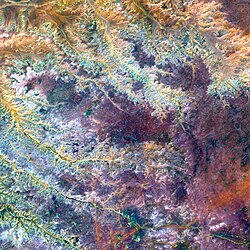
The visible and near-infrared (VNIR) portion of the electromagnetic spectrum has wavelengths between approximately 400 and 1100 nanometers (nm).1 It combines the full visible spectrum with an adjacent portion of the infrared spectrum up to the water absorption band between 1400 and 1500 nm. Some definitions also include the short-wavelength infrared band from 1400 nm up to the water absorption band at 2500 nm.2 VNIR multi-spectral image cameras have wide applications in remote sensing and imaging spectroscopy.3 Hyperspectral Imaging Satellite carried two payloads, among which one was working on the spectral range of VNIR.4
See also
See also
References
References
- Moseley, Trevor & Zabierek, Gus (2006). "Guidance On The Safe Use Of Lasers In Education And Research" (PDF). Archived from the original (PDF) on 2007-08-24. Retrieved 2007-10-31.
electromagnetic radiation at wavelengths extending from 100 nm in the ultra-violet, through the visible (400-700 nm), and the near infrared (700-1400 nm), to the far infrared (1400 nm – 1 mm).
{{cite journal}}: Cite journal requires|journal=(help) - Waiser, T.H.; Morgan, C.L.S.; Brown, D.J.; Hallmark, C.T. (2007). "In Situ Characterization of Soil Clay Content with Visible Near-Infrared Diffuse Reflectance Spectroscopy". Soil Science Society of America Journal. 71 (2): 389. Bibcode:2007SSASJ..71..389W. doi:10.2136/sssaj2006.0211.
- Ben-dor, E.; Inbar, Y.; Chen, Y. (1997). "Reflectance spectra of organic matter in the visible near-infrared and short wave infrared region(400-2500 nm) during a controlled decomposition process" (PDF). Remote Sensing of Environment. 61 (1): 1–15. Bibcode:1997RSEnv..61....1B. doi:10.1016/S0034-4257(96)00120-4. Archived from the original (PDF) on May 9, 2006. Retrieved 2007-10-31.
- "HySIS (HyperSpectral Imaging Satellite) - Satellite Missions - eoPortal Directory". directory.eoportal.org. Retrieved 2021-02-18.