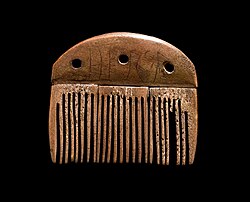
The Vimose inscriptions (Danish pronunciation: [ˈvimoːsə]), found on the island of Funen, Denmark, include some of the oldest datable Elder Futhark runic inscriptions in early Proto-Norse or late Proto-Germanic from the 2nd to 3rd century in the Scandinavian Iron Age and were written in the time of the Roman Empire.
- Vimose Comb (c. 160, considered the oldest known datable runic inscription altogether): harja (ᚺᚨᚱᛃᚨ)12
- Vimose Buckle (c. 200) aadagasu =? ansuz-a(n)dag-a(n)su / laasauwija =? la-a[n]sau-wija;3
- Vimose Chape (c. 250): mariha || [.]ala / makija; possibly "Mari (the famous one) is the sword of Alla"4
- Vimose Woodplane (c. 300) talijo gisai oj: wiliz [..]la o[...] / tkbis: hleuno: an[.]: regu5
- Vimose Sheathplate (c. 300): awgns; possibly "son/descendant of Awa"6
- Vimose Spearhead: [w]agni[ŋ]o7
See also
See also
- Illerup, a site of wetland depositions
- Meldorf fibula, an item bearing an early runic inscription
- Thorsberg moor, a site of wetland depositions
- Wetlands and islands in Germanic paganism, religious importance of wetlands and depositions
References
References
- "Deutungen zu einer Inschrift". www.runenprojekt.uni-kiel.de. Archived from the original on 2015-11-22. Retrieved 2006-04-18.
- Price, Theron Douglas (2015). Ancient Scandinavia: an archaeological history from the first humans to the Vikings. New York, NY: Oxford University Press. p. 301. ISBN 978-0-19-023197-2.
- "Deutungen zu einer Inschrift". www.runenprojekt.uni-kiel.de. Archived from the original on 2015-11-22. Retrieved 2006-04-18.
- "Deutungen zu einer Inschrift". www.runenprojekt.uni-kiel.de. Archived from the original on 2015-11-22. Retrieved 2006-04-18.
- "Deutungen zu einer Inschrift". www.runenprojekt.uni-kiel.de. Archived from the original on 2015-09-24. Retrieved 2006-04-18.
- "Deutungen zu einer Inschrift". www.runenprojekt.uni-kiel.de. Archived from the original on 2015-11-22. Retrieved 2006-04-18.
- "Deutungen zu einer Inschrift". www.runenprojekt.uni-kiel.de. Archived from the original on 2015-11-22. Retrieved 2006-04-18.
- Seebold, Elmar (1994). "Die sprachliche Deutung und Einordnung der archaischen Runeninschriften". In Düwel, Klaus; Neumann, Hannelore; et al. (eds.). Runische Schriftkultur in Kontinental-Skandinavischer und -Angelsächsischer Wechselbeziehung. Walter de Gruyter. pp. 56–94. ISBN 3-11-014328-3.