| Verbena simplex | |
|---|---|
| |
Scientific classification 
| |
| Kingdom: | Plantae |
| Clade: | Embryophytes |
| Clade: | Tracheophytes |
| Clade: | Spermatophytes |
| Clade: | Angiosperms |
| Clade: | Eudicots |
| Clade: | Asterids |
| Order: | Lamiales |
| Family: | Verbenaceae |
| Genus: | Verbena |
| Species: | V. simplex
|
| Binomial name | |
| Verbena simplex | |
| Synonyms | |
|
Verbena angustifolia Michx.1 | |
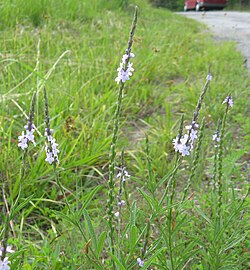
Verbena simplex is a species of flowering plant in the vervain family, Verbenaceae.23 It is commonly known as narrowleaf vervain, and is a perennial herbaceous plant. It is native to central and eastern North America where it is found in open, dry, habitats on calcareous soil. It produces lavender flowers in the summer.
Description
Verbena simplex is a perennial wildflower that grows as erect stems, branching from the base of the plant and unbranched or sparingly branched above, to a height of 24–76 cm (0.8–2.5 ft). Pairs of opposite, narrow leaves are spaced along the stems, which are glabrous or short-pubescent. The leaves measure 3–10 cm (1.25–4 in) long and less than 1 cm (0.5 in) across.4 The leaves are sessile or they may have a winged petiole. They are unlobed and finely toothed, narrowly lanceolate to oblanceolate or linear.5
The inflorescence is a solitary flowering spike, measuring 4–25 cm (1.6–9.8 in) long and 5–8 cm (2.0–3.1 in) in diameter, at the end of the stem. The 5-lobed flowers are dark lavender or purple to white or bluish, 4–6 mm (0.2–0.2 in) long, and shaped like a trumpet.5
Distribution and habitat
V. simplex is native in the United States from Nebraska to the west, Texas and Florida to the south, Massachusetts to the east and the Canadian border to the north. In Canada, it is native in Ontario and Quebec.6 It is tolerant of disturbance, and is often seen in pastures and roadsides with sparse vegetation.5
Conservation status
It is listed as endangered in Massachusetts7 and New Jersey,8 and as a species of special concern in Connecticut,9 Minnesota,10 and Wisconsin.
Ecology
The flowers bloom June through August10 and are attractive to bees, skippers and probably butterflies.4
References
References
- "Plants Profile for Verbena simplex (narrowleaf vervain)". plants.usda.gov. Retrieved 2 February 2018.
- "Verbena simplex Lehm". Plants of the World Online. The Trustees of the Royal Botanic Gardens, Kew. n.d. Retrieved June 18, 2025.
- "Verbena simplex Lehm". Catalogue of Life. Species 2000. n.d. Retrieved June 18, 2025.
- "Narrow-Leaved Vervain (Verbena simplex)". illinoiswildflowers.info. Retrieved 2025-10-09.
- "Verbena simplex page". missouriplants.com. Retrieved 2025-10-09.
- "NatureServe Explorer 2.0". explorer.natureserve.org. 1994. Retrieved 2025-10-09.
- "List of Endangered, Threatened, and Special Concern species | Mass.gov". www.mass.gov.
- "Plants Profile for Verbena simplex (narrowleaf vervain)". plants.usda.gov. Retrieved 2 February 2018.
- "Connecticut's Endangered, Threatened and Special Concern Species 2015". State of Connecticut Department of Energy and Environmental Protection Bureau of Natural Resources. Retrieved 1 February 2018. (Note: This list is newer than the one used by plants.usda.gov and is more up-to-date.)
- "Verbena simplex (Narrow-leaved Vervain): Minnesota Wildflowers". www.minnesotawildflowers.info.