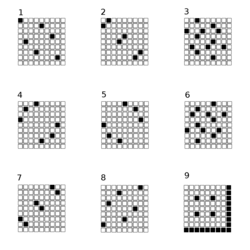
In Indian mathematics, a Vedic square is a variation on a typical 9 × 9 multiplication table where the entry in each cell is the digital root of the product of the column and row headings – in other words, each cell contains the remainder when the product of the row and column headings is divided by 9 (with remainder 0 represented by 9). Numerous geometric patterns and symmetries can be observed in a Vedic square, some of which can be found in traditional Islamic art.
| 1 | 2 | 3 | 4 | 5 | 6 | 7 | 8 | 9 | |
|---|---|---|---|---|---|---|---|---|---|
| 1 | 1 | 2 | 3 | 4 | 5 | 6 | 7 | 8 | 9 |
| 2 | 2 | 4 | 6 | 8 | 1 | 3 | 5 | 7 | 9 |
| 3 | 3 | 6 | 9 | 3 | 6 | 9 | 3 | 6 | 9 |
| 4 | 4 | 8 | 3 | 7 | 2 | 6 | 1 | 5 | 9 |
| 5 | 5 | 1 | 6 | 2 | 7 | 3 | 8 | 4 | 9 |
| 6 | 6 | 3 | 9 | 6 | 3 | 9 | 6 | 3 | 9 |
| 7 | 7 | 5 | 3 | 1 | 8 | 6 | 4 | 2 | 9 |
| 8 | 8 | 7 | 6 | 5 | 4 | 3 | 2 | 1 | 9 |
| 9 | 9 | 9 | 9 | 9 | 9 | 9 | 9 | 9 | 9 |
Algebraic properties
The Vedic Square can be viewed as the multiplication table of the monoid where is the set of positive integers partitioned by the residue classes modulo nine. (the operator refers to the abstract "multiplication" between the elements of this monoid).
If are elements of then can be defined as , where the element 9 is representative of the residue class of 0 rather than the traditional choice of 0.
This does not form a group because not every non-zero element has a corresponding inverse element; for example but there is no such that .
Properties of subsets
The subset forms a cyclic group with 2 as one choice of generator - this is the group of multiplicative units in the ring . Every column and row includes all six numbers - so this subset forms a Latin square.
| 1 | 2 | 4 | 5 | 7 | 8 | |
|---|---|---|---|---|---|---|
| 1 | 1 | 2 | 4 | 5 | 7 | 8 |
| 2 | 2 | 4 | 8 | 1 | 5 | 7 |
| 4 | 4 | 8 | 7 | 2 | 1 | 5 |
| 5 | 5 | 1 | 2 | 7 | 8 | 4 |
| 7 | 7 | 5 | 1 | 8 | 4 | 2 |
| 8 | 8 | 7 | 5 | 4 | 2 | 1 |
From two dimensions to three dimensions
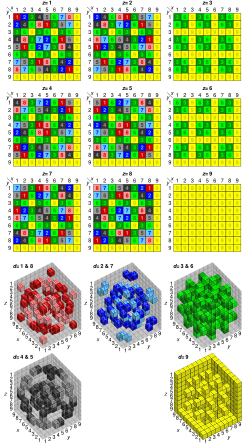
A Vedic cube is defined as the layout of each digital root in a three-dimensional multiplication table.2
Vedic squares in a higher radix
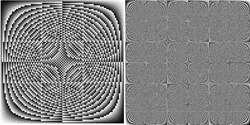
Vedic squares with a higher radix (or number base) can be calculated to analyse the symmetric patterns that arise. Using the calculation above, . The images in this section are color-coded so that the digital root of 1 is dark and the digital root of (base-1) is light.
References
References
- Lin, Chia-Yu (2016). "Digital Root Patterns of Three-Dimensional Space". Recreational Mathematics Magazine. 3 (5): 9–31. doi:10.1515/rmm-2016-0002.
- Lin, Chia-Yu. "Digital root patterns of three-dimensional space". rmm.ludus-opuscula.org. Retrieved 2016-05-25.
- Deskins, W.E. (1996), Abstract Algebra, New York: Dover, pp. 162–167, ISBN 0-486-68888-7
- Pritchard, Chris (2003), The Changing Shape of Geometry: Celebrating a Century of Geometry and Geometry Teaching, Great Britain: Cambridge University Press, pp. 119–122, ISBN 0-521-53162-4
- Ghannam, Talal (2012), The Mystery of Numbers: Revealed Through Their Digital Root, CreateSpace Publications, pp. 68–73, ISBN 978-1-4776-7841-1
- Teknomo, Kadi (2005), Digital Root: Vedic Square
- Chia-Yu, Lin (2016), Digital Root Patterns of Three-Dimensional Space, Recreational Mathematics Magazine, pp. 9–31, ISSN 2182-1976