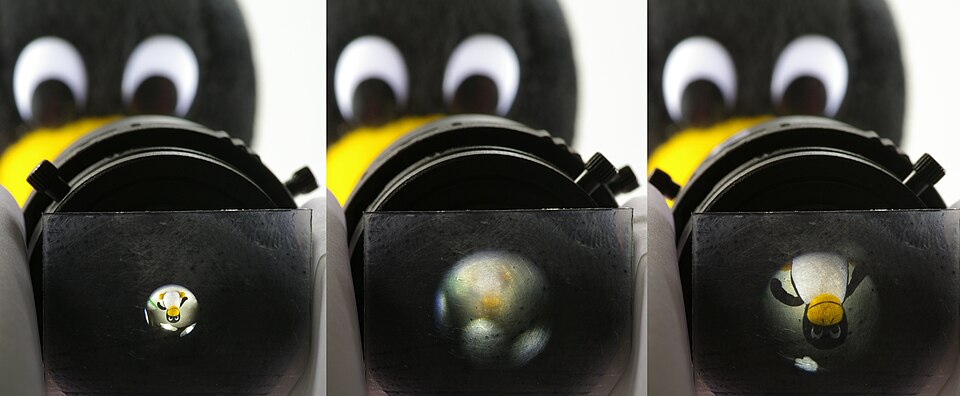
A varifocal lens is a camera lens with variable focal length in which focus changes as focal length (and magnification) changes, as compared to a parfocal ("true") zoom lens, which remains in focus as the lens zooms (focal length and magnification change). Many so-called "zoom" lenses, particularly in the case of fixed-lens cameras, are actually varifocal lenses,1 which give lens designers more flexibility in optical design trade-offs (focal length range, maximum aperture, size, weight, cost) than parfocal zoom. These are practical because of autofocus, and because the camera processor can automatically adjust the lens to keep it in focus while changing focal length ("zooming") making it suitable for still photography where a change in magnification of the subject, as demonstrated below is not a problem. The change in the subject size is a significant problem in video and true parfocal designs are needed for higher quality video work. Varifocal lenses can be used for image display as well as capture, and Meta's Reality Labs has confirmed developing a varifocal display for virtual reality.2
Optical design
The internal structure of a varifocal lens consists of several groups of optical elements arranged along a common optical axis. Adjusting the focal length is accomplished by shifting a middle or rear group of elements along this axis, while a separate front-cell movement controls focus independently.3 This two-motion mechanism — one for focal length, one for focus — is what distinguishes varifocal lenses from true parfocal zoom lenses, in which a more elaborate cam-driven linkage keeps the image plane stationary throughout the zoom range.
Because the varifocal design does not require the complex mechanical coupling needed to preserve focus during zooming, the optical and mechanical construction is simpler and less costly to manufacture than an equivalent parfocal design.4 This simplicity allows designers to allocate fewer optical elements to the zoom group and to use those elements to achieve a wider focal-length ratio, a larger maximum aperture, or a more compact overall form factor — advantages that are difficult to attain simultaneously in a parfocal design.
The variable focal length allows for multiple combinations of working distances and magnifications from a single lens. However, this convenience comes at the cost of some compromises in image quality, weight, dimensions, and aperture compared with a fixed prime lens of equivalent specification.5
Comparison with fixed and zoom lenses
The three principal lens types used in camera systems — fixed (prime), varifocal, and parfocal zoom — differ primarily in whether and how they allow the focal length to be changed:
- A fixed-focal-length lens has a single, unchangeable focal length. Because it has fewer moving parts it is simpler, lighter, and typically provides better optical performance per unit cost than variable-focal-length designs. Fixed lenses are well suited to applications where the scene geometry is predictable and stable.6
- A varifocal lens covers a continuous range of focal lengths, specified as a pair of values such as 2.8–12 mm or 5–50 mm, where the first value is the widest (shortest) focal length and the second is the narrowest (longest).7 After each adjustment of the focal length, the focus position must be reset separately.
- A parfocal zoom lens also covers a continuous focal-length range, but its internal cam mechanism keeps the focal plane stationary as the focal length changes, so no refocusing is required after zooming. This property, known as parfocality or confocality, demands a substantially more complex and expensive optical and mechanical design.8
Types of varifocal lenses
Varifocal lenses can be divided into two main categories according to the mechanism by which focal length and focus are adjusted:
Manual varifocal lenses
In manual varifocal lenses, the user physically rotates two separate control rings on the lens barrel — one to set the desired focal length (zoom) and another to bring the image into sharp focus. This design is common in CCTV cameras installed in fixed positions where the viewing angle is set once during installation and changed only infrequently. Manual varifocal lenses are generally less expensive than motorized equivalents and require no electronic control circuitry.9
Motorized varifocal lenses
Motorized varifocal lenses incorporate small electric motors that drive both the zoom and focus mechanisms under electronic control.10 The user can adjust focal length and refocus the lens remotely — via a web interface, a smartphone application, video management software, or a joystick PTZ controller — without physical access to the camera.11 This capability significantly reduces installation and commissioning time, particularly in large-scale deployments where physically climbing to each camera to adjust the lens would be impractical. Many modern motorized varifocal lenses incorporate an autofocus routine that automatically restores sharp focus whenever the focal length is changed, effectively mimicking parfocal behaviour during normal use while retaining the simpler and cheaper varifocal optical construction.12
Applications
Consumer and professional photography
In consumer point-and-shoot cameras and many mirrorless camera systems, the "zoom" lenses supplied with the camera as kit lenses are frequently varifocal rather than parfocal designs. Autofocus electronics compensate for the focus shift that occurs during zooming, so the distinction is invisible to most users during still photography. The practical disadvantage becomes apparent in videography: a subject being filmed while the focal length is continuously changing (a zoom shot) will momentarily lose sharpness as the autofocus system hunts to re-establish focus, a problem that does not occur with a true parfocal lens.
Video surveillance and security
Varifocal lenses are widely used in CCTV and IP camera installations because a single lens model can serve a wide range of deployment scenarios — from wide-angle coverage of a large open area such as a parking lot or warehouse, to a narrower field of view focused on a specific entry point or till. Common focal-length ranges for security cameras span approximately 2.8–12 mm for general indoor/outdoor use, and up to 4.5–60 mm or beyond for long-distance applications such as license plate recognition.13 The ability to achieve high-resolution optical zoom, as opposed to digital zoom (which degrades image quality by interpolating pixels), makes varifocal lenses particularly valuable when fine detail — such as facial features or vehicle registration plates — must be recorded.14
Machine vision and industrial inspection
In machine vision systems, varifocal lenses allow a single camera installation to accommodate objects of different sizes or to be repurposed across different stages of a production line without requiring a physical lens change. In applications such as multi-stage inspection lines, robotic assembly stations, or rotating inspection platforms — where the distance or size of the object being imaged may vary frequently — the ability to adjust the field of view electronically offers significant operational flexibility.15 The lens structure includes groups of elements that move along the optical axis, enabling changes to the field of view according to object size and distance; the focal adjustment can be performed manually or electronically, depending on system requirements.
Virtual reality displays
Beyond image capture, varifocal lens technology has been applied to image display in virtual reality (VR) headsets. A varifocal display system adjusts the focal distance of the displayed image to match the distance of the virtual object being depicted, potentially reducing the vergence-accommodation conflict that contributes to visual fatigue in conventional VR headsets. Meta's Reality Labs has publicly demonstrated a varifocal VR prototype — the Half Dome headset — using this principle.16
See also
See also
- Zoom lens
- Parfocal lens
- Prime lens
- Autofocus
- Camera lens
- Progressive lens (ophthalmic)
References
References
- Cavanagh, Roger (2003-05-29). "Parfocal Lenses". Archived from the original on 2007-10-07. Retrieved 2007-11-18.
- "Introducing the Team Behind Half Dome—Facebook Reality Labs' Varifocal Prototype".
- "Varifocal Imaging Lenses". Edmund Optics. Retrieved 2024-01-10.
- "Varifocal Imaging Lenses". Edmund Optics. Retrieved 2024-01-10.
- "Fixed focal length lenses for machine vision applications". Opto Engineering. Retrieved 2024-01-10.
- "Security Camera Optics: Varifocal vs Fixed Lenses". Verkada. Retrieved 2024-01-10.
- "What Is The Difference Between Varifocal CCTV Lenses And Fixed CCTV Lenses". ChuangAn Optics. Retrieved 2024-01-10.
- "Fixed focal length lenses for machine vision applications". Opto Engineering. Retrieved 2024-01-10.
- "Security Camera Lens Selection Guide". Reolink. Retrieved 2024-01-10.
- "Best Lenses - All Categories". Top Tech Choices. Retrieved 2026-04-22.
- "Security camera basics: motorized zoom lens vs manual varifocal lens". Unifore. Retrieved 2024-01-10.
- "CCTV Camera Varifocal Lens: Guide for Smarter Security". Eufy. Retrieved 2024-01-10.
- "Fixed or Varifocal Lens Security Cameras: Which is Best?". Pelco. Retrieved 2024-01-10.
- "What Is a Varifocal Lens Security Camera?". Safe and Sound. 2023-09-27. Retrieved 2024-01-10.
- "Varifocal Lenses in Machine Vision Systems". ASIO Vision. 2025-05-22. Retrieved 2024-01-10.
- "Introducing the Team Behind Half Dome—Facebook Reality Labs' Varifocal Prototype". Oculus. Retrieved 2024-01-10.
Further reading
Further reading
- "Lens Glossary". Tokina Industrial, Inc. Archived from the original on 2004-02-12. Retrieved 2007-11-18.