Valie Export | |
|---|---|
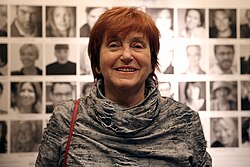 Valie Export in 2013 | |
| Born | Waltraud Lehner (1940-05-17)17 May 1940 |
| Died | 14 May 2026(2026-05-14) (aged 85) Vienna, Austria |
| Known for | Artist |
| Notable work | Cinema, photography, sculpture, computer animations |
| Movement | Avant-garde, performance art, contemporary art |
| Awards | Grand Gold Decoration for Services to the Republic of Austria |
| Website | valieexport |
Waltraud Lehner (17 May 1940 – 14 May 2026), known professionally as Valie Export (stylized in all caps; German: [ˈvaːli ˈɛkspɔrt]),1 was an Austrian avant-garde artist.2 She was best known for expanded cinema and provocative public performances.3 Her work also included video installations, computer animations, photography, sculpture, and publications on contemporary art.4
Early life
Valie Export was born Waltraud Lehner in Linz, Reichsgau Oberdonau, on 17 May 1940.56 She was raised there by a single mother of three.567 Export studied painting, drawing, and design at the National School for Textile Industry in Vienna.8
Career
1960s and 1970s
In the late 1960s and early 1970s, Austrian feminism was forced to address the fact that by the 1970s there was still a generation of Austrians whose attitudes towards women were based on Nazi ideology.9 They also had to confront the guilt of their parents' (mothers') complacency within the Nazi regime. In 1967, she changed her name from Waltraud Hollinger to VALIE EXPORT, the name of a cigarette brand. Export explained her name-change:
I did not want to have the name of my father [Lehner] any longer, nor that of my former husband Hollinger. My idea was to export from my "outside" (heraus) and also export, from that port. The cigarette package was from a design and style that I could use, but it was not the inspiration.10
With this gesture of self-determination, Export emphatically asserted her identity within the Viennese art scene, which was then dominated by the taboo-breaking performance art of the Vienna Actionists such as Hermann Nitsch, Günter Brus, Otto Mühl, and Rudolf Schwarzkogler. Of the Actionist movement, Export said, "I was very influenced, not so much by Actionism itself, but by the whole movement in the city. It was a really great movement. We had big scandals, sometimes against the politique; it helped me to bring out my ideas."11 Like her male contemporaries, she subjected her body to pain and danger in actions designed to confront the growing complacency and conformism of postwar Austrian culture. But her examination of the ways in which the power relations inherent in media representations inscribe women's bodies and consciousness distinguishes Export's project as unequivocally feminist. "In these performances and in my photo work of the 60s and 70s", Export said in a 1995 interview with Scott MacDonald, "I used a female body, generally my own, as a bearer of signs and symbols – individual, sexual, cultural – that could function within an artistic environment."12
Export's early guerrilla performances have attained an iconic status in feminist art history. In her 1968 performance Aktionshose:Genitalpanik (Action Pants: Genital Panic), Export entered an art cinema in Munich, wearing crotchless pants, and walked around the audience with her exposed genitalia at face level. The associated photographs were taken in 1969 in Vienna, by photographer Peter Hassmann. The performance at the art cinema and the photographs in 1969 were both aimed toward provoking thought about the passive role of women in cinema and confrontation of the private nature of sexuality with the public venues of her performances.13 Apocryphal stories state that the Aktionshose:Genitalpanik performance occurred in a porn theater and included Export brandishing a machine gun and shooting at the audience, as depicted in the 1969 posters,14 however she claimed that this never occurred.15 In an interview in Ocula Magazine, the artist stated that: "The fear of the vulva is present in mythology, where it is depicted devouring man. I don't know if this fear has changed."16
Her well-known performance piece Tapp-und-Tast-Kino (Tap and Touch Cinema) was performed in ten European cities, including Vienna and Munich, between 1968 and 1971.171819 For this bodily public performance, Export wandered the streets of cities with a "small mock-up of a [movie] theater", first made of styrofoam and remade later in aluminum, strapped to her bare chest.18 Peter Weibel, her collaborator, invited passersby to "'visit the cinema' for five minutes" by reaching into the "theater" and feeling her bare breasts.18
In Tap and Touch Cinema, Export inverts the sight-dependent functions of film and substitutes the "pleasure" of vision for physical touch.18 Instead of presenting a sexualized female body to be viewed, Export solicits physical contact.18 The "audience", actively participating in the performance, had direct, face-to-face contact with Export's body in the public sphere.18 The media responded to Export's provocative work with panic and fear, one newspaper comparing her to a witch. Export recalled, "There was a great campaign against me in Austria."20
Some of her other works including Invisible Adversaries, Syntagma, and "Korpersplitter", show the artist's body in connection to historical buildings not only physically, but also symbolically. The body's attachment to the historical progression of gendered spaces and stereotyped roles represent Export's feminist and political approach to art.21
In her 1970 photograph, "Body Sign Action", Export portrays a politically charged agenda through her performance artwork. The piece features a tattoo of a garter belt on Export's naked thigh. The garter is not attached at the top and only attached to a sliver of a stocking at the bottom- therefore suspended on the leg. Instead of the garter objectifying the body, the body objectifies the garter, flipping constructed societal roles in relation to the female body.22
Export's groundbreaking video piece, Facing a Family (1971) was one of the first instances of television intervention and broadcasting video art. The video, originally broadcast on the Austrian television program Kontakte on 2 February 1971,23 shows a bourgeois Austrian family watching TV while eating dinner. When other middle-class families watched this program on TV, the television would be holding a mirror up to their experience and complicating the relationship between subject, spectator, and television.24
She published "Women's Art: A Manifesto" in 1972. In it, she advocated for women to "speak so that they can find themselves, this is what I ask for in order to achieve a self-defined image of ourselves and thus a different view of the social function of women".2526 Here Export points out the unjust way that women had been living their lives within the boundaries created by men. In this same manifesto, Export also wrote "the arts can be understood as a medium of our self-definition adding new values to the arts. These values, transmitted via the cultural sign-process, will alter reality towards an accommodation of female needs."27 This statement directly related her own work to the progress of empowering women.
Export's 1973 short film, Remote, Remote exemplifies the painful ramifications of the female body conforming to societal standards. In this piece she digs at her cuticles with a knife for twelve minutes, representing the damage societal beauty standards inflict on the female body.28
Based on the precepts laid out in her 1972 manifesto, Export curated an exhibition of feminist art at the Galerie nächst St. Stephan in Vienna in 1975. Titled MAGNA. Feminism: Art and Creativity, this exhibition "introduced the feminist artist as curator and as contemporary art historian".29
The year 1977 saw the release of her first feature film, Unsichtbare Gegner. For this film's script, she collaborated with her former partner, Peter Weibel.30 The film follows Anna, a young woman photographer, as she becomes increasingly convinced that the people around her are being taken over by the Hyksos, a hostile alien force. Her delusion, the film reveals, is caused by internalized behavioral expectations for herself as a woman that run counter to her true desires.31 However, Invisible Adversaries brought a lot of criticism towards her. In an interview she explained that some people actually thought she was cutting up a bird and a mouse where in reality she was not. She further explained that a man called Schtabel who writes on a column on a magazine released false information about her piece, even though she contacted him on various occasions. She then explained that after bringing a lawsuit against him he was forced to release the letters that were sent to him by Valie Export.32
1980s to 2020s
In her 1983 experimental film, Syntagma, Export attempted to reframe the female body by using a multitude of "different cinematic montage techniques—doubling the body through overlays, for example".33 The film follows Export's belief that the female body has, throughout history, been manipulated by men through the means of art and literature.33 In an interview with Interview magazine, Export discussed her movie, Syntagma, and said, "The female body has always been a construction."33
Her 1985 film The Practice of Love was entered into the 35th Berlin International Film Festival.34
From 1995 to 2005, Export held a professorship for multimedia performance at the Academy of Media Arts Cologne.35

In 2016, the city of Linz acquired her archive and opened a research center devoted to her work.36
Bard College hosted an exhibition centered around Export's 1977 film Unsichtbare Gegner in 2016. The show featured work by Export as well as artists for whom Export's art "blew open doors: Lorna Simpson, K8 Hardy, Hito Steyerl, Trisha Donnelly and Emily Jacir, among others".37
In 2019, Export won the Roswitha Haftmann Prize of £120,000, which is "Europe's largest single-award art prize".38
Russia's war against Ukraine
In February 2023, Export was among the 69 Erstunterzeichner*innen of the Manifest für Frieden, an online petition initiated by Sahra Wagenknecht and Alice Schwarzer calling on German Chancellor Olaf Scholz to halt further arms deliveries to Ukraine and seek a negotiated peace settlement.3940 As early as March 2023, she stated that she would no longer sign the manifesto, because it had been and continues to be misused.41
Death
Export died in Vienna on 14 May 2026, three days before her 86th birthday.4243
Works
Selected filmography
- Splitscreen – Solipsismus (1968)44
- INTERRUPTED LINE (1971)44
- ...Remote…Remote... (1973)44
- Mann & Frau & Animal (1973)44
- Adjungierte Dislokationen (1973)44
- Invisible Adversaries (Unsichtbare Gegner, 1976)44
- Menschenfrauen (1977)44
- Syntagma (1983)44
- The Practice of Love (Die Praxis der Liebe, 1984)44
- Die Macht der Sprache (Power of Speech), 200245
- I turn over the pictures of my voice in my head (2008)45
Awards
- 1990: City of Vienna Prize for Visual Arts46
- 1995: Sculpture Award at the Generali Foundation47
- 1997: Gabriele Münter Prize48
- 2000: Oskar Kokoschka Prize47
- 2000: Alfred Kubin Prize Big Price culture of Upper Austria47
- 2003: Gold Medal for services to the City of Vienna47
- 2005: Austrian Decoration for Science and Art49
- 2009: Honorary Doctorate of the University of Arts and Industrial Design Linz47
- 2010: Grand Gold Decoration for Services to the Republic of Austria50
- 2014: Courage Award for the Arts47
- 2019: 19th Roswitha Haftmann Prize51
- 2020: Golden Nica Visionary Pioneer of Feminist Media Art Prix Ars Electronica52
- 2021: Honorary Fellowship of the Royal Photographic Society53
In popular culture
Her name appears in the lyrics of the Le Tigre song "Hot Topic".54
References
References
- "VALIE EXPORT – 'I Created My Own Identity'". YouTube. Tate. Retrieved 26 May 2026.
- Angkjær Jørgensen, Ulla (2012). "Bodies and real-time interfaces: in video performance and interactive digital 3D installation art by VALIE EXPORT and Jette Gejl Kristensen". Journal of Aesthetics & Culture. 4 (1) 18149. doi:10.3402/jac.v4i0.18149. ISSN 2000-4214.
- Fullerton, Elizabeth (1 February 2020). "Valie Export". Art in America. 108: 94–95.
- Warren, Lynne (2006). Encyclopedia of 20th century photography. CRC Press. pp. 468–470. ISBN 978-0-415-97665-7.
- Bock, Hans-Michael (2009). The Concise Cinegraph: Encyclopedia of German Cinema. Berghahn Books. p. 114. ISBN 978-1-57181-655-9.
- Blazwick, Iwona (2004). Faces in the crowd: picturing modern life from Manet to today. Skira. p. 349. ISBN 88-7624-069-1.
- Kennedy, Randy (29 June 2016). "Who Is Valie Export? Just Look, and Please Touch". The New York Times. ISSN 0362-4331. Retrieved 31 January 2023.
- "Biography." VALIE EXPORT Center. https://www.roswithahaftmann-stiftung.com/en/prizewinners/2019_biography_ve.htm Archived 30 October 2020 at the Wayback Machine.
- Margarete Lamb-Faffelberger (1997). Out from the Shadows. Riverside: Ariadne Press. p. 229.
- "VALIE EXPORT: A Brief Guide to the Radical Feminist Artist". Thaddaeus Ropac. 21 February 2024. Retrieved 26 May 2026.
- Indiana, Gary. "Valie Export" Archived 13 November 2011 at the Wayback Machine, BOMB Magazine Spring, 1982. Retrieved on 15 August 2011
- MacDonald, Scott (1998). A Critical Cinema 3. University of California Press. p. 255. ISBN 978-0-585-33992-4.
- "Tate.org". Archived from the original on 10 May 2011. Retrieved 12 May 2010.
- Bodytracks.org (archived 2013-02-12)
- Mueller, Roswitha (1994). Valie Export/Fragments of the Imagination. Indiana University Press. p. 32. ISBN 0-253-33906-5.
- Moldan, Tessa (6 December 2019). "Valie Export: 'The voice belongs to me'". Ocula Magazine. Archived from the original on 29 December 2019. Retrieved 31 January 2020.
- "VALIE EXPORT, Tapp- und Tastkino (Touch Cinema)". Archived from the original on 16 March 2013. Retrieved 9 April 2013.
- Molesworth, Helen (2003). Work Ethic. Pennsylvania State University Press. p. 177. ISBN 0-271-02334-1. OCLC 1158437662.
- "Valie Export | Pomeranz Collection". Archived from the original on 13 June 2019. Retrieved 10 May 2021.
- Indiana, Gary. "Valie Export"; Archived 13 November 2011 at the Wayback Machine, BOMB Magazine. Spring 1982. Retrieved on 15 August 2011
- O'Reilly, Sally. "Valie Export." Art Monthly 280 (2004): 31–32. Art & Architecture Complete. Web. 12 December 2016.
- Harris, Jane. "Valie Export: Frau Export." Artext 70 (2000): 72–75. Art & Architecture Complete.Web. 12 December 2016.
- "Facing a Family". Electronic Arts Intermix. Archived from the original on 25 December 2010. Retrieved 6 April 2012.
- "VALIE EXPORT's Facing a Family". Museum of Modern Art Magazine. 21 December 2021. Retrieved 19 May 2026.
- Export, Valie (1 March 1972). "Women's Art: A Manifesto (1972)". 391.org. Archived from the original on 29 January 2023.
- Stiles, Kristine, and Peter Howard Selz. "Performance Art." Theories and Documents of Contemporary Art. 2nd ed. Berkeley, CA: U of California, 2012. 869. Print.
- Stiles, Kristine, and Peter Howard Selz. "Performance Art." Theories and Documents of Contemporary Art. 2nd ed. Berkeley, CA: U of California, 2012. 870. Print.
- Eifler, Margret. "Valie Export's Iconography: Visual Quest For Subject Discourse." Modern Austrian Literature 29.1 (1996): 108–130. Academic Search Alumni Edition. Web. 12 December 2016.
- Krasny, Elke. "Curatorial Materialism. A Feminist Perspective on Independent and Co-Dependent Curating." Notes on Curating 29 (May 2016): 99. https://www.on-curating.org/issue-29-reader/curatorial-materialism-a-feminist-perspective-on-independent-and-co-dependent-curating.html#.X95bsMA8IlR Archived 25 November 2020 at the Wayback Machine.
- Mueller, Roswitha (1994). Valie Export/Fragments of the Imagination. Indiana University Press. p. 126. ISBN 0-253-33906-5.
- Delpeux, Sophie and C. Penwarden, trans. "VALIE EXPORT: De-Defining Women," Art Press 293 (Spring 2003): 41.
- "Valie Export by Gary Indiana – BOMB Magazine". April 1982. Archived from the original on 1 August 2021. Retrieved 1 August 2021.
- Fore, Devin (24 August 2012). "Valie Export". Interview Magazine. Archived from the original on 20 December 2016. Retrieved 12 December 2016.
- "Berlinale: 1985 Programme". berlinale.de. Archived from the original on 8 February 2017. Retrieved 12 January 2011.
- Oltermann, Philip (14 May 2026). "Renowned feminist artist and film-maker Valie Export dies aged 85". The Guardian. Retrieved 19 May 2026.
- "History." VALIE EXPORT Center Linz. https://www.valieexportcenter.at/en/center/history Archived 16 May 2021 at the Wayback Machine.
- Kennedy, Randy (29 June 2016). "Who Is Valie Export? Just Look, and Please Touch". The New York Times. ISSN 0362-4331. Archived from the original on 1 October 2022. Retrieved 31 January 2023.
- "Prizes." Art Monthly July/August 2019: 428.
- "'Manifest für Frieden': Das sind die 69 Erstunterzeichner*innen". Der Tagesspiegel. 10 February 2023. Retrieved 5 May 2025.
- Schmidtpeter, Anna (10 February 2023). "«Manifest für Frieden»: Wagenknecht und Schwarzer mobilisieren Prominente". Der Spiegel. Retrieved 5 May 2025.
- "VALIE EXPORT zeigt in Bregenz Antikriegsinstallation". Salzburger Nachrichten (in German). 2 March 2023. Archived from the original on 3 March 2023. Retrieved 31 January 2023.
- Chen, Zian (15 May 2026). "Valie Export, Radical Feminist Artist, Dies at 85". Ocula.
- "Provocative Austrian feminist artist Valie Export dies at 85". Reuters.
- "Valie Export". Generali Foundation. Retrieved 19 May 2026.
- Genda, Dagmara (August 2024). "Seeing VALIE EXPORT Photographically". Border Crossings. Retrieved 19 May 2026.
- Kolb, Andreas (19 May 2026). "Versuch einer Export-Bilanz". Politik & Kultur (in German). Retrieved 19 May 2026.
- "VALIE EXPORT Dies Shortly Before Her 86th Birthday". Kronen Zeitung. 14 May 2025. Retrieved 18 May 2026.
- "Preisträgerin des Gabriele Münter Preises steht fest" (in German). Federal Ministry for Education, Family Affairs, Senior Citizens, Women and Youth. 1 June 2016. Retrieved 19 May 2026.
- "Reply to a parliamentary question" (PDF) (in German). p. 1668. Archived (PDF) from the original on 1 May 2020. Retrieved 3 January 2013.
- "Reply to a parliamentary question" (PDF) (in German). p. 1932. Archived (PDF) from the original on 1 May 2020. Retrieved 3 January 2013.
- "Roswitha Haftmann Stiftung". Archived from the original on 30 October 2020. Retrieved 19 December 2020.
- "Visionary Pioneer of Feminist Media Art".
- Rooke, Hannah (29 October 2021). "The Royal Photographic Society announces its 2021 award winners". Digital Camera World. Retrieved 18 May 2026.
- Oler, Tammy (31 October 2019). "57 Champions of Queer Feminism, All Name-Dropped in One Impossibly Catchy Song". Slate Magazine. Archived from the original on 29 November 2020. Retrieved 8 December 2020.
External links
External links
- "Finger Envy: A Glimpse into the Short Films of VALIE EXPORT." Article in Brights Lights Film Journal.
- Media Art Net contains a description of Facing a Family as well as a video clip from the piece.
- Valie Export at IMDb
- Valie Export discography at Discogs
- Valie Export in the Video Data Bank
- Valie Export Deprecated link archived 3 February 2014 at archive.today in the Imai – inter media art institute
- Thomas Dreher on VALIE EXPORT and Peter Weibel: Multimedia feminist art. In: Artefactum Nr.46/December 1992 – February 1993, p. 17–20
- Thomas Dreher: VALIE EXPORT – Bild im Bild (PDF, ca. 13,8 MB). In: Kunst + Unterricht, Issue 106/October 1986, p. 56ff. Interpretation of an untitled photographic work (1981). In German.
- Valie Export in the Mediateca Media Art Space
- Artist Biography and list of video works by VALIE EXPORT at Electronic Arts Intermix
- Valie Export: Innovator at Museum of Modern Art